An electrolyte is a substance that produces an electrically conducting solution when dissolved in a polar solvent, such as water. Electrolytes can be ionic compounds, acids, or bases that dissociate into ions in solution. These ions facilitate the conduction of electricity. Common examples of electrolytes include: 1. **Sodium chloride (NaCl)**: Common table salt, which dissolves in water to produce sodium (Na⁺) and chloride (Cl⁻) ions.
Articles by others on the same topic

An electrolyte is a conducting medium in which mobile ions carry electric current, according to IUPAC Gold Book: electrolyte. In introductory chemistry, a substance that yields ions when dissolved in water is also called an electrolyte. Both usages point to the same mechanism: an electric field gives mobile cations and anions directed drift velocities.
Mobility matters as much as the presence of electric charge. In a simple ideal model of solid sodium chloride, ions are confined to their sites and do not carry a sustained transport electric current. Molten sodium chloride has mobile ions; dissolved sodium chloride gives mobile and ions in water. Real solids can have some ionic transport through imperfections; the immobile-solid picture is an introductory limit, rather than a claim that all solids are perfect insulators.
A strong electrolyte yields essentially all ions from the dissolved substance, whereas a weak electrolyte yields only a fraction under the specified conditions. Dissolved sodium chloride is a strong electrolyte. Sucrose is a nonelectrolyte: it dissolves as neutral molecules, so dissolving something does not automatically create mobile ions. Water's own small population of hydronium and hydroxide remains possible. See 11.2 Electrolytes (§11.2: strong, weak, and nonelectrolytes) and Flowers et al., Chemistry 2e, §11.4, Table 11.3: sucrose and sodium chloride.
Acetic acid is a weak electrolyte and a weak acid. In water, some neutral acetic acid molecules transfer a proton to water, producing hydronium and the negatively charged partner:Both sides have net electric charge zero. At chemical equilibrium, neutral acetic acid coexists with these ions; the fraction converted depends on the conditions. Electrolyte strength describes this extent of ion production, while concentration describes how much substance is present per specified quantity of chemical solution. A dilute strong electrolyte can contain fewer ions per volume than a concentrated weak electrolyte. Neither the words strong and weak nor a conductivity comparison alone specifies concentration.
Now specify an electrolytic cell with a positive anode on the left, a negative cathode on the right, and an approximately uniform electric field pointing right in the bulk electrolyte. With a steady external source and neglecting diffusion and convection, positive cations drift right toward the negative cathode; negative anions drift left toward the positive anode. Yet both populations contribute a rightward conventional current! For number densities and drift velocities , the transport current density isThe product of electric charge and velocity determines conventional current: for the anion, both the charge and its rightward velocity component are negative, making its rightward contribution positive. This is the same sign rule used for electron conventional current. It follows directly from the existing charge carrier formula.
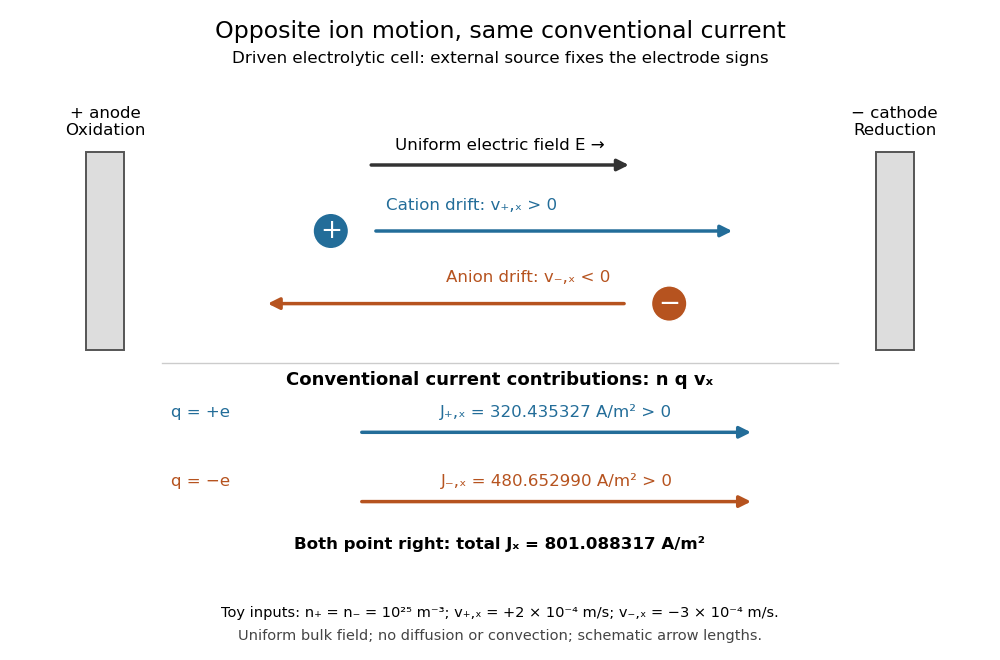
Opposite ion drift velocities contribute to the same conventional current in a specified electrolytic cell
. The positive anode is left and the negative cathode right. The upper arrows show ion motion; the lower arrows show the signs of for current density. A uniform bulk electric field is assumed; diffusion, convection, and electrode boundary layers are omitted. Arrow lengths are schematic. Details.
For an independent numerical example, stipulate , , and . With the exact elementary charge , the contributions areEqual number densities of singly charged cations and anions give zero bulk charge density, while their motion gives nonzero current density. This is why a neutral electrolyte can conduct. These numbers are chosen toy inputs, not measurements of sodium chloride; maintaining sustained cell electric current also requires suitable electrode reactions. Blocking electrodes can instead lead to charge accumulation and decay of the electric current.
An electrolyte connects the microscopic motion of ions to observable electrical conductivity. A counterion-only model keeps just the mobile counterions needed to oppose a fixed electric charge; Poisson-Boltzmann equations use ideal Boltzmann distributions to model their equilibrium distributions, rather than the drift example above.