The elementary charge is the smallest unit of electric charge that is considered to be indivisible in classical physics. It is denoted by the symbol \( e \) and has a value of approximately \( 1.602 \times 10^{-19} \) coulombs. This charge is carried by a single proton, which has a positive charge of \( +e \), while an electron, which has a negative charge, carries a charge of \( -e \).
Articles by others on the same topic

The elementary charge is the positive magnitude of the electron's electric charge, not the signed electric charge of the electron itself:Since the 2019 revision of the SI, this numerical value defines the ampere together with the definition of the second; . Thus today's numerical exactness is a choice of units, whereas measured electric charges still have experimental uncertainty. An oil drop experiment can test charge quantization and the apparatus calibration; it does not supply a new uncertain defining value of in today's SI. [ref]
https://www.bipm.org/documents/20126/41483022/SI-Brochure-9-EN.pdf. BIPM, The International System of Units, ninth edition, sections 2.2 and 2.3.1, the ampere
.For ordinary isolated chemical atoms, ions and charged objects whose net electric charge is counted through protons and electrons, charge quantization gives with signed integer . A neutral chemical atom that loses two electrons becomes an ion of electric charge . A toy object with excess electrons has . Conversely, the scale explains why laboratory electric charge often looks continuous: billions of microscopic increments fit into a small macroscopic amount. Averaged charge density is a continuum description, not a claim that each particle has an arbitrarily divisible electric charge.
The ordinary-matter qualifier matters. In the Standard Model, quarks have electric charges or , and antiquarks have the opposite signs. Confinement means these are constituents of hadrons, not isolated fractionally charged particles collected by an oil drop experiment. The usual valence quark sums give for a proton and for a neutron. Thus elementary charge should not be defined as the smallest nonzero electric charge of every constituent in particle theory. [ref]
https://pdg.lbl.gov/2022/reviews/rpp2022-rev-quark-model.pdf. Amsler, DeGrand and Krusche, Particle Data Group, Quark Model, sections 15.1–15.2 and table 15.1
.The beautiful experimental idea behind the oil drop experiment is to determine a microscopic electric charge by watching a visible carrier move. In his 1913 paper, Millikan timed the descent and electrically driven ascent of individual oil drops, repeatedly changing a drop's electric charge through capture of air ions. His apparatus used parallel plates separated by , a roughly source, and an optical scale to measure travel distances. He reported multiple relationships among a given drop's inferred electric charges. He also found that uncorrected Stokes's law gave a size-dependent inferred elementary unit, and introduced a pressure-dependent slip correction. These were measured relationships with calibration and model uncertainties, not exact readings of today's defined . [ref]
https://grundpraktikum.physik.uni-saarland.de/gpalt/Anleitungen/Ergaenzungen/Versuche/Millikan/Millikan%20-%20On%20the%20Elementary%20Electrical%20Charge%20and%20the%20Avogadro%20Constant.pdf. R. A. Millikan, On the Elementary Electrical Charge and the Avogadro Constant, Physical Review 2 (1913), 109–143, especially pp. 109–112 and 115–116
.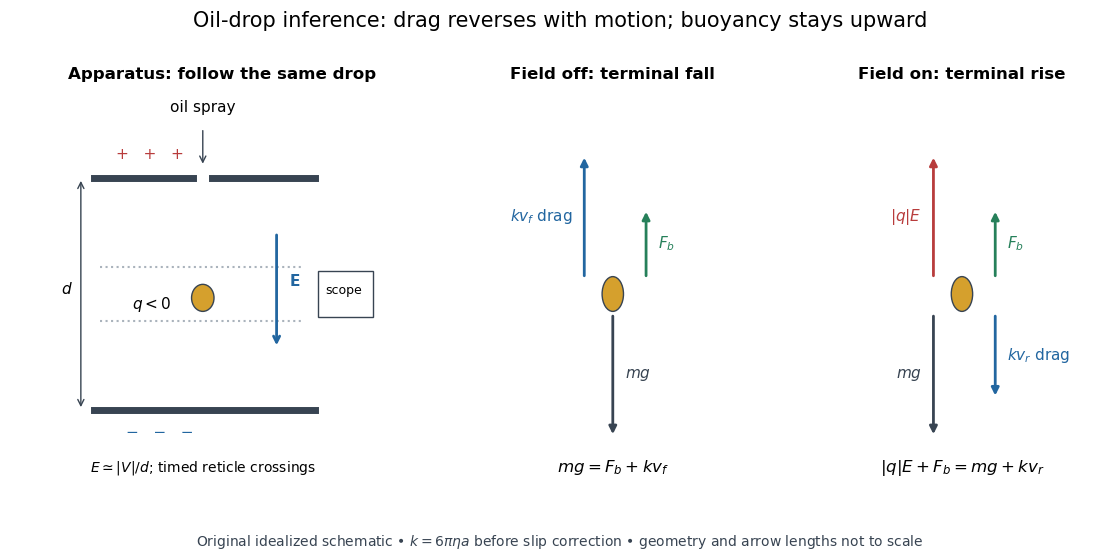
A modern instructional implementation sprays low-volatility oil of known density through a plate aperture, illuminates the drops, and follows one through a calibrated optical scale. Measure the plate spacing , electric potential difference , air temperature and pressure. Time a fixed distance with the electric field off to get a terminal falling speed . Then choose the field polarity to drive the same drop upward and measure . Repeat timings at a fixed electric charge, and compare before and after an ion-capture event. The same drop is especially useful because its radius and mass need not be inferred anew for each charge state. [ref]
https://cdn.pasco.com/product_document/Millikan-Oil-Drop-Manual-AP-8210B.pdf. PASCO, Millikan Oil Drop Apparatus AP-8210B manual, introduction, theory and experimental procedure
.Here is the leading continuum model, retaining buoyancy. Assume a drop shaped as a sphere of radius , oil and air densities and , air dynamic viscosity , and gravitational acceleration . Define the downward effective weight and positive linear drag coefficient byAt terminal velocity, the net force vanishes. Falling with no electric field, the upward drag force balances weight minus buoyancy. Rising with the electric force upward, the drag force reverses and joins the downward effective weight:Consequently the uncorrected estimates areThe observed direction of response, with known field polarity, supplies the sign of . A suspended drop gives the alternative balance , but it still requires a determination of : balancing a drop alone does not determine its electric charge.
For an explicitly invented continuum example, stipulate , , , , , and a downward . The balances predict , and . Substituting those speeds recovers within rounding. This checks the algebra; it is not a precision prediction for real micrometre drops, which need a slip correction.
The inference has two distinct parts. Compare inferred electric charges or charge changes with a common unit, seeking within uncertainty, rather than demanding exact ratios of rounded measurements. Then establish the absolute scale through electric field, density, dynamic viscosity and distance/time calibration. If the observed steps are all even multiples, their common spacing alone cannot exclude an unobserved smaller unit. Air motion, evaporation and mistimed crossings can alter inferred electric charge without an ion-capture event. Small Reynolds number supports Stokes's law, but does not by itself justify its no-slip continuum coefficient: a significant ratio of air mean free path to drop radius requires a slip correction. Millikan's comparison of different drop sizes and pressures addressed that systematic limitation; the modern PASCO manual also includes the correction. Agreement supports charge quantization for the observed carriers within experimental resolution, rather than proving a universal statement about every possible particle.
Multiplying by the Avogadro constant gives the Faraday constant, , the electric charge per mole of singly charged carriers. This connects counting individual electric charges with bulk electrochemistry. [ref]
https://physics.nist.gov/cuu/pdf/wall_2022.pdf. NIST, CODATA 2022 defining constants and Faraday constant
.

Experiments to measure it:
The 2019 redefinition of the SI base units defines it precisely and uses it as a measure of charge: en.wikipedia.org/wiki/2019_redefinition_of_the_SI_base_units#Ampere