Fresnel diffraction is a type of wave diffraction that occurs when a wavefront encounters an obstacle or aperture with dimensions comparable to its wavelength. It is named after the French engineer and physicist Augustin-Jean Fresnel, who developed the theory to better understand the behavior of light.
Articles by others on the same topic

Fresnel diffraction describes diffraction when the quadratic propagation wave phase across an aperture must be retained. Its Fresnel propagator becomes the Fraunhofer diffraction description when that curvature is negligible.
A Fresnel diffraction pattern is a map of how propagation changes the wave interference of light from an aperture. It can resemble the opening, develop bright and dark structure near its edges, and eventually approach a Fraunhofer diffraction pattern. The controlling comparison involves wavelength, opening size and propagation distance together; a distance large compared with the opening need not give the far field.
For a monochromatic wave, use time dependence , wavenumber and complex amplitude . Let be the transmitted field immediately behind an aperture in the plane . In a homogeneous medium, the scalar paraxial approximation givesThis is the two-transverse-coordinate Fresnel propagator, with its carrier restored. It adds complex amplitudes before taking their squared complex modulus to obtain light intensity. It is a scalar paraxial approximation, rather than a full vector solution of Maxwell equations.[ref]
Scalar Diffraction Optics. Interactive Optics by Sander Konijnenberg, Aurèle J.L. Adam and H. Paul Urbach; Fresnel Approximation, equations (381)–(385), and the following paraxial-wave-equation remark
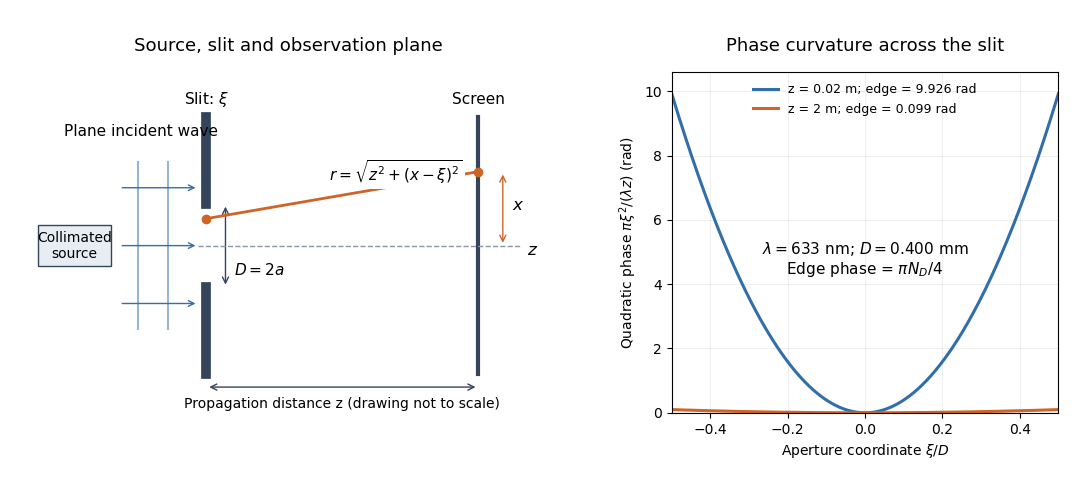
The source in this constructed geometry supplies a plane wave; the observation screen is a plane perpendicular to the optical axis. The right panel isolates the aperture-dependent wave phase that distinguishes Fresnel diffraction from Fraunhofer diffraction. Its vertical scale is in radians, and the drawing's lengths are schematic.
Keeping this wave phase is useful when transporting a field between nearby optical components: both the shape and the complex amplitude matter for subsequent wave interference. A particularly striking feature is that propagation can create a dark centre even from a uniformly illuminated symmetric aperture; the incident wave amplitudes need not be unequal for their outgoing contributions to cancel.


Near field approximation to Kirchhoff's diffraction formula, i.e. when the plane of observation is near the object diffracting.