Mutual information is a fundamental concept in information theory that measures the degree of dependence or association between two random variables. It quantifies the amount of information obtained about one random variable through the other. In essence, mutual information captures how much knowing one of the variables reduces uncertainty about the other.
Articles by others on the same topic

For finite discrete random variables, mutual information is the reduction of information entropy provided by observing the other variable:The last expression makes the symmetry visible. It is nonnegative and is zero exactly when and are independent random variables. One way to see both facts iswhere is the Kullback-Leibler divergence with base-two logarithms. The Gibbs inequality gives nonnegativity; equality means that the joint probability distribution factors. The statement extends to more general distributions via relative entropy, but differences of infinite information entropies must not be used as if they were finite numbers.
A binary symmetric channel gives a useful example. Let be a fair bit, let be an independent Bernoulli random variable with error probability , and set , where is exclusive or. The output is also a fair bit, but knowing the input leaves just the error uncertainty:Here is binary entropy. At , , so the output carries about bits of mutual information about the input per use. This is an average uncertainty reduction, not a claim that each observed symbol can be divided into fractional physical bits.
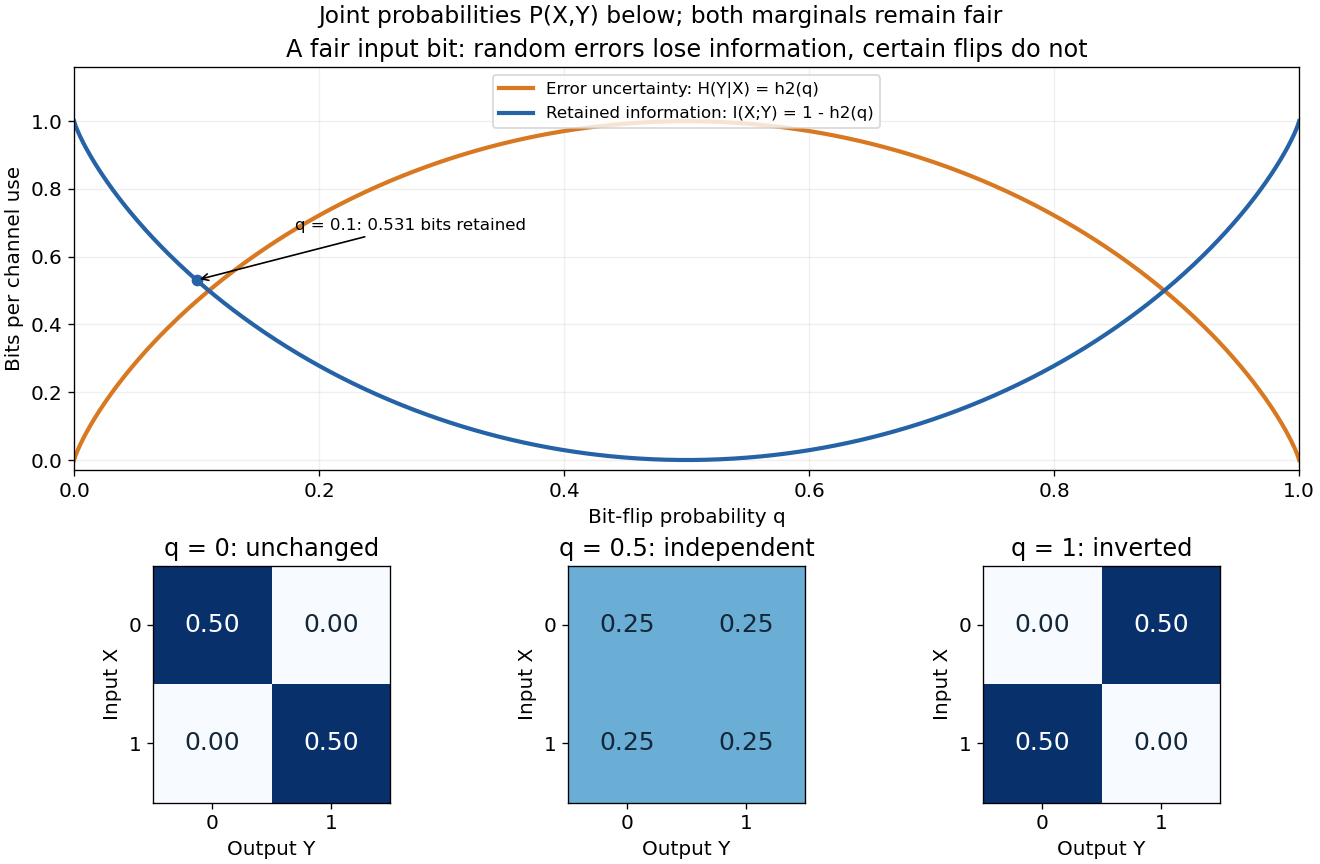
Binary entropy and retained information distinguish noisy transmission from predictable bit inversion
. Details. 
At , every output is equally likely for either input, so . At , the output is always the inverted input: knowing this rule lets the receiver recover the input exactly, so again. A high raw error rate need not mean low mutual information when the errors are predictable. For this particular channel the fair input is optimal, giving the binary symmetric channel capacity .
Mutual information detects dependence that ordinary correlation can miss. Let be uniform on and . Symmetry gives , hence zero covariance and zero correlation, while is completely determined by . Thus . This distinction is useful whenever a relationship is nonlinear: knowing one variable can reveal another without a linear trend.