The Pauli exclusion principle is a fundamental principle in quantum mechanics, formulated by physicist Wolfgang Pauli in 1925. It states that no two fermions (particles with half-integer spin, such as electrons, protons, and neutrons) can occupy the same quantum state within a quantum system simultaneously. In the context of atomic structure, this principle explains why electrons in an atom fill available energy levels in a specific way.
Articles by others on the same topic

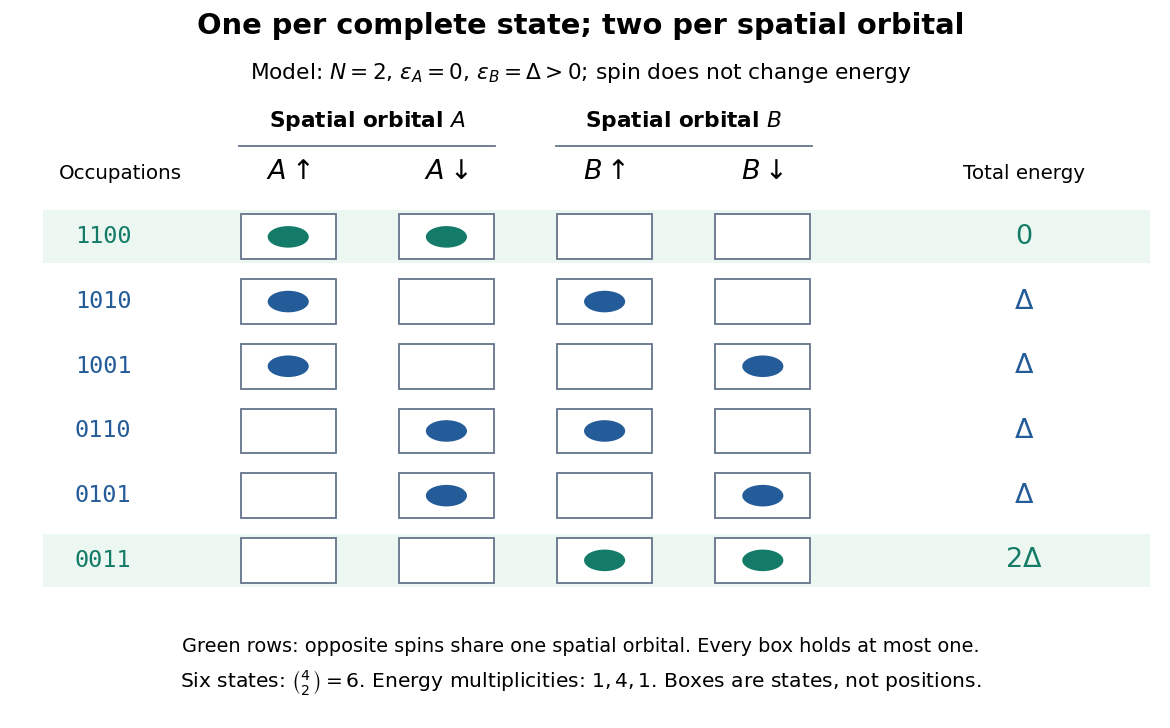
The Pauli exclusion principle says that each complete one-particle state can have fermionic occupation number zero or one. “Complete” includes spin and any other internal labels, as well as the spatial wavefunction. Thus two electrons can share a spatial orbital with opposite spin projections: these are two different spin orbitals. Equal energy alone does not mean equal quantum state, because degenerate energy levels contain several independent one-particle states.
This distinction explains how an electron shell can accommodate several electrons while exclusion still allows only one per complete one-particle state. It also makes a finite model of fermionic state counting surprisingly simple: two spatial orbitals with two spin choices each give four complete one-particle states, and exactly six two-electron basis states. The following diagram enumerates them; its boxes represent occupation numbers, not locations in space.
Pauli's Exclusion principle and quantum mechanics by Wolfgang Pauli is his retrospective account, delivered on 13 December 1946 for the 1945 Nobel Prize. On printed pp. 29–30, he describes proposing an extra two-valued electron property in autumn 1924 and formulating exclusion in 1925. The crucial clue linked counts of resolved energy eigenstates in alkali spectra under a magnetic field with the populations of closed electron shells. Resolving every label turned a complicated shell capacity into one electron per complete one-particle state. This historical route preceded the modern spin interpretation and the antisymmetric wavefunction formulation; it was not originally a deduction from a Slater determinant.


Initially a phenomenological guess to explain the periodic table. Later it was apparently proven properly with the spin-statistics theorem, physics.stackexchange.com/questions/360140/theoretical-proof-of-paulis-exclusion-principle.
And it was understood more and more that basically this is what prevents solids from collapsing into a single nucleus, not electrical repulsion: electron degeneracy pressure!
Bibliography:
- www.youtube.com/watch?v=EK_6OzZAh5k How Electron Spin Makes Matter Possible by PBS Space Time (2021)