Positional notation is a system for representing numbers in which the position of each digit within a number determines its value based on a specific base or radix. This system allows for the efficient representation of large numbers using only a finite set of symbols (digits). ### Key Features of Positional Notation: 1. **Base (Radix)**: The base of the positional number system determines how many distinct digits are used and the value of each digit's position.
Articles by others on the same topic

In positional notation, a numeral digit contributes its value multiplied by a weight determined by its position. Fix an integer radix . A finite string of numeral digits , with , represents the nonnegative integerThe rightmost position has weight ; each move left multiplies the weight by . This weight is the place value. For a nonzero integer, the canonical string has . Zero is written with the single numeral digit . Leading zeros are permitted in a fixed-width display but omitted in the canonical form: . A negative integer is written with a separate minus sign and the positional notation for its absolute value; the minus sign is not a numeral digit.[ref]
A Computational Introduction to Number Theory and Algebra by Victor Shoup. §3.3, pp. 55–56: base-B digit vectors, separate sign and nonzero highest digit
For example,The zero is essential inside this string: , not . It records that the tens position contributes nothing while keeping the hundreds and units in their proper positions. The same integer has binary representation
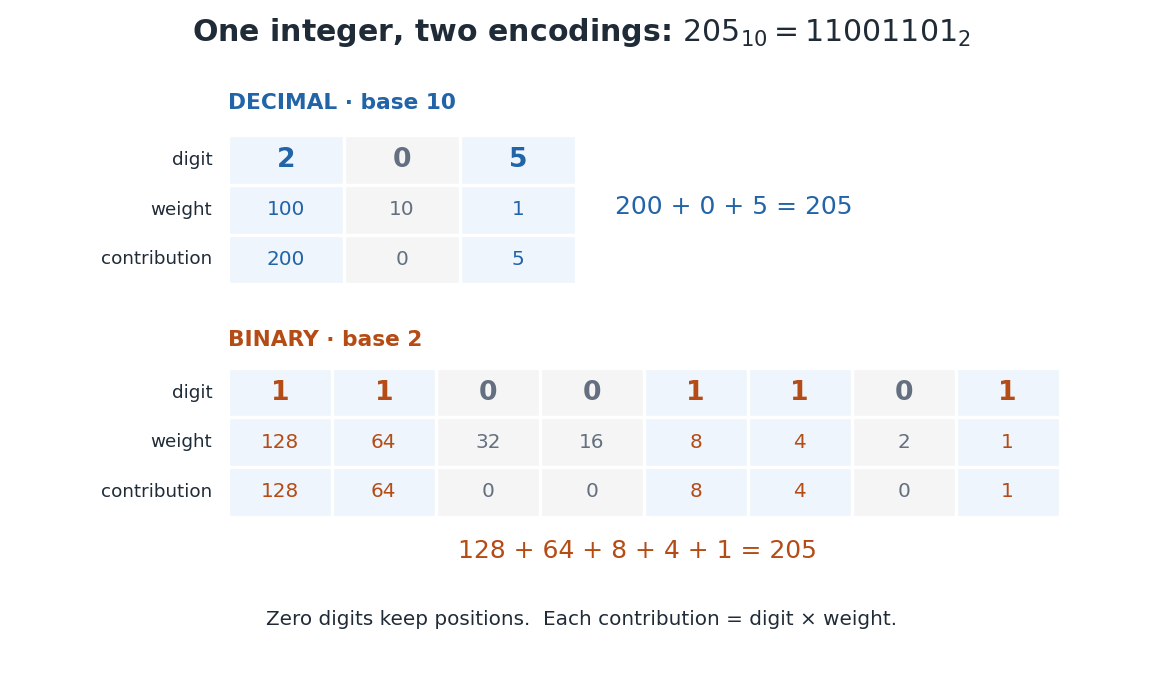

Repeated Euclidean division constructs the representation exactly. Set . At each step writeKeep the remainder and continue with the integer quotient . A positive quotient strictly decreases, so eventually it is zero. Substituting the successive equations back into the first gives : the numeral digits are obtained from right to left. The remainder modulo uniquely fixes , and then the quotient uniquely fixes the remaining string by the same reasoning. This proves existence and uniqueness once leading zeros are excluded. The needed unique quotient and remainder are precisely the conclusion of the Euclidean division theorem.[ref]
This finite expansion concerns nonnegative integers. Extending positional notation to fractional positions uses weights to the right of a point; an arbitrary real number need not have a finite digit string. In particular, the decimal representation represents , while the base-two string represents . The radix is part of the interpretation.
The benefit is compact arithmetic: positions can encode every nonnegative integer below . To see the upper endpoint, fill all positions with ; the finite geometric series gives . Carrying in addition exchanges units of one place value for one unit of the next. Thus a short string stores a large count and also supplies an algorithm for computing with it.