A real image is an image formed by the convergence of light rays that actually meet at a point after passing through a lens or reflecting off a mirror. This type of image can be projected onto a screen, meaning that if a screen or detector (like a piece of paper) is placed at the location of the image, it will show a clear and distinct picture. Key characteristics of a real image include: 1. **Formation:** Real images are formed when light rays from an object converge.
Articles by others on the same topic

A real image lies where the outgoing light rays from each object point actually intersect in geometrical optics. A screen or detector placed at that image plane receives the focused pattern. The screen reveals the real image; it does not create the intersection. A viewer can also see a real image without a screen if their eye receives the diverging light rays beyond the intersection. [ref]
https://openstax.org/books/college-physics-2e/pages/25-7-image-formation-by-mirrors. Urone and Hinrichs, College Physics 2e, §25.7: Real images and their observation
.For a converging thin lens and real object with , the real image has and signed transverse magnification . Inversion is a property of this particular setup, not the definition of a real image. With and , the following are predictions:
| Object distance | Image distance | Transverse magnification | Signed image height |
|---|---|---|---|
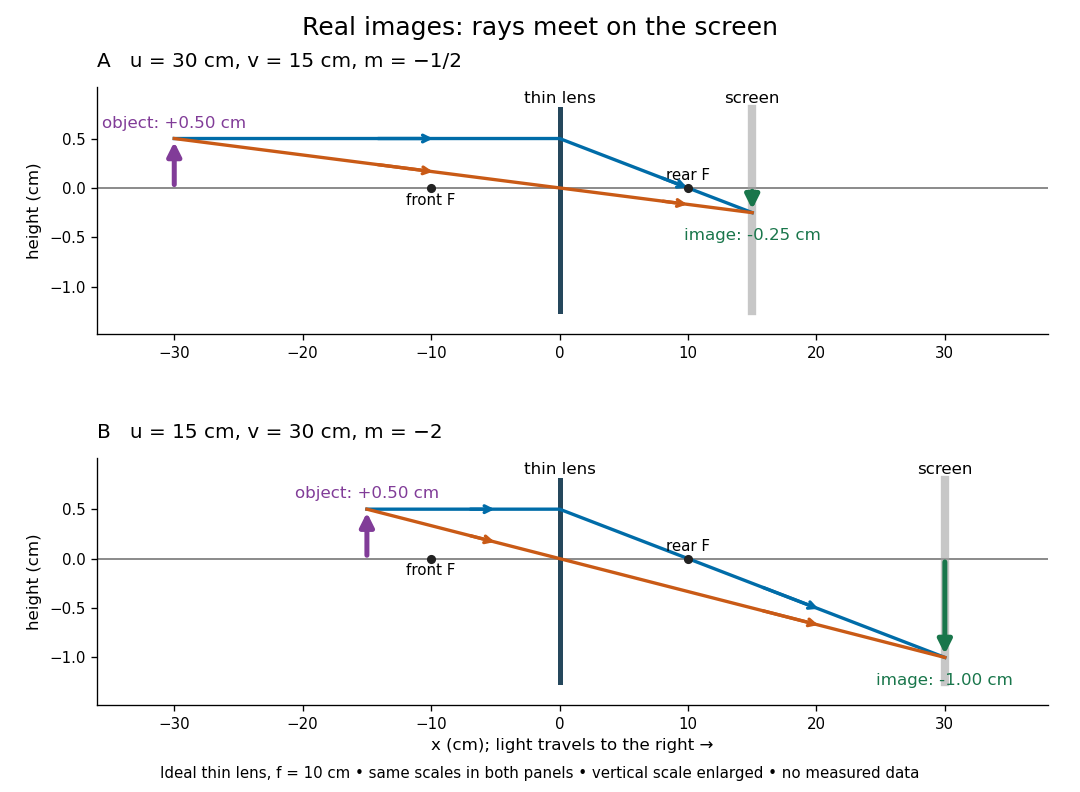

To test both image position and transverse magnification, use an optical bench with an illuminated arrow or millimetre target, a converging optical lens of nominal focal length , a movable white screen and a ruler. Measure corresponding target and image intervals, rather than guessing the whole image size when it exceeds the screen. PASCO's Experiment 12 compares distance-based and size-based magnification; the following procedure uses several object distances, as in the Northern Virginia laboratory. [ref]
https://tecnoedu.com/recursos/UNLCHidrologia/ManualesOriginalesPasco/Basic-Optics-System-Manual-OS-8515C.pdf. PASCO, Basic Optics System manual, Experiment 12, pp. 33–36
; [ref].- Align target centre, optical lens centre and screen along one optical axis, with target and screen perpendicular to it. Record bench positions of the actual target plane, optical lens plane and screen surface; distances between holder edges introduce an offset.
- Start at . Move the screen through the expected region until the target's central detail is sharpest. Record , measured , the corresponding target and image intervals, and whether the arrow is inverted. Give the measured size ratio a negative sign if inverted.
- Repeat at and . Compare the measured signed size ratio with , and calculate for each pair. The three ideal rows above are predictions to compare against, not entries to copy into the measurement record. [ref]https://sites.nvcc.edu/alphy/_files/Manuals/Physics%20242%20Lab%2011%20-%20Thin%20Lenses.pdf. Northern Virginia Community College, Physics 242 Lab 11, pp. 2–4: screen focusing, orientation and size measurements.
Keep the optical lens, illumination and central target detail fixed between trials. Approach best focus from both sides and record the interval over which sharpness is difficult to distinguish; repeat focusing to estimate its reproducibility. A modest central aperture stop tests whether peripheral light rays change the result, but also reduces brightness. Spherical aberration, chromatic aberration and diffraction can broaden the optimum; a thick optical lens also makes the chosen reference plane imperfect. Treat nominal as an initial prediction, and report position and interval-reading limits instead of forcing exact agreement. [ref]
https://www.feynmanlectures.caltech.edu/I_27.html. Feynman, Leighton and Sands, §§27-5–27-7: principal planes and imaging limits
.Moving the object toward the front optical focus from outside makes the real image larger and farther away. A failed screen search near can therefore mean that the real image is beyond the bench, rather than that a virtual image has formed. At exactly , the outgoing bundle from each point is parallel and no finite screen position focuses it.