Topics (282k) Articles (291k) Users (352) Discussions (237) Comments (383) Files (6k) New article

As a result, Ciro Santilli who likes "lower level stuff", has had many many hours if image manipulation fun with this software, see e.g.:
Where is Anatomy Encoded in Living Systems? by Michael Levin (2022)
Source. - we are very far from full understanding. End game is a design system where you draw the body and it compiles the DNA for you.
- some cool mentions of regeneration
One of the simplest known seems to be: en.wikipedia.org/wiki/Trichoplax
www.u-tokyo.ac.jp/focus/en/articles/a_00220.html "The simplest multicellular organism unveiled" from 2013 mentions Tetrabaena socialis.
- youtu.be/1v6cgSkiHik?t=513 multicellularity is polyphyletic, e.g. evolved separately on plants, fungi and animals.
- youtu.be/1v6cgSkiHik?t=668 describes how unicellular organism choanoflagellates form colony, and how animals are characterized by certain key types of cellular interaction: adhesion, communication, regulation (cell differentiation) and extra cellular matrix production
It is hard to distinguish between colonies of unicellular organism and multicellular organism as there is a continuum between both depending on how well integrated they cells are.
From Wikipedia:and:
Multicellularity has evolved independently at least 25 times in eukaryotes
Complex multicellular organisms evolved only in six eukaryotic groups: animals, symbiomycotan fungi, brown algae, red algae, green algae, and land plants.
Flow Cytometry Animation by StarCellBio (2015)
Source. This is the standard model.
Ciro Santilli's preferred visualization of the real projective plane is a small variant of the standard "lines through origin in ".
For those sphere points in the circle on the x-y plane, you should think of them as magic poins that are identified with the corresponding antipodal point, also on the x-y, but on the other side of the origin. So basically you you can teleport from one of those to the other side, and you are still in the same point.
Ciro likes this model because then all the magic is confined just to the part of the model, and everything else looks exactly like the sphere.
It is useful to contrast this with the sphere itself. In the sphere, all points in the circle are the same point. But this is not the case for the projective plane. You cannot instantly go to any other point on the by just moving a little bit, you have to walk around that circle.
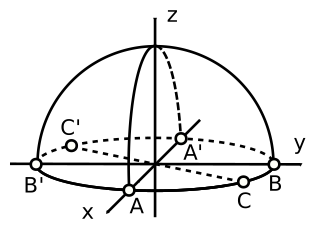
Spherical cap model of the real projective plane
. On the x-y plane, you can magically travel immediately between antipodal points such as A/A', B/B' and C/C'. Or equivalently, those pairs are the same point. Every other point outside the x-y plane is just a regular point like a normal sphere.The first proper galaxy near the Milky Way is the Andromeda Galaxy. Everything else in the middle is a satellite of either of of those.
Pinned article: Introduction to the OurBigBook Project
Welcome to the OurBigBook Project! Our goal is to create the perfect publishing platform for STEM subjects, and get university-level students to write the best free STEM tutorials ever.
Everyone is welcome to create an account and play with the site: ourbigbook.com/go/register. We belive that students themselves can write amazing tutorials, but teachers are welcome too. You can write about anything you want, it doesn't have to be STEM or even educational. Silly test content is very welcome and you won't be penalized in any way. Just keep it legal!
Intro to OurBigBook
. Source. We have two killer features:
- topics: topics group articles by different users with the same title, e.g. here is the topic for the "Fundamental Theorem of Calculus" ourbigbook.com/go/topic/fundamental-theorem-of-calculusArticles of different users are sorted by upvote within each article page. This feature is a bit like:
- a Wikipedia where each user can have their own version of each article
- a Q&A website like Stack Overflow, where multiple people can give their views on a given topic, and the best ones are sorted by upvote. Except you don't need to wait for someone to ask first, and any topic goes, no matter how narrow or broad
This feature makes it possible for readers to find better explanations of any topic created by other writers. And it allows writers to create an explanation in a place that readers might actually find it.
Figure 1. Screenshot of the "Derivative" topic page. View it live at: ourbigbook.com/go/topic/derivativeVideo 2. OurBigBook Web topics demo. Source. - local editing: you can store all your personal knowledge base content locally in a plaintext markup format that can be edited locally and published either:This way you can be sure that even if OurBigBook.com were to go down one day (which we have no plans to do as it is quite cheap to host!), your content will still be perfectly readable as a static site.
- to OurBigBook.com to get awesome multi-user features like topics and likes
- as HTML files to a static website, which you can host yourself for free on many external providers like GitHub Pages, and remain in full control

Figure 2. You can publish local OurBigBook lightweight markup files to either OurBigBook.com or as a static website.
Figure 3. Visual Studio Code extension installation.
Figure 5. . You can also edit articles on the Web editor without installing anything locally. Video 3. Edit locally and publish demo. Source. This shows editing OurBigBook Markup and publishing it using the Visual Studio Code extension. 
- Infinitely deep tables of contents:


All our software is open source and hosted at: github.com/ourbigbook/ourbigbook
Further documentation can be found at: docs.ourbigbook.com
Feel free to reach our to us for any help or suggestions: docs.ourbigbook.com/#contact