Topics (349k) Articles (361k) Users (420) Discussions (237) Comments (383) Files (12k) New article
- stackoverflow.com/questions/600079/how-do-i-clone-a-subdirectory-only-of-a-git-repository/52269934#52269934
- summaries:
- dupes:
- file or directory
- file
- only small files:
The Quora question: www.quora.com/Are-there-any-PhD-programs-in-training-an-AI-system-to-play-computer-games-Like-the-work-DeepMind-do-combining-Reinforcement-Learning-with-Deep-Learning-so-the-AI-can-play-Atari-games
Some mechanics:
- inter agent communication
- compute power is limited by limiting Java bytecode count execution per bot per cycle
Battlecode Final Tournament 2023
. Source. Introduction to Battlecode by MIT OpenCourseWare (2014)
Source. Bibliography:
2017. Directed by Michael Oswald. Adam Curtis vibes.
Some notable points:
- the role of the British Overseas Territories as tax havens
- the role of the City of London in setting economic policy
- the role of trusts
The porn version of Crushbridge, died in 2020.
.com and .net are very dominant. Here we list other choices made:
.info: has a few hits:Did a full Wayback Machine CDX scanning on .info after:That makes about 10k domains, so it's about the right size.grep -e news -e noticias -e nouvelles -e world -e global.org: has a least one hit, see: Are there .org hits?.biz:- unarchived comms:
- atthemovies.biz
- unarchived comms:
CIA 2010 covert communication websites How did Alexa find the domains? by  Ciro Santilli 40 Updated 2025-07-16
It can't be HTML crawl because presumably there wouldn't have been links to those websites? Presumably this is why Common Crawl doesn't seem to have any hits.
The same question also applies to the 2013 DNS Census. It has less hits, but still has many.
Whatever they did, we are so so glad that they did!
CIA 2010 covert communication websites Find missing hits in IP ranges by Ciro Santilli 40 Updated 2025-07-16
Ciro Santilli 40 Updated 2025-07-16It is because there was nothing there, or just because we don't have a good enough reverse IP database?
It is possible that DomainTools could help with a more complete database, but its access is extremely expensive and out of reach at the moment.
Putting 140 USD into WhoisXMLAPI to get all whois histories of interest for possible reverse searches would also be of interest.
CIA 2010 covert communication websites Searching for Carson by Ciro Santilli 40 Updated 2025-07-16
Ciro Santilli 40 Updated 2025-07-16Edit: Carson was found Oleg Shakirov's findingsby Oleg Shakirov:
alljohnny.com, communicated at: twitter.com/shakirov2036/status/1746729471778988499, earliest archive from 2004 (!): web.archive.org/web/20040113025122/http://alljohnny.com/, The domain was hidden in plain sight, it was present in a not very visible watermark visible in the Reuters article screenshot! The watermark was added to the CIA to the background image, it is actually present on the website. In retrospect, it was actually present at on the expired domain trackers dataset, but the mega discrete all second word made Ciro Santilli miss it: github.com/cirosantilli/expired-domain-names-by-day-2015/blob/9d504f3b85364a64f7db93311e70011344cff788/07/05/02#L1572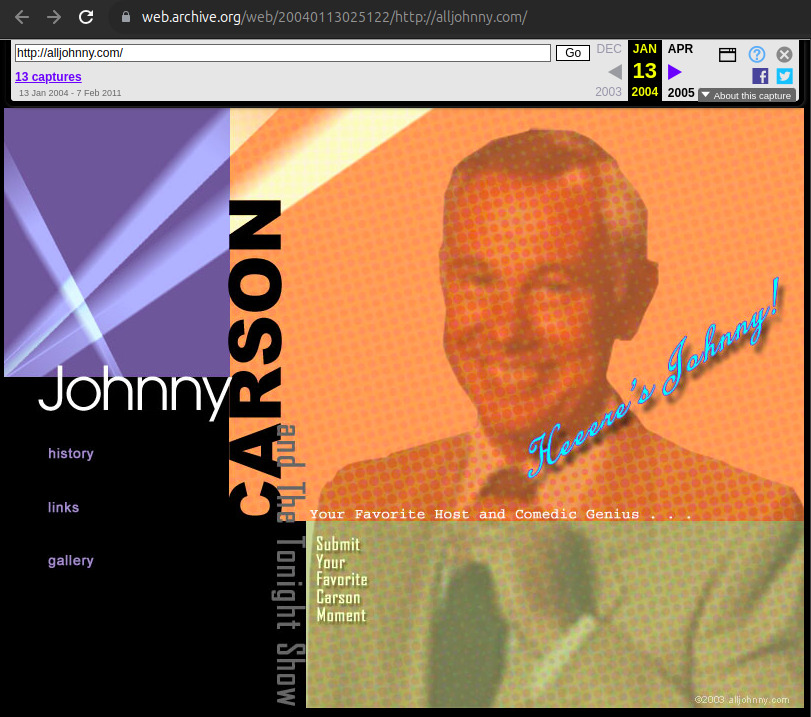
2004 Wayback Machine archive of alljohnny.com
. What follows is the previous
The fact that the Reuters article has a screenshot of it, and therefore a Wayback Machine link, plus the specificity of the website topic, will likely keep Ciro awake at night for a while until someone finds that domain.
Some text visible on the Reuters screenshot:It is unclear however if this text is plaintext or part of a an image.
Johnny Carson and The Tonight Show
Your Favorite Host and Comedic Genius
Submit Your Favorite Carson Moment
Heeere's Johnny!
Holy crap, the "Here's Johnny" line from The Shining (1980) is a reference to Johnny Carson: www.youtube.com/watch?v=WDpipB4yehk, www.youtube.com/watch?v=aYnyPAkgyvc, Ciro never knew that... but every American would have understood it at the time.
Some failed attempts, either dry guesses or from DNS grepping dataset searches:
- johnnycarson.com: official
- johnnycarson.net: fan site: web.archive.org/web/20010501225614/http://johnnycarson.net/
- johnnycarsontonight.com
- carson-johnny.com: legit
- johnnycarsonshow.com: web.archive.org/web/20110208005558/http://johnnycarsonshow.com/captcha/index.php?d=johnnycarsonshow.com your IP has been blocked
- tributetojohnnycarson.com: only one archive web.archive.org/web/20180805132430/http://tributetojohnnycarson.com/
- bestofjohnnycarson.com: web.archive.org/web/20130525035938/http://bestofjohnnycarson.com/ Lived past 2013.
- bestofjohnny.com/: web.archive.org/web/20130506011824/http://bestofjohnny.com/ empty
- johnnycarsonvideo.com: dead early 2000s web.archive.org/web/20130605152818/http://johnnycarsonvideo.com/
- johnnycarsontv.com: web.archive.org/web/20230000000000*/johnnycarsontv.com
- thejohnnycarsonshow.com: web.archive.org/web/20230000000000*/thejohnnycarsonshow.com
- carsonsbest.com: web.archive.org/web/20230000000000*/carsonsbest.com
- johnnycarsonfans.com: web.archive.org/web/20230000000000*/johnnycarsonfans.com
- web.archive.org/web/20230000000000*/carsonified.com
- night:
- amazing:
- johnnyamazing.com: broken archives: web.archive.org/web/*/http://johnnyamazing.com/*
- carson
- johnneycarson.com: no archives
- johnnycarson.co: no archives
- johnnycarsons.info
- johnnycarsons.com
- johnnycarson.org
- johnnycarsonsdesk.com
- johnny-carson-video.com
- johnnycarsondvd.org
- johnnycarsondvds.org
- johnnycarsondvd.net
- johnnycarsondvd.tv
- johnnycarsondvds.net
- johnnycarsondvds.tv
- johnnycarson.tv
- johnnyguitarcarson.com
- johnnycarsonmovie.com
- hookedonjohnnycarson.com
- johnnycarsonbook.com
- licensingjohnnycarson.com
- johnnnycarson.com
- johnnycarson360.com
- koalajohnnycarson.com
- johnny-carson.com
- johnnycarsonbirthplace.com
- johnnycarsonbirthplace.net
- johnny:
- heres:
- heresjohnnyfilm.com: web.archive.org/web/20131011115733/http://www.heresjohnnyfilm.com/ legit
- hereisjohnny.net: no archives
- heresjohnnyradioshow.com: web.archive.org/web/20130509042107/http://heresjohnnyradioshow.com/, Legit most likely: web.archive.org/web/20140517103512/http://heresjohnnyradioshow.com/
- wherejohnnylives.net: broken archives
- heresjohnny.com: squat web.archive.org/web/20130607145841/http://heresjohnny.com/ Many other TlD like .net, .co.uk
- heeeeresjohnny.com: web.archive.org/web/20130612211448/http://heeeeresjohnny.com/: legit
- night:
- johnnylatenight.com: web.archive.org/web/20150801132622/http://johnnylatenight.com/ Legit broken
- web.archive.org/web/20110208161513/http://www.johnnysnight.com/
- heres:
- johnnycarson.org: squatted past 2013, nothing before
- carsonshow.com: squat: web.archive.org/web/20110224211714/http://carsonshow.com/
- tonightshow247.net: web.archive.org/web/20101226190209/http://tonightshow247.net/: squat
- tonightshow.tv: web.archive.org/web/20141221222442/http://www.tonightshow.tv/: legit
Searching the Wayback Machine proved fruitless. There is no full text search: Wayback Machine full text search, and a heuristic web.archive.org/web/20230000000000*/Johnny%20Carson search has relevant hits but not the one we want.
Another attempt was to search for "carson" on webmasterhome.cn which lists expired domains in bulk by expiration day, and it search engine friendly. It contains most of the domains we've found so far. Google either doesn't support partial word search or requires you to be a God to find it
so we settle for DuckDuckGo which supports it: duckduckgo.com/?q=site%3Awebmasterhome.cn+%22carson%22&t=h_&ia=web Adding years also helps: duckduckgo.com/?q=site%3Awebmasterhome.cn+%22carson%22+2011&ia=web with this we might be getting all possible results. Ciro went through all in 2011, 2012 and 2013 but no luck. Also fuck en.wikipedia.org/wiki/Carson_City,_Nevada and en.wikipedia.org/wiki/Carson,_California :-)
Let's search tools.whoisxmlapi.com/reverse-whois-search for "carson" contained in any historic domain name. 10,001 lines. Grepping those, no good Wayback machine hits for those that also contain "johnny" or "show". Data at: raw.githubusercontent.com/cirosantilli/media/master/cia-2010-covert-communication-websites/tools.whoisxmlapi.com_reverse-whois-search_carson.csv in case anyone want to try and dig...
CIA 2010 covert communication websites JavaScript reverse engineering by Ciro Santilli 40 Updated 2025-07-16
Ciro Santilli 40 Updated 2025-07-16We've come across a few shallow and stylistically similar websites on suspicious ranges with this pattern.
No JS/JAR/SWF comms, but rather a subdomain, and an HTTPS page with .cgi extension that leads to a login page. Some names seen for this subdomain:
The question is, is this part of some legitimate tooling that created such patterns? And if so which? Or are they actual hits with a new comms mechanism not previously seen?
The fact that:suggests to Ciro that they are an actual hit.
- hits of this type are so dense in the suspicious ranges
- they are so stylistically similar between on another
- citizenlabs specifically mentioned a "CGI" comms method
In particular, the
secure and ssl ones are overused, and together with some heuristics allowed us to find our first two non Reuters ranges! Section "secure subdomain search on 2013 DNS Census"Some currently known URLsIf we could do a crawl search for
- backstage.musical-fortune.net/cgi-bin/backstage.cgi
- clients.smart-travel-consultant.com/cgi-bin/clients.cgi
- members.it-proonline.com/cgi-bin/members.cgi
- members.metanewsdaily.com/cgi-bin/ABC.cgi
- miembros.todosperuahora.com/cgi-bin/business.cgi
- secure.altworldnews.com/cgi-bin/desk.cgi
- secure.driversinternationalgolf.com/cgi-bin/drivers.cgi
- secure.freshtechonline.com/cgi-bin/tech.cgi
- secure.globalnewsbulletin.com/cgi-bin/index.cgi
- secure.negativeaperture.com/cgi-bin/canon.cgi
- secure.riskandrewardnews.com/cgi-bin/worldwide.cgi
- secure.theworld-news.net/cgi-bin/news.cgi
- secure.topbillingsite.com/cgi-bin/main.cgi
- secure.worldnewsandent.com/cgi-bin/news.cgi
- ssl.beyondnetworknews.com/cgi-bin/local.cgi
- ssl.newtechfrontier.com/cgi-bin/tech.cgi
- www.businessexchangetoday.com/cgi-bin/business.cgi
- heal.conquermstoday.com (path unknown)
secure.*com/cgi-bin/*.cgi that might be a good enough fingerprint, maybe even *.*com/cgi-bin/*.cgi. Edit: it is not perfect, but we kind of did it: Section "secure subdomain search on 2013 DNS Census". Pinned article: Introduction to the OurBigBook Project
Welcome to the OurBigBook Project! Our goal is to create the perfect publishing platform for STEM subjects, and get university-level students to write the best free STEM tutorials ever.
Everyone is welcome to create an account and play with the site: ourbigbook.com/go/register. We belive that students themselves can write amazing tutorials, but teachers are welcome too. You can write about anything you want, it doesn't have to be STEM or even educational. Silly test content is very welcome and you won't be penalized in any way. Just keep it legal!
Intro to OurBigBook
. Source. We have two killer features:
- topics: topics group articles by different users with the same title, e.g. here is the topic for the "Fundamental Theorem of Calculus" ourbigbook.com/go/topic/fundamental-theorem-of-calculusArticles of different users are sorted by upvote within each article page. This feature is a bit like:
- a Wikipedia where each user can have their own version of each article
- a Q&A website like Stack Overflow, where multiple people can give their views on a given topic, and the best ones are sorted by upvote. Except you don't need to wait for someone to ask first, and any topic goes, no matter how narrow or broad
This feature makes it possible for readers to find better explanations of any topic created by other writers. And it allows writers to create an explanation in a place that readers might actually find it.
Figure 1. Screenshot of the "Derivative" topic page. View it live at: ourbigbook.com/go/topic/derivativeVideo 2. OurBigBook Web topics demo. Source. - local editing: you can store all your personal knowledge base content locally in a plaintext markup format that can be edited locally and published either:This way you can be sure that even if OurBigBook.com were to go down one day (which we have no plans to do as it is quite cheap to host!), your content will still be perfectly readable as a static site.
- to OurBigBook.com to get awesome multi-user features like topics and likes
- as HTML files to a static website, which you can host yourself for free on many external providers like GitHub Pages, and remain in full control

Figure 2. You can publish local OurBigBook lightweight markup files to either OurBigBook.com or as a static website.
Figure 3. Visual Studio Code extension installation.
Figure 5. . You can also edit articles on the Web editor without installing anything locally. Video 3. Edit locally and publish demo. Source. This shows editing OurBigBook Markup and publishing it using the Visual Studio Code extension. 
- Infinitely deep tables of contents:


All our software is open source and hosted at: github.com/ourbigbook/ourbigbook
Further documentation can be found at: docs.ourbigbook.com
Feel free to reach our to us for any help or suggestions: docs.ourbigbook.com/#contact