Topics (119k) Articles (119k) Users (288) Discussions (237) Comments (383) Files (715) New article
Split in energy levels due to interaction between electron up or down spin and the electron orbitals.
Numerically explained by the Dirac equation when solving it for the hydrogen atom, and it is one of the main triumphs of the theory.
Non-anomalous: number of splits matches predictions of the Schrödinger equation about the number of possible states with a given angular momentum. TODO does it make numerical predictions?
www.pas.rochester.edu/~blackman/ast104/zeeman-split.html contains the hello world that everyone should know: 2p splits into 3 energy levels, so you see 3 spectral lines from 1s to 2p rather than just one.
It also mentions that polarization effects become visible from this: each line is polarized in a different way. TODO more details as in an experiment to observe this.
Well explained at: Video "Quantum Mechanics 7a - Angular Momentum I by ViaScience (2013)".
Experimental physics - IV: 22 - Zeeman effect by Lehrportal Uni Gottingen (2020)
Source. This one is decent. Uses a cadmium lamp and an etalon on an optical table. They see a more or less clear 3-split in a circular interference pattern,
They filter out all but the transition of interest.
- youtu.be/ZmObNFAqkBE?t=165 passes the lines through a polarizer, which shows how orbital angular momentum is carried by photon polarization
- youtu.be/ZmObNFAqkBE?t=370 says they are looking at 1D2 to 1P1 changes.
Man-made virus!
TODO: if we had cheap de novo DNA synthesis, how hard would it be to bootstrap a virus culture from that? github.com/cirosantilli/cirosantilli.github.io/issues/60
Is it easy to transfect a cell with the synthesized DNA, and get it to generate full infectious viral particles?
If so, then de novo DNA synthesis would be very similar to 3D printed guns: en.wikipedia.org/wiki/3D_printed_firearms.
It might already be possible to order dissimulated sequences online:
The key insights that it gives are:
- future and past are well defined: every reference frame sees your future in your future cone, and your past in your past coneOtherwise causality could be violated, and then things would go really bad, you could tell your past self to tell your past self to tell your past self to do something.
- every other event (to right and left, known as spacelike-separated events) can be measured to happen before or after your current spacetime event by different observers.
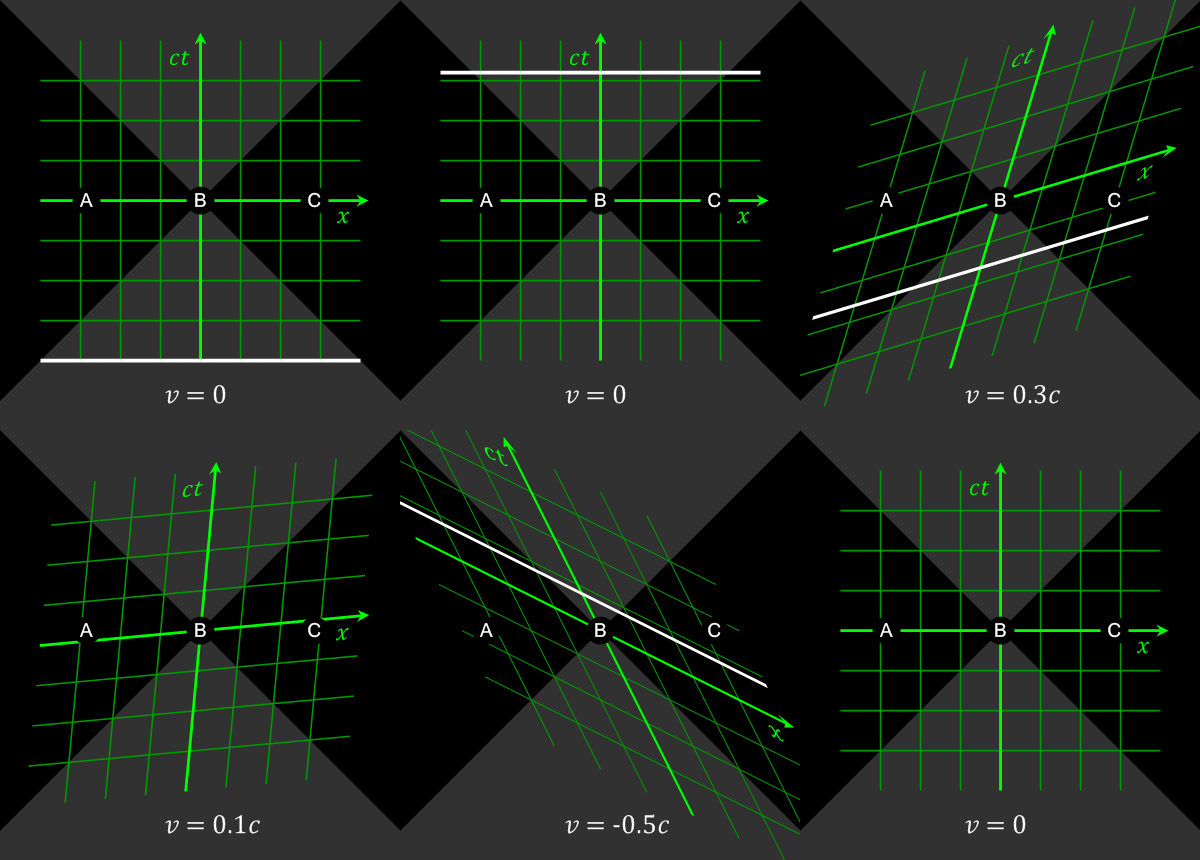
Animation showing how space-separated events can be observed to happen in different orders by observers in different frames of reference
. Source. We select for the general Equation "Schrodinger equation":giving the full explicit partial differential equation:
- , the linear cartesian coordinate in the x direction
- , which analogous to the sum of kinetic and potential energy in classical mechanics
Equation 1.
Schrödinger equation for a one dimensional particle
. The corresponding time-independent Schrödinger equation for this equation is:
Equation 2.
time-independent Schrödinger equation for a one dimensional particle
. Schrödinger equation for a one dimensional particle with . The first step is to calculate the time-independent Schrödinger equation for a free one dimensional particle
Then, for each energy , from the discussion at Section "Solving the Schrodinger equation with the time-independent Schrödinger equation", the solution is:Therefore, we see that the solution is made up of infinitely many plane wave functions.
We get the time-independent Schrödinger equation by substituting this into Equation "time-independent Schrödinger equation for a one dimensional particle":
Now, there are two ways to go about this.
The first is the stupid "here's a guess" + "hey this family of solutions forms a complete basis"! This is exactly how we solved the problem at Section "Solving partial differential equations with the Fourier series", except that now the complete basis are the Hermite functions.
The second is the much celebrated ladder operator method.
Examples:
- flash memory uses quantum tunneling as the basis for setting and resetting bits
- alpha decay is understood as a quantum tunneling effect in the nucleus
Is the only atom that has a closed form solution, which allows for very good predictions, and gives awesome intuition about the orbitals in general.
It is arguably the most important solution of the Schrodinger equation.
In particular, it predicts:
- the major spectral line of the hydrogen atom by taking the difference between energy levels
The explicit solution can be written in terms of spherical harmonics.
Solutions for the Schrodinger equation with multiple particles by  Ciro Santilli 40 Updated 2025-07-16
Ciro Santilli 40 Updated 2025-07-16Bibliography:
- Quantum Mechanics for Engineers by Leon van Dommelen (2011) "5. Multiple-Particle Systems"
Discrete quantum system model that can model both spin in the Stern-Gerlach experiment or photon polarization in polarizer.
Pinned article: Introduction to the OurBigBook Project
Welcome to the OurBigBook Project! Our goal is to create the perfect publishing platform for STEM subjects, and get university-level students to write the best free STEM tutorials ever.
Everyone is welcome to create an account and play with the site: ourbigbook.com/go/register. We belive that students themselves can write amazing tutorials, but teachers are welcome too. You can write about anything you want, it doesn't have to be STEM or even educational. Silly test content is very welcome and you won't be penalized in any way. Just keep it legal!
Intro to OurBigBook
. Source. We have two killer features:
- topics: topics group articles by different users with the same title, e.g. here is the topic for the "Fundamental Theorem of Calculus" ourbigbook.com/go/topic/fundamental-theorem-of-calculusArticles of different users are sorted by upvote within each article page. This feature is a bit like:
- a Wikipedia where each user can have their own version of each article
- a Q&A website like Stack Overflow, where multiple people can give their views on a given topic, and the best ones are sorted by upvote. Except you don't need to wait for someone to ask first, and any topic goes, no matter how narrow or broad
This feature makes it possible for readers to find better explanations of any topic created by other writers. And it allows writers to create an explanation in a place that readers might actually find it.
Figure 1. Screenshot of the "Derivative" topic page. View it live at: ourbigbook.com/go/topic/derivativeVideo 2. OurBigBook Web topics demo. Source. - local editing: you can store all your personal knowledge base content locally in a plaintext markup format that can be edited locally and published either:This way you can be sure that even if OurBigBook.com were to go down one day (which we have no plans to do as it is quite cheap to host!), your content will still be perfectly readable as a static site.
- to OurBigBook.com to get awesome multi-user features like topics and likes
- as HTML files to a static website, which you can host yourself for free on many external providers like GitHub Pages, and remain in full control

Figure 2. You can publish local OurBigBook lightweight markup files to either OurBigBook.com or as a static website.
Figure 3. Visual Studio Code extension installation.
Figure 5. . You can also edit articles on the Web editor without installing anything locally. Video 3. Edit locally and publish demo. Source. This shows editing OurBigBook Markup and publishing it using the Visual Studio Code extension. 
- Infinitely deep tables of contents:



All our software is open source and hosted at: github.com/ourbigbook/ourbigbook
Further documentation can be found at: docs.ourbigbook.com
Feel free to reach our to us for any help or suggestions: docs.ourbigbook.com/#contact