4:2:0 chroma subsampling
ID: 4-2-0-chroma-subsampling

4:2:0 chroma subsampling keeps the full luma grid while halving each colour-difference component's sampling rate horizontally and vertically. For even width and height , it retains Y samples and samples each of Cb and Cr.[ref]
Recommended 8-Bit YUV Formats for Video Rendering by Gary Sullivan and Stephen Estrop. YUV Sampling,4:2:0 definition
The zero in the notation does not mean that one colour-difference component has disappeared.For an original six-by-four eight-bit image, the active payload iscompared with 72 bytes for 4:4:4 chroma sampling and 48 bytes for 4:2:2 chroma subsampling. Thus the 4:2:0 payload is half the 4:4:4 payload and three quarters of the 4:2:2 payload under these declared assumptions. It averages 12 bits per original pixel, without row padding or alpha.
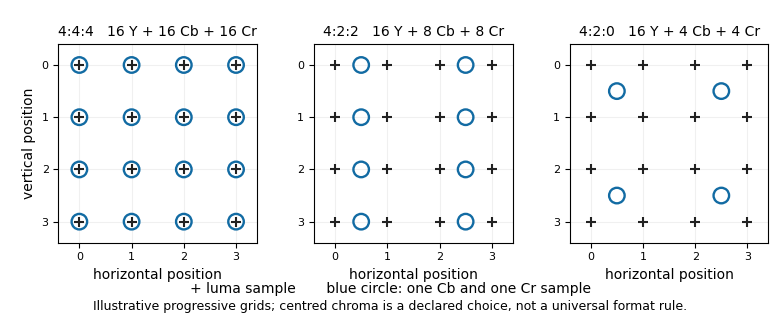

Both colour components have fewer samples, so chroma reconstruction must estimate values at additional positions before a full-resolution colour conversion. It cannot generally reverse information discarded during downsampling. The chroma sample location also matters: identical counts can correspond to different spatial offsets.
New to topics? Read the docs here!