
An arithmetic series adds the sequence terms of an arithmetic progression. Its -th partial sum is , with the empty sum convention . For ,Thus the total is the number of sequence terms multiplied by the arithmetic mean of the two endpoints. The formula also covers decreasing and constant arithmetic progressions.[ref]
1 Algebraic and Analytic Methods. NIST Digital Library of Mathematical Functions, §1.2(ii) Finite Series, equation 1.2.10: arithmetic progression sum and last-term definition
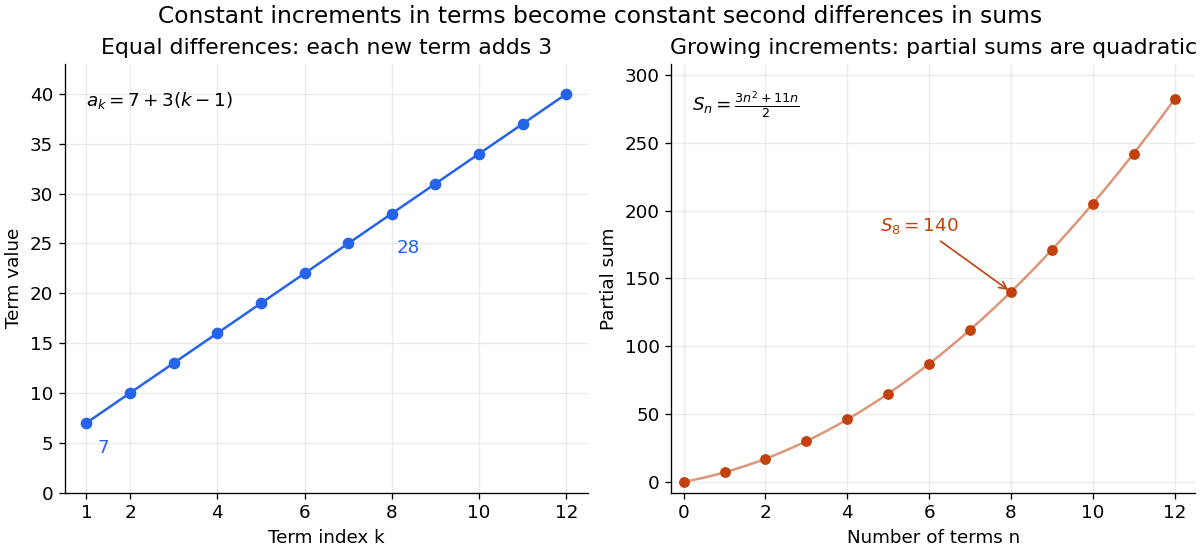
For the eight-entry example, the sum is , and the arithmetic mean of all eight entries is . A decreasing example gives . Negative values cause no algebraic difficulty: has sum .
The triangular number is the special case , giving . More generally, an equal increase in each successive allocation makes the total grow as a quadratic function of the number of allocations. The eight-entry example hasIts first four entries add to , its first eight to , and its first twelve to . The sequence terms lie on a straight line when plotted against their sequence indices, while the partial sums follow a quadratic function.

New to topics? Read the docs here!