An arithmetic series adds the sequence terms of an arithmetic progression. Its -th partial sum is , with the empty sum convention . For ,Thus the total is the number of sequence terms multiplied by the arithmetic mean of the two endpoints. The formula also covers decreasing and constant arithmetic progressions.[ref]
1 Algebraic and Analytic Methods. NIST Digital Library of Mathematical Functions, §1.2(ii) Finite Series, equation 1.2.10: arithmetic progression sum and last-term definition
For the eight-entry example, the sum is , and the arithmetic mean of all eight entries is . A decreasing example gives . Negative values cause no algebraic difficulty: has sum .
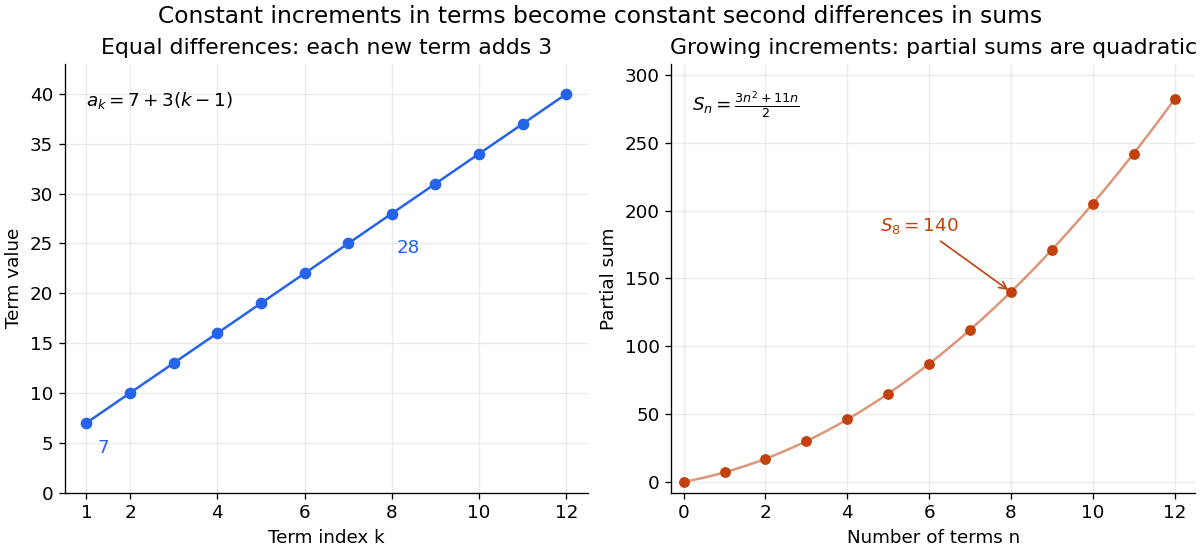
The triangular number is the special case , giving . More generally, an equal increase in each successive allocation makes the total grow as a quadratic function of the number of allocations. The eight-entry example hasIts first four entries add to , its first eight to , and its first twelve to . The sequence terms lie on a straight line when plotted against their sequence indices, while the partial sums follow a quadratic function.

Reverse the finite list of sequence terms and add it to the original list. At position ,Every position therefore contributes the same value. Reversal preserves the sum, giving and the stated formula. The symmetry explains why the endpoint average represents the whole list; one does not need to add each entry separately.
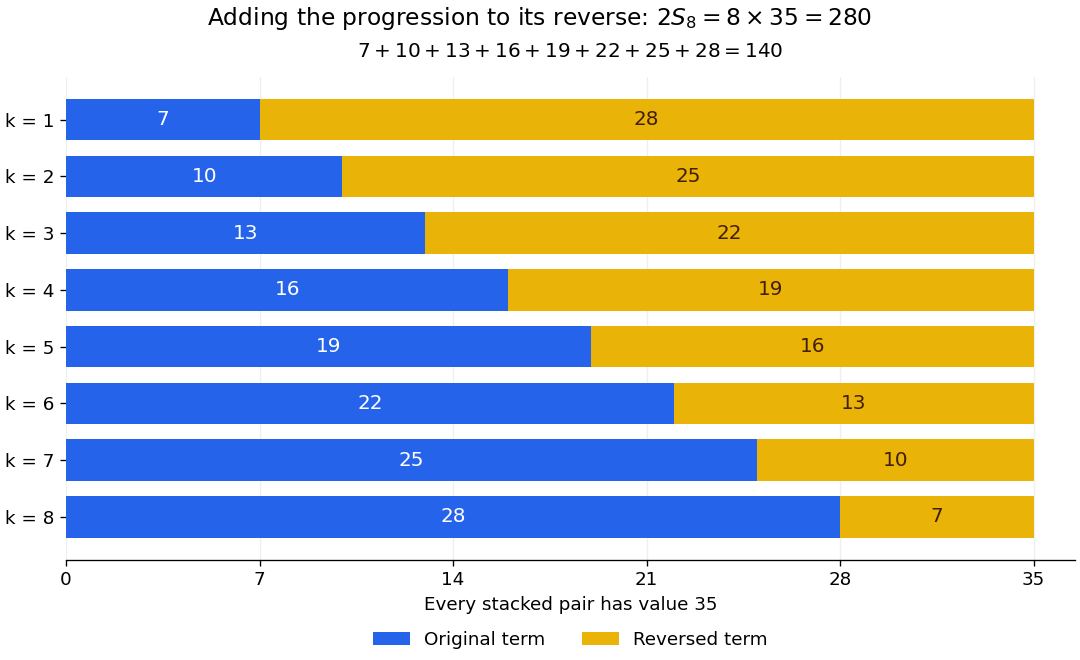
An arithmetic progression and its reverse make eight equal pairs, each of value thirty-five
. Original positive-value example . Blue bars show the original entries; yellow bars show the reversed entries. The combined sum is , twice the original sum . The algebraic argument also applies when some entries are negative. Details.
The reversal argument works for both even and odd lengths. For , the two outer pairs each total sixteen and the middle entry is eight. Adding the list to its reverse counts that middle entry twice too, giving and . No half-entry is required for an odd number of entries.
Adding one sequence term changes a partial sum by exactly that entry, so . Taking another finite difference givesThus arithmetic sequence terms produce partial sums with constant second finite differences. Conversely, if these second finite differences are a fixed and , then those entries form an arithmetic progression. For nonzero , the displayed sum formula is a quadratic function; for , it reduces to the linear expression .
Articles by others on the same topic
There are currently no matching articles.