Astronomical magnitude
ID: astronomical-magnitude

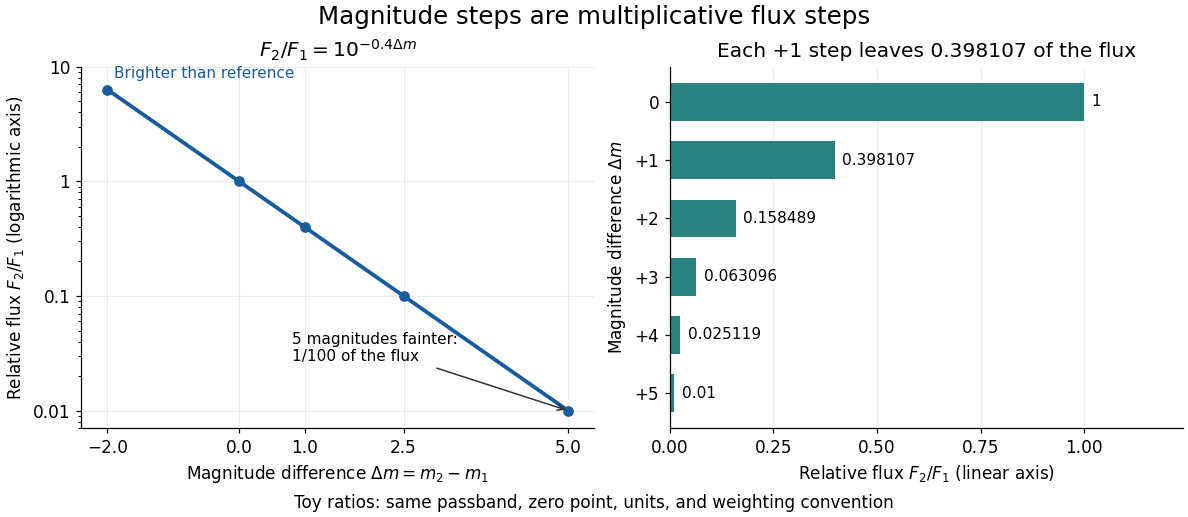
Astronomical magnitude expresses brightness on a logarithmic scale: equal steps in astronomical magnitude represent equal ratios of received radiative flux. The scale runs backwards, so a brighter source has a smaller astronomical magnitude. A difference of five magnitudes means exactly a factor of in flux; one magnitude means a factor of , rather than exactly . This compresses the enormous range of astronomical brightnesses into manageable numbers. [ref]
https://openstax.org/books/astronomy-2e/pages/17-1-the-brightness-of-stars. Fraknoi, Morrison and Wolff, Astronomy 2e, 17.1: The brightness of stars
.Apparent magnitude describes received brightness, while absolute magnitude compares sources at a shared reference distance. Both require a specified photometric passband and magnitude zero point. A magnitude difference turns a ratio of positive radiative fluxes into a difference of numbers; it does not measure an additive change in emitted luminosity.

New to topics? Read the docs here!