Asymptotic equivalence
ID: asymptotic-equivalence

For functions with nonzero sufficiently near a specified limit,The same definition applies to sequences as . Equivalently, : replacing by has a relative error tending to zero, and the difference is in little o notation. The limit and reference scale are essential parts of the statement.
For example, because . Replacing the former by the latter gives absolute error , which grows without bound. Thus asymptotic equivalence controls a ratio, rather than requiring the absolute error to vanish. This distinction is crucial when approximating a rapidly growing factorial with Stirling's formula.
By contrast, and have the same order in big theta notation, but are not asymptotically equivalent: their ratio remains two. For positive functions, asymptotic equivalence gives both-sided constant bounds eventually, whereas constant bounds alone do not recover the leading coefficient.
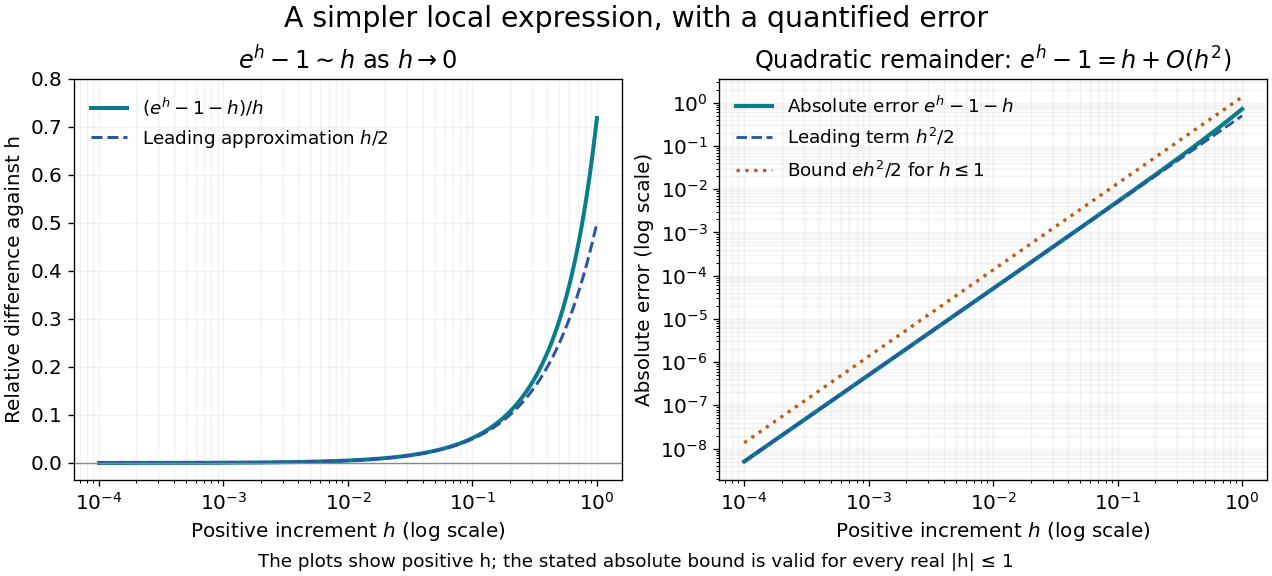

For a local example with real , the exponential function obeys as . The Taylor theorem with Lagrange remainder givesThus for ,This states in big O notation, and division by shows that the relative difference measured against vanishes. The diagram uses positive ; the bound is valid on both sides of zero. At , the absolute error is approximately and the relative difference against is approximately .
New to topics? Read the docs here!