
For nonnegative integers and , the binomial coefficientcounts the -element subsets of an -element set. To obtain the formula, first choose an ordered list of different members in ways. Each subset appears in exactly orders, so divide by that factorial. The cases and each have one selection, the empty set and the whole set. For integer outside , the combinatorial convention is .
For , , the calculation is . The left-hand panel lists all ten subsets of . Marking an included member with one and an excluded member with zero gives a bijection with length-five binary strings containing exactly two ones. More generally, this makes selection, binary encoding, and coefficients in a binomial theorem three descriptions of the same count.
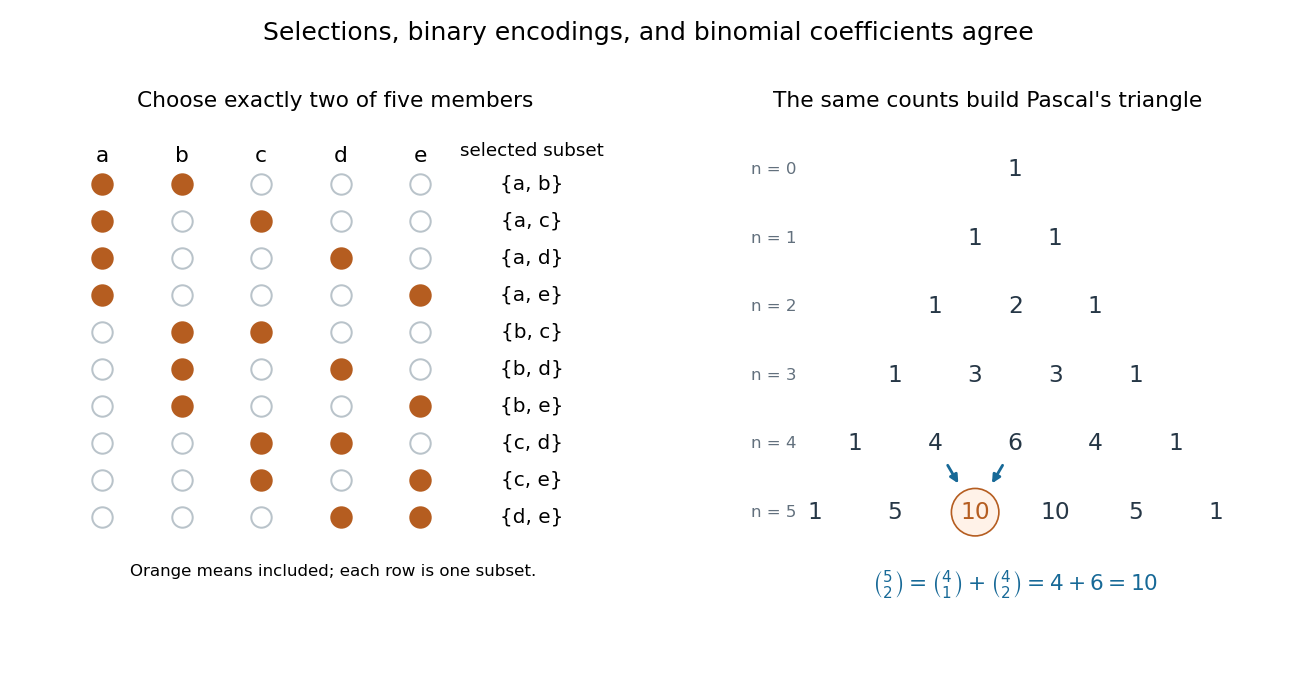
For a uniformly chosen two-person team, a specified person belongs to four of the ten teams, so the probability of their inclusion is . Uniform selection of a -element subset similarly gives inclusion probability for each member when , as the double counting identity shows.


The binomial coefficient, often denoted as \( \binom{n}{k} \) or \( C(n, k) \), is a mathematical expression that represents the number of ways to choose \( k \) elements from a set of \( n \) elements without regard to the order of selection. It is a crucial concept in combinatorics and has applications in probability, statistics, and various fields of mathematics.
New to topics? Read the docs here!