The probability of an event is its value under a probability measure, a real number between zero and one. It compares the mass assigned to that event with the unit mass of the whole sample space. For a finite sample space with equally likely outcomes, P(A)=∣A∣/∣Ω∣. For unequal outcome masses, add their individual probabilities instead.
For example, selecting a coin with head probability 1/2 with chance 4/5, or a coin with head probability 3/4 with chance 1/5, gives head probability (4/5)(1/2)+(1/5)(3/4)=11/20. This is the law of total probability: averaging over the hidden selection is part of calculating the outcome's probability.
A Statistical fluctuation is variation between repeated random outcomes or samples. Its scale can be quantified by variance or standard deviation. For independent signal counts with a Poisson mean proportional to deposited energy, the absolute fluctuation grows as the square root of energy and its relative size decreases as the inverse square root.
For an event A in a sample space Ω, the complementary event Ac=Ω∖A occurs exactly when A does not occur. The complement rule of probability follows from the Kolmogorov axioms: A and Ac are disjoint, their union is Ω, and their probabilities therefore add to P(Ω)=1.
This rule is useful when an event is easier to describe through its failure. For a nonnegative integer-valued random variable K, P(K≥1)=1−P(K=0) turns an at-least-one calculation into a single value of the probability mass function. In sampling without replacement, the hypergeometric distribution gives the chance of missing all marked objects, so its complement gives the chance of finding at least one.
For an event of probability 0<p<1, its odds in favor are o=p/(1−p). They compare the probability of the event with that of its complement. Conversely p=o/(1+o). For example, probability 1/4 gives odds 1/3, or one to three in favor. The same transformation applies to a conditional probability; an odds ratio compares these transformed probabilities in two groups, while a risk ratio compares the probabilities themselves.
For a real random variable X, an upper-tail probability has the form P(X≥t) and a lower-tail probability has the form P(X≤t). Each is the probability of an event lying beyond a chosen threshold in one direction. A tail probability need not be small: the threshold determines how much of the probability distribution it includes. A concentration inequality bounds such probabilities, often for deviations from an expected value.
Endpoint conventions matter. Write F(t)=P(X≤t) for the cumulative distribution function and F(t−)=lims↑tF(s)=P(X<t). The complement rule of probability gives four distinct formulas:The strict upper-tail convention is the survival function S(t)=P(X>t). Its value differs from the inclusive upper tail probability by exactly the probability mass at the threshold:A singleton with positive probability mass is an atom of a measure. Thus 1−F(t) excludes an atom of a measure at t, whereas 1−F(t−) includes it. These endpoint identities follow directly from the cumulative distribution function properties in Kyle Siegrist, Distribution and Quantile Functions: endpoint probabilities and right tails.
P(X≥t)P(X≤t)=1−F(t−),=F(t),P(X>t)P(X<t)=1−F(t),=F(t−).
P(X≥t)−P(X>t)=P(X=t)=F(t)−F(t−).
As the threshold increases, both upper tail probabilities are nonincreasing functions. The strict survival function is a right-continuous function; the inclusive upper tail probability takes the upper endpoint value at a downward jump, equal to the left limit of the survival function. Both tend to zero as t→∞ for a real random variable, but the speed of that decay differs across probability distributions. The cumulative distribution function properties and their proof from continuity of probability measures are given in MIT 6.436J, Lecture 4: random variables and cumulative distribution function properties.
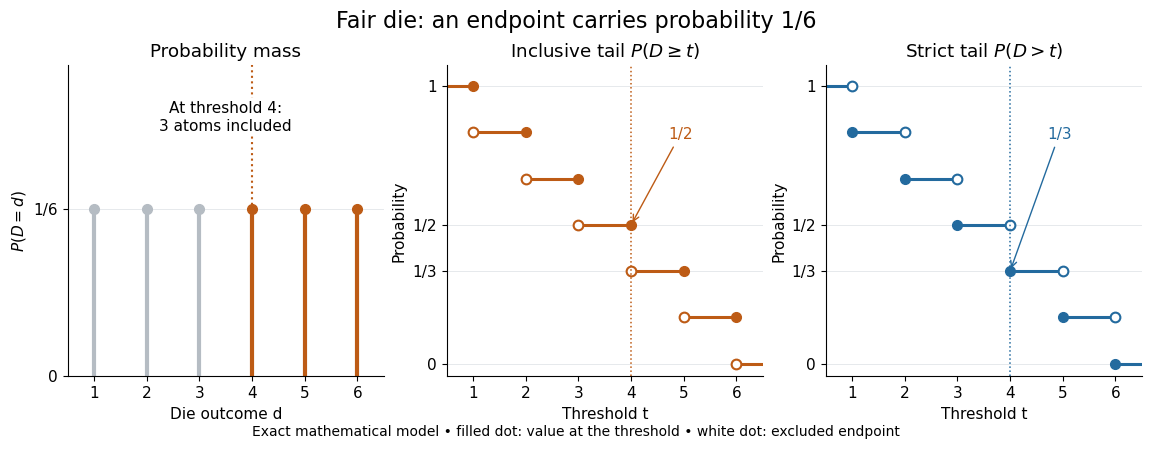
For a fair six-sided die D, the discrete uniform distribution assigns probability mass 1/6 to each of 1,…,6. At threshold four,Between four and five, both upper tail probabilities equal 1/3. At the largest possible outcome the distinction is especially visible: P(D≥6)=1/6, but P(D>6)=0. The diagram shows exact probabilities for this mathematical model; its dots specify which endpoints belong to each step function.
P(D≥4)=63=21,P(D>4)=62=31,FD(4)=64,FD(4−)=63.
If a probability distribution has a probability density function f, then every singleton has zero probability mass andFor an exponential distribution of rate two, f(x)=2e−2x for x≥0 and zero otherwise, so S(t)=e−2t for t≥0 and S(t)=1 for t<0. Hence P(X≥1)=e−2≈0.135335. This tail probability is an integral of the probability density function, not its height f(1)=2e−2≈0.270671. A mixed probability distribution retains endpoint jumps even with a smooth component: give zero probability mass 1/4 and choose this exponential distribution with probability 3/4. Then P(X≥0)=1, P(X>0)=3/4, and S(t)=(3/4)e−2t for t≥0.
P(X≥t)=P(X>t)=∫t∞f(x)dx.
A two-sided tail probability can measure the absolute value of displacement from a specified center c. For a>0, the two extreme events are disjoint events, soFor strict displacement ∣X−c∣>a, replace the last expression by F((c−a)−)+1−F(c+a). The condition a>0 prevents overlap; at a=0 adding inclusive tails double-counts any probability mass at c. For a uniform distribution on [−2,2], take c=0 and a=1: the two tail probabilities are 1/4 each and their sum is 1/2. Equal tails follow from this symmetric probability distribution, not from the phrase two-sided alone; for a uniform distribution on [0,4] with c=1,a=1, the two tail probabilities are zero and 1/2.
P(∣X−c∣≥a)=P(X≤c−a)+P(X≥c+a)=F(c−a)+1−F((c+a)−).
The tail-sum formula for expectation turns a whole curve of tail probabilities into an expected value. For any nonnegative random variable Y, without assuming a probability density function or a finite expected value,For a proof outline, write Y=∫0∞1{Y>t}dt pointwise and exchange the expected value and Lebesgue integral using Tonelli theorem; 1 is an indicator function. The inclusive version has the same Lebesgue integral: positive probability masses occur at only a countable set of thresholds, which has Lebesgue measure zero. For a nonnegative integer-valued random variable N, the tail-sum formula instead gives EN=∑k=1∞P(N≥k)=∑k=0∞P(N>k). The integer hypothesis is essential for these sums. The integral identity, its indicator function proof, and the integer version appear in Kyle Siegrist, Additional Properties of Expected Value: integration and summation of right tails.
EY=∫0∞P(Y>t)dt=∫0∞P(Y≥t)dtin [0,∞].
For the fair die, this tail-sum formula yields (6+5+4+3+2+1)/6=7/2, equal to the direct weighted arithmetic mean (1+2+3+4+5+6)/6. For the rate-two exponential distribution, the area under the survival function is ∫0∞e−2tdt=1/2, its expected value. The first panel below shades an integral of the probability density function for a single threshold; the second shades an integral of the survival function across all nonnegative thresholds. These are analytical illustrations, with the displayed curves truncated at three; their exact total areas use an infinite integration range.
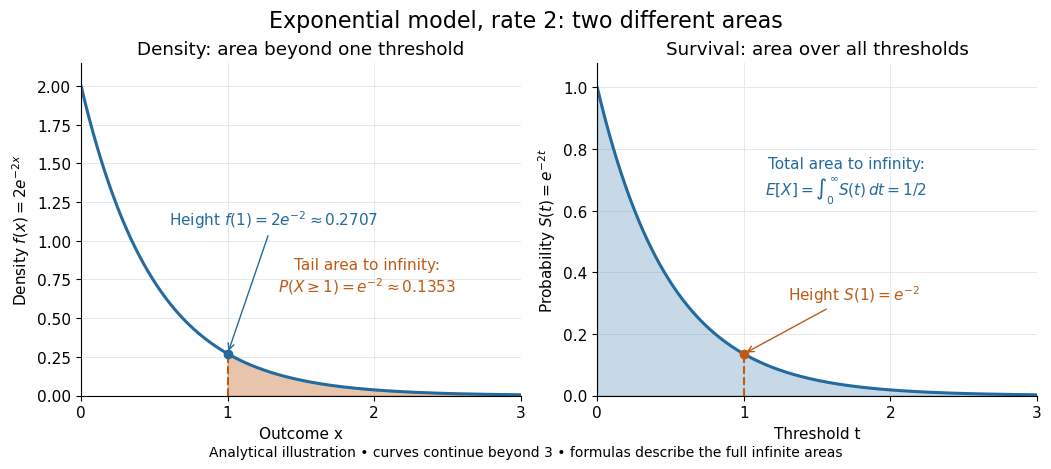
Nonnegativity is essential to interpreting the upper tail probability area as EY: for a general real random variable that area equals the expected value of its positive part. An integrable random variable satisfies EX=EX+−EX−, subtracting the expected value of its negative part; infinite terms cannot be canceled. Even when Y is finite almost surely, its expected value can be infinite. For the shape-one Pareto distribution on [1,∞), S(t)=1 on [0,1) and S(t)=1/t for t≥1, so the area is 1+∫1∞dt/t=∞. The finite versus infinite expected value distinction is illustrated in Kyle Siegrist, Definitions and Basic Properties: exponential and Pareto expected values.
Why are tail probabilities useful? They answer threshold questions directly, and a concentration inequality can bound them without knowing the full probability distribution. For nonnegative Y with finite expected value, Markov inequality gives P(Y≥t)≤EY/t for t>0: a large threshold relative to the expected value forces rarity. The quantile function reverses the question by choosing a threshold for a prescribed cumulative level. If q=Q(1−α) with 0<α<1, then P(X>q)≤α≤P(X≥q); an atom of a measure may prevent equality. For the die, Q(0.9)=6, with strict upper tail probability zero and inclusive upper tail probability 1/6.
A tail probability describes rarity under a specified probability distribution; it is not automatically a conditional probability after extra information. For u≥t with P(X≥t)>0,because the threshold events are nested. Thus the die has P(D≥5)=1/3 but P(D≥5∣D≥4)=2/3. Conditioning changes the sample space and renormalizes its probability measure; the same extreme outcomes can become common in that restricted population.
P(X≥u∣X≥t)=P(X≥t)P(X≥u),
Ancestors (5)
Incoming links (3198)
- Aalen–Johansen estimator
- Abelian hidden-subgroup Fourier sampling
- Absent-minded decision problem
- Absolutely continuous random variable
- Absorbing four-ball Ehrenfest chain
- Absorbing Markov chain
- Absorbing state
- Absorption time
- Accept-or-fallback mixture identity
- Acyclic Markov chain
- Adaptive classifier
- Additivity of Boltzmann entropy
- Adiabatic matter-enhanced neutrino conversion
- Adjacency-matrix bound for a discrete SIR epidemic
- Affected-sib-pair analysis
- Aggregation of macroparasite burdens
- Agrawal–Biswas primality test
- Aharonov-Bergmann-Lebowitz rule
- Albert R. Meyer
- Aldous-Broder algorithm
- Algorithm configuration
- Allele frequency
- Alloy sublattice order parameter
- Almost strongly universal hash family
- Almost sure convergence
- Almost-sure limit of independent random variables is constant
- Almost-sure subsequence from convergence in probability
- Alternating arms argument at the self-dual percolation parameter
- Alternating arrival and service queue
- Alternating split of a Poisson process
- Alternative hypothesis
- American College of Surgeons
- Amplitude amplification
- Amplitude poles and analytic continuation of transmission probability
- Ancilla preparation for the Bernstein-Vazirani algorithm
- Andrey Kolmogorov
- Angular distribution
- Angular momentum expectation
- An observation can increase entropy
- Antidistinguishable quantum states
- Antithetic Cauchy-tail integration on a finite interval
- Applied probability course of the University of Oxford
- Arbitrage
- Arcsine distribution
- Arcsine distribution from a uniform angle
- Arcsine quantiles and moments
- Area of a planar Brownian path
- A shared coin prevents a zero-one conclusion
- Asymmetric coordination example
- Asymptotic distribution of a sample median
- Asymptotic equipartition property
- Asymptotic remote state preparation by block indexing
- Atom interferometer
- Atoms obstruct a continuous distributional limit
- Augmented inverse-probability-weighted estimator
- Autologistic binary-image model
- Avoidance recurrence for two consecutive successes
- Avshalom Elitzur
- Azuma's inequality
- Balanced beam splitter
- Balanced Hadamard interaction-free measurement
- Barcode collision
- Barker acceptance probability
- Base rate
- Base-rate dependence of autonomic emotion classification
- Basic measurement
- Basic probability assignment
- Bayesian confirmation
- Bayesian model evidence
- Bayesian statistics
- Bayesian update after a projective measurement
- Bayes' theorem
- BB84 intercept-resend error rate
- Bell correlations versus a classical mixture
- Bell inequality
- Bell test
- Ben F. Luisi
- Benford law
- Benford law from logarithmic uniformity
- Bernoulli independence from zero covariance
- Bernoulli-Laplace diffusion model
- Bernoulli process
- Bernoulli sample sum as a sufficient statistic
- Bernoulli string
- Bernoulli thinning
- Bernoulli trial
- Bernoulli typical-set example
- Bernstein polynomial
- Bernstein-von Mises theorem
- Berry phase
- Berry-phase interference with a reference path
- Bertrand paradox (probability)
- Bessel second-moment identity
- Beta distribution
- Beta-geometric conjugacy
- Beta highest posterior density endpoint characterization
- Bhattacharyya coefficient
- Biased gambler's ruin probability
- Biased random walk
- Biased random walk hitting probability
- Biased-step entropy production model
- Bichteler-Dellacherie theorem
- Binary cross-entropy
- Binary Markov source
- Binary phase representation of a Pauli string
- Binary symmetric channel
- Binary symmetric channel capacity
- Binary test for quantum decoding success
- Binomial branching process conditioned on extinction
- Binomial coefficient
- Binomial count
- Binomial distribution
- Binomial likelihood
- Binomial probability
- Binomial probability mass
- Binomial proportion confidence interval
- Binomial random hypergraph
- Binomial thinning
- Binomial thinning of a geometric random variable
- Biomineralization
- Birthday probability for hash outputs
- Birthday problem
- Birth-death-immigration jump chain
- Birth-death master equation
- Birth-death recurrence classification
- Bit error rate
- Blocking kernel
- Boltzmann distribution
- Boltzmann distribution and state degeneracy
- Boltzmann distribution in a four-state system
- Boltzmann distribution ratios and energy reference
- Boltzmann distribution temperature limits in a finite system
- Boltzmann entropy of a two-box occupancy
- Boltzmann entropy when a restriction is removed
- Boltzmann's entropy formula
- Bond percolation
- Boolean operations on events
- Boole's inequality
- Bootstrap count vectors
- Bootstrapping (statistics)
- Bootstrap sample
- Borel-Cantelli lemmas
- Borel-Cantelli second lemma
- Born rule
- Born rule for a product-basis measurement
- Boundary bias of a kernel density estimator
- Boundary counting proof of percolation uniqueness
- Boundary likelihood-ratio test for two Gaussian means
- Boundary-side amplification for planar percolation
- Bounded errors with prescribed correlation
- Boundedness in probability
- Bounded second moments do not upgrade convergence in probability to convergence in L2
- Bouwmeester quantum teleportation experiment
- Branching fraction
- Branching-process extinction criterion
- Branch weight
- Breidbart basis
- Brier score
- Broadband radiation
- Brownian barrier survival asymptotic
- Brownian exit law from a quadrant
- Brownian motion
- Brownian scaling
- Brownian upper law of the iterated logarithm
- Càdlàg modification
- Càdlàg versions are indistinguishable
- Canonical ensemble
- Canonical entropy formula
- Canonical joint distribution for group sequential test statistics
- Canonical oscillator coordinate variance
- Canonical partition function
- Cantelli inequality
- Capacity of a disjoint sum of channels
- Capped geometric waiting time
- Capture-recapture model
- Carla P. Gomes
- Carl W. Helstrom
- Categorical distribution
- Categorical thinning of a Poisson claim count
- Causal inference
- Central binomial coefficient
- Central limit theorem
- Central limit theorem for the sample variance
- Cesium-beam clock procedure
- Chain-binomial epidemic model
- Chain rule for information entropy
- Chain rule for probabilities
- Chance constraint
- Change of variables for probability densities
- Channel capacity
- Channel decoder
- Characteristic function
- Characteristic function of a sum of independent variables
- Characteristic functions of symmetric sign sums
- Charge-transfer efficiency
- Charles M. Grinstead
- Charles M. Stein
- Chebyshev's inequality
- Chebyshev test for a regression coefficient
- Chi-squared asymptotic approximation
- Chi-squared stochastic ordering
- Christiaan Huygens
- CHSH game
- Claim count
- Classical mixture of coherent states
- Classical statistical mechanics
- Clearance time after closing an infinite-server queue
- Clipped acceptance reweighting identity
- Clone-assisted asymptotic state discrimination
- Cloning failure bound from trace-distance contraction
- Closed-cut bound for percolation in a strip
- Closed-population capture-recapture model
- Closure of Lévy processes under locally controlled convergence in probability
- Cluster algorithm
- Coeval binary population
- Coherent preparation and incoherent mixing
- Collective vigilance
- Collision probability of two independent categorical draws
- Combinatorics
- Communicating class
- Communicating states
- Compact containment
- Compensator of a counting process
- Complementary error function
- Complement of an event
- Complement rule of probability
- Complete convergence of random variables
- Complex environment overlap in qubit dephasing
- Component-number zero-one law for the wired uniform spanning forest
- Computational-basis measurement of a graph-state vertex
- Computational indistinguishability
- Computational learning theory
- Concentration inequality
- Concentration of a beta prior near zero
- Conditional bias-corrected normal mean estimate
- Conditional composition of two independent binomial counts
- Conditional concentration at a large-deviation threshold
- Conditional distribution
- Conditional entanglement of the three-qubit W state
- Conditional entropy
- Conditional error principle
- Conditional evolved-companion fraction in a coeval binary population
- Conditional expectation
- Conditional expectation choice invariant
- Conditional expectation cut formula
- Conditional hitting time
- Conditional independence
- Conditional inference in a location-scale family
- Conditional mutual information
- Conditional path probabilities after a quarter-wave plate
- Conditional randomization test
- Conditioning can destroy independence
- Conditioning on a sum can create dependence
- Conductance profile
- Confidence interval from a relative normal pivot
- Confidence score
- Configurational entropy
- Conformal invariance of planar percolation
- Conformational entropy
- Conjugate-basis steering of a Bell pair
- Conjugate-state steering from a maximally entangled pair
- Connective-constant Peierls bound
- Connectivity of random k-out graphs
- Connectivity of three acute-angle sphere points
- Conservative variance estimator
- Consistency of a uniquely bracketed zero
- Consistency of least squares
- Consistent histories
- Constant-force spatially gated motor
- Constant intensity does not imply independence
- Constant random variable
- Constrained Poisson and multinomial likelihood equivalence
- Context dependence of pre- and post-selected measurements
- Continuity correction
- Continuity of probability
- Continuous Bernoulli priors and certainty
- Continuous-birth binary state fractions
- Continuous-offer bargaining acceptance lemma
- Continuous random variable
- Continuous-time Markov chain
- Continuous-time Markov chain convergence theorem
- Continuous uniform distribution
- Continuum transition probability at long times
- Controlled-basis measurement causality obstruction
- Convergence in Lp
- Convergence in Lp from convergence in probability and an Lr bound
- Convergence in probability
- Cooling schedule for simulated annealing
- Coordinate revealment
- Coordinate-splitting proof of the BK inequality
- Coplanar qubit realization of the chained Bell inequality
- Copy-number trace-distance obstruction
- Correlated binary variables
- Cost of trials until the first success
- Cost-weighted finite search game
- Coulomb radial origin condition
- Countable random uniform hypergraph
- Countable sets have zero probability under a density
- Coupling
- Coupling characterization of total variation distance
- Coupon collector problem
- Covariance
- Covariance induced by a shared latent variable
- Covariance of Grassmann bilinears
- Covariate-dependent missing at random
- Covariate-dependent missing completely at random
- Coverage factor
- Coverage of antipodal points by a randomly oriented sector
- Coverage probability
- Cox partial likelihood
- Cox rank-likelihood deletion consistency
- Cox-Ross-Rubinstein diffusion approximation
- Cox--Ross--Rubinstein model
- Cox–Snell residual
- Credit spread
- Critical probability for site percolation on the triangular lattice
- Critical threshold for level-set percolation
- Cross-entropy
- Cross-entropy equals entropy plus relative entropy
- Cumulative hazard function
- Cumulative-response logistic model
- Cycle lemma with increments at most one
- Cyclic interval overlap bound
- Cyclic ternary channel capacity
- Cyrus Samii
- Data processing inequality
- David A. Huffman
- David J. Craig
- David W. Macdonald
- Debiased-Lasso asymptotic normality
- Decimal digit decomposition of a geometric random variable
- Decision theory
- Decision-tree query cost
- Decoherence functional
- Default intensity
- Delta method for Bernoulli odds
- Demographer
- Density level sets separate a singular measure
- Density matrix
- Dependence in Poisson thinning
- Depolarizing noise weight above one
- Depth-first quantum circuit path summation
- Detailed balance
- Deterministic boundary in an upper-tail chance constraint
- Deterministic error bound for a randomized range finder
- Deterministic reduction of maximally entangled Schmidt rank
- Deutsch algorithm with pure dephasing
- Development of the method of types
- Difference of independent Poisson processes
- Difference of independent sample proportions
- Difference of two independent uniform random variables
- Differential entropy
- Differential entropy of a uniform law
- Differential privacy
- Diffusion limit of a weakly biased random walk
- Diffusive shock acceleration
- Directed percolation
- Discounted gambler's ruin hitting probability
- Discrete back-calculation with endpoint cohorts
- Discrete Euler-Lotka equation
- Discrete harmonic function
- Discrete-logarithm Fourier sampling
- Discrete probability distribution
- Discrete random variable
- Discrete SIR epidemic on a graph
- Discrete-time binomial market
- Discrete-time Markov chain
- Discrete-time Markov chain martingale characterization
- Discrete-time multi-state diagnosis model
- Discrete uniform distribution
- Discrete uniform moments on an integer interval
- Disease-ascertained transmission probability
- Disjoint occurrence of increasing events
- Dissipative Liouville equation
- Distribution functions of independent minima and maxima
- Distribution of a critical linear birth-death population
- Double machine learning
- Double occupancy
- Double occupancy of the Hubbard dimer
- Drift-diffusion decay time
- Drift estimator
- Driven two-state rotary motor
- Duration of gambler's ruin conditioned on a chosen boundary
- Dvoretzky-Kiefer-Wolfowitz inequality
- Dyadic power variation of a continuous local martingale
- Ecological rationality
- Edge deletion preserves recurrence
- Edge-inclusion formula for a uniform spanning tree
- Edwards-Sokal coupling
- Effective local concentration
- Effective mechanical temperature of released rough balls
- Efron–Stein inequality
- Eigenphase Hadamard-test probability
- Elaboration model
- Electric-dipole excitation by a passing ion
- Electric dipole transition
- Elementary outcome
- Embedded Markov chain at level exits
- Empirical cross-entropy
- Empirical distribution function
- Empirical probability distribution
- Empirical variance
- Empty-box indicators in uniform allocation
- Empty groups in a binomial homogeneity test
- Endpoint concentration in the arcsine distribution
- Endpoint-specific rare-event sample size
- Energy populations and evolving relative phases
- Enrique Galvez
- Ensemble spin-bath coherence
- Entanglement-assisted capacity of a qubit depolarizing channel
- Entanglement-assisted statistical singlet verification
- Entropy bound for a union-closed family
- Entropy bounds for a quantum mixture
- Entropy bounds for a type class
- Entropy functional
- Entropy production
- Entropy production rate of a Markov chain
- Entropy rate
- Entropy rate and coding length
- Entropy summand
- Epoch complexity
- Equal-energy atmospheric muon-pair survival
- Equality in Boole's inequality
- Equality in Cantelli's inequality
- Equality in Chebyshev's inequality
- Equality in Markov's inequality
- Equal likelihoods preserve model odds
- Equal open probability with unequal ion-channel relaxation times
- Equal reduced states give identical local statistics
- Equal-width bin entropy
- Equilibrium distribution of a continuous-time Markov chain
- Equilibrium heat capacity of interconverting states
- Equilibrium residual-life distribution
- Equivalence test
- Erasure-pattern counting bound for maximal decoding error
- Ergodic theorem for a positive Harris recurrent Markov chain
- Eric Lehman
- Error function
- Error function and the normal distribution
- Error reduction for a randomized algorithm
- Error syndrome
- Essential range
- Estimating a quantum expectation value
- European call option
- Evanescent amplitude versus transmitted current
- Event
- Events determined by a random variable
- Eventual coupling of planar symmetric random walks
- Evolutionary-state selection by stellar lifetimes
- Exact bootstrap distribution for three observations
- Exact dilution obstruction from Schmidt rank
- Exact encoded-state failure with a faulty parity check
- Exact pooled two-sample t statistic
- Exact power of Fisher's exact test
- Exact quantum phase estimation
- Exact variational solution in a two-level system
- Exceedance count limit for extreme order statistics
- Excess prime-factor multiplicity
- Exchangeable invariant laws of symmetric exclusion
- Excursion-set description of halo formation
- Expectation value
- Expected absorption time in an illness-death model
- Expected distortion
- Expected duration of biased gambler's ruin
- Expected energy
- Expected frequency
- Expected number of observed categories
- Expected occupation before interval exit for a simple symmetric random walk
- Expected payoff
- Expected query cost
- Expected query count for Simon sampling
- Expected value
- Expected value premium principle
- Expectimax
- Expectiminimax
- Exponential attenuation
- Exponentially decaying electric-field pulse
- Exponential martingale of a biased simple random walk
- Exponential martingale of a pure birth process
- Exponential moment of a renewal count
- Exponential one-arm decay from finite susceptibility
- Exponential small-noise concentration for a Lipschitz diffusion
- Exponential survival probability
- Exponential survival risk over an interval
- Exponential terminal moment below a linear Brownian boundary
- Exponential tightness
- Exponential tilting
- Exponential transform of a standard Gumbel variable
- Exponential void probabilities characterize a Poisson random measure
- Exponential void probabilities forbid fixed atoms
- Exterior probability of a symmetric finite-well state
- Extinction probability of a branching process
- Extinction probability of a linear birth-death process
- Extremal infinite-volume Ising measures
- Extremal invariant measures of the contact process
- Failure probabilities for two independent lifetimes
- Failure-probability budget
- Familywise error rate
- Fano's inequality
- Fano's inequality via an error indicator
- Fermi's golden rule
- Feynman propagator
- Fidelity of commuting mixed states
- Finite-calibration guards for reciprocal endpoint randomization
- Finite-claim ruin probability
- Finite covariance range weak law
- Finite-dimensional quantum compression converse
- Finite-energy property (percolation)
- Finite-interval exit times have geometric tails
- Finite mean matters in Wald's equation
- Finite modification of Bernoulli percolation
- Finite-population chromosomal coancestry
- Finite-population model of raven confirmation
- Finite-prefix invariance of tail events
- Finite probability distribution
- Finite-pulse Ramsey phase response
- Finite-set example of the Johnson–Lindenstrauss lemma
- Finite trajectory entropy production
- Finite-volume angular source selection
- Finite-well confinement in a semiconductor heterostructure
- First ascent in independent continuous observations
- First-claim decomposition for survival probability
- First-cousin identity-by-descent probabilities
- First half-probability Grover iterate
- First moment method
- First-order Fermi acceleration
- First-passage-time density
- First return to equal counts in sampling without replacement
- First successful Grover iterate
- First-vertex degree in the LCD model
- Fisher-Neyman factorization theorem
- Five-qubit concatenation threshold
- Five-state barrier example for simulated annealing
- Five-state harmonic absorption example
- Fixation probability
- Fixed alternative
- Fixed-level versus simultaneous Brownian passage-time equality
- Fixed point count of a uniform random permutation
- Fixed-rate source-coding error exponent
- Fixed-temperature law of simulated annealing
- FKG inequality
- Flips versus erasures in a binary channel
- Fluctuation theorem
- Fluid limit of the SIRS Markov chain
- Fokker-Planck equation
- Forced Majorana parity measurement
- Forced merging of large components
- Foundations of quantum mechanics
- Four-spin Ising ring
- Four-state reflecting absorbing random walk
- Fractional moment decay of independent mean-one products
- Franck-Hertz energy-loss model
- Franck-Hertz retarding collector transfer
- Fréchet-Bell inequality
- Fréchet limit for a reciprocal integer tail
- Freedman-Clauser experiment
- Freidlin--Wentzell action
- FRET efficiency
- F. Thomson Leighton
- Fully mixed Nash equilibrium
- Fully mixed strategy
- Fundamental theorem of calculus
- GABA-A receptor
- Galaxy two-point correlation function
- Galton-Watson extinction fixed point
- Galton-Watson process
- Gambler's ruin
- Gaussian change-point Gibbs updates
- Gaussian concentration inequality
- Gaussian-damped martingale density construction
- Gaussian hyperplane rounding
- Gaussian identity design for debiased Lasso
- Gaussian integral
- Gaussian Johnson–Lindenstrauss concentration argument
- Gaussian Johnson–Lindenstrauss transform
- Gaussian kernel density worked example
- Gaussian maximal bound for Brownian motion
- Gaussian process classification
- Gaussian random walk spends zero density of time in bounded sets
- Gaussian sample-covariance operator-norm bound
- Gaussian sign-correlation identity
- Gaussian zero-one law for measurable linear subspaces
- Generalized measurement postulate
- Generation-interval distribution
- Genetic carrier
- Genetic linkage
- Genetic map
- Genetics
- Genetic-study ascertainment
- Genotype relative risk
- Genotyping error
- Geometric-arrival single-service queue
- Geometric count under Bernoulli thinning
- Geometric distribution
- Geometric galaxy-encounter rate
- Geometric-jump countdown Markov chain
- Geometric minimum law
- Geometric-offspring critical branching process
- Geometric return count before absorption
- Geometric series
- Geometric success deadline
- GHZ-assisted quantum teleportation
- Giant-pair fraction in an instantaneous stellar burst
- Gibbs updates for a Poisson count change point
- Gillespie algorithm
- Glauber-Sudarshan representation
- Global cloning fidelity
- Global phase
- Global phase of an uncontrolled quantum gate is unobservable
- Golden ratio approximation for MAX-2SAT
- Gradient Estimation Using Stochastic Computation Graphs by John Schulman and others
- Greenberger–Horne–Zeilinger state
- Green-function decay for simple random walk on the integer lattice
- Ground-state oscillator probability beyond the turning points
- Ground-state overlap after sudden oscillator displacement
- Grouped Bernoulli failure counts
- Group sequential design
- Grover search with a nonzero reflection label
- GRW branch persistence versus geometric containment
- GRW collapse-centre event probabilities
- GRW localization operator
- Guide program
- Gumbel distribution
- Haar sampling by Gaussian QR decomposition
- Hadamard basis
- Hadamard gate
- Hadamard interference with environment overlap
- Hadamard transform
- Half-normal distribution
- Half-ring sine-squared angular state
- Half-size prime cyclic Freiman model
- Halfspace depth
- Hamming distortion
- Hardy's paradox
- Harmonic hitting probability for the balanced-difference urn
- Harmonic-oscillator forbidden-region probability
- Harris-Kesten theorem
- Harris recurrent Markov chain
- Harris theorem for square-lattice bond percolation
- Hash collision
- Hash function
- Hazard function
- Height-weighted local extinction bound for the contact process
- Heisenberg propagation of a Pauli observable through a Clifford circuit
- Helstrom-Holevo bound
- Helstrom measurement for the zero and plus states
- Helstrom measurement for two pure states
- Heralded Bell-pair projection with two polarization parity filters
- Heralded exact quantum period finding when the period divides the register size
- Heralded remote preparation of an arbitrary qubit
- Heterogeneous individual claims model
- Heterozygote
- HHL controlled reciprocal rotation
- Hidden Markov model
- Hierarchical probability-distribution state preparation
- High-energy shift from a central delta barrier
- High-speed charge and isotope scaling of electronic stopping
- Histogram
- Hitting probabilities for a velocity-switching Markov ladder
- Hitting probability
- Hitting probability is the minimal nonnegative harmonic extension
- Hitting time of a downward-biased walk reflected at an upper barrier
- Hoeffding confidence interval
- Hoeffding inequality
- Hoeffding lemma
- Hoeffding sample size for Bernoulli frequencies
- Holding probabilities cancel from hitting-probability equations
- Holding probability of a Markov chain
- Holding-time reversal along a fixed CTMC jump path
- Holevo–Helstrom theorem
- Holevo quantity under a quantum channel
- Holley inequality
- Homogeneous Poisson point process
- Hong-Ou-Mandel effect
- Horizontal and vertical maxima before a half-plane exit
- Horvitz-Thompson estimator
- Hoyle state
- Huffman coding
- Huffman sibling property
- Hurstiness
- Hydrogen ground-state probability beyond the classical turning point
- Hypergeometric distribution
- IceCube starting-event veto
- Identical-by-descent segment
- Identical-pulse Ramsey return probability
- Igor Pak
- I. J. Good
- Immersion freezing
- Immigration chain with complete population resets
- Importance sampling of a Cauchy tail
- Impulsive quantum kick
- Inbreeding coefficient
- Inbreeding genotype frequencies
- Inclusion-exclusion principle
- Inclusion-exclusion principle for probabilities
- Inclusion probability
- Incoming-edge coupling of site and bond percolation
- Indefinite Klein-Gordon charge density
- Independence extended from generating pi-systems
- Independent and identically distributed random variables
- Independent annular barriers for percolation
- Independent assortment
- Independent censoring
- Independent coordinates of a compound Poisson process
- Independent events
- Independent marking theorem for Poisson point processes
- Independent permissive gates in an ion channel
- Independent random variables
- Independent rare-event counterexample to almost-sure convergence
- Independent repetition of a polynomial identity test
- Independent revelation of a binary variable
- Independent spin Barnett response
- Independent transversal
- Indicator random variable
- Indistinguishable particles
- Induced fit
- Inductive-statistical model
- Infinitely many heads as a tail event
- Infinite mean first passage of a simple symmetric random walk
- Infinite percolation cluster
- Infinitesimal generator (stochastic processes)
- Infinite-volume wired random-cluster measure
- Influence of a variable
- Informationally complete POVM
- Information entropy
- Information entropy dominates min-entropy
- Information projection and Euclidean projection
- Information projection and rare sample means
- Information projection on three outcomes
- Information theory
- Injective linear modelling of a small sumset
- Innovations in a binary Markov source
- Input distribution optimization for a binary symmetric channel
- Integer-valued random variable
- Integral
- Integral lower envelope for the Brownian maximum
- Interferometric visibility
- Intersection point process of a Poisson line process
- Interval arithmetic operations
- Invariant distribution of an explosive chain
- Invariant measures of the two-dimensional voter model
- Invariant-pure-state discrimination against a maximally mixed reset
- Inverse error function
- Inverse probability weighting
- Investment-consumption arbitrage
- Ion-channel open probability
- Ionotropic receptor
- Ising-chain decimation constant
- Ising model
- Ising ring bond correlation
- Ising ring magnetization fluctuations
- Isometry parametrization of a density-matrix ensemble
- Isotropy
- Jacquard identity coefficients
- Jeffreys prior for a Bernoulli parameter
- Jensen's inequality
- Jerzy Neyman
- Joint distribution function
- Joint entropy
- Joint posterior of mutation rate and coalescent times
- Joint probability density
- Joint probability mass function
- Joint red and green Poisson count formula
- Joseph Born Kadane
- Jukes-Cantor model
- Jump chain of a discrete-time Markov chain
- Kaplan–Meier estimator
- Kernel density estimation
- Kinship coefficient
- Klein-Gordon step amplification
- Klein paradox
- Known-bit quantum money forgery
- Kolmogorov axioms
- Kolmogorov-Smirnov statistic
- Kolmogorov-Smirnov test
- Kolmogorov's zero–one law
- Kramers-Moyal master equation
- Kraus operator
- Kuhn's theorem
- Kullback-Leibler divergence
- Lagrange polynomial
- Laplace distribution
- Laplace ratio-of-uniforms envelope
- Large deviation principle
- Large deviations of a scaled geometric random variable
- Last-excursion direction law at a transient junction
- Last-exit decomposition for a transient random walk
- Law of the unconscious statistician
- Law of total expectation
- Law of total probability
- Law of total variance
- Lazy Markov chain
- Lazy random walk
- Leaf depth in a code tree
- Leaky scanning
- Least-favourable null configuration
- Lebesgue integral
- Legendre transform of a cumulant-generating function
- Lepton mixing matrix
- Lévy maximal inequality
- Lévy's continuity theorem
- Ligand-gated ion channel
- Likelihood function
- Likelihood ratio
- Likelihood-ratio test for equality of exponential means
- Limsup of events
- Linear birth process with catastrophes
- Linearity of expectation
- Linearized chord diagram model
- Linear noise approximation
- Linear probability score
- Linear search comparison count
- L-infinity norm
- Linkage disequilibrium
- List-decoding Fano inequality
- Load factor of a hash table
- Local detailed balance
- Local-energy measurement verification
- Local lemma Ramsey lower bound
- LOD score
- Logarithmic loss
- Logarithmic scoring rule
- Logical failure of the three-qubit bit-flip repetition code
- Logical failure of the three-qubit phase-flip repetition code
- Logistic cell-division process
- Log-linear model
- Lorentzian quasiparticle spectral peak
- Low-degree monomial count for the cap-set bound
- Lower-tail concentration for a weakly self-bounding function
- Lp norm
- Lüders rule
- Lundberg inequality
- Luria-Delbrück experiment
- Lyapunov moment inequality
- Mach-Zehnder interferometer
- Macrostate
- Magic-state injection of a T gate
- Magnetic entropy
- Majority-vote decoding of a repetition code
- Malus' law
- Mapping theorem (point process)
- Marginal and pair probabilities in sampling without replacement
- Marginal weak convergence does not control sums
- Margulis–Russo formula
- Mark and recapture
- Marked density under a permutation
- Markov chain
- Markov chain return bridge
- Markovization
- Markov jump process
- Markov process
- Markov reward model
- Markov's inequality
- MAR standardization over a fully observed covariate
- Massive-fermion chiral weight at fixed helicity
- Mass-squared difference
- Matching pennies
- Match win probability with a fixed winning score
- Mathematical finance
- Mathematical model
- Mathematics III paper of the University of Oxford
- Mating assortment contrast
- Mating-limited macroparasite transmission
- Matter-wave coherence
- Max Born
- Maximal coupling
- Maximal decoding error probability
- Maximin test
- Maximum likelihood estimation
- Maximum-likelihood estimator
- Maximum-likelihood fitted probability
- Maximum occupation is not a hitting probability
- Maximum of finitely many Rademacher linear forms
- Maximum of independent exponential random variables
- Maximum-product edge-labelled walk
- Maxwell-Boltzmann velocity distribution
- Maxwell speed distribution
- MCAR auxiliary-variable efficiency
- Mean absorption time of a lazy symmetric random walk
- Mean allele-sharing test for affected siblings
- Mean busy period of an M-M-1 queue
- Mean busy period of an M-M-infinity queue
- Mean decay length
- Mean holding time from a transition intensity matrix
- Mean lifetime (physics)
- Mean measure of Poisson-Dirichlet components
- Measurement backaction
- Measurement-guided Zeno transfer
- Measure space
- Median
- Median-of-means estimator
- Memorylessness of the geometric distribution
- Mendelian IBD sharing of full siblings
- Mendelian segregation
- Metropolis sampling on fixed-cardinality subsets
- Michael O. Rabin
- Michael Saks (mathematician)
- Microscopic reversibility
- Midpoint current of a two-mode box state
- Miller-Rabin primality test
- Min-entropy
- Minimax theorem
- Minimum of an upward-biased random walk
- Minimum sum of errors in a simple hypothesis test
- Misclassification rate
- Mismatched asymptotic equipartition property
- Mismatch penalty in lossless coding
- Missing at random
- Missing data
- Missing-data mechanism
- Missing not at random
- Mixed and behavioural security levels without perfect recall
- Mixed probability distribution
- Mixed strategy
- Mixture monotonicity
- Mixture of a point mass and an exponential distribution
- M-M-1 queue with Bernoulli feedback
- M-M-1 queue with state-dependent admission
- Moderate deviation principle
- Mode (statistics)
- Modification of a stochastic process
- Molecular orbital theory
- Moment-generating function
- Moment-generating function of a binomial distribution
- Moment matching for a beta prior
- Monochromatic line-graph percolation counterexample
- Monotone coupling of Bernoulli percolation
- Monte Carlo test
- Mortality
- Most probable speed in the Maxwell distribution
- Moving-wall derivative coupling
- Multicellular organism
- Multinomial aggregation
- Multinomial central limit theorem
- Multinomial deviance
- Multinomial distribution
- Multinomial likelihood
- Multiple-acceptor FRET efficiency
- Multiple hypothesis testing
- Multiplicative penetrance preserves Hardy-Weinberg equilibrium
- Multiplicity bias from a detector trigger
- Multi-type Galton-Watson process
- Multitype Poisson branching process
- Multivariate Gaussian distribution
- Multivariate hypergeometric distribution
- Muon lifetime
- Mutual information
- Narrow resonance and instrumental resolution
- Natural density
- Natural language processing
- N-box pre- and post-selection paradox
- Nearest-integer stopping for amplitude amplification
- Nearest-integer success bound for quantum phase estimation
- Nearest neighbour distance
- Near-grid quantum phase estimation
- Negative binomial distribution
- Negative binomial information in capture-recapture sampling
- Negative binomial stopping argument
- Negative covariance
- Negative entropy production over finite durations
- Negative multinomial distribution
- Negative quadrant dependence of a Poisson count and an arrival time
- Net reproduction rate
- Neural network logit
- Neutral B meson mixing
- Neutrino directional-coincidence model
- Neutrino-electron elastic scattering
- Neutrino event classification model
- Neutron physics
- Nicholas Metropolis
- No-arbitrage
- No claims discount system
- Noisy GHZ parity constraints
- Noisy parity total correlation
- Noisy voter model
- Non-backtracking random walk
- Nondecreasing function
- Nondeterministic finite automaton
- Nondeterministic planning
- Nonlocal game
- Nonnegative state prices need not exclude arbitrage
- Nonselective two-level Zeno dynamics
- Nonuniqueness of bounded uncertainty laws with a fixed covariance
- Nonunique optimal prefix code
- No-regret learning
- Normal approximation to a compound Poisson aggregate
- Normal distribution
- Normalization of a probability distribution
- Normalized blocking kernel
- Normal mean confidence interval and hypothesis test duality
- Normal mean confidence interval with known variance
- Normal mean proportional to standard deviation model
- Normal-mean sample size calculation
- Normal number
- Normal-ordered boson pair count
- Normal rejection sampling with an exponential envelope
- Nuclear evaporation
- Null hypothesis
- Number of splitting events in a binary branching process
- Number operator
- Observable matrices in an energy basis
- Occupational diffuse scattering
- Occupation time at an interior state of a variable-rate symmetric walk
- Odd resonance of a strongly repulsive symmetric double-delta potential
- Odds
- Off-diagonal two-state impulse
- One-arm extension estimate
- One-arm probability
- One-bit heralding of a remote state preparation block
- One-bit teleportation
- One-nearest-neighbour asymptotic risk
- One-qubit reduction of Dicke-state superpositions
- One-sided error
- One-sided hypothesis test
- One-sided normal approximation for a rejection proposal budget
- One-sided sudden expansion of an infinite square well
- One-step exact Grover search with a quarter of the inputs marked
- Onsager–Machlup functional
- Onsager--Machlup path probability
- Ontological model of a quantum system
- Open communicating class
- Optimal one-to-one binary code
- Optimal prefix code
- Optimal tunnel-rate readout time
- Order symmetry of independent random variables
- Oriented bond percolation
- Oriented site percolation
- Origin in a triangle of three radial random points
- Orthogonal splitting with bounded volume ratio
- OSSS exploration of a one-arm event
- OSSS inequality
- Outcome determinism
- Outcome independence
- Overlap in the union bound
- Overlapping moving sum need not be Markov
- Overlap weight
- Page fault rate
- Pair detection correlation
- Pair-number statistics of polarization-entangled down-conversion
- Pairwise acute central angles of three uniform sphere points
- Pairwise comparison model
- Pairwise independence does not imply joint independence
- Pairwise independent events
- Pairwise-independent three-event avoidance
- Panel-observed multi-state likelihood
- Panmixia
- Parallel-bond ray with different site and bond thresholds
- Parallel reliability system
- Pareto distribution
- Pareto highest density interval
- Pareto moment threshold
- Pareto tail conditional scaling
- Parity constraint and total correlation
- Parity construction of pairwise independent bits
- Parity lower bound for Boolean queries
- Parity violation
- Partial decay width
- Partial inner product
- Particle out-scattering versus quasiparticle spectral width
- Past exam of the advanced quantum physics course of the University of Cambridge / 2014 / Paper 1 / 2 / a / Solution
- Past exam of the advanced quantum physics course of the University of Cambridge / 2016 / Paper 1 / 2 / a / Solution
- Past exam of the advanced quantum physics course of the University of Cambridge / 2016 / Paper 1 / 3 / Solution
- Past exam of the advanced quantum physics course of the University of Cambridge / 2016 / Paper 1 / 4 / Solution
- Past exam of the advanced quantum physics course of the University of Cambridge / 2018 / Section B / B2 / Solution
- Past exam of the advanced quantum physics course of the University of Cambridge / 2022 / Section B / 6 / a / Solution
- Past exam of the advanced quantum physics course of the University of Cambridge / 2022 / Section B / 6 / b / Solution
- Past exam of the advanced quantum physics course of the University of Cambridge / 2022 / Section B / 6 / c / Solution
- Past exam of the advanced quantum physics course of the University of Cambridge / 2022 / Section B / 6 / d / Solution
- Past exam of the advanced quantum theory: path integrals and many-particle physics course of the University of Oxford / 2017 / 1 / d / Solution
- Past exam of the advanced quantum theory: path integrals and many-particle physics course of the University of Oxford / 2018 / 1 / d / Solution
- Past exam of the advanced quantum theory: path integrals and many-particle physics course of the University of Oxford / 2025 / 1 / b / Solution
- Past exam of the advanced quantum theory: path integrals and many-particle physics course of the University of Oxford / 2025 / 1 / d / Solution
- Past exam of the advanced quantum theory: path integrals and many-particle physics course of the University of Oxford / 2025 / 2 / c / Solution
- Past exam of the advanced quantum theory: path integrals and many-particle physics course of the University of Oxford / 2025 / 2 / d / Solution
- Past exam of the atomic and laser physics course of the University of Oxford / 2021 / 2 / d / Solution
- Past exam of the atomic and laser physics course of the University of Oxford / 2022 / 3 / a / Solution
- Past exam of the atomic and laser physics course of the University of Oxford / 2022 / 3 / b / Solution
- Past exam of the atomic and laser physics course of the University of Oxford / 2022 / 3 / c / Solution
- Past exam of the atomic and laser physics course of the University of Oxford / 2022 / 3 / d / Solution
- Past exam of the atomic and Optical Physics course of the University of Cambridge / 2012 / Paper 1 / 2 / Solution
- Past exam of the atomic and Optical Physics course of the University of Cambridge / 2012 / Paper 1 / 3 / b / Solution
- Past exam of the atomic and Optical Physics course of the University of Cambridge / 2013 / Paper 1 / 1 / ii / Solution
- Past exam of the beliefs, behaviours and biology course of the University of Oxford / 2022 / 4 / Solution
- Past exam of the beliefs, behaviours and biology course of the University of Oxford / 2022 / 5 / Solution
- Past exam of the biochemistry course of the University of Cambridge / 2024 / Paper 2 / Section II / 5 / Solution
- Past exam of the biological physics course of the University of Oxford / 2015 / 2 / b / Solution
- Past exam of the biological physics course of the University of Oxford / 2015 / 2 / c / Solution
- Past exam of the biological physics course of the University of Oxford / 2015 / 5 / b / Solution
- Past exam of the biological physics course of the University of Oxford / 2015 / 5 / d / Solution
- Past exam of the biological physics course of the University of Oxford / 2016 / 1 / b / Solution
- Past exam of the biological physics course of the University of Oxford / 2016 / 1 / c / Solution
- Past exam of the biological physics course of the University of Oxford / 2016 / 4 / b / Solution
- Past exam of the biological physics course of the University of Oxford / 2016 / 6 / c / Solution
- Past exam of the biological physics course of the University of Oxford / 2017 / 1 / d / Solution
- Past exam of the biological physics course of the University of Oxford / 2017 / 2 / b / Solution
- Past exam of the biological physics course of the University of Oxford / 2017 / 2 / c / Solution
- Past exam of the biological physics course of the University of Oxford / 2017 / 4 / d / Solution
- Past exam of the biological physics course of the University of Oxford / 2017 / 5 / d / Solution
- Past exam of the biological physics course of the University of Oxford / 2017 / 6 / c / Solution
- Past exam of the biological physics course of the University of Oxford / 2018 / 1 / a / Solution
- Past exam of the biological physics course of the University of Oxford / 2018 / 1 / b / Solution
- Past exam of the biological physics course of the University of Oxford / 2018 / 3 / a / Solution
- Past exam of the biological physics course of the University of Oxford / 2018 / 3 / b / Solution
- Past exam of the biological physics course of the University of Oxford / 2018 / 5 / b / Solution
- Past exam of the biological physics course of the University of Oxford / 2019 / 2 / b / Solution
- Past exam of the biological physics course of the University of Oxford / 2019 / 4 / a / Solution
- Past exam of the biological physics course of the University of Oxford / 2019 / 4 / b / Solution
- Past exam of the biological physics course of the University of Oxford / 2019 / 4 / d / Solution
- Past exam of the biological physics course of the University of Oxford / 2019 / 6 / i / Solution
- Past exam of the biological physics course of the University of Oxford / 2021 / 1 / a / Solution
- Past exam of the biological physics course of the University of Oxford / 2021 / 1 / b / Solution
- Past exam of the biological physics course of the University of Oxford / 2021 / 6 / b / Solution
- Past exam of the biological physics course of the University of Oxford / 2021 / 6 / c / Solution
- Past exam of the biological physics course of the University of Oxford / 2022 / 4 / a / Solution
- Past exam of the biological physics course of the University of Oxford / 2022 / 4 / b / Solution
- Past exam of the biological physics course of the University of Oxford / 2022 / 6 / c / Solution
- Past exam of the chemistry A course of the University of Cambridge / 2021 / Paper 1 / A2 / c / iii / Solution
- Past exam of the chemistry A course of the University of Cambridge / 2023 / Paper 1 / A1 / d / Solution
- Past exam of the chemistry A course of the University of Cambridge / 2023 / Paper 1 / A2 / b / i / Solution
- Past exam of the chemistry course of the year 3 of the natural sciences course of the University of Cambridge / 2022 / Paper 2B / Section A / 25 / a / Solution
- Past exam of the chemistry course of the year 4 of the natural sciences course of the University of Cambridge / 2022 / Paper 1 / 15 / b / Solution
- Past exam of the chemistry course of the year 4 of the natural sciences course of the University of Cambridge / 2022 / Paper 1 / 15 / c / Solution
- Past exam of the chemistry course of the year 4 of the natural sciences course of the University of Cambridge / 2022 / Paper 1 / 5 / d / i / Solution
- Past exam of the chemistry course of the year 4 of the natural sciences course of the University of Cambridge / 2022 / Paper 1 / 7 / e / Solution
- Past exam of the chemistry course of the year 4 of the natural sciences course of the University of Cambridge / 2022 / Paper 3 / Section D / 43 / b / i / Solution
- Past exam of the chemistry course of the year 4 of the natural sciences course of the University of Cambridge / 2022 / Paper 3 / Section F / 46 / a / v / Solution
- Past exam of the chemistry course of the year 4 of the natural sciences course of the University of Cambridge / 2022 / Paper 3 / Section F / 47 / b / Solution
- Past exam of the chemistry course of the year 4 of the natural sciences course of the University of Cambridge / 2022 / Paper 3 / Section F / 47 / c / Solution
- Past exam of the cognition course of the year 2 of the psychology (experimental) course of the University of Oxford / 2022 / 5 / Solution
- Past exam of the cognitive neurology course of the University of Oxford / 2022 / 6 / Solution
- Past exam of the communication Theory course of the University of Oxford / 2009 / 1 / a / i / Solution
- Past exam of the communication Theory course of the University of Oxford / 2009 / 1 / b / i / Solution
- Past exam of the communication Theory course of the University of Oxford / 2009 / 2 / b / Solution
- Past exam of the communication Theory course of the University of Oxford / 2009 / 2 / c / Solution
- Past exam of the communication Theory course of the University of Oxford / 2009 / 3 / a / Solution
- Past exam of the communication Theory course of the University of Oxford / 2009 / 3 / b / Solution
- Past exam of the communication Theory course of the University of Oxford / 2010 / 1 / c / Solution
- Past exam of the communication Theory course of the University of Oxford / 2010 / 2 / a / i / Solution
- Past exam of the communication Theory course of the University of Oxford / 2010 / 2 / b / ii / Solution
- Past exam of the communication Theory course of the University of Oxford / 2010 / 2 / c / Solution
- Past exam of the communication Theory course of the University of Oxford / 2010 / 3 / a / Solution
- Past exam of the communication Theory course of the University of Oxford / 2010 / 3 / c / iii / Solution
- Past exam of the communication Theory course of the University of Oxford / 2011 / 1 / a / Solution
- Past exam of the communication Theory course of the University of Oxford / 2011 / 1 / b / iii / Solution
- Past exam of the communication Theory course of the University of Oxford / 2011 / 2 / c / Solution
- Past exam of the communication Theory course of the University of Oxford / 2011 / 3 / a / ii / Solution
- Past exam of the communication Theory course of the University of Oxford / 2011 / 3 / b / ii / Solution
- Past exam of the computational neuroscience course of the University of Oxford / 2022 / 4 / Solution
- Past exam of the computer science course of the University of Oxford / 2015 / Computer networks / 1 / e / Solution
- Past exam of the computer science course of the University of Oxford / 2015 / Computer security / 2 / b / iv / Solution
- Past exam of the computer science course of the University of Oxford / 2015 / Computer security / 2 / b / v / Solution
- Past exam of the computer science course of the University of Oxford / 2015 / Computer security / 3 / b / ii / Solution
- Past exam of the computer science course of the University of Oxford / 2015 / Computer security / 3 / b / i / Solution
- Past exam of the computer science course of the University of Oxford / 2015 / Probability and computing / 1 / d / Solution
- Past exam of the computer science course of the University of Oxford / 2015 / Probability and computing / 1 / g / Solution
- Past exam of the computer science course of the University of Oxford / 2015 / Probability and computing / 2 / a / Solution
- Past exam of the computer science course of the University of Oxford / 2015 / Probability and computing / 2 / b / Solution
- Past exam of the computer science course of the University of Oxford / 2015 / Probability and computing / 2 / d / Solution
- Past exam of the computer science course of the University of Oxford / 2015 / Probability and computing / 2 / f / Solution
- Past exam of the computer science course of the University of Oxford / 2015 / Probability and computing / 3 / a / Solution
- Past exam of the computer science course of the University of Oxford / 2015 / Probability and computing / 3 / b / Solution
- Past exam of the computer science course of the University of Oxford / 2015 / Probability and computing / 3 / c / Solution
- Past exam of the computer science course of the University of Oxford / 2015 / Probability and computing / 3 / d / Solution
- Past exam of the computer science course of the University of Oxford / 2015 / Probability and computing / 3 / e / Solution
- Past exam of the computer science course of the University of Oxford / 2018 / Computational game theory / 2 / a / Solution
- Past exam of the computer science course of the University of Oxford / 2019 / Computational game theory / 2 / a / Solution
- Past exam of the computer science course of the University of Oxford / 2019 / Computational game theory / 2 / b / Solution
- Past exam of the computer science course of the University of Oxford / 2019 / Computational game theory / 2 / c / Solution
- Past exam of the computer science course of the University of Oxford / 2019 / Computational game theory / 2 / f / Solution
- Past exam of the computer science course of the University of Oxford / 2019 / Quantum information / 1 / a / Solution
- Past exam of the computer science course of the University of Oxford / 2019 / Quantum information / 1 / c / Solution
- Past exam of the computer science course of the University of Oxford / 2019 / Quantum information / 1 / d / iii / Solution
- Past exam of the computer science course of the University of Oxford / 2019 / Quantum information / 1 / d / ii / Solution
- Past exam of the computer science course of the University of Oxford / 2019 / Quantum information / 1 / e / ii / Solution
- Past exam of the computer science course of the University of Oxford / 2019 / Quantum information / 1 / e / i / Solution
- Past exam of the computer science course of the University of Oxford / 2019 / Quantum information / 2 / b / ii / Solution
- Past exam of the computer science course of the University of Oxford / 2019 / Quantum information / 2 / b / i / Solution
- Past exam of the computer science course of the University of Oxford / 2019 / Quantum information / 2 / d / i / Solution
- Past exam of the computer science course of the University of Oxford / 2019 / Quantum information / 3 / d / Solution
- Past exam of the computer science course of the University of Oxford / 2019 / Quantum information / 3 / e / Solution
- Past exam of the computer science course of the University of Oxford / 2020 / Artificial intelligence / 3 / d / Solution
- Past exam of the computer science course of the University of Oxford / 2020 / Computational game theory / 1 / b / Solution
- Past exam of the computer science course of the University of Oxford / 2020 / Computational game theory / 1 / f / Solution
- Past exam of the computer science course of the University of Oxford / 2020 / Quantum information / 1 / b
- Past exam of the computer science course of the University of Oxford / 2020 / Quantum information / 1 / b / iii / Solution
- Past exam of the computer science course of the University of Oxford / 2020 / Quantum information / 1 / b / ii / Solution
- Past exam of the computer science course of the University of Oxford / 2020 / Quantum information / 2 / a / Solution
- Past exam of the computer science course of the University of Oxford / 2020 / Quantum information / 2 / c / Solution
- Past exam of the computer science course of the University of Oxford / 2020 / Quantum information / 3 / c / Solution
- Past exam of the computer science course of the University of Oxford / 2020 / Quantum information / 3 / e / Solution
- Past exam of the computer science course of the University of Oxford / 2021 / Quantum information
- Past exam of the computer science course of the University of Oxford / 2021 / Quantum information / 1 / a / ii / Solution
- Past exam of the computer science course of the University of Oxford / 2021 / Quantum information / 1 / c / iii / Solution
- Past exam of the computer science course of the University of Oxford / 2021 / Quantum information / 1 / c / i / Solution
- Past exam of the computer science course of the University of Oxford / 2021 / Quantum information / 2 / b / i / Solution
- Past exam of the computer science course of the University of Oxford / 2021 / Quantum information / 2 / c / iii / Solution
- Past exam of the computer science course of the University of Oxford / 2021 / Quantum information / 2 / c / ii / Solution
- Past exam of the computer science course of the University of Oxford / 2021 / Quantum information / 2 / c / i / Solution
- Past exam of the computer science course of the University of Oxford / 2021 / Quantum information / 3 / c / ii / Solution
- Past exam of the computer science course of the University of Oxford / 2021 / Quantum information / 3 / c / i / Solution
- Past exam of the computer science course of the University of Oxford / 2022 / Artificial intelligence / 1 / e / Solution
- Past exam of the computer science course of the University of Oxford / 2022 / Artificial intelligence / 2 / f / Solution
- Past exam of the computer science course of the University of Oxford / 2022 / Artificial intelligence / 2 / h / Solution
- Past exam of the computer science course of the University of Oxford / 2022 / Artificial intelligence / 2 / i / Solution
- Past exam of the computer science course of the University of Oxford / 2022 / Quantum information / 1 / a / Solution
- Past exam of the computer science course of the University of Oxford / 2022 / Quantum information / 1 / b / Solution
- Past exam of the computer science course of the University of Oxford / 2022 / Quantum information / 1 / c / ii / Solution
- Past exam of the computer science course of the University of Oxford / 2022 / Quantum information / 3 / c / ii / Solution
- Past exam of the computer science course of the University of Oxford / 2022 / Quantum information / 3 / d / i / Solution
- Past exam of the computer science course of the University of Oxford / 2023 / Quantum information / 1 / a / ii / Solution
- Past exam of the computer science course of the University of Oxford / 2023 / Quantum information / 1 / b / iii / Solution
- Past exam of the computer science course of the University of Oxford / 2023 / Quantum information / 1 / b / ii / Solution
- Past exam of the computer science course of the University of Oxford / 2023 / Quantum information / 1 / c / Solution
- Past exam of the computer science course of the University of Oxford / 2023 / Quantum information / 2 / c / Solution
- Past exam of the computer science course of the University of Oxford / 2023 / Quantum information / 3 / d / ii / Solution
- Past exam of the computer science course of the University of Oxford / 2023 / Quantum information / 3 / d / i / Solution
- Past exam of the condensed matter physics course of the University of Oxford / 2022 / 1 / c / i / Solution
- Past exam of the condensed matter physics course of the University of Oxford / 2022 / 1 / d / i / Solution
- Past exam of the continuous martingales and stochastic calculus course of the University of Oxford / 2023 / 1 / a / ii / Solution
- Past exam of the continuous martingales and stochastic calculus course of the University of Oxford / 2023 / 2 / a / iii / Solution
- Past exam of the continuous martingales and stochastic calculus course of the University of Oxford / 2023 / 3 / b / ii / Solution
- Past exam of the digital social research: statistics core course of the University of Oxford / 2019 / 1 / Solution
- Past exam of the digital social research: statistics core course of the University of Oxford / 2019 / 5 / Solution
- Past exam of the digital social research: statistics core course of the University of Oxford / 2019 / 6 / Solution
- Past exam of the digital social research: statistics core course of the University of Oxford / 2020 / 1 / Solution
- Past exam of the digital social research: statistics core course of the University of Oxford / 2020 / 3 / Solution
- Past exam of the digital social research: statistics core course of the University of Oxford / 2020 / 5 / Solution
- Past exam of the digital social research: statistics core course of the University of Oxford / 2020 / 6 / Solution
- Past exam of the digital social research: statistics core course of the University of Oxford / 2022 / 2 / Solution
- Past exam of the digital social research: statistics core course of the University of Oxford / 2023 / 1 / Solution
- Past exam of the emotion: extending appraisal and feedback approaches course of the University of Oxford / 2022 / 1 / Solution
- Past exam of the experimental design and methods course of the year 2 of the psychology (experimental) course of the University of Oxford / 2022 / 7 / b / Solution
- Past exam of the flows, fluctuations and complexity and symmetry and relativity paper of Part B of the physics course of the University of Oxford / 2011 / 4 / 1 / Solution
- Past exam of the flows, fluctuations and complexity and symmetry and relativity paper of Part B of the physics course of the University of Oxford / 2011 / 4 / 2 / Solution
- Past exam of the frontiers of Observational Astrophysics course of the University of Cambridge / 2012 / Paper 1 / 2 / Solution
- Past exam of the frontiers of Observational Astrophysics course of the University of Cambridge / 2013 / Paper 1 / 1 / Solution
- Past exam of the frontiers of Observational Astrophysics course of the University of Cambridge / 2015 / Paper 1 / 1 / Solution
- Past exam of the frontiers of Observational Astrophysics course of the University of Cambridge / 2016 / Paper 1 / 2 / a / Solution
- Past exam of the frontiers of Observational Astrophysics course of the University of Cambridge / 2016 / Paper 1 / 3 / Solution
- Past exam of the genetics course of the University of Cambridge / 2024 / Paper 2 / 2 / Solution
- Past exam of the graph Theory and Probabilistic Combinatorics course of the University of Oxford / 2009 / B / 4 / b / ii / Solution
- Past exam of the graph Theory and Probabilistic Combinatorics course of the University of Oxford / 2009 / B / 5 / a / ii / Solution
- Past exam of the graph Theory and Probabilistic Combinatorics course of the University of Oxford / 2009 / B / 5 / a / i / Solution
- Past exam of the graph Theory and Probabilistic Combinatorics course of the University of Oxford / 2009 / B / 5 / b / Solution
- Past exam of the graph Theory and Probabilistic Combinatorics course of the University of Oxford / 2009 / B / 6 / b / iii / Solution
- Past exam of the graph Theory and Probabilistic Combinatorics course of the University of Oxford / 2009 / B / 6 / b / ii / Solution
- Past exam of the graph Theory and Probabilistic Combinatorics course of the University of Oxford / 2009 / B / 6 / b / i / Solution
- Past exam of the graph Theory and Probabilistic Combinatorics course of the University of Oxford / 2010 / B / 4 / c / Solution
- Past exam of the graph Theory and Probabilistic Combinatorics course of the University of Oxford / 2010 / B / 5 / Solution
- Past exam of the graph Theory and Probabilistic Combinatorics course of the University of Oxford / 2011 / B / 4 / b / Solution
- Past exam of the graph Theory and Probabilistic Combinatorics course of the University of Oxford / 2011 / B / 4 / c / Solution
- Past exam of the graph Theory and Probabilistic Combinatorics course of the University of Oxford / 2011 / B / 5 / a / Solution
- Past exam of the graph Theory and Probabilistic Combinatorics course of the University of Oxford / 2011 / B / 5 / b / Solution
- Past exam of the graph Theory and Probabilistic Combinatorics course of the University of Oxford / 2011 / B / 5 / c / Solution
- Past exam of the graph Theory and Probabilistic Combinatorics course of the University of Oxford / 2011 / B / 6 / a / Solution
- Past exam of the graph Theory and Probabilistic Combinatorics course of the University of Oxford / 2011 / B / 6 / c / Solution
- Past exam of the information theory course of the University of Oxford / 2021 / 1 / a / ii / Solution
- Past exam of the information theory course of the University of Oxford / 2021 / 1 / a / i / Solution
- Past exam of the information theory course of the University of Oxford / 2021 / 2 / b / iii / Solution
- Past exam of the information theory course of the University of Oxford / 2021 / 2 / b / ii / Solution
- Past exam of the information theory course of the University of Oxford / 2021 / 2 / b / i / Solution
- Past exam of the information theory course of the University of Oxford / 2021 / 2 / c / Solution
- Past exam of the information theory course of the University of Oxford / 2021 / 3 / a / Solution
- Past exam of the information theory course of the University of Oxford / 2021 / 3 / e / Solution
- Past exam of the information theory course of the University of Oxford / 2023 / 1 / b / Solution
- Past exam of the information theory course of the University of Oxford / 2023 / 2 / b / Solution
- Past exam of the information theory course of the University of Oxford / 2023 / 3 / b / Solution
- Past exam of the information theory course of the University of Oxford / 2023 / 3 / c / ii / Solution
- Past exam of the introduction to quantum information course of the University of Oxford / 2015 / 1 / c / Solution
- Past exam of the introduction to quantum information course of the University of Oxford / 2015 / 1 / e / Solution
- Past exam of the introduction to quantum information course of the University of Oxford / 2015 / 2 / a / Solution
- Past exam of the introduction to quantum information course of the University of Oxford / 2015 / 2 / b / Solution
- Past exam of the introduction to quantum information course of the University of Oxford / 2015 / 2 / e / Solution
- Past exam of the introduction to quantum information course of the University of Oxford / 2015 / 3 / a / Solution
- Past exam of the introduction to quantum information course of the University of Oxford / 2015 / 3 / c / Solution
- Past exam of the introduction to quantum information course of the University of Oxford / 2021 / 1 / a / Solution
- Past exam of the introduction to quantum information course of the University of Oxford / 2021 / 1 / f / Solution
- Past exam of the kinetic theory course of the University of Oxford / 2023 / 1 / b / Solution
- Past exam of the laser science and quantum information processing course of the University of Oxford / 2005 / 7 and 8 / 7 / 1 / Solution
- Past exam of the laser science and quantum information processing course of the University of Oxford / 2005 / 7 and 8 / 7 / 2 / Solution
- Past exam of the laser science and quantum information processing course of the University of Oxford / 2005 / 7 and 8 / 7 / b / Solution
- Past exam of the laser science and quantum information processing course of the University of Oxford / 2005 / 7 and 8 / 8 / 3 / Solution
- Past exam of the laser science and quantum information processing course of the University of Oxford / 2007 / 5 / 1 / Solution
- Past exam of the laser science and quantum information processing course of the University of Oxford / 2008 / 5 / 1 / Solution
- Past exam of the laser science and quantum information processing course of the University of Oxford / 2008 / 5 / 2 / Solution
- Past exam of the laser science and quantum information processing course of the University of Oxford / 2010 / 6 / 3 / Solution
- Past exam of the laser science and quantum information processing course of the University of Oxford / 2017 / 3 / a / Solution
- Past exam of the laser science and quantum information processing course of the University of Oxford / 2017 / 3 / d / Solution
- Past exam of the laser science and quantum information processing course of the University of Oxford / 2017 / 4 / d / Solution
- Past exam of the laser science and quantum information processing course of the University of Oxford / 2017 / 5 / c / Solution
- Past exam of the laser science and quantum information processing course of the University of Oxford / 2018 / 3 / a / Solution
- Past exam of the laser science and quantum information processing course of the University of Oxford / 2018 / 3 / c / Solution
- Past exam of the laser science and quantum information processing course of the University of Oxford / 2018 / 3 / d / Solution
- Past exam of the laser science and quantum information processing course of the University of Oxford / 2018 / 4 / b / Solution
- Past exam of the laser science and quantum information processing course of the University of Oxford / 2019 / 3 / c / Solution
- Past exam of the laser science and quantum information processing course of the University of Oxford / 2019 / 3 / d / Solution
- Past exam of the laser science and quantum information processing course of the University of Oxford / 2019 / 4 / a / i / Solution
- Past exam of the laser science and quantum information processing course of the University of Oxford / 2019 / 4 / b / ii / Solution
- Past exam of the laser science and quantum information processing course of the University of Oxford / 2019 / 4 / b / i / Solution
- Past exam of the laser science and quantum information processing course of the University of Oxford / 2019 / 4 / d / ii / Solution
- Past exam of the laser science and quantum information processing course of the University of Oxford / 2019 / 4 / d / i / Solution
- Past exam of the laser science and quantum information processing course of the University of Oxford / 2019 / 4 / e / i / Solution
- Past exam of the laser science and quantum information processing course of the University of Oxford / 2019 / 6 / b / Solution
- Past exam of the laser science and quantum information processing course of the University of Oxford / 2019 / 6 / c / Solution
- Past exam of the laser science and quantum information processing course of the University of Oxford / 2019 / 6 / d / Solution
- Past exam of the laser science and quantum information processing course of the University of Oxford / 2022 / 4 / b / Solution
- Past exam of the laser science and quantum information processing course of the University of Oxford / 2022 / 5 / a / Solution
- Past exam of the laser science and quantum information processing course of the University of Oxford / 2022 / 5 / d / Solution
- Past exam of the laser science and quantum information processing course of the University of Oxford / 2022 / 6 / a / Solution
- Past exam of the laser science and quantum information processing course of the University of Oxford / 2022 / 6 / d / Solution
- Past exam of the learning theory: memory, cognition and psychopathology course of the University of Oxford / 2022 / 2 / Solution
- Past exam of the learning theory: memory, cognition and psychopathology course of the University of Oxford / 2022 / 6 / Solution
- Past exam of the mathematical and Computational Biology course of the University of Cambridge / 2024 / Paper 1 / A1 / g / Solution
- Past exam of the mathematical and Computational Biology course of the University of Cambridge / 2024 / Paper 1 / C4 / a / Solution
- Past exam of the mathematical and Computational Biology course of the University of Cambridge / 2024 / Paper 1 / C5 / d / Solution
- Past exam of the mathematical and Computational Biology course of the University of Cambridge / 2024 / Paper 1 / D6 / b / ii / Solution
- Past exam of the mathematical and Computational Biology course of the University of Cambridge / 2024 / Paper 1 / D6 / b / i / Solution
- Past exam of the mathematical and Computational Biology course of the University of Cambridge / 2025 / Paper 1 / 2 / b / Solution
- Past exam of the mathematical and Computational Biology course of the University of Cambridge / 2025 / Paper 1 / 5 / c / Solution
- Past exam of the mathematical and Computational Biology course of the University of Cambridge / 2025 / Paper 1 / 6 / e / Solution
- Past exam of the mathematical methods II course of the University of Oxford / 2021 resit / 7 / b / i / Solution
- Past exam of the mathematical models of financial derivatives course of the University of Oxford / 2015 / 1 / a / Solution
- Past exam of the mathematical models of financial derivatives course of the University of Oxford / 2015 / 1 / b / Solution
- Past exam of the mathematical models of financial derivatives course of the University of Oxford / 2015 / 3 / b / i / Solution
- Past exam of the mathematical models of financial derivatives course of the University of Oxford / 2015 / 3 / b / iv / Solution
- Past exam of the mathematical physiology course of the University of Oxford / 2023 / 1 / b / Solution
- Past exam of the mathematical physiology course of the University of Oxford / 2023 / 1 / c / Solution
- Past exam of the mathematical physiology course of the University of Oxford / 2023 / 1 / e / Solution
- Past exam of the mathematics course of the University of Cambridge / 2001 / ia / Paper 2 / 10F / Solution
- Past exam of the mathematics course of the University of Cambridge / 2001 / ia / Paper 2 / 11F / Solution
- Past exam of the mathematics course of the University of Cambridge / 2001 / ia / Paper 2 / 12F / Solution
- Past exam of the mathematics course of the University of Cambridge / 2001 / ia / Paper 2 / 3F / Solution
- Past exam of the mathematics course of the University of Cambridge / 2001 / ia / Paper 2 / 4F / Solution
- Past exam of the mathematics course of the University of Cambridge / 2001 / ia / Paper 2 / 9F / Solution
- Past exam of the mathematics course of the University of Cambridge / 2001 / ia / Paper 4 / 6E / Solution
- Past exam of the mathematics course of the University of Cambridge / 2001 / iii / Paper 11 / 1 / ii / Solution
- Past exam of the mathematics course of the University of Cambridge / 2001 / iii / Paper 11 / 1 / i / Solution
- Past exam of the mathematics course of the University of Cambridge / 2001 / iii / Paper 11 / 2 / Solution
- Past exam of the mathematics course of the University of Cambridge / 2001 / iii / Paper 11 / 3 / Solution
- Past exam of the mathematics course of the University of Cambridge / 2001 / iii / Paper 11 / 4 / Solution
- Past exam of the mathematics course of the University of Cambridge / 2001 / iii / Paper 11 / 5 / Solution
- Past exam of the mathematics course of the University of Cambridge / 2001 / iii / Paper 21 / 1 / Solution
- Past exam of the mathematics course of the University of Cambridge / 2001 / iii / Paper 21 / 2 / Solution
- Past exam of the mathematics course of the University of Cambridge / 2001 / iii / Paper 21 / 3 / Solution
- Past exam of the mathematics course of the University of Cambridge / 2001 / iii / Paper 21 / 4 / d / Solution
- Past exam of the mathematics course of the University of Cambridge / 2001 / iii / Paper 21 / 4 / e / Solution
- Past exam of the mathematics course of the University of Cambridge / 2001 / iii / Paper 21 / 4 / f / Solution
- Past exam of the mathematics course of the University of Cambridge / 2001 / iii / Paper 21 / 5 / b / Solution
- Past exam of the mathematics course of the University of Cambridge / 2001 / iii / Paper 22 / 1 / Solution
- Past exam of the mathematics course of the University of Cambridge / 2001 / iii / Paper 22 / 3 / Solution
- Past exam of the mathematics course of the University of Cambridge / 2001 / iii / Paper 22 / 5 / Solution
- Past exam of the mathematics course of the University of Cambridge / 2001 / iii / Paper 28 / 2 / i / Solution
- Past exam of the mathematics course of the University of Cambridge / 2001 / iii / Paper 29 / 1 / a / Solution
- Past exam of the mathematics course of the University of Cambridge / 2001 / iii / Paper 29 / 1 / b / Solution
- Past exam of the mathematics course of the University of Cambridge / 2001 / iii / Paper 29 / 2 / a / iii / Solution
- Past exam of the mathematics course of the University of Cambridge / 2001 / iii / Paper 29 / 2 / c / Solution
- Past exam of the mathematics course of the University of Cambridge / 2001 / iii / Paper 29 / 3 / a / i / Solution
- Past exam of the mathematics course of the University of Cambridge / 2001 / iii / Paper 29 / 3 / b / i / Solution
- Past exam of the mathematics course of the University of Cambridge / 2001 / iii / Paper 29 / 4 / ii / Solution
- Past exam of the mathematics course of the University of Cambridge / 2001 / iii / Paper 29 / 4 / i / Solution
- Past exam of the mathematics course of the University of Cambridge / 2001 / iii / Paper 29 / 5 / a / Solution
- Past exam of the mathematics course of the University of Cambridge / 2001 / iii / Paper 29 / 5 / b / Solution
- Past exam of the mathematics course of the University of Cambridge / 2001 / iii / Paper 29 / 5 / c / Solution
- Past exam of the mathematics course of the University of Cambridge / 2001 / iii / Paper 29 / 5 / d / Solution
- Past exam of the mathematics course of the University of Cambridge / 2001 / iii / Paper 29 / 6 / i / Solution
- Past exam of the mathematics course of the University of Cambridge / 2001 / iii / Paper 29 / 6 / vi / Solution
- Past exam of the mathematics course of the University of Cambridge / 2001 / iii / Paper 33 / 1 / a / ii / Solution
- Past exam of the mathematics course of the University of Cambridge / 2001 / iii / Paper 33 / 1 / a / i / Solution
- Past exam of the mathematics course of the University of Cambridge / 2001 / iii / Paper 33 / 1 / b / Solution
- Past exam of the mathematics course of the University of Cambridge / 2001 / iii / Paper 33 / 2 / iii / Solution
- Past exam of the mathematics course of the University of Cambridge / 2001 / iii / Paper 33 / 2 / i / Solution
- Past exam of the mathematics course of the University of Cambridge / 2001 / iii / Paper 52 / 3 / Solution
- Past exam of the mathematics course of the University of Cambridge / 2001 / iii / Paper 52 / 4 / b / Solution
- Past exam of the mathematics course of the University of Cambridge / 2001 / iii / Paper 52 / 6 / a / Solution
- Past exam of the mathematics course of the University of Cambridge / 2001 / iii / Paper 61 / 1 / Solution
- Past exam of the mathematics course of the University of Cambridge / 2001 / iii / Paper 71 / 1 / Solution
- Past exam of the mathematics course of the University of Cambridge / 2002 / ia / Paper 2 / 10F / b / Solution
- Past exam of the mathematics course of the University of Cambridge / 2002 / ia / Paper 2 / 11F / c / Solution
- Past exam of the mathematics course of the University of Cambridge / 2002 / ia / Paper 2 / 11F / d / Solution
- Past exam of the mathematics course of the University of Cambridge / 2002 / ia / Paper 2 / 12F / c / Solution
- Past exam of the mathematics course of the University of Cambridge / 2002 / ia / Paper 2 / 12F / d / Solution
- Past exam of the mathematics course of the University of Cambridge / 2002 / ia / Paper 2 / 9F / b / Solution
- Past exam of the mathematics course of the University of Cambridge / 2002 / ia / Paper 2 / 9F / c / Solution
- Past exam of the mathematics course of the University of Cambridge / 2002 / ia / Paper 2 / 9F / d / Solution
- Past exam of the mathematics course of the University of Cambridge / 2002 / ib / Paper 4 / 14H / Solution
- Past exam of the mathematics course of the University of Cambridge / 2002 / ib / Paper 4 / 3H / Solution
- Past exam of the mathematics course of the University of Cambridge / 2002 / iii / Paper 11 / 2 / Solution
- Past exam of the mathematics course of the University of Cambridge / 2002 / iii / Paper 11 / 3 / i / Solution
- Past exam of the mathematics course of the University of Cambridge / 2002 / iii / Paper 28 / 1 / Solution
- Past exam of the mathematics course of the University of Cambridge / 2002 / iii / Paper 28 / 2 / Solution
- Past exam of the mathematics course of the University of Cambridge / 2002 / iii / Paper 28 / 3 / Solution
- Past exam of the mathematics course of the University of Cambridge / 2002 / iii / Paper 28 / 4 / Solution
- Past exam of the mathematics course of the University of Cambridge / 2002 / iii / Paper 29 / 1 / Solution
- Past exam of the mathematics course of the University of Cambridge / 2002 / iii / Paper 29 / 3 / Solution
- Past exam of the mathematics course of the University of Cambridge / 2002 / iii / Paper 31 / 2 / Solution
- Past exam of the mathematics course of the University of Cambridge / 2002 / iii / Paper 31 / 4 / Solution
- Past exam of the mathematics course of the University of Cambridge / 2002 / iii / Paper 32 / 1 / a / Solution
- Past exam of the mathematics course of the University of Cambridge / 2002 / iii / Paper 32 / 5 / Solution
- Past exam of the mathematics course of the University of Cambridge / 2002 / iii / Paper 33 / 5 / Solution
- Past exam of the mathematics course of the University of Cambridge / 2002 / iii / Paper 36 / 1 / ii / Solution
- Past exam of the mathematics course of the University of Cambridge / 2002 / iii / Paper 36 / 2 / ii / Solution
- Past exam of the mathematics course of the University of Cambridge / 2002 / iii / Paper 36 / 2 / i / Solution
- Past exam of the mathematics course of the University of Cambridge / 2002 / iii / Paper 39 / 3 / Solution
- Past exam of the mathematics course of the University of Cambridge / 2002 / iii / Paper 40 / 1 / a / i / Solution
- Past exam of the mathematics course of the University of Cambridge / 2002 / iii / Paper 40 / 1 / a / iv / Solution
- Past exam of the mathematics course of the University of Cambridge / 2002 / iii / Paper 40 / 2 / b / i / Solution
- Past exam of the mathematics course of the University of Cambridge / 2002 / iii / Paper 40 / 2 / b / iv / Solution
- Past exam of the mathematics course of the University of Cambridge / 2002 / iii / Paper 40 / 3 / b / i / Solution
- Past exam of the mathematics course of the University of Cambridge / 2002 / iii / Paper 40 / 4 / a / ii / Solution
- Past exam of the mathematics course of the University of Cambridge / 2002 / iii / Paper 40 / 4 / b / iii / Solution
- Past exam of the mathematics course of the University of Cambridge / 2002 / iii / Paper 40 / 4 / b / ii / Solution
- Past exam of the mathematics course of the University of Cambridge / 2002 / iii / Paper 42 / 3 / ii / Solution
- Past exam of the mathematics course of the University of Cambridge / 2002 / iii / Paper 42 / 3 / i / Solution
- Past exam of the mathematics course of the University of Cambridge / 2002 / iii / Paper 42 / 3 / Solution
- Past exam of the mathematics course of the University of Cambridge / 2002 / iii / Paper 57 / 5 / Solution
- Past exam of the mathematics course of the University of Cambridge / 2002 / iii / Paper 57 / 6 / a / Solution
- Past exam of the mathematics course of the University of Cambridge / 2002 / iii / Paper 57 / 6 / b / Solution
- Past exam of the mathematics course of the University of Cambridge / 2002 / iii / Paper 57 / 6 / c / Solution
- Past exam of the mathematics course of the University of Cambridge / 2002 / iii / Paper 9 / 1 / Solution
- Past exam of the mathematics course of the University of Cambridge / 2003 / ia / Paper 2 / 10F / ii / Solution
- Past exam of the mathematics course of the University of Cambridge / 2003 / ia / Paper 2 / 10F / i / Solution
- Past exam of the mathematics course of the University of Cambridge / 2003 / ia / Paper 2 / 11F / Solution
- Past exam of the mathematics course of the University of Cambridge / 2003 / ia / Paper 2 / 12F / Solution
- Past exam of the mathematics course of the University of Cambridge / 2003 / ia / Paper 2 / 3F / a / Solution
- Past exam of the mathematics course of the University of Cambridge / 2003 / ia / Paper 2 / 3F / b / Solution
- Past exam of the mathematics course of the University of Cambridge / 2003 / ia / Paper 2 / 4F / Solution
- Past exam of the mathematics course of the University of Cambridge / 2003 / ia / Paper 2 / 9F / Solution
- Past exam of the mathematics course of the University of Cambridge / 2003 / iii / Paper 12 / 1 / ii / Solution
- Past exam of the mathematics course of the University of Cambridge / 2003 / iii / Paper 12 / 2 / Solution
- Past exam of the mathematics course of the University of Cambridge / 2003 / iii / Paper 12 / 3 / i / Solution
- Past exam of the mathematics course of the University of Cambridge / 2003 / iii / Paper 29 / 1 / c / Solution
- Past exam of the mathematics course of the University of Cambridge / 2003 / iii / Paper 29 / 5 / Solution
- Past exam of the mathematics course of the University of Cambridge / 2003 / iii / Paper 30 / 1 / b / Solution
- Past exam of the mathematics course of the University of Cambridge / 2003 / iii / Paper 30 / 2 / Solution
- Past exam of the mathematics course of the University of Cambridge / 2003 / iii / Paper 30 / 3 / a / Solution
- Past exam of the mathematics course of the University of Cambridge / 2003 / iii / Paper 30 / 3 / c / Solution
- Past exam of the mathematics course of the University of Cambridge / 2003 / iii / Paper 30 / 4 / b / Solution
- Past exam of the mathematics course of the University of Cambridge / 2003 / iii / Paper 30 / 4 / c / Solution
- Past exam of the mathematics course of the University of Cambridge / 2003 / iii / Paper 30 / 5 / Solution
- Past exam of the mathematics course of the University of Cambridge / 2003 / iii / Paper 30 / 6 / Solution
- Past exam of the mathematics course of the University of Cambridge / 2003 / iii / Paper 31 / 1 / Solution
- Past exam of the mathematics course of the University of Cambridge / 2003 / iii / Paper 31 / 3 / Solution
- Past exam of the mathematics course of the University of Cambridge / 2003 / iii / Paper 32 / 1 / a / i / Solution
- Past exam of the mathematics course of the University of Cambridge / 2003 / iii / Paper 32 / 1 / b / Solution
- Past exam of the mathematics course of the University of Cambridge / 2003 / iii / Paper 35 / 3 / Solution
- Past exam of the mathematics course of the University of Cambridge / 2003 / iii / Paper 37 / 4 / Solution
- Past exam of the mathematics course of the University of Cambridge / 2003 / iii / Paper 37 / 5 / Solution
- Past exam of the mathematics course of the University of Cambridge / 2003 / iii / Paper 37 / 6 / Solution
- Past exam of the mathematics course of the University of Cambridge / 2003 / iii / Paper 38 / 3 / b / Solution
- Past exam of the mathematics course of the University of Cambridge / 2003 / iii / Paper 38 / 5 / ii / a / Solution
- Past exam of the mathematics course of the University of Cambridge / 2003 / iii / Paper 40 / 1 / a / Solution
- Past exam of the mathematics course of the University of Cambridge / 2003 / iii / Paper 40 / 2 / iii / Solution
- Past exam of the mathematics course of the University of Cambridge / 2003 / iii / Paper 40 / 3 / i / 1 / Solution
- Past exam of the mathematics course of the University of Cambridge / 2003 / iii / Paper 40 / 3 / ii / Solution
- Past exam of the mathematics course of the University of Cambridge / 2003 / iii / Paper 40 / 5 / iii / Solution
- Past exam of the mathematics course of the University of Cambridge / 2003 / iii / Paper 40 / 5 / ii / Solution
- Past exam of the mathematics course of the University of Cambridge / 2003 / iii / Paper 40 / 6 / a / Solution
- Past exam of the mathematics course of the University of Cambridge / 2003 / iii / Paper 40 / 6 / c / Solution
- Past exam of the mathematics course of the University of Cambridge / 2003 / iii / Paper 43 / 1 / a / iii / Solution
- Past exam of the mathematics course of the University of Cambridge / 2003 / iii / Paper 43 / 1 / a / ii / Solution
- Past exam of the mathematics course of the University of Cambridge / 2003 / iii / Paper 43 / 1 / b / iii / Solution
- Past exam of the mathematics course of the University of Cambridge / 2003 / iii / Paper 43 / 2 / i / Solution
- Past exam of the mathematics course of the University of Cambridge / 2004 / ia / Paper 2 / 10F / Solution
- Past exam of the mathematics course of the University of Cambridge / 2004 / ia / Paper 2 / 12F / Solution
- Past exam of the mathematics course of the University of Cambridge / 2004 / ia / Paper 2 / 9F / Solution
- Past exam of the mathematics course of the University of Cambridge / 2004 / ib / Paper 1 / 11H / a / Solution
- Past exam of the mathematics course of the University of Cambridge / 2004 / ib / Paper 1 / 11H / Solution
- Past exam of the mathematics course of the University of Cambridge / 2004 / ib / Paper 1 / 21H / Solution
- Past exam of the mathematics course of the University of Cambridge / 2004 / ib / Paper 1 / 22H / Solution
- Past exam of the mathematics course of the University of Cambridge / 2004 / ib / Paper 1 / 8D / Solution
- Past exam of the mathematics course of the University of Cambridge / 2004 / iii / Paper 11 / 1 / Solution
- Past exam of the mathematics course of the University of Cambridge / 2004 / iii / Paper 11 / 2 / Solution
- Past exam of the mathematics course of the University of Cambridge / 2004 / iii / Paper 11 / 3 / Solution
- Past exam of the mathematics course of the University of Cambridge / 2004 / iii / Paper 11 / 4 / Solution
- Past exam of the mathematics course of the University of Cambridge / 2004 / iii / Paper 11 / 5 / Solution
- Past exam of the mathematics course of the University of Cambridge / 2004 / iii / Paper 29 / 1 / Solution
- Past exam of the mathematics course of the University of Cambridge / 2004 / iii / Paper 29 / 2 / Solution
- Past exam of the mathematics course of the University of Cambridge / 2004 / iii / Paper 31 / 1 / a / Solution
- Past exam of the mathematics course of the University of Cambridge / 2004 / iii / Paper 31 / 2 / b / Solution
- Past exam of the mathematics course of the University of Cambridge / 2004 / iii / Paper 33 / 5 / b / Solution
- Past exam of the mathematics course of the University of Cambridge / 2004 / iii / Paper 33 / 6 / Solution
- Past exam of the mathematics course of the University of Cambridge / 2004 / iii / Paper 34 / 1 / Solution
- Past exam of the mathematics course of the University of Cambridge / 2004 / iii / Paper 34 / 2 / Solution
- Past exam of the mathematics course of the University of Cambridge / 2004 / iii / Paper 37 / 2 / ii / Solution
- Past exam of the mathematics course of the University of Cambridge / 2004 / iii / Paper 37 / 2 / i / Solution
- Past exam of the mathematics course of the University of Cambridge / 2004 / iii / Paper 37 / 3 / Solution
- Past exam of the mathematics course of the University of Cambridge / 2004 / iii / Paper 37 / 4 / Solution
- Past exam of the mathematics course of the University of Cambridge / 2004 / iii / Paper 37 / 5 / ii / b / Solution
- Past exam of the mathematics course of the University of Cambridge / 2004 / iii / Paper 37 / 5 / ii / c / Solution
- Past exam of the mathematics course of the University of Cambridge / 2004 / iii / Paper 37 / 5 / i / Solution
- Past exam of the mathematics course of the University of Cambridge / 2004 / iii / Paper 38 / 2 / a / ii / Solution
- Past exam of the mathematics course of the University of Cambridge / 2004 / iii / Paper 38 / 3 / Solution
- Past exam of the mathematics course of the University of Cambridge / 2004 / iii / Paper 38 / 4 / a / Solution
- Past exam of the mathematics course of the University of Cambridge / 2004 / iii / Paper 38 / 4 / c / Solution
- Past exam of the mathematics course of the University of Cambridge / 2004 / iii / Paper 38 / 4 / d / Solution
- Past exam of the mathematics course of the University of Cambridge / 2004 / iii / Paper 38 / 5 / e / Solution
- Past exam of the mathematics course of the University of Cambridge / 2004 / iii / Paper 38 / 5 / f / Solution
- Past exam of the mathematics course of the University of Cambridge / 2004 / iii / Paper 39 / 3 / a / Solution
- Past exam of the mathematics course of the University of Cambridge / 2004 / iii / Paper 40 / 3 / iii / Solution
- Past exam of the mathematics course of the University of Cambridge / 2004 / iii / Paper 40 / 3 / ii / Solution
- Past exam of the mathematics course of the University of Cambridge / 2004 / iii / Paper 40 / 3 / i / Solution
- Past exam of the mathematics course of the University of Cambridge / 2004 / iii / Paper 40 / 3 / iv / Solution
- Past exam of the mathematics course of the University of Cambridge / 2004 / iii / Paper 40 / 4 / i / Solution
- Past exam of the mathematics course of the University of Cambridge / 2004 / iii / Paper 40 / 4 / iv / Solution
- Past exam of the mathematics course of the University of Cambridge / 2004 / iii / Paper 40 / 5 / vi / Solution
- Past exam of the mathematics course of the University of Cambridge / 2004 / iii / Paper 40 / 5 / v / Solution
- Past exam of the mathematics course of the University of Cambridge / 2004 / iii / Paper 40 / 6 / ii / Solution
- Past exam of the mathematics course of the University of Cambridge / 2004 / iii / Paper 41 / 1 / iii / Solution
- Past exam of the mathematics course of the University of Cambridge / 2004 / iii / Paper 41 / 1 / ii / Solution
- Past exam of the mathematics course of the University of Cambridge / 2004 / iii / Paper 41 / 2 / Solution
- Past exam of the mathematics course of the University of Cambridge / 2004 / iii / Paper 42 / 6 / Solution
- Past exam of the mathematics course of the University of Cambridge / 2004 / iii / Paper 54 / 2 / Solution
- Past exam of the mathematics course of the University of Cambridge / 2004 / iii / Paper 54 / 3 / Solution
- Past exam of the mathematics course of the University of Cambridge / 2004 / iii / Paper 54 / 4 / Solution
- Past exam of the mathematics course of the University of Cambridge / 2005 / ia / Paper 2 / 10F / Solution
- Past exam of the mathematics course of the University of Cambridge / 2005 / ia / Paper 2 / 11F / Solution
- Past exam of the mathematics course of the University of Cambridge / 2005 / ia / Paper 2 / 12F / Solution
- Past exam of the mathematics course of the University of Cambridge / 2005 / ia / Paper 2 / 3F / Solution
- Past exam of the mathematics course of the University of Cambridge / 2005 / ia / Paper 2 / 9F / Solution
- Past exam of the mathematics course of the University of Cambridge / 2005 / ib / Paper 2 / 20D / Solution
- Past exam of the mathematics course of the University of Cambridge / 2005 / ib / Paper 2 / 9D / Solution
- Past exam of the mathematics course of the University of Cambridge / 2005 / iii / Paper 12 / 2 / Solution
- Past exam of the mathematics course of the University of Cambridge / 2005 / iii / Paper 12 / 3 / a / Solution
- Past exam of the mathematics course of the University of Cambridge / 2005 / iii / Paper 12 / 4 / Solution
- Past exam of the mathematics course of the University of Cambridge / 2005 / iii / Paper 12 / 5 / a / Solution
- Past exam of the mathematics course of the University of Cambridge / 2005 / iii / Paper 12 / 6 / a / Solution
- Past exam of the mathematics course of the University of Cambridge / 2005 / iii / Paper 12 / 6 / b / Solution
- Past exam of the mathematics course of the University of Cambridge / 2005 / iii / Paper 12 / 6 / c / Solution
- Past exam of the mathematics course of the University of Cambridge / 2005 / iii / Paper 12 / 6 / Solution
- Past exam of the mathematics course of the University of Cambridge / 2005 / iii / Paper 36 / 1 / a / Solution
- Past exam of the mathematics course of the University of Cambridge / 2005 / iii / Paper 36 / 2 / a / Solution
- Past exam of the mathematics course of the University of Cambridge / 2005 / iii / Paper 36 / 2 / c / Solution
- Past exam of the mathematics course of the University of Cambridge / 2005 / iii / Paper 36 / 3 / a / Solution
- Past exam of the mathematics course of the University of Cambridge / 2005 / iii / Paper 36 / 4 / b / Solution
- Past exam of the mathematics course of the University of Cambridge / 2005 / iii / Paper 37 / 3 / a / Solution
- Past exam of the mathematics course of the University of Cambridge / 2005 / iii / Paper 37 / 4 / a / Solution
- Past exam of the mathematics course of the University of Cambridge / 2005 / iii / Paper 37 / 4 / b / Solution
- Past exam of the mathematics course of the University of Cambridge / 2005 / iii / Paper 39 / 1 / Solution
- Past exam of the mathematics course of the University of Cambridge / 2005 / iii / Paper 39 / 3 / Solution
- Past exam of the mathematics course of the University of Cambridge / 2005 / iii / Paper 40 / 6 / Solution
- Past exam of the mathematics course of the University of Cambridge / 2005 / iii / Paper 43 / 2 / Solution
- Past exam of the mathematics course of the University of Cambridge / 2005 / iii / Paper 43 / 4 / iii / Solution
- Past exam of the mathematics course of the University of Cambridge / 2005 / iii / Paper 43 / 4 / ii / Solution
- Past exam of the mathematics course of the University of Cambridge / 2005 / iii / Paper 44 / 4 / b / Solution
- Past exam of the mathematics course of the University of Cambridge / 2005 / iii / Paper 44 / 4 / d / Solution
- Past exam of the mathematics course of the University of Cambridge / 2005 / iii / Paper 44 / 4 / e / Solution
- Past exam of the mathematics course of the University of Cambridge / 2005 / iii / Paper 45 / 1 / ii / Solution
- Past exam of the mathematics course of the University of Cambridge / 2005 / iii / Paper 45 / 1 / iv / Solution
- Past exam of the mathematics course of the University of Cambridge / 2005 / iii / Paper 45 / 1 / vi / Solution
- Past exam of the mathematics course of the University of Cambridge / 2005 / iii / Paper 45 / 1 / v / Solution
- Past exam of the mathematics course of the University of Cambridge / 2005 / iii / Paper 45 / 2 / a / Solution
- Past exam of the mathematics course of the University of Cambridge / 2005 / iii / Paper 45 / 2 / b / Solution
- Past exam of the mathematics course of the University of Cambridge / 2005 / iii / Paper 45 / 2 / c / Solution
- Past exam of the mathematics course of the University of Cambridge / 2005 / iii / Paper 45 / 2 / d / Solution
- Past exam of the mathematics course of the University of Cambridge / 2005 / iii / Paper 45 / 3 / iii / Solution
- Past exam of the mathematics course of the University of Cambridge / 2005 / iii / Paper 45 / 3 / iv / Solution
- Past exam of the mathematics course of the University of Cambridge / 2005 / iii / Paper 45 / 3 / v / Solution
- Past exam of the mathematics course of the University of Cambridge / 2005 / iii / Paper 45 / 4 / v / Solution
- Past exam of the mathematics course of the University of Cambridge / 2005 / iii / Paper 47 / 3 / b / iii / Solution
- Past exam of the mathematics course of the University of Cambridge / 2005 / iii / Paper 47 / 3 / b / ii / Solution
- Past exam of the mathematics course of the University of Cambridge / 2005 / iii / Paper 47 / 3 / b / i / Solution
- Past exam of the mathematics course of the University of Cambridge / 2005 / iii / Paper 47 / 5 / a / Solution
- Past exam of the mathematics course of the University of Cambridge / 2005 / iii / Paper 47 / 5 / b / Solution
- Past exam of the mathematics course of the University of Cambridge / 2005 / iii / Paper 47 / 6 / Solution
- Past exam of the mathematics course of the University of Cambridge / 2005 / iii / Paper 5 / 5 / Solution
- Past exam of the mathematics course of the University of Cambridge / 2005 / iii / Paper 58 / 1 / iv / Solution
- Past exam of the mathematics course of the University of Cambridge / 2005 / iii / Paper 58 / 2 / ii / Solution
- Past exam of the mathematics course of the University of Cambridge / 2005 / iii / Paper 58 / 3 / iii / Solution
- Past exam of the mathematics course of the University of Cambridge / 2005 / iii / Paper 58 / 3 / ii / Solution
- Past exam of the mathematics course of the University of Cambridge / 2005 / iii / Paper 59 / 2 / Solution
- Past exam of the mathematics course of the University of Cambridge / 2005 / iii / Paper 59 / 3 / Solution
- Past exam of the mathematics course of the University of Cambridge / 2005 / iii / Paper 59 / 4 / Solution
- Past exam of the mathematics course of the University of Cambridge / 2005 / ii / Paper 1 / 13I / Solution
- Past exam of the mathematics course of the University of Cambridge / 2005 / ii / Paper 1 / 25J / Solution
- Past exam of the mathematics course of the University of Cambridge / 2005 / ii / Paper 1 / 4J / Solution
- Past exam of the mathematics course of the University of Cambridge / 2005 / ii / Paper 2 / 26I / Solution
- Past exam of the mathematics course of the University of Cambridge / 2005 / ii / Paper 2 / 5I / Solution
- Past exam of the mathematics course of the University of Cambridge / 2005 / ii / Paper 4 / 26I / a / Solution
- Past exam of the mathematics course of the University of Cambridge / 2005 / ii / Paper 4 / 26I / b / Solution
- Past exam of the mathematics course of the University of Cambridge / 2005 / ii / Paper 4 / 32D / Solution
- Past exam of the mathematics course of the University of Cambridge / 2005 / ii / Paper 4 / 33B / Solution
- Past exam of the mathematics course of the University of Cambridge / 2005 / ii / Paper 4 / 4J / Solution
- Past exam of the mathematics course of the University of Cambridge / 2005 / ii / Paper 4 / 5I / Solution
- Past exam of the mathematics course of the University of Cambridge / 2006 / iii / Paper 14 / 1 / Solution
- Past exam of the mathematics course of the University of Cambridge / 2006 / iii / Paper 14 / 2 / Solution
- Past exam of the mathematics course of the University of Cambridge / 2006 / iii / Paper 14 / 3 / Solution
- Past exam of the mathematics course of the University of Cambridge / 2006 / iii / Paper 14 / 4 / a / Solution
- Past exam of the mathematics course of the University of Cambridge / 2006 / iii / Paper 14 / 4 / c / Solution
- Past exam of the mathematics course of the University of Cambridge / 2006 / iii / Paper 14 / 4 / Solution
- Past exam of the mathematics course of the University of Cambridge / 2006 / iii / Paper 14 / 5 / ii / Solution
- Past exam of the mathematics course of the University of Cambridge / 2006 / iii / Paper 14 / 5 / Solution
- Past exam of the mathematics course of the University of Cambridge / 2006 / iii / Paper 14 / 6 / Solution
- Past exam of the mathematics course of the University of Cambridge / 2006 / iii / Paper 28 / 4 / Solution
- Past exam of the mathematics course of the University of Cambridge / 2006 / iii / Paper 37 / 2 / b / Solution
- Past exam of the mathematics course of the University of Cambridge / 2006 / iii / Paper 37 / 3 / Solution
- Past exam of the mathematics course of the University of Cambridge / 2006 / iii / Paper 37 / 4 / a / Solution
- Past exam of the mathematics course of the University of Cambridge / 2006 / iii / Paper 37 / 4 / b / Solution
- Past exam of the mathematics course of the University of Cambridge / 2006 / iii / Paper 37 / 4 / c / Solution
- Past exam of the mathematics course of the University of Cambridge / 2006 / iii / Paper 37 / 6 / b / Solution
- Past exam of the mathematics course of the University of Cambridge / 2006 / iii / Paper 37 / 6 / c / Solution
- Past exam of the mathematics course of the University of Cambridge / 2006 / iii / Paper 43 / 3 / Solution
- Past exam of the mathematics course of the University of Cambridge / 2006 / iii / Paper 45 / 1 / c / Solution
- Past exam of the mathematics course of the University of Cambridge / 2006 / iii / Paper 45 / 1 / e / Solution
- Past exam of the mathematics course of the University of Cambridge / 2006 / iii / Paper 45 / 2 / c / Solution
- Past exam of the mathematics course of the University of Cambridge / 2006 / iii / Paper 45 / 3 / a / Solution
- Past exam of the mathematics course of the University of Cambridge / 2006 / iii / Paper 45 / 3 / b / Solution
- Past exam of the mathematics course of the University of Cambridge / 2006 / iii / Paper 45 / 3 / c / Solution
- Past exam of the mathematics course of the University of Cambridge / 2006 / iii / Paper 45 / 3 / d / Solution
- Past exam of the mathematics course of the University of Cambridge / 2006 / iii / Paper 45 / 3 / f / Solution
- Past exam of the mathematics course of the University of Cambridge / 2006 / iii / Paper 45 / 3 / g / Solution
- Past exam of the mathematics course of the University of Cambridge / 2006 / iii / Paper 45 / 4 / c / Solution
- Past exam of the mathematics course of the University of Cambridge / 2006 / iii / Paper 45 / 4 / d / Solution
- Past exam of the mathematics course of the University of Cambridge / 2006 / iii / Paper 45 / 4 / e / Solution
- Past exam of the mathematics course of the University of Cambridge / 2006 / iii / Paper 45 / 4 / f / Solution
- Past exam of the mathematics course of the University of Cambridge / 2006 / iii / Paper 59 / 2 / Solution
- Past exam of the mathematics course of the University of Cambridge / 2006 / iii / Paper 59 / 3 / Solution
- Past exam of the mathematics course of the University of Cambridge / 2006 / iii / Paper 59 / 4 / Solution
- Past exam of the mathematics course of the University of Cambridge / 2006 / ii / Paper 1 / 13I / Solution
- Past exam of the mathematics course of the University of Cambridge / 2006 / ii / Paper 1 / 25J / b / Solution
- Past exam of the mathematics course of the University of Cambridge / 2006 / ii / Paper 1 / 25J / c / Solution
- Past exam of the mathematics course of the University of Cambridge / 2006 / ii / Paper 1 / 26J / b / Solution
- Past exam of the mathematics course of the University of Cambridge / 2006 / ii / Paper 1 / 27J / a / Solution
- Past exam of the mathematics course of the University of Cambridge / 2006 / ii / Paper 1 / 28I / a / Solution
- Past exam of the mathematics course of the University of Cambridge / 2006 / ii / Paper 1 / 28I / c / Solution
- Past exam of the mathematics course of the University of Cambridge / 2006 / ii / Paper 1 / 28I / Solution
- Past exam of the mathematics course of the University of Cambridge / 2006 / ii / Paper 1 / 6B / Solution
- Past exam of the mathematics course of the University of Cambridge / 2006 / ii / Paper 2 / 13B / a / Solution
- Past exam of the mathematics course of the University of Cambridge / 2006 / ii / Paper 2 / 25J / d / Solution
- Past exam of the mathematics course of the University of Cambridge / 2006 / ii / Paper 2 / 26J / b / Solution
- Past exam of the mathematics course of the University of Cambridge / 2006 / ii / Paper 2 / 28I / a / Solution
- Past exam of the mathematics course of the University of Cambridge / 2006 / ii / Paper 2 / 28I / b / Solution
- Past exam of the mathematics course of the University of Cambridge / 2006 / ii / Paper 2 / 32A / Solution
- Past exam of the mathematics course of the University of Cambridge / 2006 / ii / Paper 2 / 5I / Solution
- Past exam of the mathematics course of the University of Cambridge / 2007 / ia / Paper 2 / 9F / Solution
- Past exam of the mathematics course of the University of Cambridge / 2007 / iii / Paper 13 / 1 / ii / Solution
- Past exam of the mathematics course of the University of Cambridge / 2007 / iii / Paper 13 / 1 / i / Solution
- Past exam of the mathematics course of the University of Cambridge / 2007 / iii / Paper 13 / 2 / Solution
- Past exam of the mathematics course of the University of Cambridge / 2007 / iii / Paper 13 / 4 / ii / Solution
- Past exam of the mathematics course of the University of Cambridge / 2007 / iii / Paper 13 / 4 / i / Solution
- Past exam of the mathematics course of the University of Cambridge / 2007 / iii / Paper 13 / 5 / iii / Solution
- Past exam of the mathematics course of the University of Cambridge / 2007 / iii / Paper 13 / 6 / i / Solution
- Past exam of the mathematics course of the University of Cambridge / 2007 / iii / Paper 33 / 2 / c / Solution
- Past exam of the mathematics course of the University of Cambridge / 2007 / iii / Paper 33 / 3 / d / Solution
- Past exam of the mathematics course of the University of Cambridge / 2007 / iii / Paper 33 / 4 / a / Solution
- Past exam of the mathematics course of the University of Cambridge / 2007 / iii / Paper 33 / 4 / b / Solution
- Past exam of the mathematics course of the University of Cambridge / 2007 / iii / Paper 33 / 6 / b / i / Solution
- Past exam of the mathematics course of the University of Cambridge / 2007 / iii / Paper 38 / 1 / Solution
- Past exam of the mathematics course of the University of Cambridge / 2007 / iii / Paper 38 / 3 / Solution
- Past exam of the mathematics course of the University of Cambridge / 2007 / iii / Paper 38 / 4 / Solution
- Past exam of the mathematics course of the University of Cambridge / 2007 / iii / Paper 38 / 6 / Solution
- Past exam of the mathematics course of the University of Cambridge / 2007 / iii / Paper 9 / 4 / Solution
- Past exam of the mathematics course of the University of Cambridge / 2007 / ii / Paper 2 / 11G / Solution
- Past exam of the mathematics course of the University of Cambridge / 2007 / ii / Paper 2 / 25J / a / Solution
- Past exam of the mathematics course of the University of Cambridge / 2007 / ii / Paper 2 / 25J / b / Solution
- Past exam of the mathematics course of the University of Cambridge / 2007 / ii / Paper 2 / 25J / c / Solution
- Past exam of the mathematics course of the University of Cambridge / 2007 / ii / Paper 2 / 25J / d / Solution
- Past exam of the mathematics course of the University of Cambridge / 2007 / ii / Paper 2 / 26J / b / Solution
- Past exam of the mathematics course of the University of Cambridge / 2007 / ii / Paper 2 / 26J / f / Solution
- Past exam of the mathematics course of the University of Cambridge / 2007 / ii / Paper 2 / 27I / ii / Solution
- Past exam of the mathematics course of the University of Cambridge / 2007 / ii / Paper 2 / 28J / Solution
- Past exam of the mathematics course of the University of Cambridge / 2007 / ii / Paper 2 / 6B / Solution
- Past exam of the mathematics course of the University of Cambridge / 2008 / ia / Paper 2 / 10F / ii / Solution
- Past exam of the mathematics course of the University of Cambridge / 2008 / ia / Paper 2 / 10F / i / Solution
- Past exam of the mathematics course of the University of Cambridge / 2008 / ia / Paper 2 / 11F / Solution
- Past exam of the mathematics course of the University of Cambridge / 2008 / ia / Paper 2 / 12F / Solution
- Past exam of the mathematics course of the University of Cambridge / 2008 / ia / Paper 2 / 3F / Solution
- Past exam of the mathematics course of the University of Cambridge / 2008 / ia / Paper 2 / 4F / Solution
- Past exam of the mathematics course of the University of Cambridge / 2008 / iii / Paper 14 / 1 / Solution
- Past exam of the mathematics course of the University of Cambridge / 2008 / iii / Paper 16 / 3 / ii / Solution
- Past exam of the mathematics course of the University of Cambridge / 2008 / iii / Paper 16 / 3 / i / Solution
- Past exam of the mathematics course of the University of Cambridge / 2008 / iii / Paper 34 / 1 / Solution
- Past exam of the mathematics course of the University of Cambridge / 2008 / iii / Paper 34 / 2 / a / Solution
- Past exam of the mathematics course of the University of Cambridge / 2008 / iii / Paper 34 / 2 / c / Solution
- Past exam of the mathematics course of the University of Cambridge / 2008 / iii / Paper 34 / 3 / a / Solution
- Past exam of the mathematics course of the University of Cambridge / 2008 / iii / Paper 34 / 3 / c / Solution
- Past exam of the mathematics course of the University of Cambridge / 2008 / iii / Paper 34 / 4 / c / Solution
- Past exam of the mathematics course of the University of Cambridge / 2008 / iii / Paper 34 / 5 / b / Solution
- Past exam of the mathematics course of the University of Cambridge / 2008 / iii / Paper 38 / 6 / Solution
- Past exam of the mathematics course of the University of Cambridge / 2008 / iii / Paper 39 / 1 / v / Solution
- Past exam of the mathematics course of the University of Cambridge / 2008 / iii / Paper 39 / 5 / i / Solution
- Past exam of the mathematics course of the University of Cambridge / 2008 / iii / Paper 42 / 2 / Solution
- Past exam of the mathematics course of the University of Cambridge / 2008 / iii / Paper 57 / 1 / a / Solution
- Past exam of the mathematics course of the University of Cambridge / 2008 / iii / Paper 57 / 2 / b / Solution
- Past exam of the mathematics course of the University of Cambridge / 2008 / iii / Paper 57 / 2 / d / Solution
- Past exam of the mathematics course of the University of Cambridge / 2008 / iii / Paper 57 / 4 / b / Solution
- Past exam of the mathematics course of the University of Cambridge / 2008 / iii / Paper 57 / 4 / c / Solution
- Past exam of the mathematics course of the University of Cambridge / 2008 / iii / Paper 58 / 1 / ii / Solution
- Past exam of the mathematics course of the University of Cambridge / 2008 / iii / Paper 58 / 2 / Solution
- Past exam of the mathematics course of the University of Cambridge / 2008 / iii / Paper 58 / 3 / ii / Solution
- Past exam of the mathematics course of the University of Cambridge / 2008 / iii / Paper 60 / 1 / Solution
- Past exam of the mathematics course of the University of Cambridge / 2008 / ii / Paper 1 / 12G / Solution
- Past exam of the mathematics course of the University of Cambridge / 2008 / ii / Paper 1 / 25J / Solution
- Past exam of the mathematics course of the University of Cambridge / 2008 / ii / Paper 1 / 26I / iii / Solution
- Past exam of the mathematics course of the University of Cambridge / 2008 / ii / Paper 1 / 26I / ii / Solution
- Past exam of the mathematics course of the University of Cambridge / 2008 / ii / Paper 1 / 26I / iv / Solution
- Past exam of the mathematics course of the University of Cambridge / 2008 / ii / Paper 1 / 4G / Solution
- Past exam of the mathematics course of the University of Cambridge / 2009 / ib / Paper 1 / 18H / Solution
- Past exam of the mathematics course of the University of Cambridge / 2009 / ib / Paper 1 / 19H / Solution
- Past exam of the mathematics course of the University of Cambridge / 2009 / iii / Paper 13 / 3 / Solution
- Past exam of the mathematics course of the University of Cambridge / 2009 / iii / Paper 15 / 1 / iii / Solution
- Past exam of the mathematics course of the University of Cambridge / 2009 / iii / Paper 15 / 1 / ii / Solution
- Past exam of the mathematics course of the University of Cambridge / 2009 / iii / Paper 15 / 2 / i / Solution
- Past exam of the mathematics course of the University of Cambridge / 2009 / iii / Paper 15 / 3 / iii / Solution
- Past exam of the mathematics course of the University of Cambridge / 2009 / iii / Paper 15 / 3 / ii / Solution
- Past exam of the mathematics course of the University of Cambridge / 2009 / iii / Paper 15 / 3 / i / Solution
- Past exam of the mathematics course of the University of Cambridge / 2009 / iii / Paper 15 / 4 / ii / Solution
- Past exam of the mathematics course of the University of Cambridge / 2009 / iii / Paper 15 / 4 / i / Solution
- Past exam of the mathematics course of the University of Cambridge / 2009 / iii / Paper 31 / 1 / Solution
- Past exam of the mathematics course of the University of Cambridge / 2009 / iii / Paper 31 / 4 / Solution
- Past exam of the mathematics course of the University of Cambridge / 2009 / iii / Paper 31 / 5 / Solution
- Past exam of the mathematics course of the University of Cambridge / 2009 / iii / Paper 35 / 4 / a / Solution
- Past exam of the mathematics course of the University of Cambridge / 2009 / iii / Paper 35 / 5 / Solution
- Past exam of the mathematics course of the University of Cambridge / 2009 / iii / Paper 35 / 6 / Solution
- Past exam of the mathematics course of the University of Cambridge / 2009 / iii / Paper 41 / 1 / b / Solution
- Past exam of the mathematics course of the University of Cambridge / 2009 / iii / Paper 51 / 1 / b / Solution
- Past exam of the mathematics course of the University of Cambridge / 2009 / iii / Paper 51 / 1 / c / Solution
- Past exam of the mathematics course of the University of Cambridge / 2009 / iii / Paper 51 / 2 / c / Solution
- Past exam of the mathematics course of the University of Cambridge / 2009 / iii / Paper 51 / 4 / b / Solution
- Past exam of the mathematics course of the University of Cambridge / 2009 / iii / Paper 51 / 4 / d / Solution
- Past exam of the mathematics course of the University of Cambridge / 2009 / iii / Paper 52 / 1 / a / Solution
- Past exam of the mathematics course of the University of Cambridge / 2009 / iii / Paper 52 / 1 / e / Solution
- Past exam of the mathematics course of the University of Cambridge / 2009 / iii / Paper 53 / 2 / Solution
- Past exam of the mathematics course of the University of Cambridge / 2009 / iii / Paper 53 / 3 / Solution
- Past exam of the mathematics course of the University of Cambridge / 2009 / iii / Paper 53 / 4 / A / 1 / Solution
- Past exam of the mathematics course of the University of Cambridge / 2009 / iii / Paper 53 / 4 / A / 5 / Solution
- Past exam of the mathematics course of the University of Cambridge / 2010 / ia / Paper 2 / 10F / b / Solution
- Past exam of the mathematics course of the University of Cambridge / 2010 / ia / Paper 2 / 10F / c / Solution
- Past exam of the mathematics course of the University of Cambridge / 2010 / ia / Paper 2 / 10F / d / Solution
- Past exam of the mathematics course of the University of Cambridge / 2010 / ia / Paper 2 / 11F / b / Solution
- Past exam of the mathematics course of the University of Cambridge / 2010 / ia / Paper 2 / 11F / c / Solution
- Past exam of the mathematics course of the University of Cambridge / 2010 / ia / Paper 2 / 12F / c / Solution
- Past exam of the mathematics course of the University of Cambridge / 2010 / ia / Paper 2 / 3F / b / Solution
- Past exam of the mathematics course of the University of Cambridge / 2010 / ia / Paper 2 / 9F / a / Solution
- Past exam of the mathematics course of the University of Cambridge / 2010 / ia / Paper 2 / 9F / b / Solution
- Past exam of the mathematics course of the University of Cambridge / 2010 / ia / Paper 2 / 9F / c / Solution
- Past exam of the mathematics course of the University of Cambridge / 2010 / iii / Paper 12 / 1 / i / Solution
- Past exam of the mathematics course of the University of Cambridge / 2010 / iii / Paper 12 / 3 / iii / Solution
- Past exam of the mathematics course of the University of Cambridge / 2010 / iii / Paper 12 / 3 / i / Solution
- Past exam of the mathematics course of the University of Cambridge / 2010 / iii / Paper 12 / 4 / i / Solution
- Past exam of the mathematics course of the University of Cambridge / 2010 / iii / Paper 27 / 3 / Solution
- Past exam of the mathematics course of the University of Cambridge / 2010 / iii / Paper 27 / 4 / c / Solution
- Past exam of the mathematics course of the University of Cambridge / 2010 / iii / Paper 28 / 4 / c / Solution
- Past exam of the mathematics course of the University of Cambridge / 2010 / iii / Paper 28 / 6 / a / Solution
- Past exam of the mathematics course of the University of Cambridge / 2010 / iii / Paper 29 / 1 / b / Solution
- Past exam of the mathematics course of the University of Cambridge / 2010 / iii / Paper 29 / 1 / c / Solution
- Past exam of the mathematics course of the University of Cambridge / 2010 / iii / Paper 31 / 1 / Solution
- Past exam of the mathematics course of the University of Cambridge / 2010 / iii / Paper 31 / 3 / Solution
- Past exam of the mathematics course of the University of Cambridge / 2010 / iii / Paper 31 / 4 / Solution
- Past exam of the mathematics course of the University of Cambridge / 2010 / iii / Paper 33 / 3 / Solution
- Past exam of the mathematics course of the University of Cambridge / 2010 / iii / Paper 33 / 4 / Solution
- Past exam of the mathematics course of the University of Cambridge / 2010 / iii / Paper 33 / 5 / Solution
- Past exam of the mathematics course of the University of Cambridge / 2010 / iii / Paper 34 / 1 / a / Solution
- Past exam of the mathematics course of the University of Cambridge / 2010 / iii / Paper 34 / 1 / b / Solution
- Past exam of the mathematics course of the University of Cambridge / 2010 / iii / Paper 34 / 1 / e / Solution
- Past exam of the mathematics course of the University of Cambridge / 2010 / iii / Paper 34 / 2 / a / Solution
- Past exam of the mathematics course of the University of Cambridge / 2010 / iii / Paper 34 / 3 / c / Solution
- Past exam of the mathematics course of the University of Cambridge / 2010 / iii / Paper 34 / 5 / b / Solution
- Past exam of the mathematics course of the University of Cambridge / 2010 / iii / Paper 51 / 1 / b / Solution
- Past exam of the mathematics course of the University of Cambridge / 2011 / ia / Paper 2 / 12F / b / iii / Solution
- Past exam of the mathematics course of the University of Cambridge / 2012 / ia / Paper 2 / 10F / ii / Solution
- Past exam of the mathematics course of the University of Cambridge / 2012 / ia / Paper 2 / 10F / i / Solution
- Past exam of the mathematics course of the University of Cambridge / 2012 / ia / Paper 2 / 11F / iii / Solution
- Past exam of the mathematics course of the University of Cambridge / 2012 / ia / Paper 2 / 11F / ii / Solution
- Past exam of the mathematics course of the University of Cambridge / 2012 / ia / Paper 2 / 12F / Solution
- Past exam of the mathematics course of the University of Cambridge / 2012 / ia / Paper 2 / 3F / Solution
- Past exam of the mathematics course of the University of Cambridge / 2012 / ia / Paper 2 / 4F / Solution
- Past exam of the mathematics course of the University of Cambridge / 2012 / iii / Paper 30 / 2 / b / ii / Solution
- Past exam of the mathematics course of the University of Cambridge / 2012 / iii / Paper 30 / 2 / b / i / Solution
- Past exam of the mathematics course of the University of Cambridge / 2012 / iii / Paper 30 / 2 / b / Solution
- Past exam of the mathematics course of the University of Cambridge / 2012 / iii / Paper 30 / 2 / c / Solution
- Past exam of the mathematics course of the University of Cambridge / 2012 / iii / Paper 30 / 3 / b / Solution
- Past exam of the mathematics course of the University of Cambridge / 2012 / iii / Paper 30 / 3 / d / Solution
- Past exam of the mathematics course of the University of Cambridge / 2012 / iii / Paper 30 / 4 / Solution
- Past exam of the mathematics course of the University of Cambridge / 2012 / iii / Paper 33 / 1 / a / Solution
- Past exam of the mathematics course of the University of Cambridge / 2012 / iii / Paper 33 / 1 / c / Solution
- Past exam of the mathematics course of the University of Cambridge / 2012 / iii / Paper 33 / 1 / d / Solution
- Past exam of the mathematics course of the University of Cambridge / 2012 / iii / Paper 33 / 2 / b / Solution
- Past exam of the mathematics course of the University of Cambridge / 2012 / iii / Paper 33 / 2 / c / Solution
- Past exam of the mathematics course of the University of Cambridge / 2012 / iii / Paper 33 / 3 / a / Solution
- Past exam of the mathematics course of the University of Cambridge / 2012 / iii / Paper 33 / 3 / d / Solution
- Past exam of the mathematics course of the University of Cambridge / 2012 / iii / Paper 33 / 4 / c / Solution
- Past exam of the mathematics course of the University of Cambridge / 2012 / iii / Paper 33 / 5 / b / Solution
- Past exam of the mathematics course of the University of Cambridge / 2012 / iii / Paper 33 / 6 / a / Solution
- Past exam of the mathematics course of the University of Cambridge / 2012 / iii / Paper 33 / 6 / c / Solution
- Past exam of the mathematics course of the University of Cambridge / 2012 / iii / Paper 67 / 1 / a / Solution
- Past exam of the mathematics course of the University of Cambridge / 2012 / iii / Paper 67 / 2 / a / Solution
- Past exam of the mathematics course of the University of Cambridge / 2012 / iii / Paper 82 / 4 / Solution
- Past exam of the mathematics course of the University of Cambridge / 2012 / iii / Paper 82 / 6 / Solution
- Past exam of the mathematics course of the University of Cambridge / 2012 / iii / Paper 9 / 1 / i / Solution
- Past exam of the mathematics course of the University of Cambridge / 2012 / iii / Paper 9 / 2 / ii / Solution
- Past exam of the mathematics course of the University of Cambridge / 2012 / iii / Paper 9 / 3 / ii / Solution
- Past exam of the mathematics course of the University of Cambridge / 2012 / iii / Paper 9 / 3 / i / Solution
- Past exam of the mathematics course of the University of Cambridge / 2012 / iii / Paper 9 / 5 / ii / Solution
- Past exam of the mathematics course of the University of Cambridge / 2012 / iii / Paper 9 / 5 / i / Solution
- Past exam of the mathematics course of the University of Cambridge / 2013 / ia / Paper 2 / 10F / Solution
- Past exam of the mathematics course of the University of Cambridge / 2013 / ia / Paper 2 / 11F / Solution
- Past exam of the mathematics course of the University of Cambridge / 2013 / ia / Paper 2 / 12F / a / Solution
- Past exam of the mathematics course of the University of Cambridge / 2013 / ia / Paper 2 / 4F / ii / Solution
- Past exam of the mathematics course of the University of Cambridge / 2013 / ia / Paper 2 / 9F / Solution
- Past exam of the mathematics course of the University of Cambridge / 2013 / iii / Paper 28 / 1 / b / ii / Solution
- Past exam of the mathematics course of the University of Cambridge / 2013 / iii / Paper 30 / 5 / a / i / Solution
- Past exam of the mathematics course of the University of Cambridge / 2013 / iii / Paper 30 / 5 / b / i / Solution
- Past exam of the mathematics course of the University of Cambridge / 2013 / iii / Paper 30 / 5 / b / iv / Solution
- Past exam of the mathematics course of the University of Cambridge / 2013 / iii / Paper 30 / 5 / b / v / Solution
- Past exam of the mathematics course of the University of Cambridge / 2013 / iii / Paper 30 / 6 / b / iii / Solution
- Past exam of the mathematics course of the University of Cambridge / 2013 / iii / Paper 30 / 6 / b / i / Solution
- Past exam of the mathematics course of the University of Cambridge / 2013 / iii / Paper 32 / 1 / a / Solution
- Past exam of the mathematics course of the University of Cambridge / 2013 / iii / Paper 32 / 1 / e / Solution
- Past exam of the mathematics course of the University of Cambridge / 2013 / iii / Paper 32 / 2 / a / Solution
- Past exam of the mathematics course of the University of Cambridge / 2013 / iii / Paper 32 / 2 / b / Solution
- Past exam of the mathematics course of the University of Cambridge / 2013 / iii / Paper 32 / 2 / d / Solution
- Past exam of the mathematics course of the University of Cambridge / 2013 / iii / Paper 32 / 3 / a / iii / Solution
- Past exam of the mathematics course of the University of Cambridge / 2013 / iii / Paper 32 / 4 / a / Solution
- Past exam of the mathematics course of the University of Cambridge / 2013 / iii / Paper 37 / 1 / i / Solution
- Past exam of the mathematics course of the University of Cambridge / 2013 / iii / Paper 37 / 3 / Solution
- Past exam of the mathematics course of the University of Cambridge / 2014 / iii / Paper 28 / 1 / Solution
- Past exam of the mathematics course of the University of Cambridge / 2014 / iii / Paper 28 / 3 / Solution
- Past exam of the mathematics course of the University of Cambridge / 2014 / iii / Paper 28 / 4 / Solution
- Past exam of the mathematics course of the University of Cambridge / 2014 / iii / Paper 30 / 1 / Solution
- Past exam of the mathematics course of the University of Cambridge / 2014 / iii / Paper 30 / 3 / Solution
- Past exam of the mathematics course of the University of Cambridge / 2014 / iii / Paper 30 / 4 / Solution
- Past exam of the mathematics course of the University of Cambridge / 2014 / iii / Paper 32 / 1 / d / Solution
- Past exam of the mathematics course of the University of Cambridge / 2014 / iii / Paper 32 / 2 / b / Solution
- Past exam of the mathematics course of the University of Cambridge / 2014 / iii / Paper 32 / 2 / c / Solution
- Past exam of the mathematics course of the University of Cambridge / 2014 / iii / Paper 32 / 2 / d / Solution
- Past exam of the mathematics course of the University of Cambridge / 2014 / iii / Paper 32 / 3 / b / iii / Solution
- Past exam of the mathematics course of the University of Cambridge / 2014 / iii / Paper 32 / 3 / b / ii / Solution
- Past exam of the mathematics course of the University of Cambridge / 2014 / iii / Paper 32 / 3 / c / Solution
- Past exam of the mathematics course of the University of Cambridge / 2014 / iii / Paper 32 / 5 / Solution
- Past exam of the mathematics course of the University of Cambridge / 2014 / iii / Paper 32 / 6 / a / Solution
- Past exam of the mathematics course of the University of Cambridge / 2014 / iii / Paper 32 / 6 / b / Solution
- Past exam of the mathematics course of the University of Cambridge / 2014 / iii / Paper 32 / 7 / a / Solution
- Past exam of the mathematics course of the University of Cambridge / 2014 / iii / Paper 32 / 7 / Solution
- Past exam of the mathematics course of the University of Cambridge / 2014 / iii / Paper 37 / 4 / c / Solution
- Past exam of the mathematics course of the University of Cambridge / 2014 / iii / Paper 37 / 4 / d / Solution
- Past exam of the mathematics course of the University of Cambridge / 2014 / iii / Paper 37 / 5 / b / Solution
- Past exam of the mathematics course of the University of Cambridge / 2014 / iii / Paper 37 / 6 / c / Solution
- Past exam of the mathematics course of the University of Cambridge / 2014 / iii / Paper 37 / 6 / d / Solution
- Past exam of the mathematics course of the University of Cambridge / 2016 / iii / Paper 202 / 2 / b / Solution
- Past exam of the mathematics course of the University of Cambridge / 2016 / iii / Paper 204 / 1 / d / Solution
- Past exam of the mathematics course of the University of Cambridge / 2016 / iii / Paper 204 / 2 / c / Solution
- Past exam of the mathematics course of the University of Cambridge / 2016 / iii / Paper 204 / 3 / a / Solution
- Past exam of the mathematics course of the University of Cambridge / 2016 / iii / Paper 204 / 3 / b / Solution
- Past exam of the mathematics course of the University of Cambridge / 2016 / iii / Paper 204 / 4 / a / Solution
- Past exam of the mathematics course of the University of Cambridge / 2016 / iii / Paper 204 / 4 / b / Solution
- Past exam of the mathematics course of the University of Cambridge / 2016 / iii / Paper 209 / 3 / Solution
- Past exam of the mathematics course of the University of Cambridge / 2016 / iii / Paper 210 / 1 / a / Solution
- Past exam of the mathematics course of the University of Cambridge / 2016 / iii / Paper 210 / 2 / e / Solution
- Past exam of the mathematics course of the University of Cambridge / 2016 / iii / Paper 210 / 3 / c / Solution
- Past exam of the mathematics course of the University of Cambridge / 2016 / iii / Paper 210 / 3 / d / Solution
- Past exam of the mathematics course of the University of Cambridge / 2016 / iii / Paper 210 / 3 / e / Solution
- Past exam of the mathematics course of the University of Cambridge / 2016 / iii / Paper 210 / 4 / e / Solution
- Past exam of the mathematics course of the University of Cambridge / 2016 / iii / Paper 211 / 3 / c / Solution
- Past exam of the mathematics course of the University of Cambridge / 2016 / iii / Paper 211 / 3 / d / Solution
- Past exam of the mathematics course of the University of Cambridge / 2016 / iii / Paper 213 / 1 / i / Solution
- Past exam of the mathematics course of the University of Cambridge / 2016 / iii / Paper 213 / 2 / Solution
- Past exam of the mathematics course of the University of Cambridge / 2016 / iii / Paper 213 / 3 / Solution
- Past exam of the mathematics course of the University of Cambridge / 2016 / iii / Paper 322 / 1
- Past exam of the mathematics course of the University of Cambridge / 2016 / iii / Paper 322 / 1 / iii / Solution
- Past exam of the mathematics course of the University of Cambridge / 2016 / iii / Paper 322 / 1 / ii / Solution
- Past exam of the mathematics course of the University of Cambridge / 2016 / iii / Paper 322 / 1 / i / Solution
- Past exam of the mathematics course of the University of Cambridge / 2017 / ib / Paper 4 / 6B / a / Solution
- Past exam of the mathematics course of the University of Cambridge / 2017 / ib / Paper 4 / 9H / Solution
- Past exam of the mathematics course of the University of Cambridge / 2017 / iii / Paper 205 / 2 / Solution
- Past exam of the mathematics course of the University of Cambridge / 2017 / iii / Paper 205 / 3 / Solution
- Past exam of the mathematics course of the University of Cambridge / 2017 / iii / Paper 205 / 6 / Solution
- Past exam of the mathematics course of the University of Cambridge / 2017 / iii / Paper 207 / 1 / a / Solution
- Past exam of the mathematics course of the University of Cambridge / 2017 / iii / Paper 207 / 2 / a / ii / Solution
- Past exam of the mathematics course of the University of Cambridge / 2017 / iii / Paper 207 / 2 / a / i / Solution
- Past exam of the mathematics course of the University of Cambridge / 2017 / iii / Paper 207 / 2 / b / ii / Solution
- Past exam of the mathematics course of the University of Cambridge / 2017 / iii / Paper 207 / 2 / b / i / Solution
- Past exam of the mathematics course of the University of Cambridge / 2017 / iii / Paper 207 / 3 / a / i / Solution
- Past exam of the mathematics course of the University of Cambridge / 2017 / iii / Paper 207 / 3 / b / ii / Solution
- Past exam of the mathematics course of the University of Cambridge / 2017 / iii / Paper 207 / 3 / b / i / Solution
- Past exam of the mathematics course of the University of Cambridge / 2017 / iii / Paper 207 / 5 / a / Solution
- Past exam of the mathematics course of the University of Cambridge / 2017 / iii / Paper 207 / 5 / b / Solution
- Past exam of the mathematics course of the University of Cambridge / 2017 / iii / Paper 207 / 6 / a / Solution
- Past exam of the mathematics course of the University of Cambridge / 2017 / iii / Paper 207 / 6 / c / Solution
- Past exam of the mathematics course of the University of Cambridge / 2017 / iii / Paper 207 / 6 / d / Solution
- Past exam of the mathematics course of the University of Cambridge / 2017 / iii / Paper 210 / 1 / Solution
- Past exam of the mathematics course of the University of Cambridge / 2017 / iii / Paper 210 / 2 / Solution
- Past exam of the mathematics course of the University of Cambridge / 2017 / iii / Paper 214 / 1 / b / iii / Solution
- Past exam of the mathematics course of the University of Cambridge / 2017 / iii / Paper 214 / 1 / b / ii / Solution
- Past exam of the mathematics course of the University of Cambridge / 2017 / iii / Paper 214 / 1 / b / i / Solution
- Past exam of the mathematics course of the University of Cambridge / 2017 / iii / Paper 214 / 2 / a / Solution
- Past exam of the mathematics course of the University of Cambridge / 2017 / iii / Paper 214 / 2 / b / Solution
- Past exam of the mathematics course of the University of Cambridge / 2017 / iii / Paper 214 / 3 / a / Solution
- Past exam of the mathematics course of the University of Cambridge / 2017 / iii / Paper 214 / 3 / b / Solution
- Past exam of the mathematics course of the University of Cambridge / 2017 / iii / Paper 214 / 4 / a / Solution
- Past exam of the mathematics course of the University of Cambridge / 2017 / iii / Paper 214 / 4 / b / Solution
- Past exam of the mathematics course of the University of Cambridge / 2017 / iii / Paper 216 / 1 / b / Solution
- Past exam of the mathematics course of the University of Cambridge / 2017 / iii / Paper 216 / 1 / c / Solution
- Past exam of the mathematics course of the University of Cambridge / 2017 / iii / Paper 216 / 6 / Solution
- Past exam of the mathematics course of the University of Cambridge / 2017 / iii / Paper 217 / 3 / Solution
- Past exam of the mathematics course of the University of Cambridge / 2017 / iii / Paper 303 / 2 / a / Solution
- Past exam of the mathematics course of the University of Cambridge / 2017 / iii / Paper 311 / 4 / Solution
- Past exam of the mathematics course of the University of Cambridge / 2017 / iii / Paper 322 / 1 / ii / Solution
- Past exam of the mathematics course of the University of Cambridge / 2017 / iii / Paper 322 / 1 / i / Solution
- Past exam of the mathematics course of the University of Cambridge / 2017 / iii / Paper 324 / 1 / b / iii / Solution
- Past exam of the mathematics course of the University of Cambridge / 2017 / iii / Paper 339 / 2 / f / Solution
- Past exam of the mathematics course of the University of Cambridge / 2017 / ii / Paper 1 / 12J / Solution
- Past exam of the mathematics course of the University of Cambridge / 2017 / ii / Paper 1 / 27K / a / Solution
- Past exam of the mathematics course of the University of Cambridge / 2017 / ii / Paper 1 / 27K / b / Solution
- Past exam of the mathematics course of the University of Cambridge / 2017 / ii / Paper 1 / 27K / c / Solution
- Past exam of the mathematics course of the University of Cambridge / 2017 / ii / Paper 1 / 34D / Solution
- Past exam of the mathematics course of the University of Cambridge / 2017 / ii / Paper 2 / 11G / Solution
- Past exam of the mathematics course of the University of Cambridge / 2017 / ii / Paper 2 / 25K / a / Solution
- Past exam of the mathematics course of the University of Cambridge / 2017 / ii / Paper 2 / 25K / b / Solution
- Past exam of the mathematics course of the University of Cambridge / 2017 / ii / Paper 2 / 27J / d / Solution
- Past exam of the mathematics course of the University of Cambridge / 2017 / ii / Paper 2 / 34D / a / Solution
- Past exam of the mathematics course of the University of Cambridge / 2017 / ii / Paper 3 / 25K / b / Solution
- Past exam of the mathematics course of the University of Cambridge / 2018 / iii / Paper 110 / 4 / Solution
- Past exam of the mathematics course of the University of Cambridge / 2018 / iii / Paper 202 / 2 / i / Solution
- Past exam of the mathematics course of the University of Cambridge / 2018 / iii / Paper 202 / 5 / iii / Solution
- Past exam of the mathematics course of the University of Cambridge / 2018 / iii / Paper 202 / 5 / iv / Solution
- Past exam of the mathematics course of the University of Cambridge / 2018 / iii / Paper 202 / 6 / iii / Solution
- Past exam of the mathematics course of the University of Cambridge / 2018 / iii / Paper 211 / 1 / d / Solution
- Past exam of the mathematics course of the University of Cambridge / 2019 / iii / Paper 109 / 1 / Solution
- Past exam of the mathematics course of the University of Cambridge / 2019 / iii / Paper 147 / 1 / ii / Solution
- Past exam of the mathematics course of the University of Oxford / 2015 / Prelims / Mathematics III / 4 / a / ii / Solution
- Past exam of the mathematics course of the University of Oxford / 2015 / Prelims / Mathematics III / 4 / b / ii / Solution
- Past exam of the mathematics course of the University of Oxford / 2015 / Prelims / Mathematics III / 4 / b / i / Solution
- Past exam of the mathematics course of the University of Oxford / 2015 / Prelims / Mathematics III / 4 / c / ii / Solution
- Past exam of the mathematics course of the University of Oxford / 2015 / Prelims / Mathematics III / 6 / c / ii / Solution
- Past exam of the mathematics course of the University of Oxford / 2015 / Prelims / Mathematics III / 7 / a / i / Solution
- Past exam of the mathematics course of the University of Oxford / 2015 / Prelims / Mathematics III / 7 / b / v / Solution
- Past exam of the mathematics course of the University of Oxford / 2017 / Prelims / Mathematics III / 4 / a / i / Solution
- Past exam of the mathematics course of the University of Oxford / 2017 / Prelims / Mathematics III / 4 / a / iv / Solution
- Past exam of the mathematics course of the University of Oxford / 2017 / Prelims / Mathematics III / 4 / b / iii / Solution
- Past exam of the mathematics course of the University of Oxford / 2017 / Prelims / Mathematics III / 5 / a / i / Solution
- Past exam of the mathematics course of the University of Oxford / 2017 / Prelims / Mathematics III / 5 / b / i / Solution
- Past exam of the mathematics course of the University of Oxford / 2017 / Prelims / Mathematics III / 5 / b / iv / Solution
- Past exam of the mathematics course of the University of Oxford / 2017 / Prelims / Mathematics III / 7 / a / i / Solution
- Past exam of the mathematics course of the University of Oxford / 2017 / Prelims / Mathematics III / 7 / a / v / Solution
- Past exam of the mathematics course of the University of Oxford / 2017 / Prelims / Mathematics III / 8 / b / iii / Solution
- Past exam of the mathematics course of the University of Oxford / Undated / Prelims / Mathematics III resit / 4 / b / i / Solution
- Past exam of the mathematics course of the University of Oxford / Undated / Prelims / Mathematics III resit / 4 / c / ii / Solution
- Past exam of the mathematics course of the University of Oxford / Undated / Prelims / Mathematics III resit / 6 / c / iii / Solution
- Past exam of the mathematics course of the University of Oxford / Undated / Prelims / Mathematics III resit / 6 / c / ii / Solution
- Past exam of the mathematics course of the University of Oxford / Undated / Prelims / Mathematics III resit / 6 / c / i / Solution
- Past exam of the mathematics course of the University of Oxford / Undated / Prelims / Mathematics III resit / 7 / b / iv / Solution
- Past exam of the mathematics course of the year 1 of the natural sciences course of the University of Cambridge / 2001 / Paper 2 / 11 / a / Solution
- Past exam of the mathematics course of the year 1 of the natural sciences course of the University of Cambridge / 2001 / Paper 2 / 11 / b / ii / Solution
- Past exam of the mathematics course of the year 1 of the natural sciences course of the University of Cambridge / 2001 / Paper 2 / 11 / b / iv / Solution
- Past exam of the mathematics course of the year 1 of the natural sciences course of the University of Cambridge / 2002 / Paper 2 / 4 / Solution
- Past exam of the mathematics course of the year 1 of the natural sciences course of the University of Cambridge / 2003 / Paper 2 / 5 / a / Solution
- Past exam of the mathematics course of the year 1 of the natural sciences course of the University of Cambridge / 2003 / Paper 2 / 5 / b / ii / Solution
- Past exam of the mathematics course of the year 1 of the natural sciences course of the University of Cambridge / 2006 / Paper 1 / 7 / a / iii / Solution
- Past exam of the mathematics course of the year 1 of the natural sciences course of the University of Cambridge / 2006 / Paper 1 / 7 / b / ii / Solution
- Past exam of the mathematics course of the year 1 of the natural sciences course of the University of Cambridge / 2006 / Paper 1 / 7 / b / i / Solution
- Past exam of the mathematics course of the year 1 of the natural sciences course of the University of Cambridge / 2006 / Paper 2 / 8 / a / ii / Solution
- Past exam of the mathematics course of the year 1 of the natural sciences course of the University of Cambridge / 2007 / Paper 1 / Section B / 4 / b / Solution
- Past exam of the mathematics course of the year 1 of the natural sciences course of the University of Cambridge / 2007 / Paper 2 / Section A / 9 / b / Solution
- Past exam of the mathematics course of the year 1 of the natural sciences course of the University of Cambridge / 2007 / Paper 2 / Section B / 3 / b / Solution
- Past exam of the mathematics course of the year 1 of the natural sciences course of the University of Cambridge / 2010 / Paper 1 / 12 / a / Solution
- Past exam of the mathematics course of the year 1 of the natural sciences course of the University of Cambridge / 2010 / Paper 1 / 12 / b / Solution
- Past exam of the mathematics course of the year 1 of the natural sciences course of the University of Cambridge / 2010 / Paper 1 / 12 / d / Solution
- Past exam of the mathematics course of the year 1 of the natural sciences course of the University of Cambridge / 2010 / Paper 1 / 12 / e / Solution
- Past exam of the mathematics course of the year 1 of the natural sciences course of the University of Cambridge / 2010 / Paper 1 / 12 / f / Solution
- Past exam of the mathematics course of the year 1 of the natural sciences course of the University of Cambridge / 2010 / Paper 2 / 17 / a / i / Solution
- Past exam of the mathematics course of the year 1 of the natural sciences course of the University of Cambridge / 2010 / Paper 2 / 8 / Solution
- Past exam of the mathematics course of the year 1 of the natural sciences course of the University of Cambridge / 2011 / Paper 1 / 12 / a / Solution
- Past exam of the mathematics course of the year 1 of the natural sciences course of the University of Cambridge / 2011 / Paper 1 / 12 / b / Solution
- Past exam of the mathematics course of the year 1 of the natural sciences course of the University of Cambridge / 2011 / Paper 1 / 12 / c / Solution
- Past exam of the mathematics course of the year 1 of the natural sciences course of the University of Cambridge / 2011 / Paper 1 / 12 / d / Solution
- Past exam of the mathematics course of the year 1 of the natural sciences course of the University of Cambridge / 2011 / Paper 1 / 12 / f / Solution
- Past exam of the mathematics course of the year 1 of the natural sciences course of the University of Cambridge / 2011 / Paper 1 / 12 / g / ii / Solution
- Past exam of the mathematics course of the year 1 of the natural sciences course of the University of Cambridge / 2011 / Paper 1 / 12 / g / i / Solution
- Past exam of the mathematics course of the year 1 of the natural sciences course of the University of Cambridge / 2011 / Paper 2 / 17 / a / Solution
- Past exam of the mathematics course of the year 1 of the natural sciences course of the University of Cambridge / 2012 / Paper 1 / 18 / a / i / Solution
- Past exam of the mathematics course of the year 1 of the natural sciences course of the University of Cambridge / 2012 / Paper 1 / 18 / b / i / Solution
- Past exam of the mathematics course of the year 1 of the natural sciences course of the University of Cambridge / 2012 / Paper 1 / 18 / c / iii / Solution
- Past exam of the mathematics course of the year 1 of the natural sciences course of the University of Cambridge / 2012 / Paper 2 / 18 / b / Solution
- Past exam of the mathematics course of the year 1 of the natural sciences course of the University of Cambridge / 2012 / Paper 2 / 18 / c / Solution
- Past exam of the mathematics course of the year 1 of the natural sciences course of the University of Cambridge / 2013 / Paper 1 / 18 / b / iii / Solution
- Past exam of the mathematics course of the year 1 of the natural sciences course of the University of Cambridge / 2013 / Paper 1 / 18 / b / ii / Solution
- Past exam of the mathematics course of the year 1 of the natural sciences course of the University of Cambridge / 2013 / Paper 1 / 18 / b / Solution
- Past exam of the mathematics course of the year 1 of the natural sciences course of the University of Cambridge / 2013 / Paper 2 / 10 / a / Solution
- Past exam of the mathematics course of the year 1 of the natural sciences course of the University of Cambridge / 2013 / Paper 2 / 10 / b / Solution
- Past exam of the mathematics course of the year 1 of the natural sciences course of the University of Cambridge / 2014 / Paper 1 / 18 / a / Solution
- Past exam of the mathematics course of the year 1 of the natural sciences course of the University of Cambridge / 2014 / Paper 1 / 18 / b / Solution
- Past exam of the mathematics course of the year 1 of the natural sciences course of the University of Cambridge / 2014 / Paper 1 / 18 / c / Solution
- Past exam of the mathematics course of the year 1 of the natural sciences course of the University of Cambridge / 2014 / Paper 1 / 18 / d / Solution
- Past exam of the mathematics course of the year 1 of the natural sciences course of the University of Cambridge / 2014 / Paper 2 / 11 / a / Solution
- Past exam of the mathematics course of the year 1 of the natural sciences course of the University of Cambridge / 2014 / Paper 2 / 11 / c / Solution
- Past exam of the mathematics course of the year 1 of the natural sciences course of the University of Cambridge / 2015 / Paper 1 / 16 / a / iii / Solution
- Past exam of the mathematics course of the year 1 of the natural sciences course of the University of Cambridge / 2015 / Paper 1 / 16 / a / ii / Solution
- Past exam of the mathematics course of the year 1 of the natural sciences course of the University of Cambridge / 2015 / Paper 1 / 16 / a / i / Solution
- Past exam of the mathematics course of the year 1 of the natural sciences course of the University of Cambridge / 2015 / Paper 1 / 16 / a / iv / Solution
- Past exam of the mathematics course of the year 1 of the natural sciences course of the University of Cambridge / 2015 / Paper 2 / 10 / a / Solution
- Past exam of the mathematics course of the year 1 of the natural sciences course of the University of Cambridge / 2015 / Paper 2 / 14 / a / Solution
- Past exam of the mathematics course of the year 1 of the natural sciences course of the University of Cambridge / 2015 / Paper 2 / 14 / b / Solution
- Past exam of the mathematics course of the year 1 of the natural sciences course of the University of Cambridge / 2016 / Paper 1 / 16 / a / iii / Solution
- Past exam of the mathematics course of the year 1 of the natural sciences course of the University of Cambridge / 2016 / Paper 1 / 16 / a / ii / Solution
- Past exam of the mathematics course of the year 1 of the natural sciences course of the University of Cambridge / 2016 / Paper 1 / 16 / a / i / Solution
- Past exam of the mathematics course of the year 1 of the natural sciences course of the University of Cambridge / 2016 / Paper 1 / 16 / a / iv / Solution
- Past exam of the mathematics course of the year 1 of the natural sciences course of the University of Cambridge / 2016 / Paper 1 / 16 / b / iii / Solution
- Past exam of the mathematics course of the year 1 of the natural sciences course of the University of Cambridge / 2016 / Paper 2 / 16 / a / iv / Solution
- Past exam of the mathematics course of the year 1 of the natural sciences course of the University of Cambridge / 2016 / Paper 2 / 16 / b / ii / Solution
- Past exam of the mathematics course of the year 1 of the natural sciences course of the University of Cambridge / 2016 / Paper 2 / 4 / a / Solution
- Past exam of the mathematics course of the year 1 of the natural sciences course of the University of Cambridge / 2016 / Paper 2 / 4 / b / Solution
- Past exam of the mathematics course of the year 1 of the natural sciences course of the University of Cambridge / 2017 / Paper 1 / 16 / a / Solution
- Past exam of the mathematics course of the year 1 of the natural sciences course of the University of Cambridge / 2017 / Paper 1 / 16 / b / Solution
- Past exam of the mathematics course of the year 1 of the natural sciences course of the University of Cambridge / 2017 / Paper 1 / 16 / c / ii / Solution
- Past exam of the mathematics course of the year 1 of the natural sciences course of the University of Cambridge / 2017 / Paper 2 / 10 / b / Solution
- Past exam of the mathematics course of the year 1 of the natural sciences course of the University of Cambridge / 2017 / Paper 2 / 14 / c / iii / Solution
- Past exam of the mathematics course of the year 1 of the natural sciences course of the University of Cambridge / 2017 / Paper 2 / 14 / c / i / Solution
- Past exam of the mathematics course of the year 1 of the natural sciences course of the University of Cambridge / 2018 / Paper 1 / 16 / a / Solution
- Past exam of the mathematics course of the year 1 of the natural sciences course of the University of Cambridge / 2018 / Paper 1 / 16 / b / Solution
- Past exam of the mathematics course of the year 1 of the natural sciences course of the University of Cambridge / 2018 / Paper 2 / 14 / a / ii / Solution
- Past exam of the mathematics course of the year 1 of the natural sciences course of the University of Cambridge / 2018 / Paper 2 / 14 / a / i / Solution
- Past exam of the mathematics course of the year 1 of the natural sciences course of the University of Cambridge / 2018 / Paper 2 / 14 / a / iv / Solution
- Past exam of the mathematics course of the year 1 of the natural sciences course of the University of Cambridge / 2018 / Paper 2 / 14 / a / v / Solution
- Past exam of the mathematics course of the year 1 of the natural sciences course of the University of Cambridge / 2018 / Paper 2 / 14 / b / iii / Solution
- Past exam of the mathematics course of the year 1 of the natural sciences course of the University of Cambridge / 2018 / Paper 2 / 14 / b / ii / Solution
- Past exam of the mathematics course of the year 1 of the natural sciences course of the University of Cambridge / 2018 / Paper 2 / 14 / b / i / Solution
- Past exam of the mathematics course of the year 1 of the natural sciences course of the University of Cambridge / 2019 / Paper 1 / 16 / a / Solution
- Past exam of the mathematics course of the year 1 of the natural sciences course of the University of Cambridge / 2019 / Paper 1 / 16 / b / iii / Solution
- Past exam of the mathematics course of the year 1 of the natural sciences course of the University of Cambridge / 2019 / Paper 1 / 16 / b / i / Solution
- Past exam of the mathematics course of the year 1 of the natural sciences course of the University of Cambridge / 2019 / Paper 1 / 16 / c / ii / Solution
- Past exam of the mathematics course of the year 1 of the natural sciences course of the University of Cambridge / 2019 / Paper 1 / 16 / c / i / Solution
- Past exam of the mathematics course of the year 1 of the natural sciences course of the University of Cambridge / 2019 / Paper 1 / 16 / d / Solution
- Past exam of the mathematics course of the year 1 of the natural sciences course of the University of Cambridge / 2020 / Paper 1 / 16 / a / iii / Solution
- Past exam of the mathematics course of the year 1 of the natural sciences course of the University of Cambridge / 2020 / Paper 1 / 16 / a / i / Solution
- Past exam of the mathematics course of the year 1 of the natural sciences course of the University of Cambridge / 2020 / Paper 1 / 16 / a / iv / Solution
- Past exam of the mathematics course of the year 1 of the natural sciences course of the University of Cambridge / 2020 / Paper 1 / 16 / b / i / Solution
- Past exam of the mathematics course of the year 1 of the natural sciences course of the University of Cambridge / 2021 / Paper 1 / 16 / b / iii / Solution
- Past exam of the mathematics course of the year 1 of the natural sciences course of the University of Cambridge / 2021 / Paper 1 / 16 / b / ii / Solution
- Past exam of the mathematics course of the year 1 of the natural sciences course of the University of Cambridge / 2021 / Paper 2 / 14 / a / ii / Solution
- Past exam of the mathematics course of the year 1 of the natural sciences course of the University of Cambridge / 2021 / Paper 2 / 14 / a / i / Solution
- Past exam of the mathematics course of the year 1 of the natural sciences course of the University of Cambridge / 2021 / Paper 2 / 14 / a / iv / Solution
- Past exam of the mathematics course of the year 1 of the natural sciences course of the University of Cambridge / 2021 / Paper 2 / 14 / b / Solution
- Past exam of the mathematics course of the year 1 of the natural sciences course of the University of Cambridge / 2022 / Paper 1 / 16 / b / Solution
- Past exam of the mathematics course of the year 1 of the natural sciences course of the University of Cambridge / 2022 / Paper 2 / 14 / a / iii / Solution
- Past exam of the mathematics course of the year 1 of the natural sciences course of the University of Cambridge / 2022 / Paper 2 / 14 / a / ii / Solution
- Past exam of the mathematics course of the year 1 of the natural sciences course of the University of Cambridge / 2022 / Paper 2 / 14 / a / i / Solution
- Past exam of the mathematics course of the year 1 of the natural sciences course of the University of Cambridge / 2022 / Paper 2 / 14 / b / Solution
- Past exam of the mathematics course of the year 1 of the natural sciences course of the University of Cambridge / 2022 / Paper 2 / 14 / d / Solution
- Past exam of the mathematics course of the year 1 of the natural sciences course of the University of Cambridge / 2023 / Paper 1 / 16 / h / Solution
- Past exam of the mathematics course of the year 1 of the natural sciences course of the University of Cambridge / 2024 / Paper 1 / 16 / a / ii / Solution
- Past exam of the mathematics course of the year 1 of the natural sciences course of the University of Cambridge / 2024 / Paper 1 / 16 / a / i / Solution
- Past exam of the mathematics course of the year 1 of the natural sciences course of the University of Cambridge / 2024 / Paper 1 / 16 / b / ii / Solution
- Past exam of the mathematics course of the year 1 of the natural sciences course of the University of Cambridge / 2024 / Paper 1 / 16 / b / i / Solution
- Past exam of the mathematics course of the year 1 of the natural sciences course of the University of Cambridge / 2024 / Paper 1 / 16 / c / i / Solution
- Past exam of the mathematics course of the year 1 of the natural sciences course of the University of Cambridge / 2024 / Paper 2 / 14 / a / i / Solution
- Past exam of the mathematics course of the year 1 of the natural sciences course of the University of Cambridge / 2024 / Paper 2 / 6 / b / Solution
- Past exam of the mathematics course of the year 1 of the natural sciences course of the University of Cambridge / 2025 / Paper 1 / 10 / a / Solution
- Past exam of the mathematics course of the year 1 of the natural sciences course of the University of Cambridge / 2025 / Paper 1 / 10 / b / Solution
- Past exam of the mathematics course of the year 1 of the natural sciences course of the University of Cambridge / 2025 / Paper 2 / 10 / a / Solution
- Past exam of the mathematics course of the year 1 of the natural sciences course of the University of Cambridge / 2025 / Paper 2 / 10 / b / Solution
- Past exam of the mathematics course of the year 1 of the natural sciences course of the University of Cambridge / 2025 / Paper 2 / 12 / b / iii / Solution
- Past exam of the mathematics course of the year 1 of the natural sciences course of the University of Cambridge / 2025 / Paper 2 / 12 / d / Solution
- Past exam of the MPhil in micro- and nanotechnology enterprise course of the University of Cambridge / 2018 / Paper 2 / Section A(ii) / 14 / ii / a / Solution
- Past exam of the MPhil in micro- and nanotechnology enterprise course of the University of Cambridge / 2018 / Paper 2 / Section A(ii) / 14 / ii / d / Solution
- Past exam of the MPhil in micro- and nanotechnology enterprise course of the University of Cambridge / 2019 / Paper 2 / Section A(ii) / 15 / iv / b / Solution
- Past exam of the MPhil in micro- and nanotechnology enterprise course of the University of Cambridge / 2019 / Paper 2 / Section A(ii) / 15 / iv / c / Solution
- Past exam of the MPhil in nuclear energy course of the University of Cambridge / 2020 / Module NE4 / 2 / b / Solution
- Past exam of the MSc in advanced computer science course of the University of Oxford / 2021 / Bayesian statistical probabilistic programming / 1 / a / Solution
- Past exam of the MSc in advanced computer science course of the University of Oxford / 2021 / Bayesian statistical probabilistic programming / 1 / d / Solution
- Past exam of the MSc in advanced computer science course of the University of Oxford / 2021 / Bayesian statistical probabilistic programming / 1 / e / Solution
- Past exam of the MSc in advanced computer science course of the University of Oxford / 2021 / Bayesian statistical probabilistic programming / 1 / f / Solution
- Past exam of the MSc in advanced computer science course of the University of Oxford / 2021 / Bayesian statistical probabilistic programming / 2 / b / Solution
- Past exam of the MSc in advanced computer science course of the University of Oxford / 2021 / Bayesian statistical probabilistic programming / 2 / c / Solution
- Past exam of the MSc in advanced computer science course of the University of Oxford / 2021 / Bayesian statistical probabilistic programming / 3 / a / Solution
- Past exam of the MSc in advanced computer science course of the University of Oxford / 2021 / Bayesian statistical probabilistic programming / 3 / b / Solution
- Past exam of the MSc in advanced computer science course of the University of Oxford / 2021 / Bayesian statistical probabilistic programming / 3 / c / Solution
- Past exam of the MSc in advanced computer science course of the University of Oxford / 2021 / Bayesian statistical probabilistic programming / 3 / d / Solution
- Past exam of the MSc in advanced computer science course of the University of Oxford / 2021 / Computational game theory / 1 / a / Solution
- Past exam of the MSc in advanced computer science course of the University of Oxford / 2021 / Computational game theory / 1 / b / Solution
- Past exam of the MSc in advanced computer science course of the University of Oxford / 2021 / Computational game theory / 2 / a / Solution
- Past exam of the MSc in advanced computer science course of the University of Oxford / 2021 / Computational game theory / 2 / d / Solution
- Past exam of the MSc in advanced computer science course of the University of Oxford / 2021 / Computational game theory / 3 / b / Solution
- Past exam of the MSc in advanced computer science course of the University of Oxford / 2021 / Computational game theory / 4 / b / Solution
- Past exam of the MSc in advanced computer science course of the University of Oxford / 2022 / Computational game theory / 1 / c / Solution
- Past exam of the MSc in advanced computer science course of the University of Oxford / 2022 / Computational game theory / 3 / a / Solution
- Past exam of the MSc in advanced computer science course of the University of Oxford / 2023 / Computational game theory / 2 / a / Solution
- Past exam of the MSc in advanced computer science course of the University of Oxford / 2023 / Computational game theory / 3 / b / Solution
- Past exam of the multisensory perception: attention, integration, and development course of the University of Oxford / 2022 / 3 / Solution
- Past exam of the nonlinear Optics and Quantum States of Light course of the University of Cambridge / 2012 / Paper 1 / 3 / a / Solution
- Past exam of the nonlinear Optics and Quantum States of Light course of the University of Cambridge / 2014 / Paper 1 / 2 / Solution
- Past exam of the nuclear and particle physics course of the University of Oxford / 2022 / 1 / d / Solution
- Past exam of the nuclear and particle physics course of the University of Oxford / 2022 / 1 / e / Solution
- Past exam of the numerical linear algebra course of the University of Oxford / 2025 / 2 / b / v / Solution
- Past exam of the numerical linear algebra course of the University of Oxford / 2025 / 3 / b / iv / Solution
- Past exam of the optimisation for data science course of the University of Oxford / 2023 / 3 / d / Solution
- Past exam of the options I course of the University of Oxford / 2004 / J / J1 / ii / Solution
- Past exam of the options I course of the University of Oxford / 2004 / M / M1 / Solution
- Past exam of the options I course of the University of Oxford / 2004 / N / N1 / Solution
- Past exam of the options I course of the University of Oxford / 2005 / N / 1 / Solution
- Past exam of the options I course of the University of Oxford / 2005 / O / 1 / i / Solution
- Past exam of the options I course of the University of Oxford / 2012 / J / J1 / Solution
- Past exam of the options I course of the University of Oxford / 2012 / M / M1 / a / Solution
- Past exam of the options I course of the University of Oxford / 2012 / M / M1 / b / ii / Solution
- Past exam of the options I course of the University of Oxford / 2012 / M / M1 / b / i / Solution
- Past exam of the options I course of the University of Oxford / 2012 / M / M2 / b / i / Solution
- Past exam of the options I course of the University of Oxford / 2012 / M / M2 / b / iv / Solution
- Past exam of the options I course of the University of Oxford / 2012 / O / O1 / b / Solution
- Past exam of the options I course of the University of Oxford / 2013 / M / 1 / c / Solution
- Past exam of the options I course of the University of Oxford / 2013 / M / 1 / d / Solution
- Past exam of the options I course of the University of Oxford / 2013 / M / 2 / a / Solution
- Past exam of the options I course of the University of Oxford / 2013 / O / 1 / a / Solution
- Past exam of the options I course of the University of Oxford / 2013 / O / 1 / b / Solution
- Past exam of the options I course of the University of Oxford / 2013 / O / 1 / c / Solution
- Past exam of the options I course of the University of Oxford / 2013 / O / 2 / b / Solution
- Past exam of the options I course of the University of Oxford / 2013 / O / 2 / d / Solution
- Past exam of the options II course of the University of Oxford / 2005 / J / 2 / Solution
- Past exam of the options II course of the University of Oxford / 2005 / N / 2 / ii / Solution
- Past exam of the options II course of the University of Oxford / 2005 / N / 2 / i / Solution
- Past exam of the options II course of the University of Oxford / 2005 / O / 4 / Solution
- Past exam of the options II course of the University of Oxford / 2005 / O / 5 / ii / Solution
- Past exam of the options II course of the University of Oxford / 2011 / M / M4 / c / Solution
- Past exam of the options II course of the University of Oxford / 2011 / M / M5 / a / iii / Solution
- Past exam of the options II course of the University of Oxford / 2011 / M / M5 / a / i / Solution
- Past exam of the options II course of the University of Oxford / 2011 / M / M5 / a / iv / Solution
- Past exam of the options II course of the University of Oxford / 2011 / M / M5 / b / ii / Solution
- Past exam of the options II course of the University of Oxford / 2011 / M / M5 / b / i / Solution
- Past exam of the options II course of the University of Oxford / 2011 / O / O4 / b / Solution
- Past exam of the options II course of the University of Oxford / 2011 / O / O5 / a / Solution
- Past exam of the options II course of the University of Oxford / 2011 / O / O5 / d / Solution
- Past exam of the options II course of the University of Oxford / 2012 / J / J2 / b / Solution
- Past exam of the options II course of the University of Oxford / 2012 / M / M4 / b / i / Solution
- Past exam of the options II course of the University of Oxford / 2012 / M / M4 / c / Solution
- Past exam of the options II course of the University of Oxford / 2012 / M / M5 / b / Solution
- Past exam of the options II course of the University of Oxford / 2012 / M / M5 / Solution
- Past exam of the options II course of the University of Oxford / 2012 / O / O5 / a / Solution
- Past exam of the options II course of the University of Oxford / 2012 / O / O5 / b / Solution
- Past exam of the options II course of the University of Oxford / 2012 / O / O5 / c / Solution
- Past exam of the options II course of the University of Oxford / 2012 / O / O5 / e / Solution
- Past exam of the options II course of the University of Oxford / 2013 / J2 / c / Solution
- Past exam of the options II course of the University of Oxford / 2013 / M4 / a / Solution
- Past exam of the options II course of the University of Oxford / 2013 / M4 / c / Solution
- Past exam of the options II course of the University of Oxford / 2013 / M4 / f / Solution
- Past exam of the options II course of the University of Oxford / 2013 / O4 / a / Solution
- Past exam of the options II course of the University of Oxford / 2013 / O4 / b / Solution
- Past exam of the options II course of the University of Oxford / 2013 / O4 / c / Solution
- Past exam of the options II course of the University of Oxford / 2013 / O5 / a / Solution
- Past exam of the options II course of the University of Oxford / 2013 / O5 / b / Solution
- Past exam of the options II for mathematics and philosophy course of the University of Oxford / 2013 / J2 / c / Solution
- Past exam of the particle and nuclear physics course of the University of Cambridge / 2014 / Paper 1 / 2 / c / Solution
- Past exam of the particle and nuclear physics course of the University of Cambridge / 2021 / Section B / 4 / a / Solution
- Past exam of the particle physics course of the University of Oxford / 2015 / 4 / a / Solution
- Past exam of the particle physics course of the University of Oxford / 2017 / 1 / d / Solution
- Past exam of the particle physics course of the University of Oxford / 2017 / 3 / a / Solution
- Past exam of the particle physics course of the University of Oxford / 2017 / 3 / b / Solution
- Past exam of the particle physics course of the University of Oxford / 2018 / 3 / c / ii / Solution
- Past exam of the particle physics course of the University of Oxford / 2018 / 4 / a / Solution
- Past exam of the particle physics course of the University of Oxford / 2018 / 4 / c / Solution
- Past exam of the particle physics course of the University of Oxford / 2018 / 4 / d / Solution
- Past exam of the particle physics course of the University of Oxford / 2021 / 3 / c / Solution
- Past exam of the particle physics course of the University of Oxford / 2021 / 3 / d / Solution
- Past exam of the particle physics course of the University of Oxford / 2022 / 6 / c / Solution
- Past exam of the particle physics course of the University of Oxford / 2022 / 6 / d / vii / Solution
- Past exam of the perception course of the year 2 of the psychology (experimental) course of the University of Oxford / 2022 / 2 / Solution
- Past exam of the phase transitions and collective phenomena course of the University of Cambridge / 2012 / Paper 1 / 3 / c / Solution
- Past exam of the philosophy of science supplementary subject of the University of Oxford / 2015 / 2 / b / Solution
- Past exam of the philosophy of science supplementary subject of the University of Oxford / 2015 / 4 / Solution
- Past exam of the philosophy of science supplementary subject of the University of Oxford / 2016 / 2 / Solution
- Past exam of the philosophy of science supplementary subject of the University of Oxford / 2016 / 4 / Solution
- Past exam of the philosophy of science supplementary subject of the University of Oxford / 2017 / 3 / a / Solution
- Past exam of the philosophy of science supplementary subject of the University of Oxford / 2021 / 2 / a / Solution
- Past exam of the philosophy of science supplementary subject of the University of Oxford / 2021 / 4 / b / Solution
- Past exam of the philosophy of science supplementary subject of the University of Oxford / 2022 / 5 / Solution
- Past exam of the philosophy of science supplementary subject of the University of Oxford / 2022 / 7 / Solution
- Past exam of the philosophy of space-time and philosophy of quantum mechanics paper of Parts A and B of the physics course of the University of Oxford / 2019 / 11 / Solution
- Past exam of the philosophy of space-time and philosophy of quantum mechanics paper of Parts A and B of the physics course of the University of Oxford / 2019 / 7 / Solution
- Past exam of the physics 1 paper of the University of Oxford / 2014 / 10 / c / Solution
- Past exam of the physics 1 paper of the University of Oxford / 2021 / 10 / Solution
- Past exam of the physics A course of the University of Cambridge / 2010 / Paper 2 / Section A / 5 / Solution
- Past exam of the physics A course of the University of Cambridge / 2010 / Paper 2 / Section B / B9 / c / Solution
- Past exam of the physics A course of the University of Cambridge / 2010 / Paper 2 / Section C / C11 / Solution
- Past exam of the physics A course of the University of Cambridge / 2010 / Paper 2 / Section D / D12 / a / Solution
- Past exam of the physics A course of the University of Cambridge / 2011 / Paper 2 / Section B / B8 / a / Solution
- Past exam of the physics A course of the University of Cambridge / 2011 / Paper 2 / Section C / C11 / a / Solution
- Past exam of the physics A course of the University of Cambridge / 2011 / Paper 2 / Section C / C11 / b / Solution
- Past exam of the physics A course of the University of Cambridge / 2011 / Paper 2 / Section D / D12 / a / Solution
- Past exam of the physics A course of the University of Cambridge / 2012 / Paper 1 / Section B / B8 / Solution
- Past exam of the physics A course of the University of Cambridge / 2012 / Paper 1 / Section B / B9 / Solution
- Past exam of the physics A course of the University of Cambridge / 2012 / Paper 1 / Section C / C11 / a / Solution
- Past exam of the physics A course of the University of Cambridge / 2012 / Paper 1 / Section C / C11 / b / Solution
- Past exam of the physics A course of the University of Cambridge / 2012 / Paper 1 / Section D / D12 / a / Solution
- Past exam of the physics A course of the University of Cambridge / 2014 / Paper 1 / Section A / 4 / Solution
- Past exam of the physics A course of the University of Cambridge / 2014 / Paper 1 / Section B / B6 / Solution
- Past exam of the physics A course of the University of Cambridge / 2014 / Paper 1 / Section C / C10 / Solution
- Past exam of the physics A course of the University of Cambridge / 2014 / Paper 1 / Section C / C11 / b / Solution
- Past exam of the physics A course of the University of Cambridge / 2014 / Paper 1 / Section D / D12 / Solution
- Past exam of the physics A course of the University of Cambridge / 2015 / Paper 1 / Section A / 2 / Solution
- Past exam of the physics A course of the University of Cambridge / 2015 / Paper 1 / Section B / B7 / Solution
- Past exam of the physics A course of the University of Cambridge / 2015 / Paper 1 / Section C / C10 / Solution
- Past exam of the physics A course of the University of Cambridge / 2015 / Paper 1 / Section C / C11 / a / Solution
- Past exam of the physics A course of the University of Cambridge / 2015 / Paper 1 / Section C / C11 / c / Solution
- Past exam of the physics A course of the University of Cambridge / 2015 / Paper 1 / Section D / D13 / b / Solution
- Past exam of the physics A course of the University of Cambridge / 2017 / Paper 1 / Section B / B8 / Solution
- Past exam of the physics A course of the University of Cambridge / 2017 / Paper 1 / Section B / B9 / Solution
- Past exam of the physics A course of the University of Cambridge / 2017 / Paper 1 / Section C / C11 / c / Solution
- Past exam of the physics A course of the University of Cambridge / 2017 / Paper 1 / Section D / D13 / c / Solution
- Past exam of the physics A course of the University of Cambridge / 2018 / Paper 1 / Section B / B6 / a / Solution
- Past exam of the physics A course of the University of Cambridge / 2018 / Paper 1 / Section B / B6 / b / Solution
- Past exam of the physics A course of the University of Cambridge / 2018 / Paper 1 / Section B / B7 / c / Solution
- Past exam of the physics A course of the University of Cambridge / 2018 / Paper 1 / Section B / B7 / d / Solution
- Past exam of the physics A course of the University of Cambridge / 2018 / Paper 1 / Section C / C10 / Solution
- Past exam of the physics A course of the University of Cambridge / 2018 / Paper 1 / Section C / C11 / c / Solution
- Past exam of the physics A course of the University of Cambridge / 2018 / Paper 1 / Section D / D12 / a / Solution
- Past exam of the physics A course of the University of Cambridge / 2018 / Paper 1 / Section D / D13 / a / Solution
- Past exam of the physics A course of the University of Cambridge / 2019 / Paper 1 / Section B / B7 / c / Solution
- Past exam of the physics A course of the University of Cambridge / 2019 / Paper 1 / Section B / B7 / d / Solution
- Past exam of the physics A course of the University of Cambridge / 2019 / Paper 1 / Section B / B9 / d / Solution
- Past exam of the physics A course of the University of Cambridge / 2019 / Paper 1 / Section C / C10 / Solution
- Past exam of the physics A course of the University of Cambridge / 2019 / Paper 1 / Section C / C11 / b / Solution
- Past exam of the physics A course of the University of Cambridge / 2019 / Paper 1 / Section C / C11 / c / Solution
- Past exam of the physics A course of the University of Cambridge / 2019 / Paper 1 / Section D / D13 / a / Solution
- Past exam of the physics A course of the University of Cambridge / 2021 / Paper 1 / Section A / 1 / Solution
- Past exam of the physics A course of the University of Cambridge / 2021 / Paper 1 / Section A / 2 / Solution
- Past exam of the physics A course of the University of Cambridge / 2022 / Paper 1 / Section A / 3 / Solution
- Past exam of the physics A course of the University of Cambridge / 2022 / Paper 1 / Section B / B7 / b / Solution
- Past exam of the physics A course of the University of Cambridge / 2022 / Paper 1 / Section D / D9 / Solution
- Past exam of the physics B course of the University of Cambridge / 2010 / Paper 1 / Section C / C11 / Solution
- Past exam of the physics B course of the University of Cambridge / 2010 / Paper 1 / Section C / C12 / Solution
- Past exam of the physics B course of the University of Cambridge / 2011 / Paper 1 / Section C / C13 / Solution
- Past exam of the physics B course of the University of Cambridge / 2017 / Paper 2 / Section C / C12 / Solution
- Past exam of the physics B course of the University of Cambridge / 2019 / Paper 2 / Section C / C11 / Solution
- Past exam of the physics B course of the University of Cambridge / 2019 / Paper 2 / Section C / C13 / Solution
- Past exam of the physics course of the year 1 of the natural sciences course of the University of Cambridge / 2012 / Paper 1 / Section D / D13 / Solution
- Past exam of the physics course of the year 1 of the natural sciences course of the University of Cambridge / 2022 / Section B / 9 / a / Solution
- Past exam of the physics course of the year 1 of the natural sciences course of the University of Cambridge / 2024 / Paper 1 / Section B / 9 / a / Solution
- Past exam of the physics course of the year 1 of the natural sciences course of the University of Cambridge / 2024 / Paper 1 / Section B / 9 / d / Solution
- Past exam of the physics course of the year 1 of the natural sciences course of the University of Cambridge / 2024 / Paper 1 / Section B / 9 / e / Solution
- Past exam of the physics course of the year 4 of the natural sciences course of the University of Cambridge / 2013 / Paper 1 / Section A / A2 / Solution
- Past exam of the physics course of the year 4 of the natural sciences course of the University of Cambridge / 2013 / Paper 1 / Section B / B5 / Solution
- Past exam of the physics course of the year 4 of the natural sciences course of the University of Cambridge / 2013 / Paper 1 / Section B / B8 / Solution
- Past exam of the physics course of the year 4 of the natural sciences course of the University of Cambridge / 2015 / Paper 1 / Section A / A3 / Solution
- Past exam of the physics of Nanoelectronic Systems course of the University of Cambridge / 2012 / Paper 1 / 3 / b / Solution
- Past exam of the physics of Nanoelectronic Systems course of the University of Cambridge / 2013 / Paper 1 / 3 / a / Solution
- Past exam of the plant Sciences course of the University of Cambridge / 2024 / Paper PLL1 / 1 / Solution
- Past exam of the plant Sciences course of the University of Cambridge / 2024 / Paper PLL1 / 5 / Solution
- Past exam of the plant Sciences course of the University of Cambridge / 2025 / Paper plm3 / 2 / Solution
- Past exam of the probability course of the University of Oxford / 2014 / 1 / a / iii / Solution
- Past exam of the probability course of the University of Oxford / 2014 / 1 / b / ii / Solution
- Past exam of the probability course of the University of Oxford / 2014 / 1 / c / ii / Solution
- Past exam of the probability course of the University of Oxford / 2014 / 3 / a / ii / Solution
- Past exam of the probability course of the University of Oxford / 2014 / 3 / b / Solution
- Past exam of the probability course of the University of Oxford / 2015 / 1 / b / ii / Solution
- Past exam of the probability course of the University of Oxford / 2015 / 2 / a / ii / Solution
- Past exam of the probability course of the University of Oxford / 2015 / 2 / a / i / Solution
- Past exam of the probability course of the University of Oxford / 2015 / 3 / b / ii / Solution
- Past exam of the probability course of the University of Oxford / 2015 / 3 / b / i / Solution
- Past exam of the probability course of the University of Oxford / 2015 / 3 / c / ii / Solution
- Past exam of the probability course of the University of Oxford / 2015 / 3 / c / i / Solution
- Past exam of the probability course of the University of Oxford / 2021 / 1 / b / iii / Solution
- Past exam of the probability course of the University of Oxford / 2021 / 1 / b / i / Solution
- Past exam of the probability course of the University of Oxford / 2021 / 1 / c / iv / Solution
- Past exam of the probability course of the University of Oxford / 2021 / 1 / c / v / Solution
- Past exam of the probability course of the University of Oxford / 2021 / 2 / c / iii / Solution
- Past exam of the probability course of the University of Oxford / 2021 / 3
- Past exam of the probability course of the University of Oxford / 2021 / 3 / a / Solution
- Past exam of the probability course of the University of Oxford / 2021 / 3 / b / ii / Solution
- Past exam of the probability course of the University of Oxford / 2021 / 3 / b / i / Solution
- Past exam of the probability course of the University of Oxford / 2021 / 3 / b / iv / Solution
- Past exam of the probability course of the University of Oxford / 2021 / 3 / c
- Past exam of the probability course of the University of Oxford / 2021 / 3 / c / ii / Solution
- Past exam of the probability course of the University of Oxford / 2021 / 3 / c / i / Solution
- Past exam of the probability course of the University of Oxford / 2021 / 3 / d / Solution
- Past exam of the probability course of the University of Oxford / 2023 / 1 / a / Solution
- Past exam of the probability course of the University of Oxford / 2023 / 1 / b / Solution
- Past exam of the probability course of the University of Oxford / 2023 / 1 / c / ii / Solution
- Past exam of the probability course of the University of Oxford / 2023 / 3 / b / iv / Solution
- Past exam of the probability, measure and martingales course of the University of Oxford / 2021 / 1 / a / ii / Solution
- Past exam of the probability, measure and martingales course of the University of Oxford / 2021 / 1 / b / ii / Solution
- Past exam of the probability, measure and martingales course of the University of Oxford / 2021 / 2 / b / iii / Solution
- Past exam of the probability, measure and martingales course of the University of Oxford / 2021 / 2 / b / iv / Solution
- Past exam of the probability, measure and martingales course of the University of Oxford / 2021 / 3 / b / iii / Solution
- Past exam of the probability, measure and martingales course of the University of Oxford / 2021 / 3 / b / ii / Solution
- Past exam of the probability, measure and martingales course of the University of Oxford / 2023 / 1 / b / Solution
- Past exam of the probability, measure and martingales course of the University of Oxford / 2023 / 1 / c / ii / Solution
- Past exam of the probability, measure and martingales course of the University of Oxford / 2023 / 1 / d / iii / Solution
- Past exam of the probability, measure and martingales course of the University of Oxford / 2023 / 1 / d / ii / Solution
- Past exam of the probability, measure and martingales course of the University of Oxford / 2023 / 2 / b / i / Solution
- Past exam of the probability, measure and martingales course of the University of Oxford / 2023 / 2 / b / iv / Solution
- Past exam of the probability, measure and martingales course of the University of Oxford / 2023 / 2 / c / iii / Solution
- Past exam of the probability, measure and martingales course of the University of Oxford / 2023 / 2 / c / i / Solution
- Past exam of the probability, measure and martingales course of the University of Oxford / 2023 / 3 / a / iii / Solution
- Past exam of the probability, measure and martingales course of the University of Oxford / 2023 / 3 / a / ii / Solution
- Past exam of the probability, statistics and options I course of the University of Oxford / 2007 / M / 1 / Solution
- Past exam of the probability, statistics and options I course of the University of Oxford / 2007 / M / 2 / Solution
- Past exam of the probability, statistics and options I course of the University of Oxford / 2007 / O / 1 / Solution
- Past exam of the probability, statistics and options I course of the University of Oxford / 2007 / O / 2 / Solution
- Past exam of the probability, statistics and options I course of the University of Oxford / 2010 / M / 2 / c / ii / Solution
- Past exam of the probability, statistics and options I course of the University of Oxford / 2010 / M / 2 / c / i / Solution
- Past exam of the probability, statistics and options I course of the University of Oxford / 2010 / M / 3 / a / Solution
- Past exam of the probability, statistics and options I course of the University of Oxford / 2010 / M / 3 / c / Solution
- Past exam of the probability, statistics and options I course of the University of Oxford / 2010 / S / 1 / a / Solution
- Past exam of the probability, statistics and options I course of the University of Oxford / 2010 / S / 1 / b / Solution
- Past exam of the probability, statistics and options I course of the University of Oxford / 2010 / T / 1 / a / Solution
- Past exam of the probability, statistics and options I course of the University of Oxford / 2010 / T / 1 / c / Solution
- Past exam of the probability, statistics and options I course of the University of Oxford / 2010 / U / 1 / b / Solution
- Past exam of the probability, statistics and options I course of the University of Oxford / 2010 / U / 1 / c / Solution
- Past exam of the Probability, statistics and options II course of the University of Oxford / 2007 / M / 5 / b / Solution
- Past exam of the Probability, statistics and options II course of the University of Oxford / 2007 / O / 4 / Solution
- Past exam of the Probability, statistics and options II course of the University of Oxford / 2007 / O / 5 / Solution
- Past exam of the Probability, statistics and options II course of the University of Oxford / 2011 / J / J2 / Solution
- Past exam of the Probability, statistics and options II course of the University of Oxford / 2011 / M / M4 / c / Solution
- Past exam of the Probability, statistics and options II course of the University of Oxford / 2011 / M / M4 / d / Solution
- Past exam of the Probability, statistics and options II course of the University of Oxford / 2011 / M / M5 / a / iii / Solution
- Past exam of the Probability, statistics and options II course of the University of Oxford / 2011 / M / M5 / a / i / Solution
- Past exam of the Probability, statistics and options II course of the University of Oxford / 2011 / M / M5 / b / ii / Solution
- Past exam of the Probability, statistics and options II course of the University of Oxford / 2011 / M / M5 / b / i / Solution
- Past exam of the Probability, statistics and options II course of the University of Oxford / 2011 / O / O5 / d / Solution
- Past exam of the Probability, statistics and options II course of the University of Oxford / 2011 / S / S2 / a / Solution
- Past exam of the Probability, statistics and options II course of the University of Oxford / 2011 / S / S2 / b / Solution
- Past exam of the Probability, statistics and options II course of the University of Oxford / 2011 / U / U2 / b / iii / Solution
- Past exam of the Probability, statistics and options II course of the University of Oxford / 2011 / U / U2 / b / ii / Solution
- Past exam of the Probability, statistics and options II course of the University of Oxford / 2011 / U / U2 / b / i / Solution
- Past exam of the psychology and primary education course of the University of Oxford / 2022 / 5 / Solution
- Past exam of the quantum, atomic and molecular physics course of the University of Oxford / 2016 / 4 / a / Solution
- Past exam of the quantum, atomic and molecular physics course of the University of Oxford / 2016 / 4 / b / Solution
- Past exam of the quantum, atomic and molecular physics course of the University of Oxford / 2016 / 4 / d / Solution
- Past exam of the quantum Condensed Matter Field Theory course of the University of Cambridge / 2015 / Paper 1 / 2 / b / Solution
- Past exam of the quantum information course of the University of Cambridge / 2012 / Paper 1 / 2 / Solution
- Past exam of the quantum information course of the University of Cambridge / 2012 / Paper 1 / 3 / b / Solution
- Past exam of the quantum information course of the University of Cambridge / 2012 / Paper 1 / 3 / c / Solution
- Past exam of the quantum information course of the University of Cambridge / 2013 / Paper 1 / 1 / a / Solution
- Past exam of the quantum information course of the University of Cambridge / 2013 / Paper 1 / 1 / b / Solution
- Past exam of the quantum information course of the University of Cambridge / 2013 / Paper 1 / 1 / c / Solution
- Past exam of the quantum information course of the University of Cambridge / 2013 / Paper 1 / 1 / d / Solution
- Past exam of the quantum information course of the University of Cambridge / 2013 / Paper 1 / 1 / Solution
- Past exam of the quantum information course of the University of Cambridge / 2013 / Paper 1 / 1 / Solution (Hardy contradiction)
- Past exam of the quantum information course of the University of Cambridge / 2013 / Paper 1 / 2 / Solution
- Past exam of the quantum information course of the University of Cambridge / 2013 / Paper 1 / 3 / c / Solution
- Past exam of the quantum information course of the University of Cambridge / 2014 / Paper 1 / 3 / a / Solution
- Past exam of the quantum information course of the University of Cambridge / 2014 / Paper 1 / 3 / b / Solution
- Past exam of the quantum information course of the University of Cambridge / 2014 / Paper 1 / 3 / c / Solution
- Past exam of the quantum mechanics and electromagnetism course of the University of Oxford / 2011 / A / 3 / Solution
- Past exam of the quantum mechanics quantum theory and quantum computers course of the University of Oxford / 2008 / A / 1 / Solution
- Past exam of the quantum mechanics quantum theory and quantum computers course of the University of Oxford / 2008 / A / 3 / Solution
- Past exam of the quantum mechanics quantum theory and quantum computers course of the University of Oxford / 2009 / A / 1 / Solution
- Past exam of the quantum mechanics quantum theory and quantum computers course of the University of Oxford / 2009 / A / 2 / Solution
- Past exam of the quantum mechanics quantum theory and quantum computers course of the University of Oxford / 2009 / B / 6 / Solution
- Past exam of the quantum physics course of the University of Oxford / 2016 / 10 / e / a / Solution
- Past exam of the quantum physics course of the University of Oxford / 2016 / 4 / Solution
- Past exam of the quantum theory and quantum computers course of the University of Oxford / 2009 / 3 / Solution
- Past exam of the quantum theory course of the University of Oxford / 2014 / 1 / d / Solution
- Past exam of the quantum theory course of the University of Oxford / 2015 / 3 / ii / Solution
- Past exam of the quantum theory course of the University of Oxford / 2017 / 1 / b / ii / Solution
- Past exam of the quantum theory course of the University of Oxford / 2017 / 1 / b / i / Solution
- Past exam of the quantum theory course of the University of Oxford / 2017 / 2 / b / Solution
- Past exam of the quantum theory course of the University of Oxford / 2017 / 3 / b / iv / Solution
- Past exam of the quantum theory course of the University of Oxford / 2021 / 1 / c / iii / Solution
- Past exam of the quantum theory course of the University of Oxford / 2021 / 1 / c / ii / Solution
- Past exam of the quantum theory course of the University of Oxford / 2021 / 1 / c / i / Solution
- Past exam of the quantum theory course of the University of Oxford / 2021 / 3 / b / iii / Solution
- Past exam of the quantum theory course of the University of Oxford / 2021 / 3 / b / ii / Solution
- Past exam of the quantum theory course of the University of Oxford / 2023 / 1 / b / iv / Solution
- Past exam of the quantum theory course of the University of Oxford / 2023 / 1 / b / v / Solution
- Past exam of the quantum theory course of the University of Oxford / 2023 / 1 / c / ii / Solution
- Past exam of the random matrix theory course of the University of Oxford / 2025 / 3 / a / i / Solution
- Past exam of the random matrix theory course of the University of Oxford / 2025 / 3 / d / Solution
- Past exam of the real and harmonic analysis course of the University of Oxford / 2008 / 3 / d / Solution
- Past exam of the real and harmonic analysis course of the University of Oxford / 2008 / 3 / e / Solution
- Past exam of the real and harmonic analysis course of the University of Oxford / 2008 / 3 / f / Solution
- Past exam of the sensing and perceiving light, colour and materials course of the University of Oxford / 2022 / 3 / Solution
- Past exam of the short options paper of the physics Prelims of the University of Oxford / 2019 / S3 / 3 / d / Solution
- Past exam of the short options paper of the physics Prelims of the University of Oxford / 2019 / S3 / 3 / e / Solution
- Past exam of the short options paper of the physics Prelims of the University of Oxford / 2022 / S03 / 1 / c / Solution
- Past exam of the short options paper of the physics Prelims of the University of Oxford / 2022 / S03 / 1 / d / Solution
- Past exam of the short options paper of the physics Prelims of the University of Oxford / 2022 / S03 / 2 / b / iii / Solution
- Past exam of the short options paper of the physics Prelims of the University of Oxford / 2022 / S03 / 2 / c / Solution
- Past exam of the short options paper of the physics Prelims of the University of Oxford / 2022 / S03 / 2 / e / Solution
- Past exam of the short options paper of the physics Prelims of the University of Oxford / 2022 / S03 / 2 / f / Solution
- Past exam of the short options paper of the physics Prelims of the University of Oxford / 2022 / S03 / 3 / c / Solution
- Past exam of the short options paper of the physics Prelims of the University of Oxford / 2022 / S03 / 3 / e / Solution
- Past exam of the short options paper shared by Prelims and Parts A and B of the physics course of the University of Oxford / 2012 / S3 / 3 / 2 / Solution
- Past exam of the short options paper shared by Prelims and Parts A and B of the physics course of the University of Oxford / 2012 / S3 / 3 / 5 / Solution
- Past exam of the short options paper shared by Prelims and Parts A and B of the physics course of the University of Oxford / 2012 / S3 / 3 / 6 / Solution
- Past exam of the short options paper shared by Prelims and Parts A and B of the physics course of the University of Oxford / 2012 / S9 / 2 / 2 / Solution
- Past exam of the short options paper shared by Prelims and Parts A and B of the physics course of the University of Oxford / 2012 / S9 / 2 / a / Solution
- Past exam of the short options paper shared by Prelims and Parts A and B of the physics course of the University of Oxford / 2012 / S9 / 3 / 2 / Solution
- Past exam of the short options paper shared by Prelims and Parts A and B of the physics course of the University of Oxford / 2012 / S9 / 3 / 3 / Solution
- Past exam of the short options paper shared by Prelims and Parts A and B of the physics course of the University of Oxford / 2012 / S9 / 3 / a / Solution
- Past exam of the short options paper shared by Prelims and Parts A and B of the physics course of the University of Oxford / 2012 / S9 / 3 / b / Solution
- Past exam of the short options paper shared by Prelims and Parts A and B of the physics course of the University of Oxford / 2016 / S12 / 2 / 2 / Solution
- Past exam of the short options paper shared by Prelims and Parts A and B of the physics course of the University of Oxford / 2016 / S12 / 2 / 4 / Solution
- Past exam of the short options paper shared by Prelims and Parts A and B of the physics course of the University of Oxford / 2016 / S28 / 2 / Solution
- Past exam of the short options paper shared by Prelims and Parts A and B of the physics course of the University of Oxford / 2016 / S3 / 1 / 4 / Solution
- Past exam of the short options paper shared by Prelims and Parts A and B of the physics course of the University of Oxford / 2016 / S3 / 2 / 1 / Solution
- Past exam of the short options paper shared by Prelims and Parts A and B of the physics course of the University of Oxford / 2016 / S3 / 2 / c / Solution
- Past exam of the short options paper shared by Prelims and Parts A and B of the physics course of the University of Oxford / 2016 / S3 / 2 / d / Solution
- Past exam of the short options paper shared by Prelims and Parts A and B of the physics course of the University of Oxford / 2017 / S18 / 1 / 7 / Solution
- Past exam of the short options paper shared by Prelims and Parts A and B of the physics course of the University of Oxford / 2017 / S18 / 2 / d / Solution
- Past exam of the short options paper shared by Prelims and Parts A and B of the physics course of the University of Oxford / 2017 / S18 / 2 / e / Solution
- Past exam of the short options paper shared by Prelims and Parts A and B of the physics course of the University of Oxford / 2017 / S18 / 2 / f / Solution
- Past exam of the short options paper shared by Prelims and Parts A and B of the physics course of the University of Oxford / 2017 / S28 / 2 / Solution
- Past exam of the short options paper shared by Prelims and Parts A and B of the physics course of the University of Oxford / 2017 / S3 / 3 / 3 / Solution
- Past exam of the short options paper shared by Prelims and Parts A and B of the physics course of the University of Oxford / 2017 / S3 / 3 / 4 / Solution
- Past exam of the short options paper shared by Prelims and Parts A and B of the physics course of the University of Oxford / 2017 / S7 / 3 / c / Solution
- Past exam of the simulation and statistical programming course of the University of Oxford / 2021 / 1 / a / Solution
- Past exam of the simulation and statistical programming course of the University of Oxford / 2021 / 1 / d / i / Solution
- Past exam of the simulation and statistical programming course of the University of Oxford / 2021 / 2 / a / iii / Solution
- Past exam of the simulation and statistical programming course of the University of Oxford / 2021 / 2 / a / ii / Solution
- Past exam of the simulation and statistical programming course of the University of Oxford / 2021 / 2 / b / ii / Solution
- Past exam of the simulation and statistical programming course of the University of Oxford / 2021 / 2 / b / i / Solution
- Past exam of the simulation and statistical programming course of the University of Oxford / 2021 / 3 / a / i / Solution
- Past exam of the simulation and statistical programming course of the University of Oxford / 2021 / 3 / b / ii / Solution
- Past exam of the simulation and statistical programming course of the University of Oxford / 2023 / 1 / a / ii / Solution
- Past exam of the simulation and statistical programming course of the University of Oxford / 2023 / 1 / b / iii / Solution
- Past exam of the simulation and statistical programming course of the University of Oxford / 2023 / 1 / b / i / Solution
- Past exam of the simulation and statistical programming course of the University of Oxford / 2023 / 2 / a / iv / Solution
- Past exam of the simulation and statistical programming course of the University of Oxford / 2023 / 2 / b / iii / Solution
- Past exam of the simulation and statistical programming course of the University of Oxford / 2023 / 2 / b / ii / Solution
- Past exam of the simulation and statistical programming course of the University of Oxford / 2023 / 2 / b / i / Solution
- Past exam of the simulation and statistical programming course of the University of Oxford / 2023 / 2 / b / iv / Solution
- Past exam of the simulation and statistical programming course of the University of Oxford / 2023 / 3 / c / ii / Solution
- Past exam of the simulation and statistical programming course of the University of Oxford / 2023 / 3 / c / i / Solution
- Past exam of the simulation and statistical programming course of the University of Oxford / 2023 / 3 / c / iv / Solution
- Past exam of the soft condensed matter course of the University of Cambridge / 2022 / Section B / 5 / b / Solution
- Past exam of the soft condensed matter course of the University of Cambridge / 2022 / Section B / 5 / c / Solution
- Past exam of the statistics course of the University of Oxford / 2014 / 1 / b / i / Solution
- Past exam of the statistics course of the University of Oxford / 2014 / 1 / c / ii / Solution
- Past exam of the statistics course of the University of Oxford / 2014 / 2 / a / i / Solution
- Past exam of the statistics course of the University of Oxford / 2014 / 3 / a / ii / Solution
- Past exam of the statistics course of the University of Oxford / 2014 / 3 / a / i / Solution
- Past exam of the statistics course of the University of Oxford / 2014 / 3 / b / iii / Solution
- Past exam of the statistics course of the University of Oxford / 2014 / 3 / b / iv / Solution
- Past exam of the statistics course of the University of Oxford / 2015 / 1 / b / i / Solution
- Past exam of the statistics course of the University of Oxford / 2017 / 1 / a / iii / Solution
- Past exam of the statistics course of the University of Oxford / 2017 / 1 / a / ii / Solution
- Past exam of the statistics course of the University of Oxford / 2017 / 1 / b / i / Solution
- Past exam of the statistics course of the University of Oxford / 2017 / 2 / a / Solution
- Past exam of the statistics course of the University of Oxford / 2017 / 2 / c / ii / Solution
- Past exam of the statistics course of the University of Oxford / 2017 / 3 / a / ii / Solution
- Past exam of the statistics course of the University of Oxford / 2017 / 3 / b / ii / Solution
- Past exam of the statistics course of the University of Oxford / 2017 / 3 / b / i / Solution
- Past exam of the statistics course of the University of Oxford / 2021 / 1 / a / i / Solution
- Past exam of the statistics course of the University of Oxford / 2021 / 1 / b / ii / Solution
- Past exam of the statistics course of the University of Oxford / 2021 / 2 / a / iii / Solution
- Past exam of the statistics course of the University of Oxford / 2021 / 2 / a / i / Solution
- Past exam of the statistics course of the University of Oxford / 2021 / 2 / b / iii / Solution
- Past exam of the statistics course of the University of Oxford / 2021 / 2 / b / i / Solution
- Past exam of the statistics course of the University of Oxford / 2021 / 3 / a / iii / Solution
- Past exam of the statistics course of the University of Oxford / 2023 / 1 / c / i / Solution
- Past exam of the stochastic analysis and partial differential equations course of the University of Oxford / 2025 / 1 / c / ii / Solution
- Past exam of the stochastic differential equations and Brownian motion in complex analysis course of the University of Oxford / 2008 / A / 1 / a / Solution
- Past exam of the stochastic differential equations and Brownian motion in complex analysis course of the University of Oxford / 2008 / A / 4 / c / Solution
- Past exam of the stochastic differential equations and Brownian motion in complex analysis course of the University of Oxford / 2008 / B / 7 / Solution
- Past exam of the stochastic differential equations and Brownian motion in complex analysis course of the University of Oxford / 2008 / B / 8 / Solution
- Past exam of the stochastic modelling of biological processes course of the University of Oxford / 2023 / 1 / a / Solution
- Past exam of the stochastic modelling of biological processes course of the University of Oxford / 2023 / 1 / c / Solution
- Past exam of the stochastic modelling of biological processes course of the University of Oxford / 2023 / 1 / d / Solution
- Past exam of the stochastic modelling of biological processes course of the University of Oxford / 2023 / 2 / a / Solution
- Past exam of the stochastic modelling of biological processes course of the University of Oxford / 2023 / 2 / c / Solution
- Past exam of the systems biology course of the University of Cambridge / 2024 / Paper 1 / Section I / 1.2 / Solution
- Past exam of the systems biology course of the University of Cambridge / 2024 / Paper 1 / Section I / 1.3 / Solution
- Past exam of the systems biology course of the University of Cambridge / 2024 / Paper 1 / Section II / 2.2 / Solution
- Past exam of the systems biology course of the University of Cambridge / 2024 / Paper 3 / 2 / d / Solution
- Past exam of the systems biology course of the University of Cambridge / 2024 / Paper 4 / Section I / 1.7 / Solution
- Past exam of the theoretical physics II course of the University of Cambridge / 2012 / Paper 1 / 2 / a / Solution
- Past exam of the theoretical physics II course of the University of Cambridge / 2012 / Paper 1 / 2 / e / Solution
- Past exam of the theoretical physics II course of the University of Cambridge / 2012 / Paper 1 / 6 / a / Solution
- Past exam of the theoretical physics II course of the University of Cambridge / 2013 / Paper 1 / 6 / c / Solution
- Past exam of the theoretical physics II course of the University of Cambridge / 2013 / Paper 1 / 6 / d / Solution
- Past exam of the theoretical physics II course of the University of Cambridge / 2014 / Paper 1 / 1 / c / Solution
- Past exam of the theoretical physics II course of the University of Cambridge / 2014 / Paper 1 / 1 / d / Solution
- Past exam of the theoretical physics II course of the University of Cambridge / 2015 / Paper 1 / 2 / c / Solution
- Past exam of the theoretical physics II course of the University of Cambridge / 2015 / Paper 1 / 2 / e / Solution
- Past exam of the theoretical physics II course of the University of Cambridge / 2015 / Paper 1 / 5 / a / Solution
- Past exam of the theoretical physics II course of the University of Cambridge / 2015 / Paper 1 / 5 / b / Solution
- Past exam of the theoretical physics II course of the University of Cambridge / 2015 / Paper 1 / 5 / d / Solution
- Past exam of the theoretical physics II course of the University of Cambridge / 2016 / Paper 1 / 1 / e / Solution
- Past exam of the theoretical physics II course of the University of Cambridge / 2016 / Paper 1 / 4 / a / Solution
- Past exam of the theoretical physics II course of the University of Cambridge / 2016 / Paper 1 / 4 / c / Solution
- Past exam of the theoretical physics II course of the University of Cambridge / 2017 / 2 / e / Solution
- Past exam of the theoretical physics II course of the University of Cambridge / 2019 / 4 / a / Solution
- Past exam of the theoretical physics II course of the University of Cambridge / 2019 / 4 / c / Solution
- Past exam of the theoretical physics II course of the University of Cambridge / 2019 / 4 / d / Solution
- Past exam of the theoretical physics major option course of the University of Oxford / 2015 / 1 / a / Solution
- Past exam of the theoretical physics major option course of the University of Oxford / 2015 / 1 / c / Solution
- Past exam of the theoretical physics major option course of the University of Oxford / 2015 / 1 / e / Solution
- Past exam of the theoretical physics major option course of the University of Oxford / 2017 / 1 / d / Solution
- Past exam of the theoretical physics major option course of the University of Oxford / 2017 / 3 / a / Solution
- Past exam of the theoretical physics major option course of the University of Oxford / 2017 / 3 / b / Solution
- Past exam of the theoretical physics major option course of the University of Oxford / 2017 / 3 / c / Solution
- Past exam of the theoretical physics major option course of the University of Oxford / 2017 / 3 / e / Solution
- Past exam of the theoretical physics major option course of the University of Oxford / 2018 / 5 / d / Solution
- Past exam of the theoretical physics major option course of the University of Oxford / 2022 / 3 / a / Solution
- Past exam of the theoretical physics major option course of the University of Oxford / 2022 / 3 / b / Solution
- Past exam of the theoretical physics major option course of the University of Oxford / 2022 / 3 / e / Solution
- Past exam of the thermal and statistical physics course of the University of Cambridge / 2012 / Paper 1 / 4 / Solution
- Past exam of the thermal and statistical physics course of the University of Cambridge / 2015 / Paper 1 / 3 / Solution
- Past exam of the thermal and statistical physics course of the University of Cambridge / 2018 / Section B / B3 / Solution
- Past exam of the thermal and statistical physics course of the University of Cambridge / 2019 / Section B / 4 / Solution
- Past exam of the thermal and statistical physics course of the University of Cambridge / 2019 / Section B / 5 / Solution
- Past exam of the thermal and statistical physics course of the University of Cambridge / 2019 / Section B / 6 / Solution
- Past exam of the thermal and statistical physics course of the University of Cambridge / 2021 / Section B / 5 / d / Solution
- Past exam of the thermal and statistical physics course of the University of Cambridge / 2021 / Section B / 6 / c / Solution
- Past exam of the thermal and statistical physics course of the University of Cambridge / 2021 / Section B / 6 / d / Solution
- Past exam of the thermal and statistical physics course of the University of Cambridge / 2021 / Section B / 6 / e / Solution
- Past exam of the thermal and statistical physics course of the University of Cambridge / 2021 / Section B / 6 / f / Solution
- Past exam of the thermal physics course of the University of Oxford / 2016 / 6 / Solution
- Past exam of the year 1 of the computer science course of the University of Oxford / 2003 / Calculus, probability, linear algebra, discrete mathematics, logic and proof, and models of computation / 5 / a / iii / Solution
- Past exam of the year 1 of the computer science course of the University of Oxford / 2003 / Calculus, probability, linear algebra, discrete mathematics, logic and proof, and models of computation / 5 / a / ii / Solution
- Past exam of the year 1 of the computer science course of the University of Oxford / 2003 / Calculus, probability, linear algebra, discrete mathematics, logic and proof, and models of computation / 5 / a / i / Solution
- Past exam of the year 1 of the computer science course of the University of Oxford / 2003 / Calculus, probability, linear algebra, discrete mathematics, logic and proof, and models of computation / 5 / b / ii / Solution
- Past exam of the year 1 of the computer science course of the University of Oxford / 2003 / Calculus, probability, linear algebra, discrete mathematics, logic and proof, and models of computation / 5 / b / i / Solution
- Past exam of the year 1 of the computer science course of the University of Oxford / 2013 / Discrete mathematics, probability and continuous mathematics / 7 / b / ii / Solution
- Past exam of the year 1 of the computer science course of the University of Oxford / 2013 / Discrete mathematics, probability and continuous mathematics / 7 / b / i / Solution
- Past exam of the year 1 of the computer science course of the University of Oxford / 2013 / Discrete mathematics, probability and continuous mathematics / 7 / c / i / Solution
- Past exam of the year 1 of the computer science course of the University of Oxford / 2013 / Discrete mathematics, probability and continuous mathematics / 8 / a / Solution
- Past exam of the year 1 of the computer science course of the University of Oxford / 2013 / Discrete mathematics, probability and continuous mathematics / 8 / c / i / Solution
- Past exam of the year 1 of the computer science course of the University of Oxford / 2013 / Discrete mathematics, probability and continuous mathematics / 8 / c / iv / Solution
- Past exam of the year 1 of the computer science course of the University of Oxford / 2013 / Discrete mathematics, probability and continuous mathematics / 8 / c / v / Solution
- Past exam of the year 1 of the computer science course of the University of Oxford / 2014 / Discrete mathematics, continuous mathematics and probability / 7 / a / ii / Solution
- Past exam of the year 1 of the computer science course of the University of Oxford / 2014 / Discrete mathematics, continuous mathematics and probability / 7 / a / i / Solution
- Past exam of the year 1 of the computer science course of the University of Oxford / 2014 / Discrete mathematics, continuous mathematics and probability / 7 / b / iii / Solution
- Past exam of the year 1 of the computer science course of the University of Oxford / 2014 / Discrete mathematics, continuous mathematics and probability / 7 / b / ii / Solution
- Past exam of the year 1 of the computer science course of the University of Oxford / 2014 / Discrete mathematics, continuous mathematics and probability / 7 / b / iv / Solution
- Past exam of the year 1 of the computer science course of the University of Oxford / 2014 / Discrete mathematics, continuous mathematics and probability / 8 / b / ii / Solution
- Past exam of the year 1 of the computer science course of the University of Oxford / 2014 / Discrete mathematics, continuous mathematics and probability / 8 / b / i / Solution
- Past exam of the year 1 of the computer science course of the University of Oxford / 2015 / Discrete mathematics, continuous mathematics, and probability / 7 / a / i / Solution
- Past exam of the year 1 of the computer science course of the University of Oxford / 2015 / Discrete mathematics, continuous mathematics, and probability / 7 / b / i / Solution
- Past exam of the year 1 of the computer science course of the University of Oxford / 2015 / Discrete mathematics, continuous mathematics, and probability / 7 / c / ii / Solution
- Past exam of the year 1 of the computer science course of the University of Oxford / 2015 / Discrete mathematics, continuous mathematics, and probability (resit) / 7 / a / ii / Solution
- Past exam of the year 1 of the computer science course of the University of Oxford / 2015 / Discrete mathematics, continuous mathematics, and probability (resit) / 7 / a / i / Solution
- Past exam of the year 1 of the computer science course of the University of Oxford / 2015 / Discrete mathematics, continuous mathematics, and probability (resit) / 7 / b / i / Solution
- Past exam of the year 1 of the computer science course of the University of Oxford / 2015 / Discrete mathematics, continuous mathematics, and probability (resit) / 8 / b / iii / Solution
- Past exam of the year 1 of the computer science course of the University of Oxford / 2015 / Discrete mathematics, continuous mathematics, and probability (resit) / 8 / b / iv / Solution
- Past exam of the year 1 of the computer science course of the University of Oxford / 2015 / Imperative programming / 8 / a / Solution
- Past exam of the year 1 of the computer science course of the University of Oxford / 2015 / Imperative programming / 8 / b / Solution
- Past exam of the year 1 of the computer science course of the University of Oxford / 2015 / Imperative programming / 8 / d / Solution
- Past exam of the year 1 of the computer science course of the University of Oxford / 2015 / Imperative programming (resit) / 4 / d / Solution
- Past exam of the year 1 of the computer science course of the University of Oxford / 2019 / Discrete mathematics, continuous mathematics, and probability
- Past exam of the year 1 of the computer science course of the University of Oxford / 2019 / Discrete mathematics, continuous mathematics, and probability / 7 / b / ii / Solution
- Past exam of the year 1 of the computer science course of the University of Oxford / 2019 / Discrete mathematics, continuous mathematics, and probability / 7 / b / i / Solution
- Past exam of the year 1 of the computer science course of the University of Oxford / 2019 / Discrete mathematics, continuous mathematics, and probability / 7 / c / ii / Solution
- Past exam of the year 1 of the computer science course of the University of Oxford / 2019 / Discrete mathematics, continuous mathematics, and probability / 8 / a / i / Solution
- Past exam of the year 1 of the computer science course of the University of Oxford / 2019 / Discrete mathematics, continuous mathematics, and probability / 8 / b / i / Solution
- Past exam of the year 1 of the computer science course of the University of Oxford / 2019 / Discrete mathematics, continuous mathematics, and probability / 9 / c / ii / Solution
- Past exam of the year 1 of the computer science course of the University of Oxford / 2019 / Discrete mathematics, continuous mathematics, and probability resit / 8 / a / iii / Solution
- Past exam of the year 1 of the computer science course of the University of Oxford / 2019 / Discrete mathematics, continuous mathematics, and probability resit / 8 / a / ii / Solution
- Past exam of the year 1 of the computer science course of the University of Oxford / 2019 / Discrete mathematics, continuous mathematics, and probability resit / 8 / a / i / Solution
- Past exam of the year 1 of the computer science course of the University of Oxford / 2019 / Discrete mathematics, continuous mathematics, and probability resit / 8 / c / iii / Solution
- Past exam of the year 1 of the computer science course of the University of Oxford / 2019 / Discrete mathematics, continuous mathematics, and probability resit / 8 / c / i / Solution
- Past exam of the year 1 of the computer science course of the University of Oxford / 2021 / Discrete mathematics, continuous mathematics, and probability / 7 / a / Solution
- Past exam of the year 1 of the computer science course of the University of Oxford / 2021 / Discrete mathematics, continuous mathematics, and probability / 7 / b / iv / Solution
- Past exam of the year 1 of the computer science course of the University of Oxford / 2021 / Discrete mathematics, continuous mathematics, and probability / 8 / a / ii / Solution
- Past exam of the year 1 of the computer science course of the University of Oxford / 2021 / Discrete mathematics, continuous mathematics, and probability / 8 / a / iv / Solution
- Past exam of the year 1 of the computer science course of the University of Oxford / 2021 / Discrete mathematics, continuous mathematics, and probability / 8 / a / v / Solution
- Past exam of the year 1 of the computer science course of the University of Oxford / 2021 / Discrete mathematics, continuous mathematics, and probability / 8 / b / ii / Solution
- Past exam of the year 1 of the computer science course of the University of Oxford / 2021 / Discrete mathematics, continuous mathematics, and probability / 8 / b / i / Solution
- Past exam of the year 1 of the computer science course of the University of Oxford / 2021 / Discrete mathematics, continuous mathematics, and probability / 9 / a / Solution
- Past exam of the year 1 of the computer science course of the University of Oxford / 2021 / Discrete mathematics, continuous mathematics, and probability / 9 / b / i / Solution
- Past exam of the year 1 of the computer science course of the University of Oxford / 2021 / Discrete mathematics, continuous mathematics, and probability / 9 / b / iv / Solution
- Past exam of the year 1 of the computer science course of the University of Oxford / 2021 / Discrete mathematics, continuous mathematics, and probability / 9 / c / Solution
- Past exam of the year 1 of the computer science course of the University of Oxford / 2021 / Imperative programming (resit) / 2 / c / Solution
- Past exam of the year 1 of the computer science course of the University of Oxford / 2021 / Imperative programming (resit) / 7 / c / Solution
- Past exam of the year 1 of the computer science course of the University of Oxford / 2022 / Discrete mathematics, continuous mathematics and probability resit / 7 / b / ii / Solution
- Past exam of the year 1 of the computer science course of the University of Oxford / 2022 / Discrete mathematics, continuous mathematics and probability resit / 7 / b / i / Solution
- Past exam of the year 1 of the computer science course of the University of Oxford / 2022 / Discrete mathematics, continuous mathematics and probability resit / 7 / b / iv / Solution
- Past exam of the year 1 of the computer science course of the University of Oxford / 2022 / Discrete mathematics, continuous mathematics and probability resit / 8 / a / Solution
- Past exam of the year 1 of the computer science course of the University of Oxford / 2022 / Discrete mathematics, continuous mathematics and probability resit / 8 / b / ii / Solution
- Past exam of the year 1 of the computer science course of the University of Oxford / 2022 / Discrete mathematics, continuous mathematics and probability resit / 8 / b / i / Solution
- Past exam of the year 1 of the computer science course of the University of Oxford / 2022 / Discrete mathematics, continuous mathematics and probability resit / 9 / a / i / Solution
- Past exam of the year 1 of the computer science course of the University of Oxford / 2022 / Discrete mathematics, continuous mathematics and probability resit / 9 / b / ii / Solution
- Past exam of the year 1 of the computer science course of the University of Oxford / 2022 / Discrete mathematics, continuous mathematics and probability resit / 9 / c / ii / Solution
- Past exam of the year 1 of the computer science course of the University of Oxford / 2023 / Discrete mathematics, probability and continuous mathematics / 7 / b / ii / Solution
- Past exam of the year 2 of the earth sciences (geology) course of the University of Oxford / 2022 / Paper 1 / 11 / a / Solution
- Past exam of the year 2 of the earth sciences (geology) course of the University of Oxford / 2022 / Paper 1 / 9 / Solution
- Past hypothesis
- Patch clamp
- Path coupling theorem
- Path integral
- Patrick Jaillet
- Pattern waiting time
- Pauli channel
- Pauli-mixture parametrization of qubit depolarization
- Payoff
- Pearson chi-squared goodness-of-fit test
- Pearson chi-squared statistic for contingency tables
- Pearson chi-squared test of homogeneity
- Pearson's chi-squared test
- Pedigree likelihood
- Peeking ahead in a random sum
- Peierls argument
- Penetrance
- Percentage point
- Percentile
- Percolation critical probability
- Percolation probability
- Percolation theory
- Percolation triangle condition
- Percolation two-point connection probability
- Perfect secrecy of Shamir's threshold scheme
- Period-two martingale corrector for a birth-death chain
- Permanent as probability of distinct independent choices
- Permutation-preimage quantum search
- Perplexity
- Persistence of unsampled graph components
- Peter M. Aronow
- Phase-known genotype
- Phase shifter
- Phenomenological paired-pulse recovery
- Philip J. Boland
- Photon addition
- Photon correlation loss and background model
- Photonic entanglement-swapping experiment
- Photon-number measurement backaction
- Photon-recoil lag correlation
- Piecewise-exponential mortality comparison
- Pierre de Fermat
- Pinsker's inequality
- Plotting position
- Poisson arrivals see time averages
- Poisson binomial distribution
- Poisson-binomial random variable
- Poisson count-arrival joint central limit theorem
- Poisson counting in a coherent state
- Poisson distribution
- Poisson germ-grain model
- Poisson interarrival times
- Poissonization
- Poisson limit theorem
- Poisson Metropolis chain
- Poisson-multinomial conditioning
- Poisson point process
- Poisson process
- Poisson thinning
- Poisson thinning theorem
- Polar decomposition of a planar standard normal vector
- Polarization CHSH count model
- Polarized beta-decay angular distribution
- Polygon probability for independent uniform rods
- Polynomial critical one-arm upper bound
- Polynomial identity testing over a finite field
- Polynomial method for quantum query lower bounds
- Population geneticist
- Portmanteau theorem
- Position measurement
- Positive common intersection from pair-intersection probabilities
- Positive covariance
- Positive difference of independent exponential waiting times
- Positive operator-valued measure
- Positive-payoff linear programming for a matrix game
- Positive predictive value
- Positive-weight expectation cone
- Positivity assumption
- Positivity of the limiting Pólya urn proportion
- Posterior coin count after exactly one head
- Posterior coin selection from repeated tosses
- Posterior mean from adjacent mixed Poisson probabilities
- Posterior predictive repeated-success identity
- Posterior replacement probability after different-colour draws
- Posterior structural-zero probability
- Post-quench oscillations in a two-level system
- Postselection
- Postselection probability for Kerr-cat preparation
- POVM does not determine the post-measurement state
- POVM on the occupied support
- Power of a two-sample rare-event comparison
- Predicted local distance difference test
- Prefix code for a rare geometric success
- Prior probability
- Prisoner's dilemma
- Probabilistic Banzhaf index
- Probabilistic combinatorics
- Probability
- Probability amplitude
- Probability calibration
- Probability content of a nearest neighbour ball
- Probability current velocity
- Probability distribution
- Probability generating function of an independent random sum
- Probability inequality
- Probability mass
- Probability mass function
- Probability measure
- Probability model
- Probability of a type class
- Probability of a useful unit in Shor factorization
- Probability sampling
- Probability space
- Probability theory
- Probability vector
- Probable error
- Problem of old evidence
- Product measure
- Product probability space
- Product-state factorization of measurement probabilities
- Product stationarity under single-coordinate Markov updates
- Projective measurement
- Projective state exclusion
- Propensity score
- Proper mean lifetime
- Proper scoring rule
- Property B
- Proportional allocation contest
- Protein sequence motif
- Pseudorandom function family
- Pseudorandom number
- Pure-investment arbitrage
- Pure-state gentle measurement bound
- Pure-state realization of a basis measurement distribution
- Pure-target upper bound on trace distance
- Purity of a density operator
- Pusey-Barrett-Rudolph theorem
- P-value
- Q-Q plot
- Quadratic covariation under an absolutely continuous measure change
- Quadratic excitation of an oscillator ground state
- Quadratic short-time quantum survival probability
- Quadratic variation
- Quantile endpoint at probability one
- Quantronium Ramsey interference experiment
- Quantum algorithm
- Quantum binary hypothesis testing
- Quantum bit-flip channel
- Quantum differential cross-section from a scattering amplitude
- Quantum erasure channel
- Quantum Fourier sampling bound for order finding
- Quantum Fourier sampling of powers of three modulo ten
- Quantum Fourier transform of a periodic coset state
- Quantum Gibbs state
- Quantum information
- Quantum instrument
- Quantum interference
- Quantum measurement
- Quantum measurement in the computational basis
- Quantum mechanics
- Quantum money
- Quantum nonlocality
- Quantum operation
- Quantum phase
- Quantum phase estimation
- Quantum phase estimation tail bound
- Quantum phase estimation with a maximally mixed target
- Quantum quench
- Quantum random access code
- Quantum reflection amplitude
- Quantum reflection probability
- Quantum spectral filtering
- Quantum state
- Quantum state continuity at a finite Hamiltonian step
- Quantum state ensemble
- Quantum state population
- Quantum state ray
- Quantum step-reflection phase
- Quantum superposition
- Quantum theory
- Quantum-to-classical imaginary-time mapping
- Quantum Trajectory Theory
- Quantum transition probability
- Quantum typical subspace
- Quantum Zeno effect
- Quartile
- Qubit
- Qubit fidelity along a Bloch meridian
- Qubit precession under a constant Hamiltonian
- Qubit state
- Rabi cycle
- Race model inequality
- Rademacher distribution
- Radial magnetic-field Fokker-Planck equation
- Radial random walk on a regular tree
- Radial uncertainty scale in a uniform sphere
- Ramsey frequency precision
- Ramsey fringe envelope
- Ramsey interferometry
- Ramsey separated oscillatory fields experiment
- Ramsey spectroscopy
- Random-cluster inverse correlation length
- Random-cluster model
- Random-cluster single-edge conditional probability
- Random cuts of a cycle
- Random evaluation test for a polynomial identity
- Randomized block coordinate descent
- Randomized controlled trial
- Randomized minimization in clinical trials
- Randomized play-the-winner rule
- Randomized response
- Randomized statistical test
- Randomly shifted lattice point process
- Random path in a binary tree
- Random quadratic with uniform coefficients
- Random-restart optimization
- Random spanning of a binary vector space
- Random transposition shuffle
- Random variable
- Random walk
- Rank-one dephasing
- Rao-Blackwellization of a multinomial probability product
- Rare-event collaboration size at half power
- Rare-event discovery versus inverse-moment precision
- Rational Decisions by I. J. Good
- Rayleigh distribution
- Rayleigh radial thresholds and quantiles
- Razborov–Rudich natural-proofs barrier
- Reaction-limited polymerization Brownian ratchet
- Reactive strategy (game theory)
- Recessive affected-sib-pair likelihood
- Recessive inheritance
- Reciprocal-state construction of unambiguous discrimination
- Recombination fraction
- Record value
- Recovery of a continuous Brownian integrand from short increments
- Rectangle crossing in bond percolation
- Recurrence characterized by constant nonnegative superharmonic functions
- Recurrence criterion by return probabilities
- Recurrence survives deletion of self-transitions
- Recurrent Markov chain
- Recurrent state
- Red-ball prediction with one certain red ball
- Reduction of compound lotteries
- Reflected biased random walk on the nonnegative integers
- Reflected chain with geometric downward jumps
- Reflected lazy walk with doubled endpoint transitions
- Reflected nearest-neighbour random walk
- Reflected real-basis CHSH strategy
- Reflecting boundary condition for a diffusion
- Reflection comparison of random-cluster connections
- Reflectionless potential
- Reflection lower bound for two-point percolation
- Regular pair of bipartite partitions
- Rejection region
- Relative-entropy identity for rank-one dephasing
- Relative entropy minimization under a mean constraint
- Relative risk from group compositions
- Relative state of a bipartite vector
- Reliability diagram
- Removal of a half-oscillator wall
- Renewal equation
- Renewal interval containing a fixed time
- Renewal representation
- Repeated projective-measurement survival probability
- Repeated singleton-removal allocation
- Repeated weak-rotation bomb-test efficiency
- Repetition code
- Replicating portfolio in a binomial market
- Replication in experimental design
- Representativeness heuristic
- Resonance envelope of a Rabi transition
- Resonance pole
- Resonance spin statistical factor
- Response-adaptive randomization
- Return level
- Return level plot
- Return period
- Reverse Fatou inequality for events
- Reversible density-ratio propagation
- Rick Durrett
- Right continuity of percolation probability
- Risk communication
- Risk difference
- Risk factor
- Risk-neutral measure
- Risk-neutral price
- Risk-neutral probability
- Risk-neutral probability in a binomial market
- Risk-neutral probability in the Cox--Ross--Rubinstein model
- Risk-neutral valuation in the Cox--Ross--Rubinstein model
- Rödl nibble
- Rotating-frame solution for a harmonically driven two-level system
- RSW gluing lemma for two one-arm events
- RSW reflection extension lemma
- Ruin integro-differential equation
- Run of successes
- Russo-Seymour-Welsh theorem
- Ryan O'Donnell (computer scientist)
- Sample mean of iid Bernoulli variables
- Sample mean sufficiency depends on the model
- Sample mean under simple random sampling
- Sample proportion
- Sample quantile
- Sample space
- Sampling a discrete uniform distribution
- Sampling bias
- Sampling increment
- Sampling without replacement
- Sanov theorem
- Scale function of a birth-death chain
- Scale increments for a birth-death chain
- Scaling classification of a continuous-time symmetric simple random walk
- Schmidt spectrum
- Schoenfeld function for a three-person binary risk set
- Schrödinger equation
- Scientific corroboration
- Scoring rule
- Scott Sheffield
- Secant-slope existence criterion for an adjustment coefficient
- Second-moment bound for positivity
- Second moment bound for spectral truncation
- Second moment method
- Section induction for the Talagrand exponential moment
- Selection model for publication bias
- Self-averaging
- Self-decomposable distribution
- Semi-log plot
- Semimartingale stability under an absolutely continuous measure change
- Sensitivity analysis for unit and item nonresponse
- Sensitivity index
- Separation chain for two labels in a circular transposition shuffle
- Separation in logistic regression
- Sequential Bayesian photon counting
- Sequential normal predictive monitoring
- Sequential qubit measurement correlation
- Series reliability system
- Sex-linked cousin kinship
- Shannon-Fano-Elias code
- Shape of minimum-cost positive-weight ternary prefix trees
- Shapley value
- Shapley value of an airport game
- Shapley value of an induced subgraph game
- Shapley wages in an entrepreneur-worker game
- Shared random rate gives dependent point counts
- Shared-uniform counterexample to the second Borel-Cantelli lemma
- Sharp threshold
- Shifted-exponential Poisson mixture
- Shot noise counting model
- Shot noise departures from Poisson statistics
- Sibling IBD ascertainment under multiplicative penetrance
- Sibling recurrence risk
- Sigma-algebra of a finite-valued random vector
- Significance level
- Simes inequality
- Simple cooperative game
- Simple random sampling
- Simple random walk
- Simple random walk on the integer line
- Simulated annealing
- Simultaneous empirical distribution confidence band
- Simultaneous giant for fixed random-edge choice
- Simultaneous returns of independent simple random walks
- Simultaneous wavelet coefficient noise bound
- Single-channel conductance from open probability
- Single-channel current-voltage relation
- Single-offer reward-effort ambiguity
- Single-photon source
- Single-photon state
- Single-qubit interference with conditional environment states
- Single-sample distribution in Simon's algorithm
- Singular continuous distribution
- Singular obstruction to normalized quantum matrix multiplication
- Site percolation
- Size bias
- Size-biased geometric distribution
- Size-biased probability generating function
- Size of a statistical test
- Skewness
- SLE does not hit a fixed nonzero boundary point
- Sliding diffusivity with per-step dissociation
- Slower-speed degeneration of a large deviation principle
- Slow holding rates destroy positive recurrence
- Small-detuning error of a Rabi pi pulse
- Small normal sample mean confidence interval
- Smoothing bandwidth
- Somenath Biswas
- Source redundancy in cryptanalysis
- Spatially gated myosin attachment
- Spatial phase gradient of a Schrodinger wavefunction
- Spectral condition for a small discrete SIR outbreak
- Spectrum of lazy random walk on the hypercube
- Spin-connectivity identity for the Potts model
- Spin expectation value
- Spin measurement
- Spin measurement in the yz plane
- Spin-one maximum-projection eigenvector
- Spin-one reversal under quadratic anisotropy
- Spin-one transverse measurement after axial precession
- Spin uncertainty state dependence
- Splitting probability
- Sprinkling coupling for Bernoulli percolation
- Squared-amplitude diagram
- Squared discrepancy of a digit frequency
- Squared-population near-invariant for stochastic attrition
- Squared quantum fidelity
- Square-lattice one-arm lower bound from disjoint occurrence
- Square-root bound for increasing events
- Square-root trick for positively associated events
- Squeezed-vacuum photon-number moments
- Squeeze rejection sampling
- Stag hunt
- Standardization of a normal random variable
- Standard normal distribution
- Standard normal distribution function
- Stationarity equations
- Stationarity without ergodicity in an information source
- Stationary distribution
- Stationary distribution of a graph random walk
- Stationary distribution of a regenerative countdown chain
- Stationary jump traffic at a single contact
- Stationary position of a transposed distinguished book
- Stationary-reset perturbation of a Markov chain
- Stationary weights of a reflected birth-death chain
- Stationary workload of an exponential-payload queue
- Statistical hypothesis test
- Statistical inference
- Statistical learning
- Statistical model
- Statistical physics
- Statistical power
- Statistical significance
- Statistical test
- Stellar collision cross-section
- Stellar lifetime regions in a mass-age diagram
- Stellar noise
- Stern-Gerlach spin measurement
- Stochastic computation graph
- Stochastic continuity
- Stochastic domination of probability measures
- Stochastic matrix
- Stochastic process
- Stoquastic acceptance floor
- Stratified sampling
- Stratonovich integral
- Stress generation
- Strict disk-void bound for a Poisson line process
- Strict increase of a Gaussian norm distribution
- Strictly proper scoring rule
- Strict positive covariance with an increasing payoff
- Strict record
- Strong classical simulation of a quantum circuit
- Strong law of large numbers
- Strongly universal hash family
- Strong plan
- Studentization of the generalized covariance measure statistic
- Subexponential distribution (heavy-tailed)
- Sub-Gaussian random vector
- Substitution of indifferent lotteries
- Success-failure stopping identity
- Sudden oscillator frequency quench
- Sufficient statistic
- Summable and harmonic event probabilities
- Support of a probability distribution
- Surface-code decoding as a random-bond Ising model
- Surprise
- Survival among independently moving Poisson traps
- Survival function
- Survival likelihood
- Survival prediction calibration
- Survival probability
- Survival probability of a branching process
- Survival probability of the contact process
- Survival probability under risk pooling
- Swap test
- Symmetric stochastic attrition process
- Symptom equivalence does not establish mechanistic identity
- Synaptic release probability
- Synaptic vesicle
- Synchronous product of simple symmetric random walks
- Tagged-label Rayleigh quotient for adjacent transpositions
- Tail event
- Tail measurability of limits of sample averages
- Tail probability
- Tail sigma-algebra
- Tail-sum formula
- Talagrand concentration inequality for certifiable functions
- Talagrand's concentration inequality
- Talagrand's convex distance inequality
- Tangent of a uniform angle has a Cauchy distribution
- Teleportation fidelity
- Teleportation with an ambiguous Bell-state phase label
- Temperature scaling
- Ternary prefix code
- Tetrahedral qubit POVM
- Thermal calibration of an optical trap
- Thermal reduction of a two-mode squeezed vacuum
- Thinning of a point process
- Thrashing (computer science)
- Three Bernoulli variables through characteristic functions
- Three-input two-point additive-noise channel
- Three-mode revival of a planar quantum rotor
- Three-qubit bit-flip syndrome table
- Three-way qutrit sign-flip discrimination
- Threshold-censored normal likelihood
- Threshold stopping of an independent Gaussian series
- Tie probability for independent binomial counts
- Time-independent Schrödinger equation
- Time-integrated pulse operator has action units
- Time-origin alignment of clinical endpoints
- Time reversal of a continuous-time Markov chain
- Time-reversed Markov chain
- Total correlation
- Total infectiousness
- Total variance stationary condition for excess of loss
- Total variation distance
- Total variation distance and hypothesis testing
- Tournament won by two consecutive victories
- Trace distance
- Trans-dimensional annealing for penalized likelihood
- Transfer-current theorem
- Transience of Brownian motion in dimension at least three
- Transient Markov chain
- Transient state
- Transition probability for a rotated two-level observable
- Translational and two-level energy variance
- Translation ergodicity of Bernoulli percolation
- Transmission disequilibrium test
- Transverse electronic mode
- Trapped-ion fluorescence count model
- Trapped-ion sideband pulse model
- Tree-graph moment bound for a percolation cluster
- Trifurcation vertex in percolation
- Trimmed mean
- Triweight kernel
- Truncated distribution
- Truncated geometric distribution
- Truncated normal distribution
- Two-bid three-player least unique bid auction
- Two-bit remote state preparation on a graph-state path
- Two-channel scattering with flux normalization
- Two-event probability in a stochastic SIR model
- Two excited atoms in a resonant Tavis-Cummings mode
- Two-exponential-mixture survival probability
- Two-flavour vacuum survival model
- Two-interval approximation by one interval
- Two-level donor occupancy
- Two-level sudden quench
- Two-level variational contamination estimate
- Two-outcome LOCC dilution of a Bell pair
- Two-pair component of polarization-entangled down-conversion
- Two-phase inspection model
- Two-point phase correlation function
- Two-sample exact period recovery
- Two-species uniform boson number state
- Two-spin Boltzmann learning
- Two-spin quenched and annealed free energies
- Two-state excursion visit law
- Two-state ion-channel gating
- Two-threshold concentration for certifiable functions
- Two-toss sample space
- Two-turn renewal game
- Two-vertex branching comparison for contact-process survival
- Type (information theory)
- Typical-set concentration for a biased coin
- Typical-set indexing example
- Typical sets with an additional high-probability constraint
- Typical subspace theorem
- Ultimate ruin probability
- Unbounded torsion obstructs uniform control of four-term progressions
- Uncorrelated random variables
- Uniform balls-in-bins allocation
- Uniform convergence in probability
- Uniform convergence on compacts in probability
- Uniform-envelope rejection sampling for a beta distribution
- Uniform half-circle balance for independent Bernoulli variables
- Uniform integrability of conditional expectations
- Uniform-interval encoding of conditioning and a binary query
- Uniform labelled tree generation
- Uniformly most powerful test for an exponential rate
- Uniform order statistic
- Uniform prior
- Uniform quantum superposition
- Uniform random orientation out-cluster comparison
- Uniform random permutation
- Uniform spanning tree of a recurrent infinite graph
- Uniform-sum crossing time below one
- Uniqueness of a limit in probability
- Unitary dilation of a measurement instrument
- Unitary time evolution
- Universal hash family
- Vacuum electron-flavour survival probability
- Vacuum energy
- Varentropy
- Variance
- Variance comparison for compound portfolio approximations
- Variance of a sample mean
- Variational characterization of trace distance
- Velocity-averaged Ramsey line
- Very weakly dominated strategy
- Violation of charge conjugation
- Virial pressure from pair correlations
- Void probability for growing Poisson rain patches
- Void probability functional
- Volume fraction
- Von Neumann-Morgenstern utility theorem
- Voter-model duality
- Waiting time for two consecutive successes
- Waiting time to observe both Bernoulli outcomes
- Wald and likelihood-ratio asymptotic equivalence
- Wassily Hoeffding
- Wave-particle duality
- Weak large deviation principle
- Weak law forces a characteristic-function derivative
- Weak law of large numbers
- Weak law without an absolute first moment
- Weak selection
- Weighted graph
- Weighted Hamming distance for the noisy voter model
- Wild bootstrap
- Wilson's algorithm
- Winning probability
- Wired random-cluster boundary condition
- WKB tunnelling exponent
- Work in a two-level sudden quench
- Year 1 of the computer science and philosophy course of the University of Oxford
- Year 1 of the mathematics and computer science course of the University of Oxford
- Zero-event binomial upper confidence bound
- Zero-flow steady gyrotactic orientation distribution
- Zero-flux boundary condition
- Zero-inflated Poisson regression
- Zero-temperature correlation of an odd antiferromagnetic Ising ring
- Zero-truncated binomial distribution
- Zero-truncated claim-count distribution
Discussion (0) New discussion
There are no discussions about this article yet.
Articles by others on the same topic (2)

Probability is a branch of mathematics that deals with the quantification of uncertainty. It measures how likely an event is to occur, expressed as a number between 0 and 1, or as a percentage between 0% and 100%. Here are some key concepts related to probability: 1. **Experiments and Outcomes**: A probability experiment is a procedure that yields one or more outcomes. An outcome is the result of a single trial of an experiment.


