
The boundary of a subset of a topological space consists of the points whose every neighbourhood in meets both and its complement . Equivalently,Here the two operations are closure and interior. The second formula shows that the boundary is a closed set and that and its complement have the same boundary. It locates precisely the points where membership cannot be decided from a small neighbourhood alone. [ref]
For in the usual real line, the interior is , the closure is , and the boundary is . In particular, belongs both to and to its boundary, while belongs to the boundary but not to . A boundary point need not be excluded from the original set: open sets exclude all their boundary points, closed sets contain all theirs, and this half-open interval does one of each.
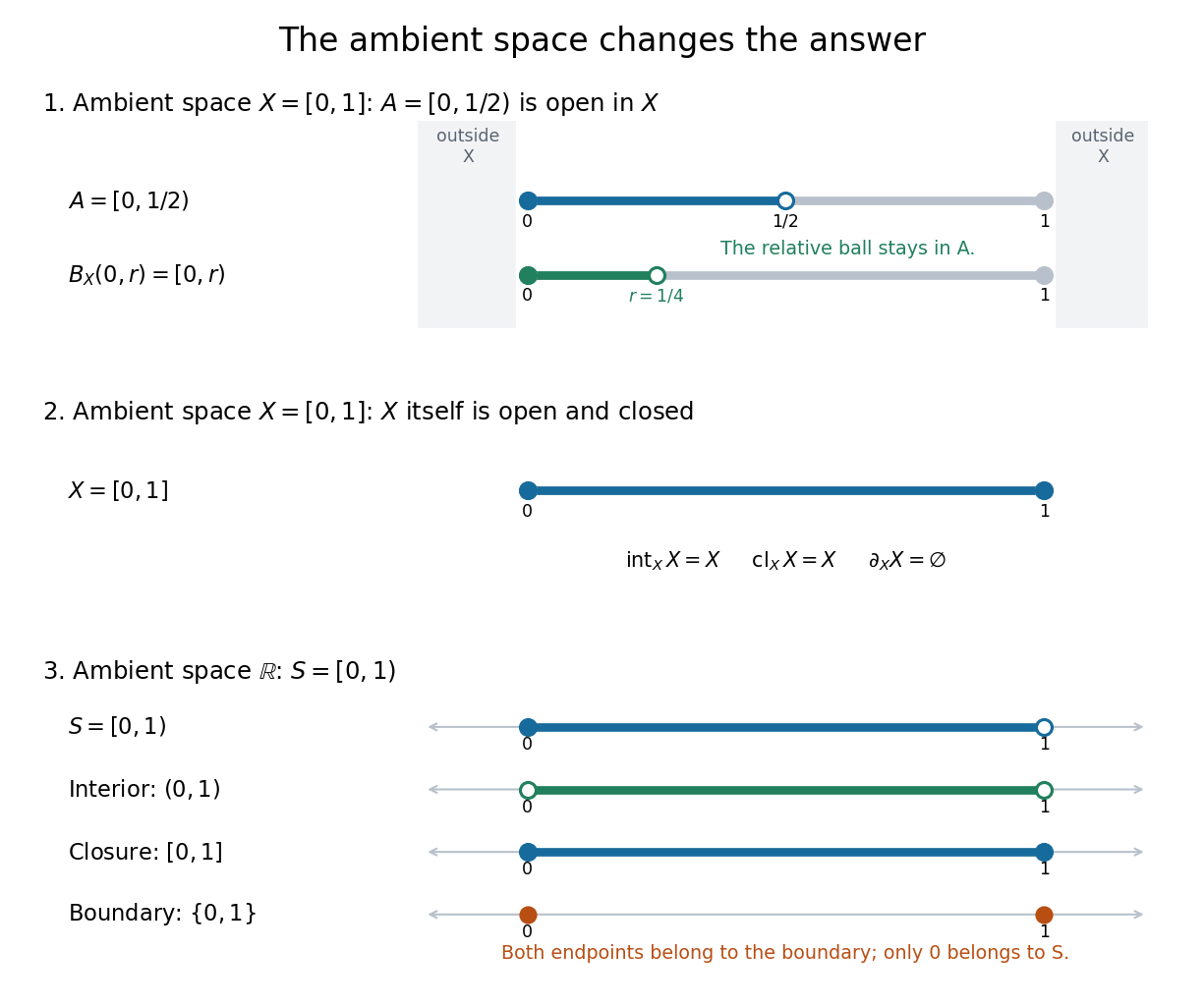

The upper panel visualizes the relative example from open set: for and , an open ball about zero in is when . This open ball stays in ; points outside are not required. The middle panel shows that is clopen in itself, with interior and closure both and empty boundary, although its boundary in the real line is . The lower panel returns to ambient space and separates the interior, closure, and boundary of ; both marked boundary points are included in the boundary itself.
New to topics? Read the docs here!