
A Cauchy sequence is a sequence whose sufficiently late terms are all close to one another. In a metric space , the precise condition isFor real numbers with their usual metric, . The useful feature is that the definition compares computed terms to other computed terms: it does not require an already known limit of a sequence. The one index must control every pair of later indices, not merely successive terms. [ref]
https://www.jirka.org/ra/html/sec_cauchy.html. Lebl, Basic Analysis I, §2.4: Cauchy sequences and the role of all late pairs
.For an explicit example, take for . Its tail of a sequence beginning at lies in , and for every ,Choose with to certify the entire future sequence. For , works because . The limit of a sequence is one, but the pairwise bound establishes the Cauchy sequence property without first needing that answer. By contrast, is not a Cauchy sequence: arbitrarily late even integers and odd integers give values separated by two. [ref]
https://www.ocw.mit.edu/courses/18-100a-real-analysis-fall-2020/mit18_100af20_lec102.pdf. MIT 18.100A, Lecture 10, Definition 1, Negation 3 and Example 4
.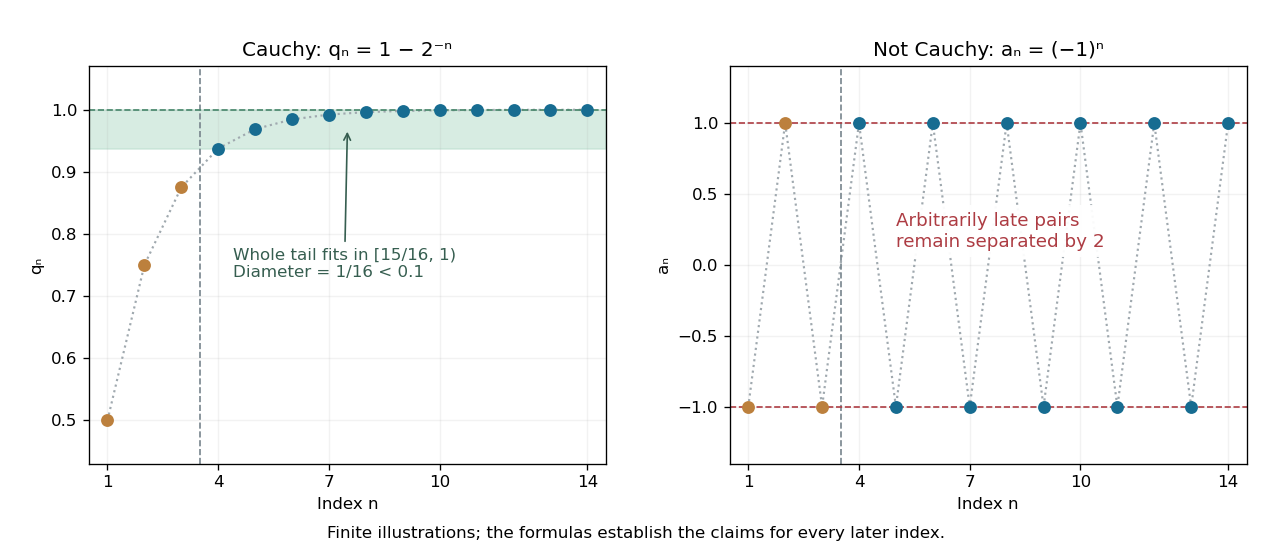
A Cauchy sequence confines every sufficiently late pair to a small band; persistent alternation cannot do so
. The original geometric example has all terms with in , a band narrower than . Only finitely many terms are drawn; the formula certifies the entire tail. The alternating example continues to attain both and arbitrarily late. Details.Tiny successive changes do not provide this guarantee. For the harmonic numbers , the successive difference tends to zero, butThus, beyond every proposed , choosing and defeats the fixed tolerance . Even every fixed positive lag passes the weaker test: . The failing lag grows with , as explained more generally by convergence from arbitrary variable-lag increments. [ref]
https://www.jirka.org/ra/html/sec_cauchy.html. Lebl, Basic Analysis I, §2.4: shrinking fixed-lag increments do not imply the Cauchy condition
.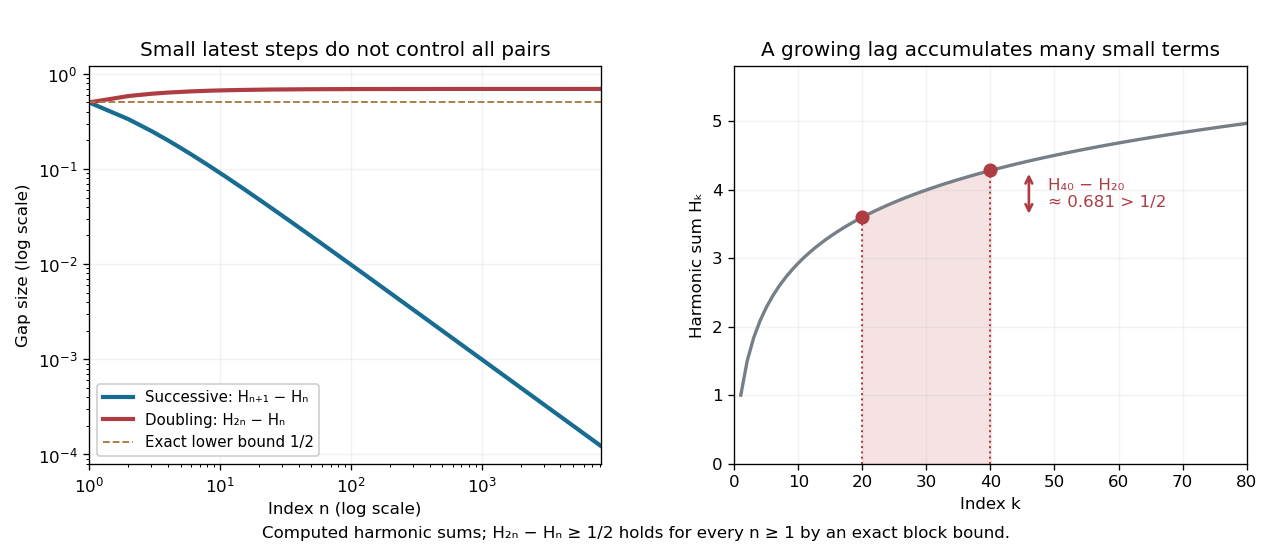
Harmonic numbers take vanishing successive steps while retaining a nonvanishing gap between indices and
. The blue curve is ; the red curve is . The exact lower bound holds for every positive integer , not just the plotted sample. The shaded region between and in the right panel illustrates how many individually small terms produce a substantial gap. Details.Every convergent sequence in a metric space is a Cauchy sequence: apply the triangle inequality to two late terms and their common limit of a sequence. The reverse implication requires completeness. It holds in the real numbers by completeness of the real numbers, but can fail in the rational numbers: the rational endpoints from the bisection method approaching are a Cauchy sequence with no rational limit of a sequence. The existing construction in completeness of the real numbers shows how this happens. A Cauchy sequence is always a bounded sequence; in , boundedness gives a convergent subsequence by the Bolzano-Weierstrass theorem, and the pairwise condition forces the whole sequence to share its limit. [ref]
https://www.ocw.mit.edu/courses/18-100a-real-analysis-fall-2020/mit18_100af20_lec102.pdf. MIT 18.100A, Lecture 10, Theorems 5–7: boundedness, subsequences and real completeness
.


A Cauchy sequence is a sequence of elements in a metric space (or a normed vector space) that exhibits a particular convergence behavior, focusing on the distances between its terms rather than on their actual limits.
New to topics? Read the docs here!