The bisection method finds a zero of a function by repeatedly halving a root bracket. Let be a real-valued continuous function on the closed interval , with . First check for endpoint zeros of a function; otherwise require strictly opposite signs at the endpoints. Evaluate the midpoint and retain the half with strictly opposite endpoint signs, stopping immediately if the midpoint is a zero of a function. The intermediate value theorem ensures that every retained root bracket still contains a zero of a function. This is the construction in MIT's root-finding notes.[ref]
https://ocw.mit.edu/courses/18-330-introduction-to-numerical-analysis-spring-2012/5b325bfa56a599794c7196de926844b0_MIT18_330S12_Chapter4.pdf. Laurent Demanet, MIT 18.330, Chapter 4, §4.1, pp. 1–2, 2012
For a worked square root calculation, use the polynomial on . Write for the root bracket after halvings, with . The candidate evaluated during update is the old midpoint :The initial midpoint is . After four halvings the new midpoint is , and the bisection error bound is . Its actual error is approximately . The last tested candidate and the reported midpoint are different points.
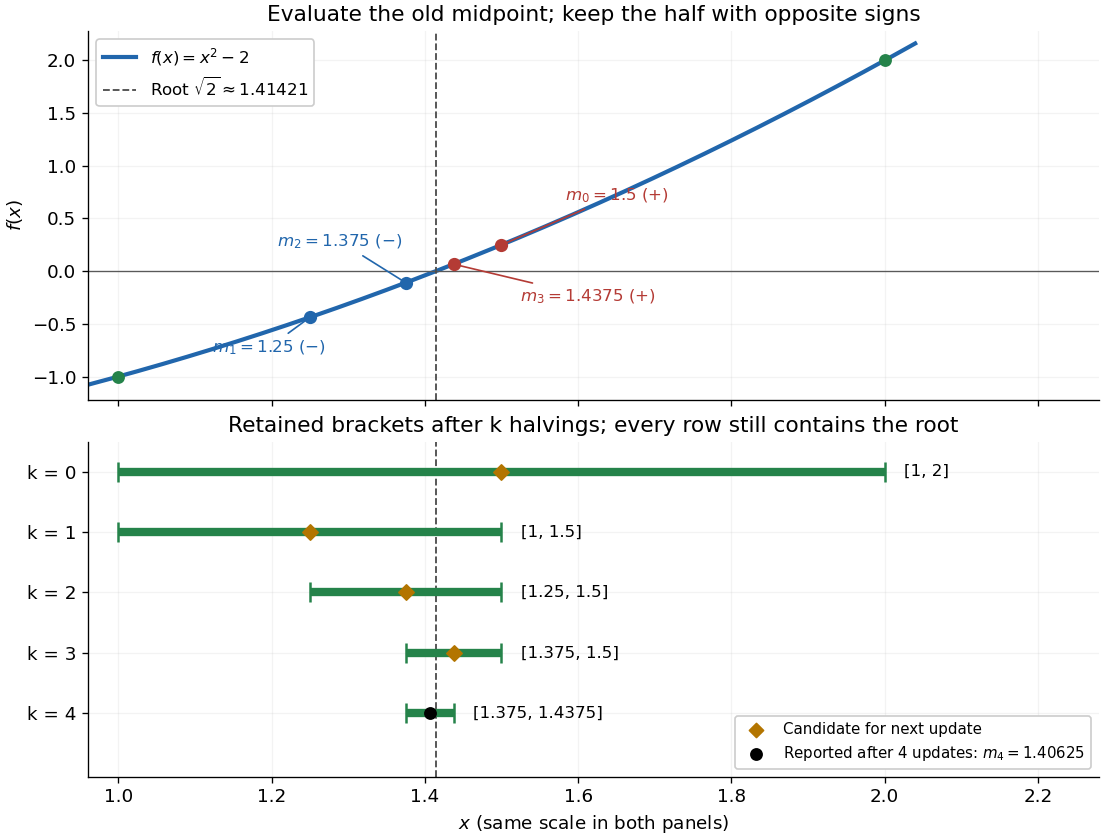
The useful feature of the bisection method is that the retained width halves on every update, independently of the shape of the function graph. The bisection error bound therefore supplies an accuracy guarantee before the zero of a function is known. No derivative is needed, and a valid initial root bracket gives convergence without a close initial guess. This makes the bisection method a dependable fallback for the faster Newton root-finding iteration.
Articles by others on the same topic


The Bisection method is a numerical technique used to find roots of a continuous function. It is particularly useful for functions that are continuous on a closed interval and whose values at the endpoints of the interval have opposite signs. This indicates, by the Intermediate Value Theorem, that there is at least one root within that interval.