
A circular RNA has a covalently closed RNA backbone with no free or end. The closure concerns the chain of phosphodiester bonds, not whether a drawing happens to look round. A linear RNA folded into a stem-loop still has two ends. Circular RNAs can arise through RNA ligation; some cellular examples are generated by back-splicing of transcribed sequences.[ref]
Purification and properties of bacteriophage T4-induced RNA ligase by R. Silber and others. Abstract, intramolecular circularization
[ref]Circular RNAs are abundant, conserved, and associated with ALU repeats by William R. Jeck and others. Abstract and Figures1–4, endogenous backsplice products
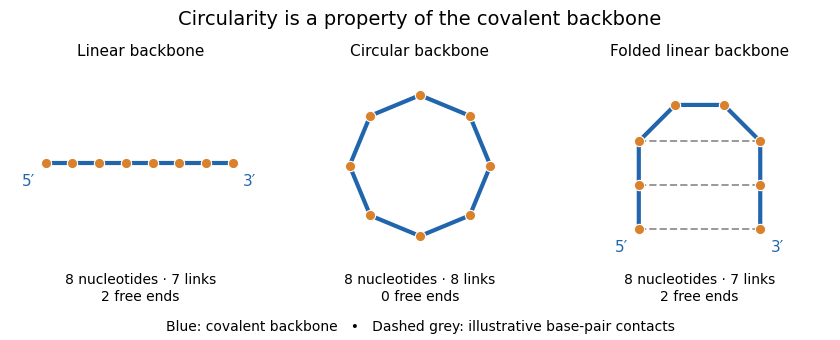
Backbone connectivity distinguishes circular RNA from folded linear RNA
. Original eight-nucleotide schematic, not a molecular structure or folding prediction. Blue lines are covalent backbone links. The circle has eight links and no ends; either linear arrangement has seven links and two ends. Dashed contacts illustrate possible base pairing without joining the ends covalently. No particular sequence or geometric scale is specified. Details.
One internal cut in the circle produces a single linear chain. One internal cut in an already linear chain produces two fragments, assuming no other links hold the pieces together. This connectivity difference explains why enzymes requiring a free end can distinguish the molecules, although circularity does not make an RNA immune to every cleavage process.
A 2013 study combined RNA sequencing with and without treatment by RNase R, an enzyme acting from RNA ends. Enrichment of back-splicing junction reads, together with additional validation, supported a substantial population of endogenous circular molecules.[ref]
Circular RNAs are abundant, conserved, and associated with ALU repeats by William R. Jeck and others. Figures1–4, matched treatment comparison and junction validation
Combining chemical resistance with junction evidence is more informative than classifying a molecule solely by its apparent shape or persistence after one treatment. New to topics? Read the docs here!