A nucleotide contains a nucleobase, a sugar, and one or more phosphate groups. In DNA and RNA, linked nucleotides form a polymer whose nucleotide sequence carries information. The sugar is deoxyribose in DNA and ribose in RNA. See NHGRI: nucleotide.
A nucleoside monophosphate is a nucleotide with one phosphate group attached to a nucleoside. The nucleoside supplies a nucleobase linked to a sugar; the monophosphate specifies the phosphate count. Attachment position and sugar identity still matter. A common example is adenosine monophosphate, with a phosphate ester at the 5′ position of ribose; ChEBI identifies it specifically as adenosine 5′-monophosphate.[ref]
Adenosine 5'-monophosphate in ChEBI. CHEBI:16027, Definition and structure
The corresponding acid structure has molecular formula . Its single phosphorus atom provides a quick count, but the chemical structure is what identifies the 5′ attachment. The neutral acid formula is a stated representation; proton loss changes charge and hydrogen count without adding a second phosphate group.[ref]
Adenosine 5'-monophosphate in ChEBI. Formula, Net Charge and structure
A nucleoside diphosphate instead contains a linked pair of phosphate groups.A useful reaction is the adenylate kinase interconversionwhere the abbreviations denote adenosine triphosphate, adenosine monophosphate and adenosine diphosphate. The phosphate-unit balance is : a phosphate group is transferred rather than created.[ref]
Enzyme Nomenclature by the IUBMB. EC 2.7.4.3, Reaction: ATP + AMP = 2 ADP; iubmb.qmul.ac.uk/enzyme/EC2/7/4/3.html
For an original reaction-extent example, start with of ATP, of AMP and no ADP. A forward extent of leaves ATP, AMP and produces ADP. Both sides of this bookkeeping contain of phosphate units. This is a stoichiometry calculation for a specified extent, not a prediction of chemical equilibrium.
A nucleoside diphosphate is a nucleotide whose nucleoside carries a diphosphate chain: two phosphate groups joined through a phosphoanhydride bond. For the usual 5′ species, the phosphate nearest the sugar is attached at its 5′ position. Adenosine diphosphate is an example, with adenine as its nucleobase and ribose as its sugar. ChEBI records its acid structure as .[ref]
Counting two phosphorus atoms is necessary for this example but does not establish that connectivity. A molecule bearing two separate phosphate esters on different sugar positions would have different connectivity from a single diphosphate chain. The chemical structure, including the bridging oxygen, distinguishes the alternatives.
The adenylate kinase reaction makes the relationship with nucleoside monophosphates and nucleoside triphosphates explicit: one adenosine triphosphate and one adenosine monophosphate interconvert with two adenosine diphosphates.[ref] The number of nucleotide molecules stays two while their phosphate counts change from three plus one to two plus two.
An original comparison also shows why identifying a nucleoside diphosphate is more informative than measuring total phosphorus. A sample containing of pure adenosine diphosphate contains of phosphorus atoms. A different sample containing each of adenosine monophosphate and free phosphate has that same phosphorus total, but different molecules and reaction possibilities. Total phosphorus alone cannot discriminate the samples.
Uridine diphosphate, conventionally abbreviated UDP in chemistry, is a nucleotide consisting of uridine with a linked diphosphate group at the ribose 5′ position. The uridine portion contains uracil and ribose. ChEBI records the neutral acid representation with molecular formula and distinguishes it from its deprotonated forms.[ref]
Uridine diphosphate in ChEBI. CHEBI:17659, structure, Formula, IUPAC Name and conjugate-base relation.
A useful reaction example is glycosyltransferase action. UDP-N-acetylgalactosamine contains an additional sugar-derived portion; transferring that portion to an acceptor can release uridine diphosphate. The free nucleotide product and the complete nucleotide sugar donor are therefore not interchangeable names for one molecule.[ref]
Enzyme Nomenclature by the IUBMB. EC 2.4.1.41, Reactions 1–2: nucleotide-sugar donor and UDP product.
For a simple connectivity check, count the phosphorus atoms in the free product and in the linked donor: both contain two. That count alone cannot reveal whether the transferable sugar is still attached. Distinguishing the chemical structures explains why observing a nucleotide product can inform a transfer reaction, whereas measuring total phosphorus cannot establish the same conclusion.
UDP-N-acetylgalactosamine is a nucleotide sugar combining a uridine diphosphate moiety with N-acetylgalactosamine. It serves as a donor for glycosyltransferases: the sugar-derived residue is incorporated into an acceptor, and uridine diphosphate is released. The nucleotide-linked donor and the free N-acetylgalactosamine molecule are therefore different chemical participants.[ref]
A structural example is chondroitin synthesis. Addition of an N-acetylgalactosamine residue to an appropriate growing chain uses UDP-N-acetylgalactosamine, while formation of the alternating glucuronic acid portion requires a different nucleotide sugar. The donor is not itself the finished polysaccharide.[ref]
Enzyme Nomenclature by the IUBMB. EC 2.4.1.175, Reactions and Comments: chondroitin-chain extension and complementary glucuronosyltransferase activity.
A primary characterization of a chondroitin synthase tested donor specificity as well as product identity. Structurally related nucleotide sugars did not simply replace the required donors in that assay. This illustrates why the shared nucleotide portion does not make every nucleotide sugar interchangeable: the sugar identity and the accepting enzyme both matter.[ref]
Identification and molecular cloning of a chondroitin synthase from Pasteurella multocida type F by P. L. DeAngelis and A. J. Padgett-McCue. Abstract: sugar-donor specificity and chemically tested polymer product.
Adenosine 3′,5′-bisphosphate, often abbreviated PAP, is a nucleotide with separate phosphate groups attached at the 3′ and 5′ positions of the ribose in adenosine. The positions are part of its identity: two phosphate groups on different sugar positions do not make the same structure as the linked phosphate chain of adenosine diphosphate.[ref]
An important reaction example is sulfation using PAPS. In the reaction catalyzed by heparan sulfate glucosamine N-sulfotransferase, PAPS transfers a sulfur-containing group to a glucosamine unit in heparan sulfate, leaving adenosine 3',5'-bisphosphate. The product retains the two phosphate groups but lacks the transferred sulfo group. Counting phosphorus atoms alone would therefore fail to distinguish donor from product.[ref]
Heparan sulfate glucosamine N-sulfotransferase in IUBMB Enzyme Nomenclature. EC 2.8.2.8, Reaction and Glossary.
This is a useful example of why a molecular formula or a count of functional groups is less informative than a chemical structure: attachment positions and connectivity determine which molecule is present.
3'-Phosphoadenylyl sulfate, abbreviated PAPS, is a nucleotide used as an activated donor in sulfation. Its adenosine unit bears phosphate groups at the ribose 3′ and 5′ positions; a sulfo group is attached to the 5′ phosphate. That covalent arrangement distinguishes PAPS from free sulfate dissolved alongside an unrelated nucleotide.[ref]
A concrete example is heparan sulfate glucosamine N-sulfotransferase. The enzyme transfers the sulfur-containing group from PAPS to a glucosamine nitrogen within heparan sulfate, leaving adenosine 3',5'-bisphosphate. Abbreviating that product as PAP, the transfer can be summarized schematically asThis schematic omits proton and charge bookkeeping; the IUBMB reaction specifies the actual polymer-associated acceptor.[ref]
Heparan sulfate glucosamine N-sulfotransferase in IUBMB Enzyme Nomenclature. EC 2.8.2.8, Reaction and Glossary.
The example separates donor availability from product specificity. PAPS supplies a transferable group, while the enzyme determines which acceptor and attachment site participate. Supplying sulfate is therefore not, by itself, a specification of which position in a glycosaminoglycan becomes modified.
Deoxyadenosine triphosphate, usually abbreviated dATP, is a nucleotide containing adenine, a deoxyribose sugar and three phosphate groups. The “deoxy” distinguishes its sugar from the ribose in adenosine triphosphate. The usual molecular formula for the neutral acid is ; its ionization state in solution depends on conditions.[ref]
Deoxyadenosine triphosphate in PubChem. CID 15993, identity and molecular formula
A DNA polymerase uses dATP as the substrate for adding an adenine-containing unit to a growing DNA strand opposite a template thymine. The strand's terminal hydroxyl attacks the incoming nucleotide's alpha phosphate; the other two phosphates leave as pyrophosphate. The incorporated unit is therefore a monophosphate residue within the chain, not a triphosphate hanging from the completed backbone. This distinction connects nucleotide chemistry with the directional growth of DNA.[ref]
https://www.ncbi.nlm.nih.gov/books/NBK26850/. Molecular Biology of the Cell, DNA Replication Mechanisms, incoming deoxyribonucleoside triphosphates and the growing 3-prime end
A polymerase assay can supply the template, primer, enzyme and nucleotide substrates, then compare product lengths with and without dATP. A failure to extend past a template position requiring adenine tests substrate dependence; it does not by itself determine every enzymatic step.
Replacement of a bound nucleotide by another. A changed exchange rate can alter a protein state without proving direct competition at the nucleotide-binding site.
A nucleotide sugar carries an activated sugar linked to a nucleotide-containing group. It supports selective glycosyl transfer; donor identity alone does not specify the linkage or final glycan structure.
UDP-glucuronic acid is an activated donor containing a glucuronic acid residue linked to UDP. Transfer requires an appropriate glycosyltransferase and acceptor; access to the correct compartment can be limiting.
CMP-sialic acid is an activated donor containing a sialic acid residue linked to CMP. Transfer requires an appropriate glycosyltransferase and acceptor; access to the correct compartment can be limiting.
ADP-glucose is an activated donor containing a glucose residue linked to ADP. Transfer requires an appropriate glycosyltransferase and acceptor; access to the correct compartment can be limiting.
GDP-fucose is an activated donor containing a fucose residue linked to GDP. Transfer requires an appropriate glycosyltransferase and acceptor; access to the correct compartment can be limiting.
GDP-mannose is an activated donor containing a mannose residue linked to GDP. Transfer requires an appropriate glycosyltransferase and acceptor; access to the correct compartment can be limiting.
UDP-N-acetylglucosamine is an activated donor containing a N-acetylglucosamine residue linked to UDP. Transfer requires an appropriate glycosyltransferase and acceptor; access to the correct compartment can be limiting.
UDP-galactose is an activated donor containing a galactose residue linked to UDP. Transfer requires an appropriate glycosyltransferase and acceptor; access to the correct compartment can be limiting.
UDP-glucose is an activated donor containing a glucose residue linked to UDP. Transfer requires an appropriate glycosyltransferase and acceptor; access to the correct compartment can be limiting.
Collective notation for guanosine tetraphosphate and pentaphosphate alarmones involved in the bacterial stringent response.
A nucleoside carrying three phosphate groups. The relevant ribonucleoside triphosphates supply substrates for RNA polymerase.
An RNA-type nucleotide containing ribose. Chemical modification can affect its contacts, pairing or recognition without changing its place in the transcript.
guanosine diphosphate, abbreviated GDP, is the diphosphate form of a guanine nucleotide. Exchange between GDP and GTP, rather than receptor-catalyzed phosphorylation of GDP, controls the usual G protein switch.
ATP is a nucleotide consisting of adenosine, itself adenine joined to ribose, carrying three phosphate groups. From the ribose outward, these groups are labelled , , and . ATP connects energy-supplying processes to energy coupling for synthesis and active transport; the same carrier can be regenerated and reused. [ref]
https://openstax.org/books/biology-2e/pages/6-4-atp-adenosine-triphosphate. OpenStax Biology 2e, 6.4: ATP composition and recycling
.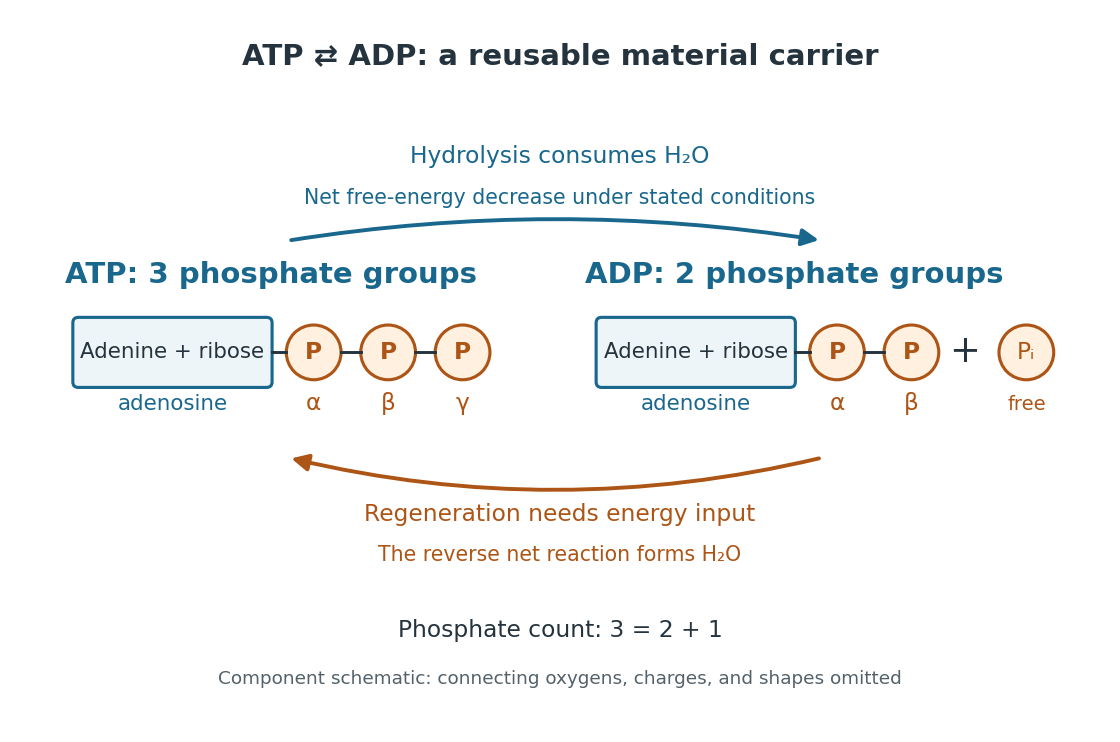
The net hydrolysis commonly used in energy coupling isHere denotes inorganic phosphate. At buffered pH , this biochemical shorthand groups the appropriate protonation states into pools and leaves proton exchange with the buffer solution implicit. An explicit, charge-balanced choice is , without implying these are the only chemical species present. See the IUBMB recommendations for biochemical thermodynamics.
The quoted textbook biochemical standard state value is approximatelyThis convention uses fixed pH , temperature (), reference pressure (), unit reference thermodynamic activities for dissolved reactants and reaction products, and water thermodynamic activity approximated by one. The prime indicates the fixed-pH biochemical convention. See OpenStax Biology 2e, 6.4: standard ATP hydrolysis value and Biology 2e, 6.2: biochemical standard conditions. This is a reference value, rather than a universal value inside a biological cell; precise tables must also specify chemical solution conditions and any magnesium ion binding convention. Different reference conventions and data treatments give different tabulated values, as discussed in Li et al., 2010: a database of thermodynamic quantities for biochemical reactions.
An exergonic reaction has a negative change in Gibbs free energy, so the overall ATP hydrolysis is favourable under those reference conditions. Breaking a chemical bond by itself costs energy; forming new chemical bonds can release energy. The net change compares all reactants with all reaction products, including their interactions with water and the entropy contribution. Calling the phosphate connection a "high-energy bond" describes a large favourable change in Gibbs free energy on hydrolysis, rather than energy released by bond breaking alone. See 7.5 Strengths of Ionic and Covalent Bonds and Cooper, The Cell: ATP and metabolic energy.
Composition changes the driving force. At the same fixed pH, temperature, pressure, and binding convention, write the molar reaction change asHere is the molar gas constant, the absolute temperature, and a dimensionless thermodynamic activity for a biochemical pool. Constant water thermodynamic activity is absorbed into the reference term; fixed pH accounts for buffered protons. The shorthand means transformed molar reaction Gibbs free energy change, , rather than a finite sample's total change. The natural logarithm acts on a dimensionless reaction quotient, never on concentrations with units. See the IUBMB biochemical thermodynamics recommendations and the general equilibrium constant relation.
For a stipulated ideal dilute chemical solution, let , with . Choose , , and , ignoring activity coefficient corrections and magnesium binding. These are illustrative inputs, not a claim about a particular biological cell. ThenandIncreasing tenfold raises by at this temperature. Thus the ATP to ADP ratio and available inorganic phosphate matter, even with the same standard state value. These are local molar predictions at the stipulated composition, rather than a constant total yield as an isolated sample reacts.
ADP contains the same adenosine unit as ATP, with two phosphate groups instead of three. One ATP converted by the stated hydrolysis gives one ADP and one inorganic phosphate: accounts for the phosphate groups while adenine and ribose are retained. ADP is therefore a reusable material carrier, rather than ATP with its entire structure discarded.
Regeneration reverses the net chemical reaction:At the same stipulated reference conditions its is , the negative of the hydrolysis value. It is an endergonic reaction and requires energy input through energy coupling; a catalyst alone cannot supply that input. Recycling the material carrier does not recycle the expended driving energy. Cellular respiration and light-dependent reactions supply routes for regeneration. See Cooper, The Cell: ATP generation and energy coupling.
ADP is a nucleotide with two phosphate groups. Formation of ATP from ADP and phosphate couples to energy supply in light-dependent reactions; the Calvin cycle returns ADP after using ATP. [ref]
https://openstax.org/books/biology-2e/pages/8-3-using-light-energy-to-make-organic-molecules. OpenStax Biology 2e, 8.3: recycling ATP and ADP
.AMP is adenosine carrying one phosphate group at the ribose's position. The count distinguishes AMP from ADP with two and ATP with three; adenosine itself has none. See Cooper, The Cell: ATP, ADP, and AMP.
An adenylyl group is the adenosine monophosphate-derived portion transferred in an adenylyl-transfer reaction. It includes the adenosine unit and one phosphorus-containing group; it is not simply adenine detached from its ribose. The IUBMB recommends adenylyl, rather than adenyl, for nucleotide groups.[ref]
Enzyme Nomenclature by the IUBMB. Rules and Guidelines, nucleotide-group naming recommendation: adenylyl rather than adenyl.
A concrete example is FAD synthase, whose systematic name is ATP:FMN adenylyltransferase. It transfers an ATP-derived adenylyl portion to flavin mononucleotide, forming flavin adenine dinucleotide and releasing diphosphate:The reaction identifies which part of ATP is incorporated, rather than merely recording ATP consumption.[ref]
An original bookkeeping example makes the distinction visible. Complete conversion of 10 nmol of flavin mononucleotide using 20 nmol of ATP, with no side reactions, gives 10 nmol each of flavin adenine dinucleotide and diphosphate, leaving 10 nmol of ATP. The initial phosphorus inventory is nmol of phosphorus atoms; the final inventory is . Conservation checks the accounting but cannot, by itself, identify the products.
Guanosine triphosphate is a nucleotide consisting of guanine, ribose, and three phosphate groups, abbreviated GTP. It is a precursor for RNA synthesis and an energy-coupling substrate in processes such as translation.
GTP-binding proteins also use the difference between GTP- and GDP-bound states as part of molecular switching. Hydrolysis changes the bound nucleotide state; regulatory proteins determine when that switch is activated and reset.
Articles by others on the same topic

A nucleotide is the basic building block of nucleic acids, which are essential molecules in living organisms. Nucleotides serve as the monomers that link together to form DNA (deoxyribonucleic acid) and RNA (ribonucleic acid).

