Clipped waveform area
ID: clipped-waveform-area

A clipped waveform area is the integral of an amplitude-limited trace over the specified interval. It can differ from the unclipped area by a different proportion than the change in peak height. The amplifier clipping article gives the instantaneous limiter model and a rectangular-pulse example; real saturated integrators can also have recovery dynamics.[ref]
ACF2101 Low Noise, Dual Switched Integrator datasheet. p10, Output Overload
An original triangular example takes with . Its true area is . Clip its top at , with the zero baseline unchanged. The missing region is a triangle of height and base , soFor , and , the area falls from to . The peak is halved but the area loses only . The clipping loss for a triangular pulse therefore cannot be inferred merely by applying the peak-loss percentage to its integral.
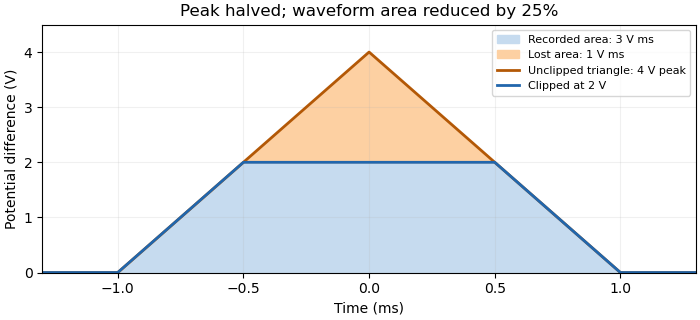

Record input and output together while changing gain or attenuation to test whether the trace is clipped. Recovering area by fitting an assumed triangle is a model-based correction, not recovery of an arbitrary waveform from its plateau. Baseline errors, limited bandwidth and overload recovery require their own measurement models.
New to topics? Read the docs here!