A clipped waveform area is the integral of an amplitude-limited trace over the specified interval. It can differ from the unclipped area by a different proportion than the change in peak height. The amplifier clipping article gives the instantaneous limiter model and a rectangular-pulse example; real saturated integrators can also have recovery dynamics.[ref]
ACF2101 Low Noise, Dual Switched Integrator datasheet. p10, Output Overload
An original triangular example takes with . Its true area is . Clip its top at , with the zero baseline unchanged. The missing region is a triangle of height and base , soFor , and , the area falls from to . The peak is halved but the area loses only . The clipping loss for a triangular pulse therefore cannot be inferred merely by applying the peak-loss percentage to its integral.
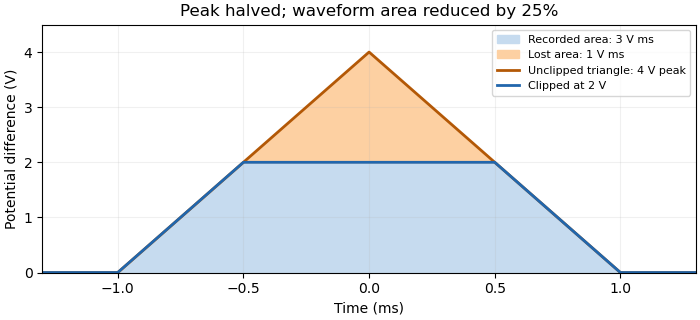

Record input and output together while changing gain or attenuation to test whether the trace is clipped. Recovering area by fitting an assumed triangle is a model-based correction, not recovery of an arbitrary waveform from its plateau. Baseline errors, limited bandwidth and overload recovery require their own measurement models.
The clipping loss for a triangular pulse is the area removed when a triangular waveform exceeds an amplitude limit. In the ideal model of clipped waveform area, and the upper limit is . The original area is ; the missing top triangle has areaThe geometry is derived in clipped waveform area, with its original diagram. Here is the half-width of the full support, not the width of the clipped plateau.
A useful inverse problem asks how much peak truncation an area-error tolerance permits. If the allowable fractional loss is , the ideal triangle requiresFor an original , pulse, a area-loss allowance requires . At equality, the peak is reduced by but the area changes from to . The plateau duration is only . This is a shape-dependent calculation, not a universal relationship between peak error and integral error.
An attenuated simultaneous trace can test whether the input is approximately triangular and whether its duration stays fixed as amplitude changes. Baseline and bandwidth must be comparable before an area ratio is meaningful. A real saturated integrating amplifier can have additional overload recovery, which the instantaneous clipping model omits.[ref]
ACF2101 Low Noise, Dual Switched Integrator datasheet. p10, Output Overload
The formula supplies a conditional error estimate; it cannot identify an arbitrary missing waveform from its plateau. Articles by others on the same topic
There are currently no matching articles.