Coherent harmonic pulse-train model
ID: coherent-harmonic-pulse-train-model

Choose equal-amplitude, monochromatic odd components with orders , , and odd . Fix the complex-field conventionHere is a normalized light intensity after averaging the fast carrier oscillations. Setting every and summing a geometric series givesAt the removable singularities take the continuous limit. Maxima repeat every ; the first zeros on either side of a maximum lie at . The zero-to-zero width is , which is not the full width at half maximum.
Choose orders and driving wavelength . Using with the speed of light gives and burst spacing . Solving the exact half-maximum equation gives a full width at half maximum of approximately attoseconds. These are values of the specified five-component model, not measurements from the 2001 experiment.
A deliberately chosen spectral phase translates the whole attosecond pulse train by without changing its shape. Adding makes neighboring phase increments unequal: the same component intensities then produce a different temporal profile. For the choice and radians per squared harmonic order, the adjacent-component delay estimates arenamely , , and for . This finite difference estimates the group delay at the pair's midpoint. It is not a single common arrival time.
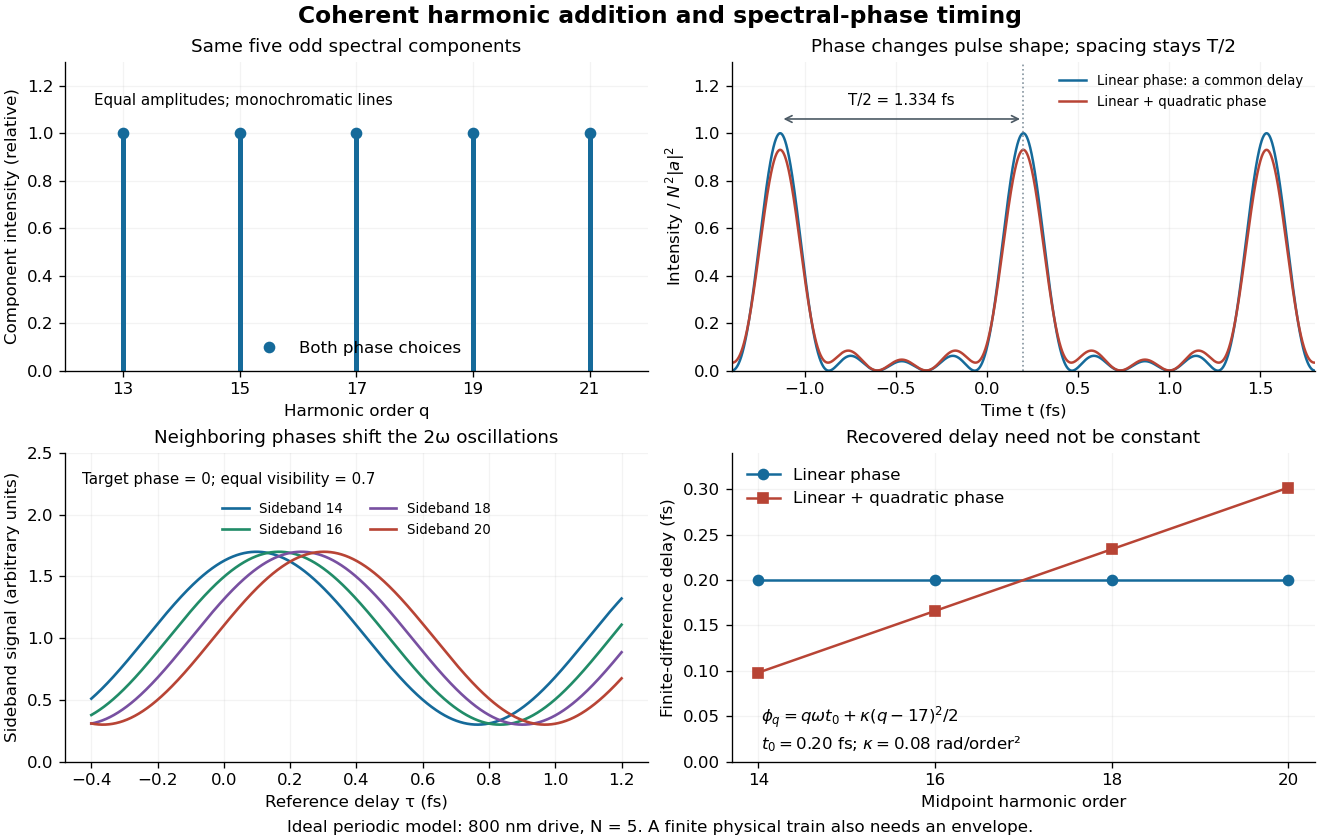

The infinite monochromatic sum is periodic forever and has infinite total energy. A real attosecond pulse train has a finite envelope and finite component linewidths. This calculation isolates coherent addition; it cannot describe an isolated burst or establish its contrast against satellites. As a further check, averaging over one half-period gives for any constant component spectral phases, because the cross terms integrate to zero by Fourier orthogonality. Spectral phase redistributes the light intensity in time while leaving that average fixed.
New to topics? Read the docs here!