Collective-curvature resonance model
ID: collective-curvature-resonance-model

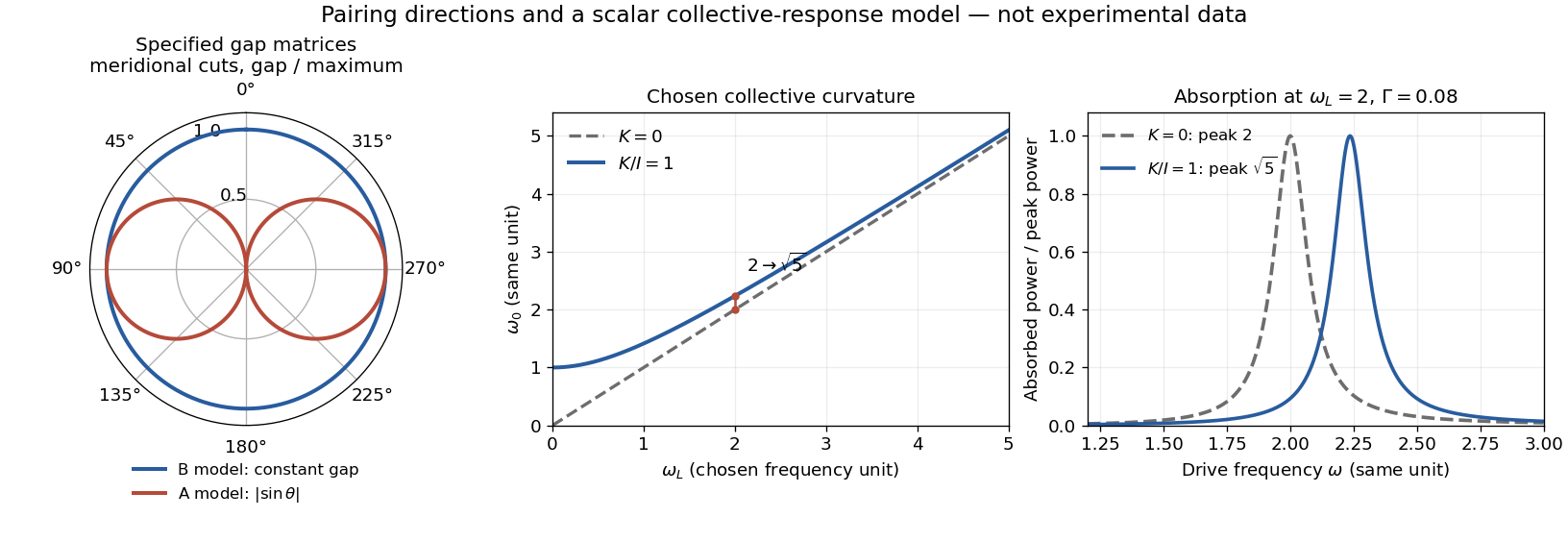
Consider an original scalar response model for a small collective angle . Stipulate effective inertia , restoring curvature , damping rate , and a drive torque :The undamped resonance scale is , where . This illustrates the role of an additional collective restoring energy. It is not the full coupled spin dynamics of either helium phase, and its parameters are not fitted to historical observations.
The steady response and mean absorbed power follow directly:With constant damping, differentiating this last expression places its positive-frequency maximum exactly at . Setting chosen and moves the peak from to , about . At the same curvature moves it only to , about . At large , the shift is to leading order. A smaller shift at larger field therefore need not mean that the restoring curvature vanished.

New to topics? Read the docs here!