
The complement of a subset within a specified universal set contains exactly the set elements of excluded from :Here depends on the chosen universal set. Within , taking a complement performs logical negation (NOT) on membership. Writing keeps the ambient set visible when there could be ambiguity.
For , , and :If the universal set grows to , the same sets have different complements: and . In a database illustration, “records that fail this condition” therefore requires deciding which records are eligible to begin with; those eligible records form .
For subsets , De Morgan's laws exchange union and intersection when taking complements:For the same example, failing both conditions leaves . Failing at least one condition leaves . This is useful for rewriting exclusion rules into separate membership tests. The symmetry is also pleasing: exchanging union with intersection turns one rule into its partner.
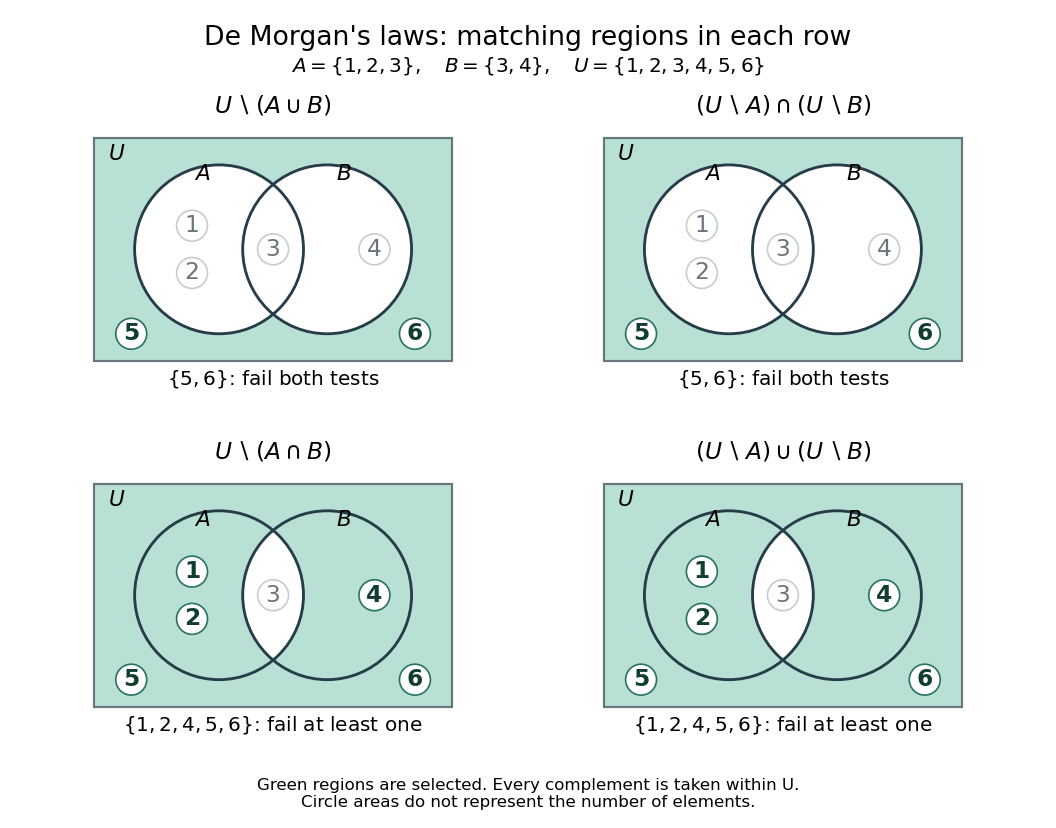
De Morgan's laws: excluding a union means failing both tests, while excluding an intersection means failing at least one
. Details. 
A brief membership proof works in classical propositional logic. For any , let mean and mean . The truth table below checks all four possibilities, with meaning true and false:Each paired column agrees. Translating logical disjunction (OR), logical conjunction (AND), and logical negation (NOT) back into membership proves the two set equalities. For the general method of reducing set equalities to equivalences in propositional logic, see Lehman, Leighton and Meyer, Mathematics for Computer Science (2015), §4.1.5 and Problem 4.5.
A historical perspective appears in Augustus De Morgan's [ref]
https://en.wikisource.org/wiki/Page:Formal_Logic_(1847,_De_Morgan).djvu/8. Formal Logic (1847), preface
: he describes treating each name together with its contradictory name. In the membership viewpoint here, a set and its complement likewise pair a condition with its logical negation. New to topics? Read the docs here!