Complex conjugate roots in Vieta's formulas
ID: complex-conjugate-roots-in-vieta-s-formulas

For the quadratic polynomial , the discriminant is , so its roots of a polynomial are the complex conjugatesTheir sum is , and their product is , matching the constant coefficient divided by the leading coefficient. More revealingly, : the product is the square of a complex modulus. Coefficients in the real numbers therefore need not imply polynomial roots in the real numbers.
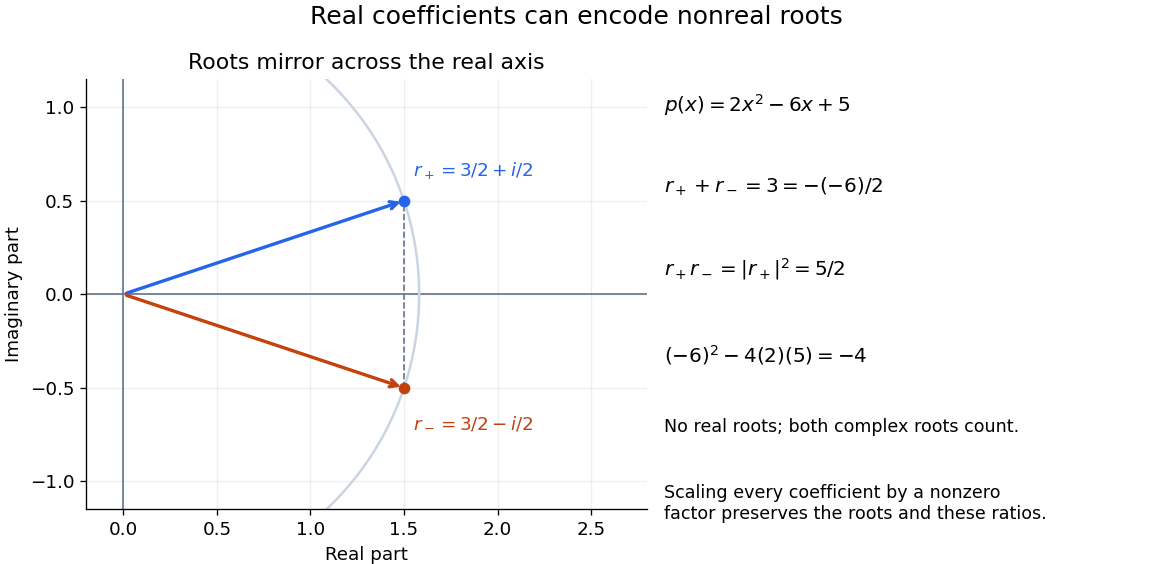

For any polynomial with coefficients in the real numbers, . Thus a nonreal root of a polynomial brings its complex conjugate along with the same multiplicity of a root. This follows by applying complex conjugation to the polynomial expression and its factors. It explains why sums of complex conjugate terms can produce coefficients in the real numbers.
New to topics? Read the docs here!