
Two integers are coprime when their greatest common divisor is one:For positive integers, this says that the only positive common divisor is one. For signed integers, use , with absolute values; changing either sign leaves coprimality unchanged. With the convention , zero is coprime precisely to , because . Both are coprime to every integer. [ref]
https://darijgrinberg.gitlab.io/floor.pdf. Darij Grinberg, MIT 18.781, Section 1.2: greatest common divisors and coprimality
The word concerns shared prime factors, not whether either input is a prime number. For instance and are coprime composite numbers, even though neither is a square-free integer. Conversely, and are square-free integers but are not coprime. Consecutive integers are always coprime: any common divisor of divides their difference one. Thus provide another pair of coprime composite numbers.
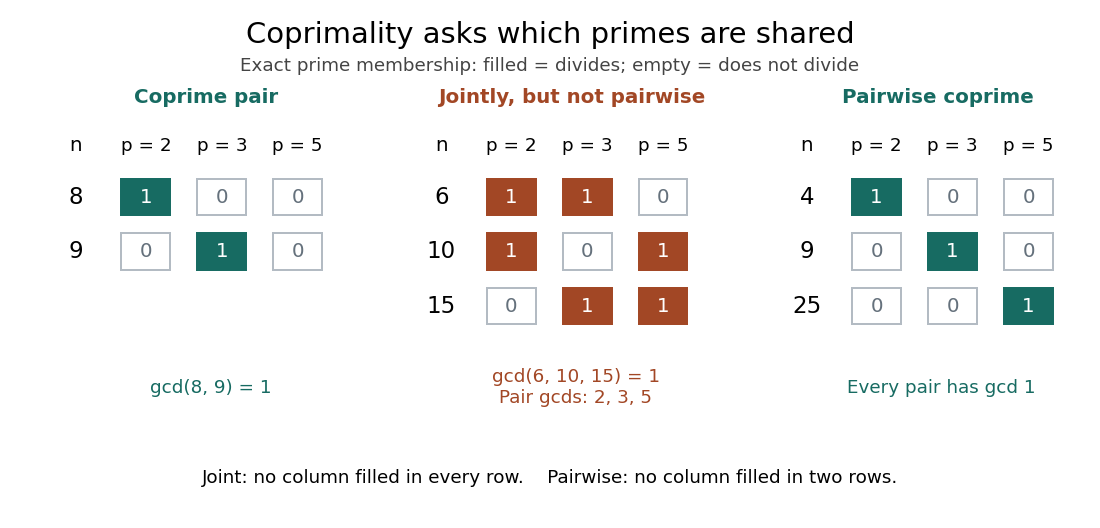
For positive integers, let be the prime support of an integer. The equivalent test isThe set intersection of the two prime supports of an integer must be the empty set. Indeed, any positive common divisor greater than one has a prime factor, and any shared prime factor is a common divisor greater than one. Hence coprimality depends on which prime factors occur, rather than on their prime valuations; replacing either input by its radical of an integer preserves coprimality.
For a list of at least two integers, distinguish pairwise coprimality, requiring every pair to be coprime, from joint coprimality, requiring only the greatest common divisor of the entire list to be one. For example,No prime factor belongs to all three prime supports of an integer, yet each pair shares one. By contrast, have pairwise coprimality. The distinction is presented by Poritz under the names pairwise and mutually relatively prime. [ref]
https://math.libretexts.org/Bookshelves/Combinatorics_and_Discrete_Mathematics/Yet_Another_Introductory_Number_Theory_Textbook_-_Cryptology_Emphasis_(Poritz)/01:_Well-Ordering_and_Division/1.05:_The_Greatest_Common_Divisor. Jonathan A. Poritz, Yet Another Introductory Number Theory Textbook, Section 1.5
One use is simplifying fractions. For a fraction with integer entries and , divide its numerator and denominator by to obtain a reduced fraction with coprime entries. For example, since , and uses the same . A further common divisor would make too small, so the reduction is complete. In particular, the reduced fraction for zero is .
Another use is reversible modular arithmetic: for an integer modulus , an integer has a modular inverse precisely when are coprime. The proof outline uses Bézout's identity: makes a modular inverse, and any inverse relation forces every common divisor to divide one. For example, gives , whereas has no modular inverse modulo . Thus coprimality is the exact condition allowing division by a residue in modular arithmetic. [ref]
https://ocw.mit.edu/courses/18-200-principles-of-discrete-applied-mathematics-spring-2024/mit18_200_s24_lec15.pdf. Ankur Moitra, MIT 18.200, Lecture 15, Lemmas 1–2 and modular inverses


New to topics? Read the docs here!