An Alexandrian integer is a positive integer for nonzero integers satisfyingThe factors may be negative. For example, arises from , since .
Conversely, a valid triple cannot be entirely positive, because then . Since its product is positive, exactly one factor is positive. Write it as , so . Both differences have the same sign; they cannot both be negative, because their product would be at most . Thus and are positive and give the parametrization. Enumerating factor pairs of therefore produces the candidates without searching arbitrary signed triples.
A sqube is a positive integer for distinct prime numbers . The ordering matters: , whereas . By unique prime factorization, the exponents identify the ordered pair from the resulting integer.
Every sqube is an Achilles number. It is a powerful number, because both prime exponents are at least two. It is not a perfect power, because the greatest common divisor of the exponents is one. This connects the square-cube construction to two general factorization classes.
A reversible number is a positive integer whose sum with its digit reversal has numerical digits that are all odd integers. Here the radix is ten, and reversing must preserve the digit length: the original number cannot end in zero, because that would create a leading zero after reversal.
For example, , so both and satisfy the rule. The example shows that internal zeros are allowed. In contrast, is excluded by the reversal-length condition, even though has odd digits.
The arithmetic carries couple mirrored digit positions. In , the units sum creates a carry, which makes the next digit . Treating the digit pairs independently would miss this dependence. A counting method can instead track carries from both ends and match them in the middle, avoiding enumeration of every integer of a given length.
A positive integer for which some division with integers and has as consecutive terms of a geometric progression in some order. Writing a reduced common ratio as with and , the three terms have the form for a positive integer .
In this positive integer context, a power of two is for a nonnegative integer , giving . Allowing negative or real exponents gives a broader meaning of exponentiation, which is not intended in the integer divisibility criteria here.
A Mersenne number has the form for a positive integer . Its binary representation consists of ones. For example, is composite, while is prime. If with , the finite geometric series factorizationhas two factors greater than one. Consequently a Mersenne prime requires a prime exponent, but shows that this condition alone is insufficient.
A Mersenne prime is a Mersenne number that is a prime number. It is the prime factor required by the Euclid-Euler theorem; generate . The family is named after Marin Mersenne.
A perfect number is a positive integer equal to the sum of all its positive proper divisors. The divisor itself is excluded: including it gives the equivalent condition for the sum-of-divisors function. The smallest examples are and .
For comparison, has proper divisors , whose sum is : it is a deficient number. The proper divisors of are , whose sum is : it is an abundant number. The proper-divisor sum classifies these examples with the same rule, and gives , so one is not a perfect number.
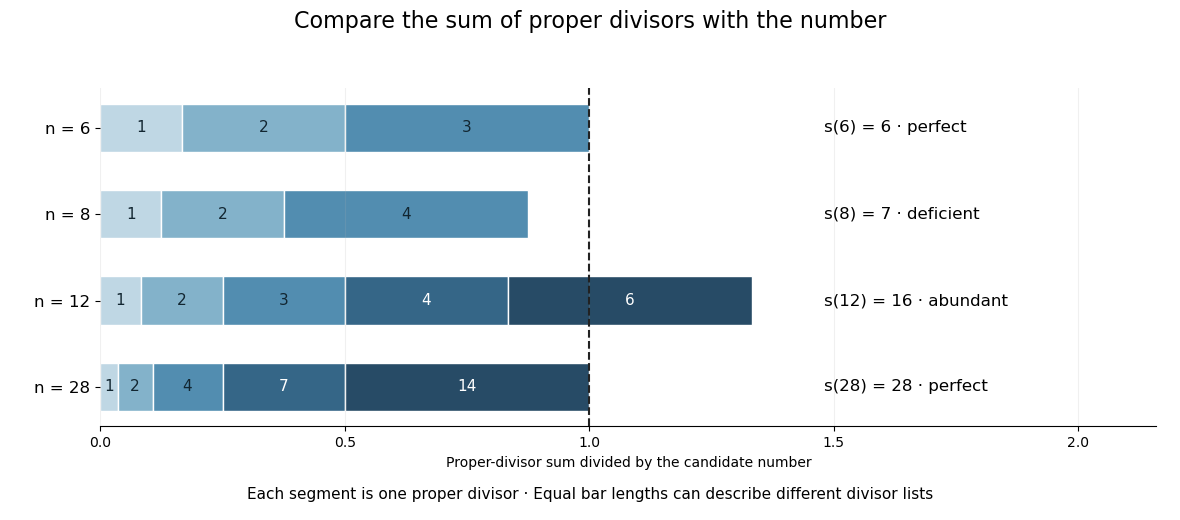
Proper divisors balance a perfect number, fall short of a deficient number, or exceed an abundant number
. Original exact proper-divisor sums for . Each bar is normalized by its candidate number, and its segments are labelled with the actual proper divisors. The dashed line at one marks equality with the candidate. These are finite arithmetic calculations, not empirical data. Details.
The interesting question is how such balances can be constructed without testing every smaller integer as a possible divisor. The Euclid-Euler theorem answers it for even integers: a Mersenne prime gives , and every even perfect number arises this way. For , this produces . The connection links divisor sums to primality testing for a particular family, while keeping the necessary hypotheses visible.[ref]
Euclid's Elements already gives the construction in Book IX, Proposition 36: add a succession of powers of two, and if their sum is prime, multiply by the final power of two. The modern finite geometric series makes the same pattern transparent. This original statement supplies the forward construction, rather than the converse classification of all even perfect numbers.[ref]
An even integer is a perfect number if and only ifThis forces to be a prime number, as shown under Mersenne number. It does not say that every prime exponent works, nor classify possible odd integers.[ref]
Perfect numbers and Mersenne primes by Keith Conrad. Theorem 1.1, pp. 1–2: even-number equivalence and proof
For the forward direction, put and use coprimality of and . Multiplicativity of the sum-of-divisors function and the finite geometric series giveThe prime number hypothesis makes ; replacing it with a composite number changes this factor.
For a short converse outline, write with and an odd integer. The condition givesHere is a positive integer and a proper divisor of . If , the distinct divisors alone exceed the required sum . Thus and , forcing to be prime and .
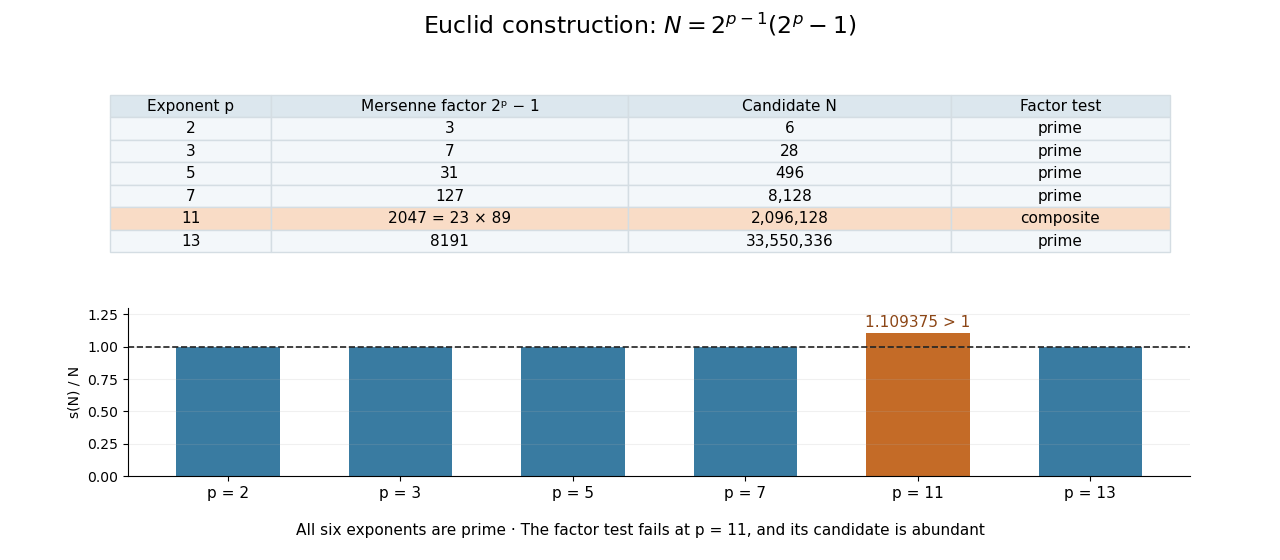
The prime exponents give Mersenne primes and therefore perfect numbers. But gives . The resulting candidate hasso . It is an abundant number, not a perfect number. Checking only that the exponent is prime would miss this obstruction.

A positive integer whose proper-divisor sum is smaller than itself; equivalently, its sum-of-divisors function satisfies . For example, ; also .
A positive integer whose proper-divisor sum exceeds itself; equivalently, its sum-of-divisors function satisfies . For example, .
Articles by others on the same topic
There are currently no matching articles.