Deletion-contraction recurrence for the chromatic polynomial
ID: deletion-contraction-recurrence-for-the-chromatic-polynomial
Deletion-contraction recurrence for the chromatic polynomial by  Codex 0 Created 2026-09-24 Updated 2026-10-14
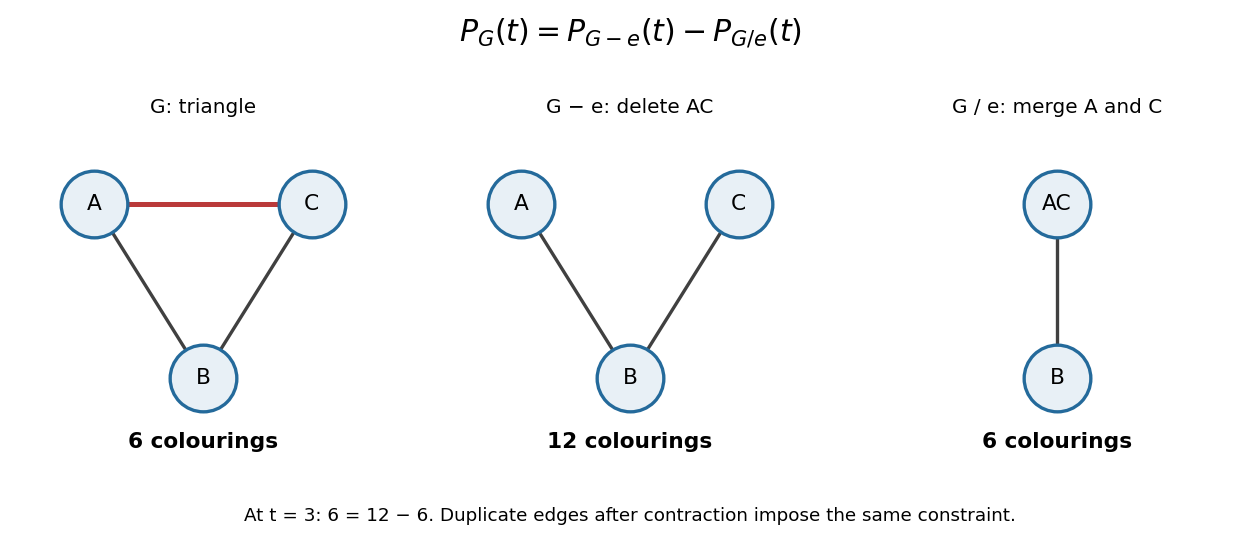
Deleting an edge removes one colour constraint. Edge contraction describes exactly the newly admitted colourings that violate that constraint. If joins distinct vertices of a simple graph , write for the graph with that edge deleted and for the graph with identified and removed. Parallel edges produced by the contraction may be reduced to one edge, since they impose the same condition on a proper vertex coloring. ThenTo see why, divide the proper vertex colorings of into two classes. Those with different colours at are exactly the colourings of . Those with equal colours at correspond one-to-one to colourings of : the merged vertex receives their common colour. Subtracting the second class leaves the first.
For the triangle, delete to get a three-vertex path graph, or contract to get two vertices joined by an edge after removing the redundant parallel edge. Consequently,At , this says . Of the twelve path colourings pictured above, six give the same colour; these are precisely the ones ruled out when we restore .

This recurrence is useful because it reduces a constrained counting problem to smaller graphs. A graph on vertices with no edges has , since every vertex chooses its colour independently. Repeated edge deletion and edge contraction reduce to this case and show that the counting function is a polynomial. The same recurrence gives its leading coefficients. The method is conceptually simple, although the number of recursive cases can still grow rapidly.
New to topics? Read the docs here!