Effective displayed-library coverage
ID: effective-displayed-library-coverage

Effective displayed-library coverage describes which molecular sequence variants actually occur as usable displayed molecules, rather than merely being allowed by a library design or present in its input material. In mRNA display, successful translation, fusion formation and recovery connect input sequences to usable genotype-phenotype linkages. Duplicates of one sequence do not replace missing sequences.
An original occupancy model has equally likely sequence variants, independent input molecules and usable-display probability for each input. A particular variant is usable with probability per input. Thereforewhere is the number of distinct represented variants. The expected usable molecule count is , which is generally larger than the expected distinct count.
For , and stipulated , the expected usable count is 3000 but the expected distinct count is only about 950.2. An average 95% represented fraction does not imply 95% probability that every variant is represented. By the union bound,A sufficient condition for that probability to be at most is . With in this example, this requires at least 990,349 input molecules under the stated model.
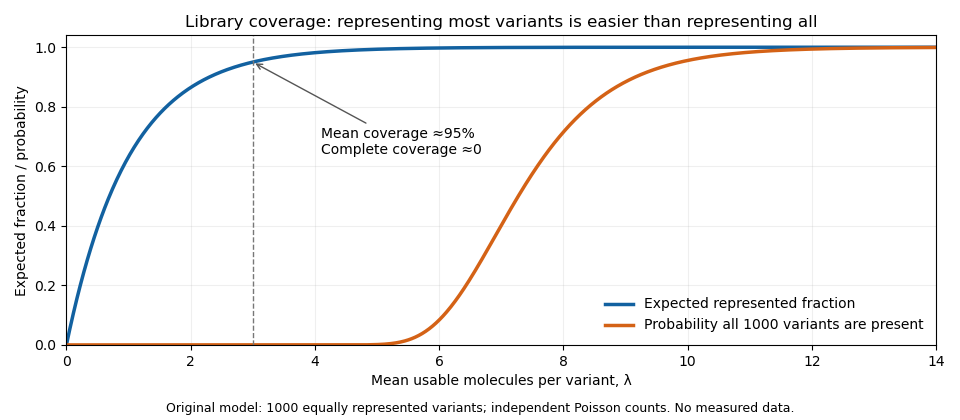
Expected represented fraction and probability of complete coverage answer different library-design questions
. Details. 
The figure uses a Poissonized displayed-library occupancy model: independently Poisson-distributed usable counts per variant with mean . The expected represented fraction is , while the probability of all variants being present is . That is an explicitly different count model, providing a convenient comparison rather than an exact fixed-input formula.
Real variants need not have equal abundance or display probability. In the original RNA-peptide fusion experiment, the selected and unselected encoding-sequence ratios were affected by preferential translation and reverse transcription.[ref]
RNA-peptide fusions for the in vitro selection of peptides and proteins by Richard W. Roberts and Jack W. Szostak. Figure 5 legend: input mixtures and biased unselected ratios
Coverage calculations therefore need assumptions about sequence representation and process losses; nominal library size alone does not validate them. New to topics? Read the docs here!