Euler characteristic of a cube boundary and its interior
ID: euler-characteristic-of-a-cube-boundary-and-its-interior

The boundary of a cube has eight vertices, twelve edges and six square faces. Treating each open face as a two-dimensional topological cell givesThis agrees with its being a two-sphere: stretching the hollow polyhedral surface changes its geometry but not its topology. The interior is excluded from this space.
Now include the solid interior. The cube has the same lower-dimensional topological cells, together with one open three-dimensional topological cell. The cell-count formula for Euler characteristic becomesThe filled cube is contractible, so its homology agrees with that of a point. The term is essential: by itself is the full count only for a two-dimensional CW complex.
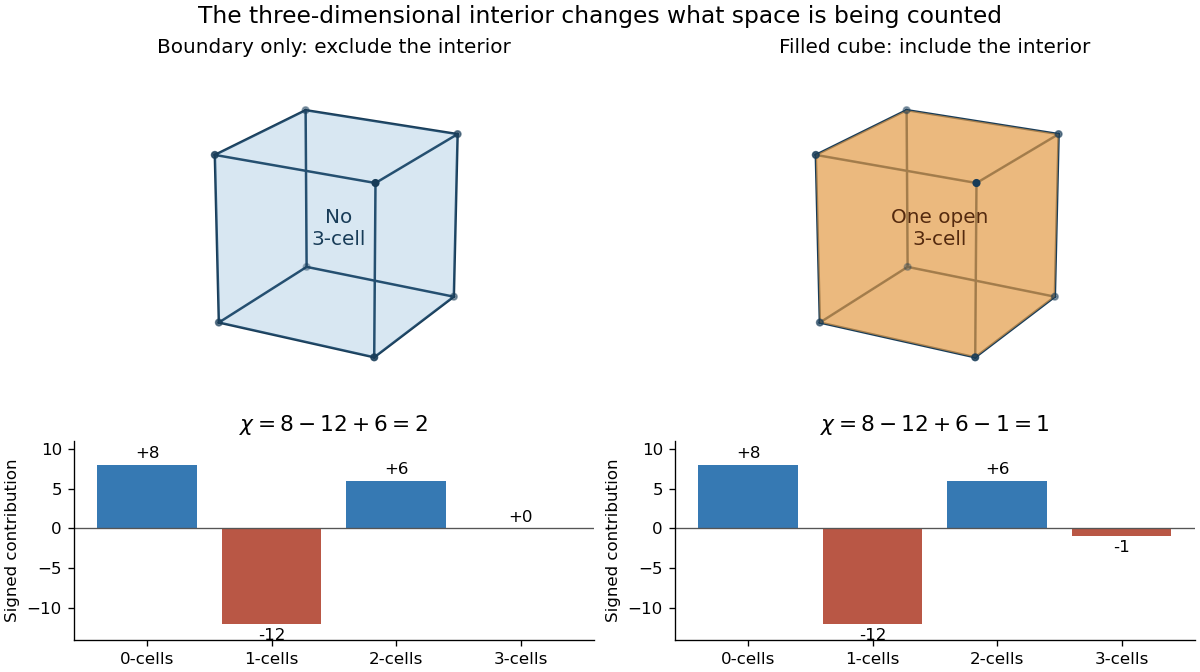
The boundary of a cube has Euler characteristic 2; including its three-dimensional interior adds one negative contribution and gives 1
. Details. 
Adding a diagonal within one square face replaces that face by two triangular faces and introduces one edge. Thus the Euler characteristic changes by , as in subdivision invariance of Euler characteristic. Including an interior is a different operation: it adds points to the space, rather than giving the same space a finer description. This distinction matters whenever a geometric model could mean either a surface or the solid it encloses.
New to topics? Read the docs here!