Exponent reduction for units
ID: exponent-reduction-for-units

For a unit modulo n and a nonnegative integer , division with remainder writes with . Euler's theorem then givesThis replaces a potentially enormous exponent by a small remainder. The exponent itself is reduced modulo Euler's totient function, while the powers are reduced modulo : these are different integer moduli.
For a worked modulo-fifteen calculation, seven is coprime to fifteen and . ThereforeUse exponentiation by squaring on the remaining exponent , reducing after each multiplication:Thus . Modular exponentiation supplies the computation; Euler's theorem supplies the optional shortening of its exponent. Exponentiation by squaring also works for nonunit bases, without using this shortening.
The guaranteed exponent is a common return exponent and an upper bound on the shortest period; it need not be that period. The multiplicative order is the least positive return exponent for the chosen unit. The Carmichael function is the least positive return exponent that works for every unit. Their precise relation isEither smaller return exponent can replace in exponent reduction for units. Modulo fifteen, , so gives immediately. For base four the multiplicative order is only two, smaller even than . A return at exponent eight alone does not prove that the multiplicative order is eight.[ref]
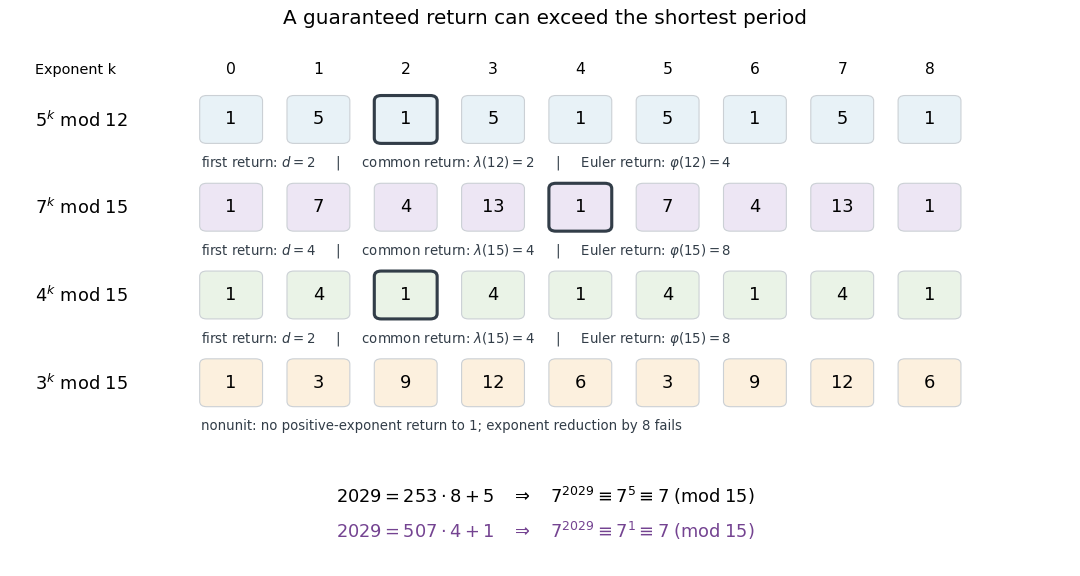
Actual power periods, Carmichael function exponents and Euler return exponents
. Each row lists powers from exponent zero through eight. Highlighted first returns identify multiplicative orders; the accompanying labels distinguish a chosen base's shortest period, the common exponent for all units, and Euler's totient function. Powers of the nonunit three modulo fifteen repeat after an initial term but never return to one at a positive exponent. The final calculation compares reduction of modulo eight and modulo four. Details.
New to topics? Read the docs here!