For an integer modulus and an integer with greatest common divisor , Euler's theorem, also called the Fermat-Euler theorem, statesHere Euler's totient function counts the units in the unit group . These congruence classes have modular multiplicative inverses, equivalently their representatives are coprime to . The guaranteed return to one permits exponent reduction for units.[ref]
For a prime number , , recovering Fermat's little theorem in the form when . Multiplying by and separately handling gives for every integer . For a composite number used as the integer modulus, a nonzero congruence class can be a nonunit.
Modulo twelve, the units have representatives , so Euler's totient function gives . Multiplication by five producesThus this permutation has two permutation cycles, each of length two. In particular , and the guaranteed return follows. The number of units need not be the length of one permutation cycle. Modulo fifteen, multiplication by seven similarly gives the two permutation cycles and , covering all eight units. The powers of seven follow the permutation cycle containing one; the other permutation cycle shows that these powers do not visit every unit.
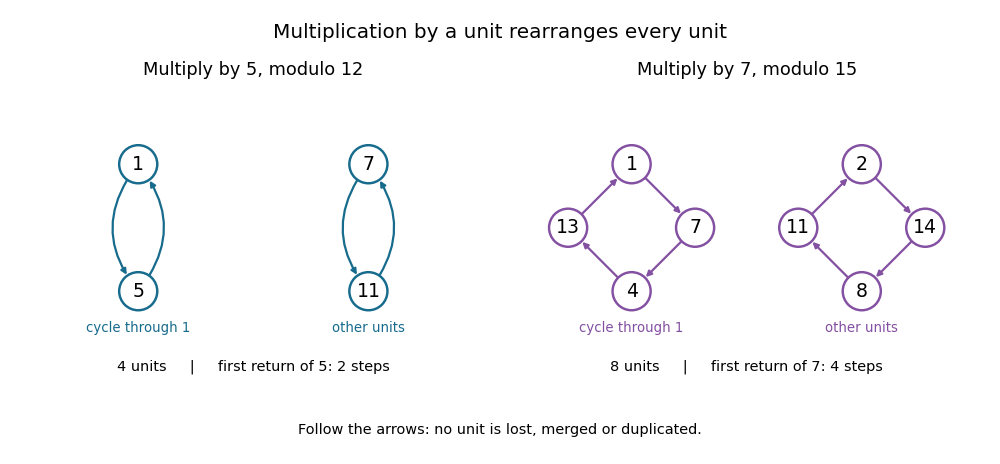
There is a stronger obstruction for a nonunit than just an occasional failed calculation. If a positive integer divides both and , then for every , so cannot be congruent to one modulo . For example, and , rather than one. Such a base has no multiplicative order modulo that integer modulus.[ref]
Orders of Units in Modular Arithmetic by Keith Conrad. p. 2, explanation following Example 1.8: a positive-exponent return to one forces coprimality
Choose a reduced residue system . For a unit modulo n , the bijection on the unit group has inverse . Comparing products before and after this permutation givesThe product is a unit; its modular inverse cancels it, proving Euler's theorem. Merely being nonzero would not justify cancellation.[ref]
Euler’s Theorem by Keith Conrad. pp. 2–3, Section 2: permutation of the units, comparison of products, cancellation
In the modulo-twelve example, . The permuted representatives have the same product, while the unreduced products equal . Equating these products modulo twelve exposes the fourth power without calculating it directly. Using all nonzero congruence classes instead would include nonunits, whose product need not permit cancellation.
For a unit modulo n and a nonnegative integer , division with remainder writes with . Euler's theorem then givesThis replaces a potentially enormous exponent by a small remainder. The exponent itself is reduced modulo Euler's totient function, while the powers are reduced modulo : these are different integer moduli.
For a worked modulo-fifteen calculation, seven is coprime to fifteen and . ThereforeUse exponentiation by squaring on the remaining exponent , reducing after each multiplication:Thus . Modular exponentiation supplies the computation; Euler's theorem supplies the optional shortening of its exponent. Exponentiation by squaring also works for nonunit bases, without using this shortening.
The guaranteed exponent is a common return exponent and an upper bound on the shortest period; it need not be that period. The multiplicative order is the least positive return exponent for the chosen unit. The Carmichael function is the least positive return exponent that works for every unit. Their precise relation isEither smaller return exponent can replace in exponent reduction for units. Modulo fifteen, , so gives immediately. For base four the multiplicative order is only two, smaller even than . A return at exponent eight alone does not prove that the multiplicative order is eight.[ref]
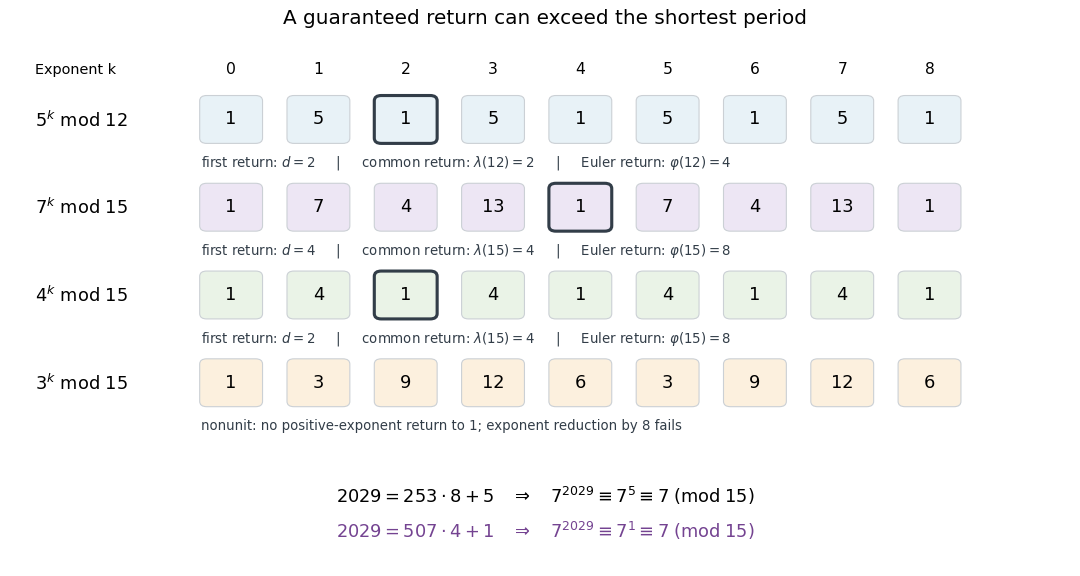
Actual power periods, Carmichael function exponents and Euler return exponents
. Each row lists powers from exponent zero through eight. Highlighted first returns identify multiplicative orders; the accompanying labels distinguish a chosen base's shortest period, the common exponent for all units, and Euler's totient function. Powers of the nonunit three modulo fifteen repeat after an initial term but never return to one at a positive exponent. The final calculation compares reduction of modulo eight and modulo four. Details.If the reduced exponent is zero, the rule gives , and still requires a unit. Applying it to the nonunit three would falsely predict ; the actual residue is six. For negative exponents, first interpret the power using a modular multiplicative inverse, as in modular exponentiation.
For fixed and suitable odd primes , the composite generalized repunitis congruent to one modulo and is a pseudoprime to base .
Articles by others on the same topic



Euler's theorem is a fundamental statement in number theory that relates to modular arithmetic. It is particularly useful for working with integers and their properties under modular exponentiation. The theorem states that if \( a \) and \( n \) are coprime (i.e.