Extreme point that is not an exposed point
ID: extreme-point-that-is-not-an-exposed-point

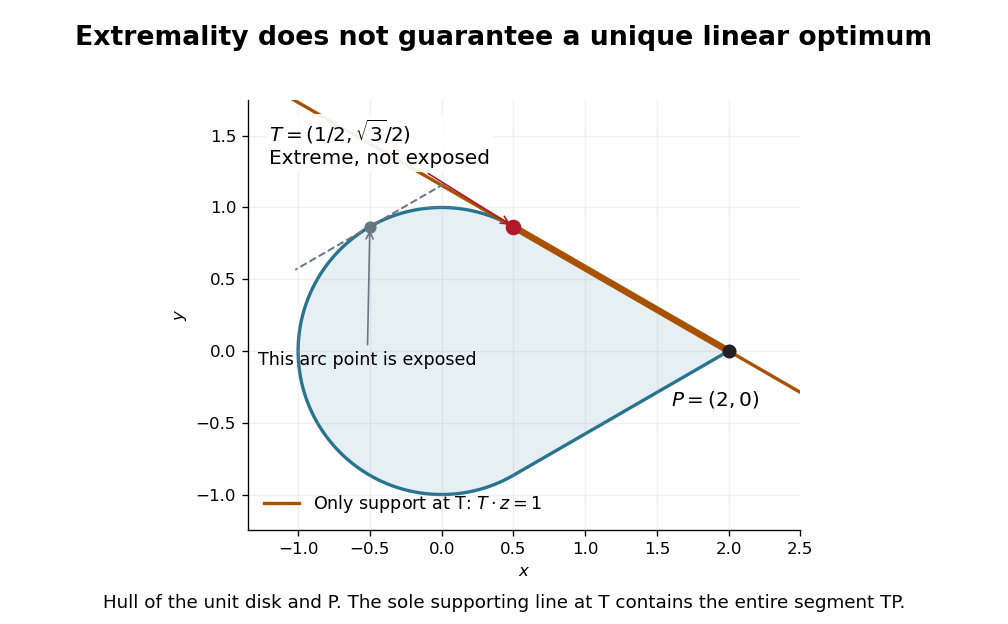
The distinction appears at a smooth join between a straight segment and a curved boundary. Consider the convex hullThe upper tangent from meets the unit circle at . The supporting line isEvery point of the unit disk has , with equality only at . Hence the convex face of where equality holds is exactly the line segment .
An extreme point can fail to be an exposed point
. Original analytic convex hull of the unit disk and . The tangent contact is extreme, but its only supporting line contains the entire line segment . A different marked point on the curved arc is exposed by its own tangent line. Details.
The point is extreme. If a nontrivial convex combination of two points of equals , both must belong to the convex face . Since is an endpoint of that line segment, both must equal .
Yet is not exposed. A nonzero linear functional maximizing at on must also maximize there on the included unit disk. Its vector must be a positive multiple of , by the equality condition in the Cauchy-Schwarz inequality. It then gives the same value as . No linear functional can select alone. Being an extreme point is a property of possible mixtures; being an exposed point adds the ability to distinguish it by one linear objective.
New to topics? Read the docs here!