A vector is an element of a vector space. Its defining operations are vector addition and scalar multiplication. An arrow in a Euclidean space is one example; a polynomial or a function can also be a vector when the chosen vector space uses the corresponding addition and scalar multiplication.
For instance, the polynomials p(x)=1+x and q(x)=x−x2 belong to the real vector space of polynomials of degree at most two. Their vector addition gives (p+q)(x)=1+2x−x2, and scalar multiplication gives (2p)(x)=2+2x. In the monomial basis (1,x,x2) these are the coordinate vectors (1,1,0), (0,1,−1), (1,2,−1) and (2,2,0) respectively. The vectors are the polynomials; these tuples are their representations in a chosen basis.
A general vector space does not itself prescribe lengths or angles. A norm supplies a size, while an inner product also supplies angle information and orthogonality. The familiar arrow geometry below belongs to Euclidean vectors, where this extra structure is available.
An axial vector transforms as a′=(detQ)Qa under an orthogonal matrix Q. It agrees with a polar vector under a proper rotation matrix and has the additional determinant sign under an orientation-reversing transformation. Angular momentum and angular velocity are axial vectors.
A polar vector transforms as v′=Qv under an orthogonal matrix Q, including an orientation-reversing transformation. Displacement, velocity and force are polar vectors. An axial vector instead transforms as a′=(detQ)Qa.
A Euclidean vector is a vector in a finite-dimensional real inner product space. Choosing an orthonormal basis identifies it with its real vector components in Rn. A geometric arrow represents a Euclidean vector by a length and a direction; translating the arrow without changing either represents the same Euclidean vector. The zero vector has length zero and no distinguished direction.[ref]
2.1 Scalars and Vectors. University Physics Volume 1 by William Moebs and others; §2.1, Figures 2.2–2.5: vector arrows, equal vectors and displacement
For points P=(1,1) and Q=(4,5) in a Cartesian coordinate system, the displacement is Q−P=(3,4). The arrow from (−2,0) to (1,4) represents the same Euclidean vector, even though its endpoints differ. An endpoint is a position; their difference is a vector. In an orthonormal basis (e1,e2),The Euclidean norm comes from the inner product: ∥v∥22=⟨v,v⟩. The sum of squared vector components is valid in an orthonormal basis; an arbitrary basis requires the appropriate Gram matrix. This distinction lets the geometric vector stay the same while its coordinate vector changes.[ref]
v=(3,4)=3e1+4e2,∥v∥2=32+42=5.
2.2 Coordinate Systems and Components of a Vector. University Physics Volume 1 by William Moebs and others; §2.2, Cartesian coordinates: equations (2.10)–(2.13) and Figure 2.16, unit basis vectors and scalar components
Vector addition is componentwise. With u=(2,1) and w=(1,3),Geometrically, translate the second arrow so its tail starts at the first arrow's head. The vector sum joins the starting point to the final endpoint. Reversing the order gives the other route around the same parallelogram, so vector addition is commutative. This is the useful bookkeeping behind adding successive displacements, velocities, or forces: direction information survives the calculation. For a force, the Euclidean vector alone does not specify its point of application, which also affects the torque.[ref]
u+w=(3,4).
2.1 Scalars and Vectors. University Physics Volume 1 by William Moebs and others; §2.1, Algebra of Vectors in Two Dimensions: Figure 2.12 and the head-to-tail construction
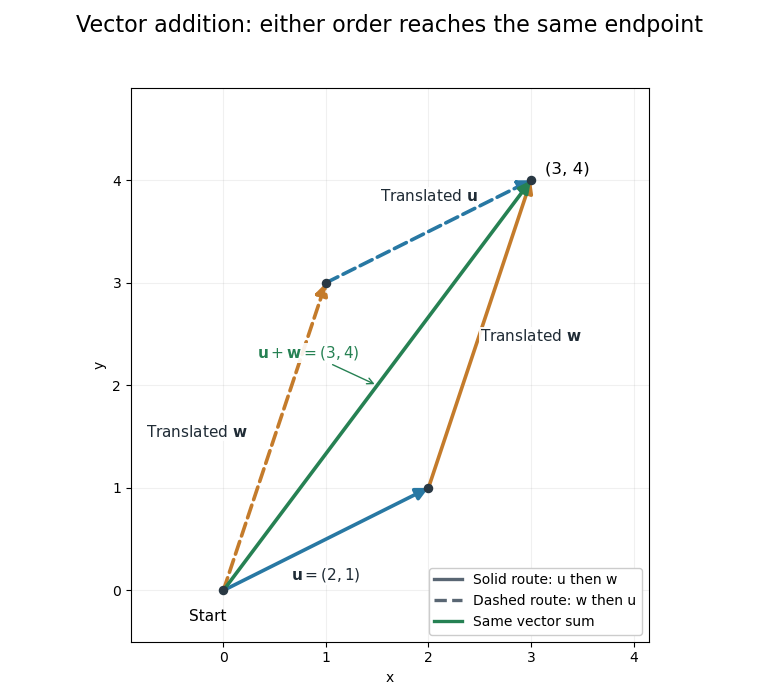
Two orders of vector addition reach the same endpoint
. The original Euclidean vectors u=(2,1) and w=(1,3) form a parallelogram. Either head-to-tail route gives their vector sum (3,4); dashed copies are translated arrows, not additional terms. Details.
The magnitude of a vector sum is generally different from the sum of the magnitudes. Here ∥u+w∥2=5, whereas ∥u∥2+∥w∥2=5+10>5. The triangle inequality explains why the direct displacement cannot exceed the length of this two-segment route. A return displacement (−3,−4) makes the net vector sum zero, although the lengths of the three travelled segments sum to a positive number.
The dot product exposes direction quantitatively: for nonzero Euclidean vectors, ⟨u,w⟩=∥u∥2∥w∥2cosθ. For the displayed pair, the dot product is 2⋅1+1⋅3=5, so cosθ=1/2 and the angle is 45∘. For orthogonal vectors, that dot product is zero. Dividing by magnitudes separates direction from size, which is the purpose of vector normalization.
A unit vector is a vector of norm one in a normed vector space. For a nonzero vector v, vector normalization produces one by dividing by ∥v∥. In a real Euclidean space, this keeps the direction and removes the magnitude. The zero vector cannot be normalized because its norm is zero.
For v=(3,4) with Euclidean norm 5, the corresponding unit vector isThe Euclidean vector can therefore be reconstructed as v=5v: size and direction are distinct pieces of information. The standard basis vectors are familiar unit vectors, but a unit vector need not point along a coordinate axis.
v=(53,54),∥v∥22=259+2516=1.
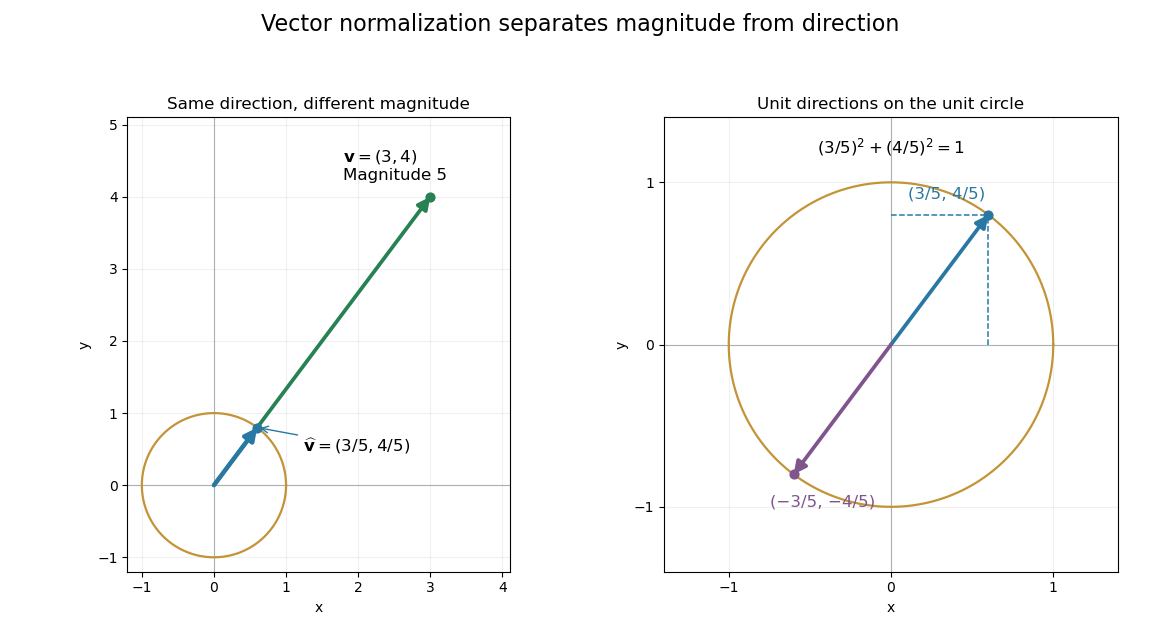
Normalization keeps direction and places the endpoint on the unit circle
. The original Euclidean vector (3,4) has magnitude 5. Its vector normalization (3/5,4/5) lies on the unit circle. The enlarged right panel also shows its negative, which has the same Euclidean norm and the opposite direction. Details.
Vector normalization converts a nonzero vector in a normed vector space into a unit vector. Absolute homogeneity of a norm givesThe direction is unchanged by multiplying by a positive real scalar. For c>0, ∥cv∥=c∥v∥ and cv=v; for a negative real scalar, cv=−v. Thus (3,4) and (6,8) normalize to the same unit vector, while (−3,−4) normalizes to its negative. This decomposition is useful for specifying a direction independently of a force, velocity or displacement magnitude.
∥v∥v=∥v∥∥v∥=1.
In a complex normed vector space, a nonzero complex scalar c instead gives cv=(c/∣c∣)v. The remaining complex argument is not removed by normalization. For a pure quantum state, vectors differing only by this overall global phase represent the same physical state; vector normalization alone does not identify them.
The zero vector cannot be normalized this way. The construction also applies in a function space: an eigenfunction of a Sturm-Liouville problem can be scaled to unit weighted norm byThe positive weight w specifies the weighted inner product. Multiplication by this nonzero constant preserves the eigenvalue equation and its homogeneous boundary conditions.
ynormalized(x)=∫abw(s)∣y(s)∣2dsy(x).
Vector normalization is not a linear map. With e1=(1,0) and e2=(0,1),Consequently, adding individually normalized directions does not generally give the direction of the original vector sum. Compute the intended vector sum first, then normalize it if it is nonzero. Cancellation is a further boundary case: v+(−v)=0 has no normalized direction even though both nonzero summands do. A numerical algorithm must check that case before dividing by the norm.
e1+e2=21(1,1)=(1,1)=e1+e2.
The cross product a×b of two three-dimensional vectors is perpendicular to both, has magnitude ∣a∣∣b∣sinθ, and is oriented by the right-hand rule.
For a unit vector n, real α=0, and real β, the displayed linear equation has the unique vector solutionTo prove it, split vectors into components parallel and orthogonal to n. On the parallel line, the linear map is multiplication by α. On the perpendicular plane, the operator Nv=n×v obeys N2=−I, by the vector triple product. Therefore (αI−βN)(αI+βN)=(α2+β2)I on that plane. Combining its inverse with the parallel solution gives the formula. This avoids component calculations in equations with an axial cross product term.
x=α2+β2αb−βn×b+(β2/α)n(n⋅b).
For any real three-dimensional vectors a,b, the displayed linear equation has the unique solutionTaking a dot product with b first yields (1+∣b∣2)(b⋅x)=a⋅b. Taking a cross product with b and using the vector triple product identity givesSubstitution into the original equation cancels the longitudinal terms and proves the formula. Conversely direct substitution verifies it for all b, including b=0, since the denominator is positive. If Cbx=b×x, the underlying identity for linear maps is (I−Cb)(I+Cb+bbT)=(1+∣b∣2)I, using Cb2=bbT−∣b∣2I.
x=1+∣b∣2a−b×a.
b×x=b×a−b(b⋅x)+∣b∣2x.
For a fixed unit vector g∈R3, the linear map r↦r×g has kernel Rg and image the perpendicular plane g⊥. Thus r×g=f is solvable exactly when f⋅g=0, and then its full solution set isFor the proof, a cross product with g must be perpendicular to g. Conversely the vector triple product identity gives g×(r×g)=r−(r⋅g)g, which determines the perpendicular orthogonal projection of r. The remaining parallel component is arbitrary. Finally (g×f)×g=f when f⋅g=0, verifying sufficiency.
r=g×f+tg,t∈R.
Geometrically, the solution set is a straight line with direction g. Its nearest point to the origin is g×f and its distance from the origin is ∣f∣. For a general nonzero fixed vector a, the corresponding formula is r=(a×f)/∣a∣2+ta, again subject to f⋅a=0.
Ancestors (6)
Incoming links (1491)
- Absolute homogeneity of a norm
- Acceleration
- Active planar rotation
- Active spectrum of the power method
- Addition map of subspaces
- Additivity of a cooperative-game value
- Adjoint operator
- Admissible crystallographic Coxeter graph
- Affine dependence
- Affine independence
- Affine map
- Algebraically irreducible representation of a Banach algebra
- Alignment of current and field in an axisymmetric conductor
- Alternating bilinear form
- Analytic vector Landau expansion
- Angle between vectors
- Antisymmetric first moment of a localized solenoidal field
- Areal velocity
- Atomic orientation
- Axial normal modes of an octahedral spring framework
- Axisymmetric linear map
- Axisymmetric second-order tensor
- Basis
- Basis-copying isometry
- Basis vector
- BDF2 discrete energy identity
- Beam splitter scattering matrix
- Bellman expectation equation
- Bent molecular geometry
- Best affine state estimate
- Bilinear form
- Bi-Lipschitz distortion
- Binormal vector
- Biorthogonal system
- Biot-Savart law
- Bipartite sign rounding bound
- Bit vector
- Bivector
- Block averaging compactness counterexample
- Block coordinate gradient
- Bond angle
- Bounded bilinear form
- Bra-ket notation
- Brunn-Minkowski theorem
- Capped simplex
- Carathéodory's theorem (convex hull)
- Cartesian and oblique coordinate reconstruction
- Cartesian basis
- Cartesian basis under rotation
- Cartesian frame
- Causal Dirac spinor current
- Central angle between independent uniform sphere points
- Change of basis
- Cholesky decomposition as a sum of squares
- Circulant matrix
- Classical Heisenberg model
- Classical query complexity of linear Boolean function identification
- Classical spin
- Closed convex set
- Closure of outward face area vectors
- Coercive bilinear form
- Cokernel
- Collinearity
- Column space
- Common representer coefficients for a sum of kernels
- Commuting plane reflections
- Complex matrix representation of quaternions
- Complex plane
- Computational tradeoffs of the kernel trick
- Conditional entanglement of the three-qubit W state
- Conditional-vector product-state criterion
- Cones generated by rotation and dilation characteristics
- Conic dual problem
- Conic hull
- Conic primal-dual gap
- Conjugate direction
- Conjugate-state steering from a maximally entangled pair
- Conserved inventory from a left null vector
- Constant tangent component forces perpendicular principal normals
- Continuation predictor-corrector step
- Continuous dual space
- Controlled-unitary entangling criterion
- Control point
- Control-point influence on a curve
- Convergence criterion for a stationary iteration
- Convergence of diagonalizable fixed-shift inverse iteration
- Converse geodesic characterization of a Killing vector
- Convex hull
- Cooperative cost game
- Coordinate axis
- Coordinate derivatives give directional Taylor expansion for convex functions
- Coordinate (linear algebra)
- Coordinates relative to a basis
- Coordinate subspace
- Coordinate vector
- Copositive reformulation of an orthant Rayleigh minimum
- Core of a simple cooperative game
- Coriolis acceleration
- Coulomb's law
- Countable annihilation sequence in an irreducible Banach module
- Counting spin orbitals in an electron shell
- Covariance matrix
- Covector transformation under a change of basis
- Cross product
- Cross product equation with a fixed unit vector
- Cross-product Lie algebra
- Cross-product operator with a longitudinal rank-one term
- Crystal momentum conservation
- Current loop
- Cyclic representation of a C-star algebra
- Cyclic vector for an operator algebra
- Definiteness of a norm
- Degenerate bilinear form
- Degenerate metric tensor
- Descent direction
- Determinant
- Determinant formula for triangle area
- Diagonalizable matrix
- Differential form
- Diffusion on a graph
- Dimension (vector space)
- Directional derivative
- Direction vector
- Dirichlet Poisson solution by tridiagonal elimination
- Discrete Fourier transform
- Discrete-time Markov chain
- Divergence of a Cartesian second-rank tensor
- Dot product
- Double pendulum
- Dual norm
- Dual norm as a worst-case linear error bound
- Dual pairing
- Dual prediction with a kernel
- Dual space
- Efficiency of a cooperative-game value
- Eigenspace
- Eigenspace decomposition from a square-free annihilating polynomial
- Eigenspace invariance for commuting linear maps
- Eigenvalue
- Eigenvector
- Eigenvectors under similarity
- Electric current
- Electric dipole moment
- Electric flux
- Electric potential
- Ellipsoid level sets of a positive-definite quadratic form
- Elliptical polarization
- Elliptope
- Energy eigenvalue
- Energy-norm proof of convergence of SOR
- Equal-cardinality basis criterion
- Equal-coupling three-state perturbation
- Equality case of the Heisenberg uncertainty relation
- Equality in Hölder's inequality
- Equality in Minkowski inequality
- Equality in the projected Cauchy-Schwarz inequality
- Equation of a plane through three points
- Error modes of a three-variable Jacobi iteration
- Euclidean geometry
- Euclidean vector
- Euler angular velocity vector
- Euler pole
- Evaluation onto the dual of a reflexive dual subspace
- Exact error contraction of a two-variable Gauss-Seidel iteration
- Exact two-dimensional power iteration
- Exact variational solution in a two-level system
- Expectation value
- Exponential map of a Lie group
- Exposed point
- Exterior algebra
- Exterior product
- Extreme point that is not an exposed point
- Faithful four-point action of GL2 over F2
- Farkas certificate for linear inequalities
- Farkas' lemma
- Fault rake
- Fault slip
- Finite greedy basis extension and choice
- Finite-set example of the Johnson–Lindenstrauss lemma
- Finite termination of conjugate directions
- Finite-vector example of Hölder's inequality
- Finite-window lock-in response
- Fitted values
- Fixed-step gradient descent on a positive-definite quadratic
- Floor and ceiling functions
- Force field (physics)
- Four-dimensional symplectic basis change
- Fourier diagonalization of a circulant matrix
- Fourier's law
- Four-vector
- Four-vector scalar triple product identity
- Four-velocity
- Fundamental matrix of a finite absorbing Markov chain
- Fundamental system of solutions
- Galilean velocity addition
- Gaussian binomial coefficient counts finite-field subspaces
- Gaussian elimination
- Gaussian Johnson–Lindenstrauss concentration argument
- Gaussian sign-correlation identity
- Gauss-Seidel convergence from diagonal dominance and positive definiteness
- Gauss-Seidel iteration for a two-variable positive-definite system
- Gauss-Seidel method
- Gelfand–Naimark–Segal construction
- Geometric continuity
- Givens rotation
- Gliding-hump continuity principle
- GNS representation of a vector state
- Gradient
- Gradient descent
- Gram matrix representation of a trigonometric polynomial
- Gram-Schmidt process
- Gravity components on an inclined plane
- Great-circle distance
- Ground set
- Group von Neumann algebra
- Hadamard transform
- Hamming cube as an L1 and L2 metric
- Heat flux density
- Heine-Borel theorem
- Hemicontinuity
- Hermitian conjugation
- Hermitian form
- Hermitian inner product
- Hermitian Rayleigh quotient range
- Hessian matrix
- Hessian of a sum of functions of linear forms
- Hessian of the Euclidean norm
- Hilbert space
- Hilbert space completion
- Hölder's inequality
- Householder QR example in two dimensions
- Householder reflection sending a vector to a coordinate axis
- Householder transformation
- Impossibility of universal identical-basis perfect correlations
- Impulse
- Increment
- Indefinite Hermitian form
- Indefinite quadratic form
- Independent head-tail reversal symmetry
- Index notation
- Initial value problem
- Inner product
- Integer lattice
- Integer linear combination
- Interior of the copositive cone
- Intersection parameters from scalar triple products
- Invariant subspace
- Invariant subspaces of a quarter-turn in three dimensions
- Inverse of a scalar plus a cross-product operator
- Jacobi convergence from strict diagonal dominance
- Jacobi iteration for a three-variable tridiagonal system
- Jacobi method
- Johnson–Lindenstrauss lemma
- Johnson's continuity theorem for irreducible normed representations
- Joint dominance of payoff vectors
- Kalman filter
- Karmarkar standard form
- Kernel dimensions of powers of a nilpotent map
- Kernel of a graph Laplacian
- Kernel of a linear map
- Kernel of a seminorm
- Kernel trick
- L0 sparsity count
- Laplacian matrix
- Lax-Milgram theorem
- Least-norm dual certificate
- Lectures on Landau Theory of Phase Transitions by Peter D. Olmsted
- Left null space
- Left preconditioning
- Lie theory
- Lift (force)
- Limited-memory BFGS
- Linear algebra
- Linear combination
- Linear dependence
- Linear functional
- Linear independence
- Linear independence depends on the scalar field
- Linear inequality
- Linear least squares
- Linear matroid
- Linear optimization on a convex hull
- Linear relation
- Linear span
- Line element on a sphere
- Line search
- Local-unitary equivalence
- Lock-in harmonic rejection
- Lock-in quadratures
- Logarithmic gradient of an exponential squared-distance sum
- Low-dimensional SU3 tensor representations
- Low-rank approximation
- Low-weight coefficients of a binary Hamming code
- Lp norm
- Lq null space property
- Lq quasi-norm
- Magnetic dipole moment
- Magnetic field-line curvature
- Magnetism
- Magnetization
- Massive Rarita-Schwinger constraints
- Matrix decomposition
- Matrix determinant lemma
- Matrix-free Hessian-vector product
- Matrix inverse
- Matrix norm induced by an energy norm
- Matrix preconditioner
- Matrix rank
- Matrix similarity
- Matrix splitting
- Matrix-vector product
- Matroid
- Metric embedding
- Metropolis sampling on fixed-cardinality subsets
- Minimally dependent vector family
- Minimal total family in a normed space
- Minimum image norm outside a Euclidean unit ball
- Minkowski addition
- Minkowski inequality
- Minkowski inequality for error aggregation
- Minkowski inequality for finite vectors
- Minkowski metric
- Mixed strategy
- Modified Gram-Schmidt
- Modular conjugation
- Modular operator
- Modulus
- Molecular dipole cancellation
- Momentum
- Monotonicity of uniform sparse recovery in the exponent
- Moore-Penrose inverse
- Multitype Poisson branching process
- Nearest-neighbour model of graphene
- Negative-definite matrix
- Negotiation set in two-person bargaining
- Newton's first law
- Newton's third law
- Nodal plane of a double couple
- Nominal end traction of a twisted neo-Hookean cylinder
- Noncommuting rotations about fixed axes
- Nondegenerate bilinear form
- Noninjective linear measurement
- Nonorthogonal vectors
- Nonsymmetric matrix
- Normal and tangential components
- Normal component
- Normal modes of a double pendulum
- Normal regression with independent coefficient and variance priors
- Normal reversal around the Möbius core
- Normed vector space
- Norming functional
- Null direction of a linear map
- One-dimensional Anderson chain
- Order-p matrices in GL2 over the prime field
- Ordinary differential equation
- Origin (mathematics)
- Orthogonality to the image of a matrix
- Orthogonal projection
- Orthogonal projection matrix
- Orthogonal projection onto a finite-dimensional subspace
- Orthogonal projection residual
- Orthogonal vectors
- Orthonormal eigenbasis
- Orthonormal set
- Paired coordinates of a symplectic basis
- Paired eigenspaces of the square of a real skew-symmetric matrix
- Parallel elements of a matroid
- Parallelepiped
- Parametrization of a plane with an auxiliary vector
- Partial derivative
- Partial inner product
- Passive rotation of coordinates
- Past exam of the advanced quantum physics course of the University of Cambridge / 2016 / Paper 1 / 1 / b / Solution
- Past exam of the advanced quantum theory: path integrals and many-particle physics course of the University of Oxford / 2017 / 2 / a / Solution
- Past exam of the advanced topics in statistical machine learning course of the University of Oxford / 2025 / 2 / a / ii / Solution
- Past exam of the advanced topics in statistical machine learning course of the University of Oxford / 2025 / 2 / b / ii / Solution
- Past exam of the advanced topics in statistical machine learning course of the University of Oxford / 2025 / 2 / c / iii / Solution
- Past exam of the advanced topics in statistical machine learning course of the University of Oxford / 2025 / 2 / c / ii / Solution
- Past exam of the advanced topics in statistical machine learning course of the University of Oxford / 2025 / 2 / c / iv / Solution
- Past exam of the advanced topics in statistical machine learning course of the University of Oxford / 2025 / 3 / c / i / Solution
- Past exam of the algebra 1 and differential equations 1 course of the University of Oxford / 2014 / 1 / a / ii / Solution
- Past exam of the algebra, analysis and differential equations 1 course of the University of Oxford / 2011 / 2 / b / Solution
- Past exam of the algebra, analysis and differential equations II course of the University of Oxford / 2005 / Algebra / 1 / Solution
- Past exam of the algebra, analysis and differential equations II course of the University of Oxford / 2005 / Algebra / 2 / iii / Solution
- Past exam of the algebra, analysis and differential equations II course of the University of Oxford / 2005 / Algebra / 2 / ii / Solution
- Past exam of the algebra, analysis and differential equations II course of the University of Oxford / 2006 / Algebra / 1 / Solution
- Past exam of the algebra, analysis and differential equations II course of the University of Oxford / 2007 / 1 / Solution
- Past exam of the algebra, analysis and differential equations II course of the University of Oxford / 2007 / 2 / Solution
- Past exam of the algebra, analysis and differential equations II course of the University of Oxford / 2010 / Algebra / 1 / a / Solution
- Past exam of the algebra, analysis and differential equations II course of the University of Oxford / 2010 / Algebra / 1 / b / Solution
- Past exam of the algebra, analysis and differential equations II course of the University of Oxford / 2012 / 1 / c / Solution
- Past exam of the algebra, analysis and differential equations II course of the University of Oxford / 2012 / 2 / a / Solution
- Past exam of the algebra, analysis and differential equations II course of the University of Oxford / 2012 / 2 / b / Solution
- Past exam of the algebra, analysis and differential equations II course of the University of Oxford / 2012 / 7 / c / Solution
- Past exam of the algebra, analysis and differential equations II course of the University of Oxford / 2012 / 9 / a / Solution
- Past exam of the algebra, analysis and differential equations II course of the University of Oxford / 2012 / 9 / b / ii / Solution
- Past exam of the algebra and analysis II for mathematics and philosophy course of the University of Oxford / 2013 / 2 / b / i / Solution
- Past exam of the algebra and analysis II for mathematics and philosophy course of the University of Oxford / 2013 / 6 / a / Solution
- Past exam of the Banach and C*-algebras course of the University of Oxford / 2011 / 3 / Solution
- Past exam of the biological physics course of the University of Oxford / 2019 / 5 / c / Solution
- Past exam of the biological physics course of the University of Oxford / 2019 / 5 / f / Solution
- Past exam of the computer science course of the University of Oxford / 2015 / Advanced data structures and algorithms / 3 / e / Solution
- Past exam of the computer science course of the University of Oxford / 2015 / Computational learning theory / 1 / c / Solution
- Past exam of the computer science course of the University of Oxford / 2015 / Computational learning theory / 2 / c / Solution
- Past exam of the computer science course of the University of Oxford / 2015 / Computer graphics
- Past exam of the computer science course of the University of Oxford / 2015 / Computer graphics / 2 / b / iii / Solution
- Past exam of the computer science course of the University of Oxford / 2015 / Computer graphics / 2 / b / i / Solution
- Past exam of the computer science course of the University of Oxford / 2015 / Geometric modelling / 1 / a / Solution
- Past exam of the computer science course of the University of Oxford / 2015 / Geometric modelling / 2 / g / Solution
- Past exam of the computer science course of the University of Oxford / 2018 / Algorithms / 3 / e / Solution
- Past exam of the computer science course of the University of Oxford / 2019 / Algorithms / 2 / c / Solution
- Past exam of the computer science course of the University of Oxford / 2019 / Algorithms / 2 / d / Solution
- Past exam of the computer science course of the University of Oxford / 2019 / Computational game theory / 3 / a / Solution
- Past exam of the computer science course of the University of Oxford / 2019 / Quantum information
- Past exam of the computer science course of the University of Oxford / 2019 / Quantum information / 1 / d / iii / Solution
- Past exam of the computer science course of the University of Oxford / 2019 / Quantum information / 2 / d / ii / Solution
- Past exam of the computer science course of the University of Oxford / 2019 / Quantum information / 2 / d / i / Solution
- Past exam of the computer science course of the University of Oxford / 2019 / Quantum information / 2 / e / Solution
- Past exam of the computer science course of the University of Oxford / 2019 / Quantum information / 3 / a / ii / Solution
- Past exam of the computer science course of the University of Oxford / 2019 / Quantum information / 3 / a / i / Solution
- Past exam of the computer science course of the University of Oxford / 2019 / Quantum information / 3 / b / ii / Solution
- Past exam of the computer science course of the University of Oxford / 2019 / Quantum information / 3 / b / i / Solution
- Past exam of the computer science course of the University of Oxford / 2019 / Quantum information / 3 / c / Solution
- Past exam of the computer science course of the University of Oxford / 2020 / Computational game theory / 2 / b / Solution
- Past exam of the computer science course of the University of Oxford / 2020 / Computational game theory / 2 / c / Solution
- Past exam of the computer science course of the University of Oxford / 2020 / Computational game theory / 3 / d / Solution
- Past exam of the computer science course of the University of Oxford / 2020 / Quantum information
- Past exam of the computer science course of the University of Oxford / 2020 / Quantum information / 1 / a / Solution
- Past exam of the computer science course of the University of Oxford / 2020 / Quantum information / 1 / b / ii / Solution
- Past exam of the computer science course of the University of Oxford / 2020 / Quantum information / 1 / c / Solution
- Past exam of the computer science course of the University of Oxford / 2020 / Quantum information / 1 / f / iii / Solution
- Past exam of the computer science course of the University of Oxford / 2020 / Quantum information / 1 / f / ii / Solution
- Past exam of the computer science course of the University of Oxford / 2020 / Quantum information / 1 / f / i / Solution
- Past exam of the computer science course of the University of Oxford / 2020 / Quantum information / 2 / a / Solution
- Past exam of the computer science course of the University of Oxford / 2020 / Quantum information / 2 / b / iii / Solution
- Past exam of the computer science course of the University of Oxford / 2020 / Quantum information / 2 / c / Solution
- Past exam of the computer science course of the University of Oxford / 2020 / Quantum information / 2 / d / iii / Solution
- Past exam of the computer science course of the University of Oxford / 2020 / Quantum information / 2 / d / ii / Solution
- Past exam of the computer science course of the University of Oxford / 2020 / Quantum information / 3 / c / Solution
- Past exam of the computer science course of the University of Oxford / 2020 / Quantum information / 3 / d / Solution
- Past exam of the computer science course of the University of Oxford / 2021 / Quantum information / 1 / a / i / Solution
- Past exam of the computer science course of the University of Oxford / 2021 / Quantum information / 3 / a / ii / Solution
- Past exam of the differential equations 2 course of the University of Oxford / 2021 / 1 / a / i / Solution
- Past exam of the elasticity and plasticity course of the University of Oxford / 2010 / 1 / c / Solution
- Past exam of the fixed point methods for nonlinear partial differential equations course of the University of Oxford / 2023 / 1 / d / Solution
- Past exam of the fixed point methods for nonlinear partial differential equations course of the University of Oxford / 2023 / 3 / b / iii / Solution
- Past exam of the functional analysis course of the University of Oxford / 2011 / 1 / b / ii / Solution
- Past exam of the functional analysis course of the University of Oxford / 2011 / 2 / i / Solution
- Past exam of the functional analysis course of the University of Oxford / 2011 / 3 / ii / Solution
- Past exam of the functional analysis course of the University of Oxford / 2011 / 3 / i / Solution
- Past exam of the functional analysis I course of the University of Oxford / 2023 / 1 / b / i / Solution
- Past exam of the further quantum theory course of the University of Oxford / 2023 / 2 / b / Solution
- Past exam of the general relativity and cosmology course of the University of Oxford / 2018 / 1 / b / Solution
- Past exam of the general relativity II course of the University of Oxford / 2017 / 3 / a / Solution
- Past exam of the genetics course of the University of Cambridge / 2025 / Paper 4 / 3 / Solution
- Past exam of the groups and representations course of the University of Oxford / 2018 / 4 / c / Solution
- Past exam of the groups and representations course of the University of Oxford / 2019 / 3 / c / Solution
- Past exam of the groups and representations course of the University of Oxford / 2020 / 3 / b / Solution
- Past exam of the groups and representations course of the University of Oxford / 2021 / 3 / e / Solution
- Past exam of the groups and representations course of the University of Oxford / 2021 / 4 / d / Solution
- Past exam of the how to build a brain from scratch course of the University of Oxford / 2022 / 1 / Solution
- Past exam of the Lie algebras and representation theory of symmetric groups course of the University of Oxford / 2007 / A / 1 / b / Solution
- Past exam of the Lie algebras and representation theory of symmetric groups course of the University of Oxford / 2007 / A / 2 / Solution
- Past exam of the Lie algebras and representation theory of symmetric groups course of the University of Oxford / 2007 / A / 3 / Solution
- Past exam of the Lie algebras and representation theory of symmetric groups course of the University of Oxford / 2007 / A / 4 / Solution
- Past exam of the Lie algebras and representation theory of symmetric groups course of the University of Oxford / 2007 / B / 5 / a / Solution
- Past exam of the Lie algebras and representation theory of symmetric groups course of the University of Oxford / 2007 / B / 7 / e / Solution
- Past exam of the Lie algebras and representation theory of symmetric groups course of the University of Oxford / 2007 / B / 8 / b / Solution
- Past exam of the Lie algebras and representation theory of symmetric groups course of the University of Oxford / 2007 / B / 8 / d / Solution
- Past exam of the linear algebra course of the University of Oxford / 2021 / 1 / a / i / Solution
- Past exam of the linear algebra course of the University of Oxford / 2021 / 3 / a / Solution
- Past exam of the linear algebra course of the University of Oxford / 2021 / 3 / b / ii / Solution
- Past exam of the linear algebra course of the University of Oxford / 2021 / 3 / c / Solution
- Past exam of the linear algebra course of the University of Oxford / 2023 / 3 / c / iii / Solution
- Past exam of the linear algebra course of the University of Oxford / 2023 / 3 / c / i / Solution
- Past exam of the mathematical and Computational Biology course of the University of Cambridge / 2024 / Paper 1 / B3 / a / Solution
- Past exam of the mathematical and Computational Biology course of the University of Cambridge / 2024 / Paper 1 / B3 / b / Solution
- Past exam of the mathematical methods I course of the University of Oxford / 2013 / 11 / c / i / Solution
- Past exam of the mathematical methods I course of the University of Oxford / 2013 / 3 / Solution
- Past exam of the mathematical methods I course of the University of Oxford / 2014 / 10 / a / i / Solution
- Past exam of the mathematical methods I course of the University of Oxford / 2014 / 11 / i / Solution
- Past exam of the mathematical methods I course of the University of Oxford / 2014 resit / 11 / ii / Solution
- Past exam of the mathematical methods I course of the University of Oxford / 2014 resit / 11 / i / Solution
- Past exam of the mathematical methods I course of the University of Oxford / 2014 resit / 11 / v / Solution
- Past exam of the mathematical methods I course of the University of Oxford / 2014 resit / 12 / iii / Solution
- Past exam of the mathematical methods I course of the University of Oxford / 2014 resit / 6 / ii / Solution
- Past exam of the mathematical methods I course of the University of Oxford / 2018 / 10 / b / Solution
- Past exam of the mathematical methods I course of the University of Oxford / 2018 / 10 / c / Solution
- Past exam of the mathematical methods I course of the University of Oxford / 2018 / 10 / d / Solution
- Past exam of the mathematical methods I course of the University of Oxford / 2018 / 5 / b / Solution
- Past exam of the mathematical methods I course of the University of Oxford / 2018 / 9 / a / Solution
- Past exam of the mathematical methods I course of the University of Oxford / 2019 / 11 / c / v / Solution
- Past exam of the mathematical methods I course of the University of Oxford / 2019 / 12 / c / Solution
- Past exam of the mathematical methods I course of the University of Oxford / 2019 / 8 / Solution
- Past exam of the mathematical methods I course of the University of Oxford / 2019 resit / 11 / b / iii / Solution
- Past exam of the mathematical methods I course of the University of Oxford / 2019 resit / 9 / Solution
- Past exam of the mathematical methods I course of the University of Oxford / 2021 / 5 / a / Solution
- Past exam of the mathematical methods I course of the University of Oxford / 2021 / 5 / b / Solution
- Past exam of the mathematical methods I course of the University of Oxford / 2021 resit / 4 / a / Solution
- Past exam of the mathematical methods I course of the University of Oxford / 2021 resit / 8 / c / i / Solution
- Past exam of the mathematical methods I course of the University of Oxford / 2021 resit / 9 / iii / b / Solution
- Past exam of the mathematical methods I course of the University of Oxford / 2021 resit / 9 / ii / Solution
- Past exam of the mathematical methods I course of the University of Oxford / 2021 resit / 9 / i / Solution
- Past exam of the mathematical methods I course of the University of Oxford / 2022 / 1 / Solution
- Past exam of the mathematical methods I course of the University of Oxford / 2022 / 5 / i / Solution
- Past exam of the mathematical methods I course of the University of Oxford / 2022 / 7 / i / Solution
- Past exam of the mathematical methods I course of the University of Oxford / 2022 / 8 / a / ii / Solution
- Past exam of the mathematical methods I course of the University of Oxford / 2022 / 8 / b / ii / Solution
- Past exam of the mathematical methods I course of the University of Oxford / 2022 / 8 / b / i / Solution
- Past exam of the mathematical methods II course of the University of Oxford / 2018 / 9 / c / Solution
- Past exam of the mathematics and the environment and mathematical physiology course of the University of Oxford / 2010 / B / 6 / a / Solution
- Past exam of the mathematics and the environment and mathematical physiology course of the University of Oxford / 2010 / B / 6 / d / Solution
- Past exam of the mathematics course of the University of Cambridge / 2001 / ib / Paper 1 / 14C / b / Solution
- Past exam of the mathematics course of the University of Cambridge / 2001 / ib / Paper 1 / 17B / Solution
- Past exam of the mathematics course of the University of Cambridge / 2001 / ib / Paper 1 / 18F / b / Solution
- Past exam of the mathematics course of the University of Cambridge / 2001 / iii / Paper 31 / 1 / Solution
- Past exam of the mathematics course of the University of Cambridge / 2001 / iii / Paper 31 / 3 / ii / Solution
- Past exam of the mathematics course of the University of Cambridge / 2001 / iii / Paper 31 / 3 / Solution
- Past exam of the mathematics course of the University of Cambridge / 2001 / iii / Paper 31 / 5 / Solution
- Past exam of the mathematics course of the University of Cambridge / 2001 / iii / Paper 31 / 6 / c / Solution
- Past exam of the mathematics course of the University of Cambridge / 2001 / iii / Paper 3 / 4 / c / Solution
- Past exam of the mathematics course of the University of Cambridge / 2001 / iii / Paper 3 / 5 / c / Solution
- Past exam of the mathematics course of the University of Cambridge / 2001 / iii / Paper 3 / 6 / a / Solution
- Past exam of the mathematics course of the University of Cambridge / 2001 / iii / Paper 3 / 6 / b / Solution
- Past exam of the mathematics course of the University of Cambridge / 2001 / iii / Paper 58 / 1 / Solution
- Past exam of the mathematics course of the University of Cambridge / 2001 / iii / Paper 58 / 7 / Solution
- Past exam of the mathematics course of the University of Cambridge / 2002 / ia / Paper 1 / 2D / Solution
- Past exam of the mathematics course of the University of Cambridge / 2002 / ia / Paper 1 / 7B / a / Solution
- Past exam of the mathematics course of the University of Cambridge / 2002 / ia / Paper 1 / 7B / b / Solution
- Past exam of the mathematics course of the University of Cambridge / 2002 / ia / Paper 1 / 8D / Solution
- Past exam of the mathematics course of the University of Cambridge / 2002 / ia / Paper 3 / 1A / Solution
- Past exam of the mathematics course of the University of Cambridge / 2002 / ia / Paper 4 / 4E / Solution
- Past exam of the mathematics course of the University of Cambridge / 2002 / iii / Paper 1 / 2 / Solution
- Past exam of the mathematics course of the University of Cambridge / 2002 / iii / Paper 1 / 3 / Solution
- Past exam of the mathematics course of the University of Cambridge / 2002 / iii / Paper 1 / 5 / Solution
- Past exam of the mathematics course of the University of Cambridge / 2002 / iii / Paper 19 / 5 / Solution
- Past exam of the mathematics course of the University of Cambridge / 2002 / iii / Paper 30 / 1 / Solution
- Past exam of the mathematics course of the University of Cambridge / 2002 / iii / Paper 30 / 2 / Solution
- Past exam of the mathematics course of the University of Cambridge / 2002 / iii / Paper 38 / 3 / Solution
- Past exam of the mathematics course of the University of Cambridge / 2002 / iii / Paper 40 / 3 / a / iii / Solution
- Past exam of the mathematics course of the University of Cambridge / 2002 / iii / Paper 46 / 1 / i / Solution
- Past exam of the mathematics course of the University of Cambridge / 2002 / iii / Paper 46 / 3 / Solution
- Past exam of the mathematics course of the University of Cambridge / 2002 / iii / Paper 47 / 1 / b / Solution
- Past exam of the mathematics course of the University of Cambridge / 2002 / iii / Paper 47 / 1 / Solution
- Past exam of the mathematics course of the University of Cambridge / 2002 / iii / Paper 47 / 2 / Solution
- Past exam of the mathematics course of the University of Cambridge / 2002 / iii / Paper 5 / 6 / Solution
- Past exam of the mathematics course of the University of Cambridge / 2002 / iii / Paper 7 / 4 / Solution
- Past exam of the mathematics course of the University of Cambridge / 2002 / iii / Paper 7 / 5 / Solution
- Past exam of the mathematics course of the University of Cambridge / 2003 / iii / Paper 37 / 2 / Solution
- Past exam of the mathematics course of the University of Cambridge / 2003 / iii / Paper 37 / 4 / Solution
- Past exam of the mathematics course of the University of Cambridge / 2003 / iii / Paper 37 / 6 / Solution
- Past exam of the mathematics course of the University of Cambridge / 2003 / iii / Paper 50 / 1 / Solution
- Past exam of the mathematics course of the University of Cambridge / 2003 / iii / Paper 50 / 2 / Solution
- Past exam of the mathematics course of the University of Cambridge / 2003 / iii / Paper 70 / 1 / b / Solution
- Past exam of the mathematics course of the University of Cambridge / 2003 / iii / Paper 70 / 1 / c / ii / Solution
- Past exam of the mathematics course of the University of Cambridge / 2003 / iii / Paper 70 / 2 / Solution
- Past exam of the mathematics course of the University of Cambridge / 2004 / ia / Paper 1 / 1B / Solution
- Past exam of the mathematics course of the University of Cambridge / 2004 / ia / Paper 1 / 2C / Solution
- Past exam of the mathematics course of the University of Cambridge / 2004 / ia / Paper 1 / 6A / Solution
- Past exam of the mathematics course of the University of Cambridge / 2004 / ia / Paper 1 / 8C / iii / Solution
- Past exam of the mathematics course of the University of Cambridge / 2004 / ia / Paper 1 / 8C / ii / Solution
- Past exam of the mathematics course of the University of Cambridge / 2004 / iii / Paper 11 / 5 / Solution
- Past exam of the mathematics course of the University of Cambridge / 2004 / iii / Paper 11 / 6 / Solution
- Past exam of the mathematics course of the University of Cambridge / 2004 / iii / Paper 12 / 3 / Solution
- Past exam of the mathematics course of the University of Cambridge / 2004 / iii / Paper 2 / 3 / d / Solution
- Past exam of the mathematics course of the University of Cambridge / 2004 / iii / Paper 2 / 4 / c / Solution
- Past exam of the mathematics course of the University of Cambridge / 2004 / iii / Paper 2 / 4 / d / Solution
- Past exam of the mathematics course of the University of Cambridge / 2004 / iii / Paper 2 / 6 / b / Solution
- Past exam of the mathematics course of the University of Cambridge / 2004 / iii / Paper 43 / 4 / Solution
- Past exam of the mathematics course of the University of Cambridge / 2004 / iii / Paper 70 / 1 / i / Solution
- Past exam of the mathematics course of the University of Cambridge / 2005 / ia / Paper 1 / 1C / iii / Solution
- Past exam of the mathematics course of the University of Cambridge / 2005 / ia / Paper 1 / 1C / Solution
- Past exam of the mathematics course of the University of Cambridge / 2005 / ia / Paper 1 / 1C / v / Solution
- Past exam of the mathematics course of the University of Cambridge / 2005 / ia / Paper 1 / 2B / Solution
- Past exam of the mathematics course of the University of Cambridge / 2005 / ia / Paper 1 / 6B / Solution
- Past exam of the mathematics course of the University of Cambridge / 2005 / ia / Paper 1 / 7A / Solution
- Past exam of the mathematics course of the University of Cambridge / 2005 / ia / Paper 1 / 8A / Solution
- Past exam of the mathematics course of the University of Cambridge / 2005 / ib / Paper 2 / 10C / ii / Solution
- Past exam of the mathematics course of the University of Cambridge / 2005 / ib / Paper 2 / 16G / Solution
- Past exam of the mathematics course of the University of Cambridge / 2005 / ib / Paper 2 / 20D / Solution
- Past exam of the mathematics course of the University of Cambridge / 2005 / ib / Paper 2 / 8E / Solution
- Past exam of the mathematics course of the University of Cambridge / 2005 / ib / Paper 2 / 9D / Solution
- Past exam of the mathematics course of the University of Cambridge / 2005 / iii / Paper 12 / 5 / a / Solution
- Past exam of the mathematics course of the University of Cambridge / 2005 / iii / Paper 12 / 5 / b / Solution
- Past exam of the mathematics course of the University of Cambridge / 2005 / iii / Paper 12 / 5 / c / Solution
- Past exam of the mathematics course of the University of Cambridge / 2005 / iii / Paper 29 / 2 / Solution
- Past exam of the mathematics course of the University of Cambridge / 2005 / ii / Paper 1 / 13I / Solution
- Past exam of the mathematics course of the University of Cambridge / 2005 / ii / Paper 1 / 16F / Solution
- Past exam of the mathematics course of the University of Cambridge / 2005 / ii / Paper 1 / 18G / Solution
- Past exam of the mathematics course of the University of Cambridge / 2005 / ii / Paper 1 / 19G / i / Solution
- Past exam of the mathematics course of the University of Cambridge / 2005 / ii / Paper 1 / 22F / Solution
- Past exam of the mathematics course of the University of Cambridge / 2005 / ii / Paper 1 / 24H / iii / Solution
- Past exam of the mathematics course of the University of Cambridge / 2005 / ii / Paper 1 / 29C / Solution
- Past exam of the mathematics course of the University of Cambridge / 2005 / ii / Paper 1 / 34B / Solution
- Past exam of the mathematics course of the University of Cambridge / 2005 / ii / Paper 1 / 3G / Solution
- Past exam of the mathematics course of the University of Cambridge / 2005 / ii / Paper 4 / 19G / i / Solution
- Past exam of the mathematics course of the University of Cambridge / 2005 / ii / Paper 4 / 24H / i / Solution
- Past exam of the mathematics course of the University of Cambridge / 2005 / ii / Paper 4 / 26I / c / Solution
- Past exam of the mathematics course of the University of Cambridge / 2005 / ii / Paper 4 / 39A / b / Solution
- Past exam of the mathematics course of the University of Cambridge / 2005 / ii / Paper 4 / 5I / Solution
- Past exam of the mathematics course of the University of Cambridge / 2005 / ii / Paper 4 / 6E / a / i / Solution
- Past exam of the mathematics course of the University of Cambridge / 2005 / ii / Paper 4 / 6E / b / iii / Solution
- Past exam of the mathematics course of the University of Cambridge / 2006 / iii / Paper 17 / 1 / Solution
- Past exam of the mathematics course of the University of Cambridge / 2006 / iii / Paper 17 / 4 / Solution
- Past exam of the mathematics course of the University of Cambridge / 2006 / iii / Paper 68 / 1 / a / Solution
- Past exam of the mathematics course of the University of Cambridge / 2007 / ia / Paper 1 / 1A / i / Solution
- Past exam of the mathematics course of the University of Cambridge / 2007 / ia / Paper 1 / 5B / i / b / Solution
- Past exam of the mathematics course of the University of Cambridge / 2007 / ia / Paper 1 / 5B / i / Solution
- Past exam of the mathematics course of the University of Cambridge / 2007 / ia / Paper 1 / 6C / iii / Solution
- Past exam of the mathematics course of the University of Cambridge / 2007 / ia / Paper 1 / 8A / i / Solution
- Past exam of the mathematics course of the University of Cambridge / 2007 / ia / Paper 2 / 12F / Solution
- Past exam of the mathematics course of the University of Cambridge / 2007 / iii / Paper 10 / 1 / a / Solution
- Past exam of the mathematics course of the University of Cambridge / 2007 / iii / Paper 10 / 1 / b / Solution
- Past exam of the mathematics course of the University of Cambridge / 2007 / iii / Paper 10 / 1 / c / Solution
- Past exam of the mathematics course of the University of Cambridge / 2007 / iii / Paper 10 / 2 / d / Solution
- Past exam of the mathematics course of the University of Cambridge / 2007 / iii / Paper 10 / 3 / b / Solution
- Past exam of the mathematics course of the University of Cambridge / 2007 / iii / Paper 10 / 4 / b / Solution
- Past exam of the mathematics course of the University of Cambridge / 2007 / iii / Paper 10 / 5 / Solution
- Past exam of the mathematics course of the University of Cambridge / 2007 / iii / Paper 10 / 6 / Solution
- Past exam of the mathematics course of the University of Cambridge / 2007 / iii / Paper 10 / 7 / Solution
- Past exam of the mathematics course of the University of Cambridge / 2007 / iii / Paper 10 / 8 / Solution
- Past exam of the mathematics course of the University of Cambridge / 2007 / iii / Paper 20 / 2 / Solution
- Past exam of the mathematics course of the University of Cambridge / 2007 / iii / Paper 20 / 4 / Solution
- Past exam of the mathematics course of the University of Cambridge / 2007 / iii / Paper 29 / 1 / a / Solution
- Past exam of the mathematics course of the University of Cambridge / 2007 / iii / Paper 29 / 4 / b / Solution
- Past exam of the mathematics course of the University of Cambridge / 2007 / iii / Paper 29 / 6 / a / Solution
- Past exam of the mathematics course of the University of Cambridge / 2007 / iii / Paper 49 / 1 / Solution
- Past exam of the mathematics course of the University of Cambridge / 2007 / iii / Paper 49 / 2 / Solution
- Past exam of the mathematics course of the University of Cambridge / 2007 / iii / Paper 75 / 1 / c / Solution
- Past exam of the mathematics course of the University of Cambridge / 2007 / iii / Paper 75 / 3 / c / Solution
- Past exam of the mathematics course of the University of Cambridge / 2007 / ii / Paper 3 / 14E / ii / Solution
- Past exam of the mathematics course of the University of Cambridge / 2007 / ii / Paper 3 / 19H / Solution
- Past exam of the mathematics course of the University of Cambridge / 2007 / ii / Paper 3 / 25J / b / Solution
- Past exam of the mathematics course of the University of Cambridge / 2007 / ii / Paper 3 / 25J / d / Solution
- Past exam of the mathematics course of the University of Cambridge / 2007 / ii / Paper 3 / 38C / a / Solution
- Past exam of the mathematics course of the University of Cambridge / 2007 / ii / Paper 3 / 3G / Solution
- Past exam of the mathematics course of the University of Cambridge / 2007 / ii / Paper 3 / 7E / Solution
- Past exam of the mathematics course of the University of Cambridge / 2008 / ia / Paper 3 / 10C / i / Solution
- Past exam of the mathematics course of the University of Cambridge / 2008 / ia / Paper 3 / 10C / Solution
- Past exam of the mathematics course of the University of Cambridge / 2008 / ia / Paper 3 / 2E / Solution
- Past exam of the mathematics course of the University of Cambridge / 2008 / ia / Paper 3 / 4C / Solution
- Past exam of the mathematics course of the University of Cambridge / 2008 / ia / Paper 4 / 11B / i / Solution
- Past exam of the mathematics course of the University of Cambridge / 2008 / ia / Paper 4 / 11B / Solution
- Past exam of the mathematics course of the University of Cambridge / 2008 / ib / Paper 1 / 16B / iv / Solution
- Past exam of the mathematics course of the University of Cambridge / 2008 / ib / Paper 1 / 1E / Solution
- Past exam of the mathematics course of the University of Cambridge / 2008 / iii / Paper 1 / 1 / a / Solution
- Past exam of the mathematics course of the University of Cambridge / 2008 / iii / Paper 1 / 1 / b / Solution
- Past exam of the mathematics course of the University of Cambridge / 2008 / iii / Paper 1 / 1 / c / Solution
- Past exam of the mathematics course of the University of Cambridge / 2008 / iii / Paper 1 / 2 / c / Solution
- Past exam of the mathematics course of the University of Cambridge / 2008 / iii / Paper 1 / 3 / a / Solution
- Past exam of the mathematics course of the University of Cambridge / 2008 / iii / Paper 1 / 3 / b / Solution
- Past exam of the mathematics course of the University of Cambridge / 2008 / iii / Paper 14 / 1 / Solution
- Past exam of the mathematics course of the University of Cambridge / 2008 / iii / Paper 14 / 3 / Solution
- Past exam of the mathematics course of the University of Cambridge / 2008 / iii / Paper 14 / 4 / Solution
- Past exam of the mathematics course of the University of Cambridge / 2008 / iii / Paper 1 / 5 / a / Solution
- Past exam of the mathematics course of the University of Cambridge / 2008 / iii / Paper 1 / 5 / b / Solution
- Past exam of the mathematics course of the University of Cambridge / 2008 / iii / Paper 1 / 5 / c / Solution
- Past exam of the mathematics course of the University of Cambridge / 2008 / iii / Paper 1 / 5 / d / Solution
- Past exam of the mathematics course of the University of Cambridge / 2008 / iii / Paper 1 / 6 / Solution
- Past exam of the mathematics course of the University of Cambridge / 2008 / iii / Paper 1 / 7 / a / Solution
- Past exam of the mathematics course of the University of Cambridge / 2008 / iii / Paper 1 / 7 / b / Solution
- Past exam of the mathematics course of the University of Cambridge / 2008 / iii / Paper 1 / 7 / c / Solution
- Past exam of the mathematics course of the University of Cambridge / 2008 / iii / Paper 1 / 8 / b / Solution
- Past exam of the mathematics course of the University of Cambridge / 2008 / iii / Paper 3 / 4 / ii / Solution
- Past exam of the mathematics course of the University of Cambridge / 2008 / iii / Paper 3 / 4 / i / Solution
- Past exam of the mathematics course of the University of Cambridge / 2008 / iii / Paper 57 / 1 / a / Solution
- Past exam of the mathematics course of the University of Cambridge / 2008 / iii / Paper 57 / 1 / b / Solution
- Past exam of the mathematics course of the University of Cambridge / 2008 / iii / Paper 57 / 1 / c / Solution
- Past exam of the mathematics course of the University of Cambridge / 2008 / iii / Paper 57 / 2 / a / Solution
- Past exam of the mathematics course of the University of Cambridge / 2008 / iii / Paper 57 / 2 / c / Solution
- Past exam of the mathematics course of the University of Cambridge / 2008 / iii / Paper 57 / 3 / c / Solution
- Past exam of the mathematics course of the University of Cambridge / 2009 / ia / Paper 1 / 1C / a / Solution
- Past exam of the mathematics course of the University of Cambridge / 2009 / ia / Paper 1 / 5C / Solution
- Past exam of the mathematics course of the University of Cambridge / 2009 / ia / Paper 1 / 6B / Solution
- Past exam of the mathematics course of the University of Cambridge / 2009 / ia / Paper 1 / 7A / b / Solution
- Past exam of the mathematics course of the University of Cambridge / 2009 / ia / Paper 1 / 8A / a / Solution
- Past exam of the mathematics course of the University of Cambridge / 2009 / ia / Paper 1 / 8A / b / Solution
- Past exam of the mathematics course of the University of Cambridge / 2009 / ib / Paper 2 / 10G / Solution
- Past exam of the mathematics course of the University of Cambridge / 2009 / ib / Paper 2 / 19H / Solution
- Past exam of the mathematics course of the University of Cambridge / 2009 / iii / Paper 72 / 1 / b / Solution
- Past exam of the mathematics course of the University of Cambridge / 2009 / iii / Paper 72 / 4 / b / Solution
- Past exam of the mathematics course of the University of Cambridge / 2009 / iii / Paper 72 / 6 / Solution
- Past exam of the mathematics course of the University of Cambridge / 2010 / iii / Paper 4 / 1 / ii / Solution
- Past exam of the mathematics course of the University of Cambridge / 2010 / iii / Paper 4 / 3 / ii / Solution
- Past exam of the mathematics course of the University of Cambridge / 2010 / iii / Paper 4 / 3 / i / Solution
- Past exam of the mathematics course of the University of Cambridge / 2010 / iii / Paper 4 / 4 / iii / Solution
- Past exam of the mathematics course of the University of Cambridge / 2010 / iii / Paper 4 / 4 / ii / Solution
- Past exam of the mathematics course of the University of Cambridge / 2010 / iii / Paper 4 / 4 / i / Solution
- Past exam of the mathematics course of the University of Cambridge / 2010 / iii / Paper 4 / 4 / iv / Solution
- Past exam of the mathematics course of the University of Cambridge / 2010 / iii / Paper 4 / 5 / Solution
- Past exam of the mathematics course of the University of Cambridge / 2010 / iii / Paper 56 / 1 / Solution
- Past exam of the mathematics course of the University of Cambridge / 2010 / iii / Paper 56 / 3 / Solution
- Past exam of the mathematics course of the University of Cambridge / 2011 / ia / Paper 1 / 5C / Solution
- Past exam of the mathematics course of the University of Cambridge / 2011 / ia / Paper 1 / 6A / b / Solution
- Past exam of the mathematics course of the University of Cambridge / 2011 / ia / Paper 1 / 6A / d / Solution
- Past exam of the mathematics course of the University of Cambridge / 2011 / ia / Paper 1 / 7B / a / Solution
- Past exam of the mathematics course of the University of Cambridge / 2011 / ia / Paper 1 / 7B / b / Solution
- Past exam of the mathematics course of the University of Cambridge / 2011 / ia / Paper 1 / 8B / b / Solution
- Past exam of the mathematics course of the University of Cambridge / 2011 / ia / Paper 2 / 6A / b / ii / Solution
- Past exam of the mathematics course of the University of Cambridge / 2011 / ii / Paper 4 / 12G / Solution
- Past exam of the mathematics course of the University of Cambridge / 2012 / ia / Paper 3 / 7E / Solution
- Past exam of the mathematics course of the University of Cambridge / 2012 / iii / Paper 20 / 1 / ii / b / Solution
- Past exam of the mathematics course of the University of Cambridge / 2013 / ia / Paper 3 / 11C / Solution
- Past exam of the mathematics course of the University of Cambridge / 2013 / iii / Paper 36 / 1 / a / Solution
- Past exam of the mathematics course of the University of Cambridge / 2013 / iii / Paper 36 / 1 / b / Solution
- Past exam of the mathematics course of the University of Cambridge / 2013 / iii / Paper 36 / 1 / c / Solution
- Past exam of the mathematics course of the University of Cambridge / 2013 / iii / Paper 36 / 3 / a / Solution
- Past exam of the mathematics course of the University of Cambridge / 2013 / iii / Paper 36 / 3 / b / Solution
- Past exam of the mathematics course of the University of Cambridge / 2013 / iii / Paper 36 / 3 / c / Solution
- Past exam of the mathematics course of the University of Cambridge / 2013 / iii / Paper 36 / 3 / d / Solution
- Past exam of the mathematics course of the University of Cambridge / 2013 / iii / Paper 36 / 4 / a / Solution
- Past exam of the mathematics course of the University of Cambridge / 2013 / iii / Paper 49 / 1 / b / Solution
- Past exam of the mathematics course of the University of Cambridge / 2014 / ia / Paper 3 / 10A / b / Solution
- Past exam of the mathematics course of the University of Cambridge / 2014 / ia / Paper 3 / 12A / b / ii / Solution
- Past exam of the mathematics course of the University of Cambridge / 2014 / ia / Paper 3 / 12A / c / ii / Solution
- Past exam of the mathematics course of the University of Cambridge / 2014 / ia / Paper 3 / 12A / c / i / Solution
- Past exam of the mathematics course of the University of Cambridge / 2014 / ia / Paper 3 / 3A / a / Solution
- Past exam of the mathematics course of the University of Cambridge / 2014 / ia / Paper 3 / 5D / ii / Solution
- Past exam of the mathematics course of the University of Cambridge / 2014 / ia / Paper 3 / 7D / ii / Solution
- Past exam of the mathematics course of the University of Cambridge / 2014 / ia / Paper 4 / 10C / Solution
- Past exam of the mathematics course of the University of Cambridge / 2015 / iii / Paper 11 / 4 / Solution
- Past exam of the mathematics course of the University of Cambridge / 2015 / iii / Paper 12 / 6 / Solution
- Past exam of the mathematics course of the University of Cambridge / 2016 / ia / Paper 1 / 5A / b / Solution
- Past exam of the mathematics course of the University of Cambridge / 2016 / ia / Paper 3 / 4C / Solution
- Past exam of the mathematics course of the University of Cambridge / 2016 / ia / Paper 3 / 6D / Solution
- Past exam of the mathematics course of the University of Cambridge / 2016 / ib / Paper 1 / 1F / a / Solution
- Past exam of the mathematics course of the University of Cambridge / 2017 / ia / Paper 3 / 10B / Solution
- Past exam of the mathematics course of the University of Cambridge / 2017 / ia / Paper 3 / 4B / a / Solution
- Past exam of the mathematics course of the University of Cambridge / 2017 / ia / Paper 3 / 4B / b / Solution
- Past exam of the mathematics course of the University of Cambridge / 2017 / ib / Paper 4 / 8C / Solution
- Past exam of the mathematics course of the University of Cambridge / 2017 / iii / Paper 205 / 1 / Solution
- Past exam of the mathematics course of the University of Cambridge / 2017 / iii / Paper 205 / 6 / Solution
- Past exam of the mathematics course of the University of Cambridge / 2017 / iii / Paper 301 / 2 / d / ii / Solution
- Past exam of the mathematics course of the University of Cambridge / 2017 / iii / Paper 301 / 2 / g / Solution
- Past exam of the mathematics course of the University of Cambridge / 2017 / iii / Paper 306 / 1 / Solution
- Past exam of the mathematics course of the University of Cambridge / 2017 / iii / Paper 329 / 1 / a / Solution
- Past exam of the mathematics course of the University of Cambridge / 2017 / iii / Paper 329 / 3 / c / Solution
- Past exam of the mathematics course of the University of Cambridge / 2017 / iii / Paper 339 / 1 / a / Solution
- Past exam of the mathematics course of the University of Cambridge / 2017 / iii / Paper 339 / 1 / d / Solution
- Past exam of the mathematics course of the University of Cambridge / 2017 / iii / Paper 339 / 1 / f / Solution
- Past exam of the mathematics course of the University of Cambridge / 2017 / iii / Paper 339 / 1 / g / Solution
- Past exam of the mathematics course of the University of Cambridge / 2017 / iii / Paper 339 / 1 / h / Solution
- Past exam of the mathematics course of the University of Cambridge / 2017 / iii / Paper 339 / 2 / a / Solution
- Past exam of the mathematics course of the University of Cambridge / 2017 / iii / Paper 339 / 2 / b / Solution
- Past exam of the mathematics course of the University of Cambridge / 2017 / iii / Paper 339 / 2 / c / Solution
- Past exam of the mathematics course of the University of Cambridge / 2017 / iii / Paper 339 / 2 / e / Solution
- Past exam of the mathematics course of the University of Cambridge / 2017 / iii / Paper 339 / 2 / f / Solution
- Past exam of the mathematics course of the University of Cambridge / 2017 / iii / Paper 339 / 3 / c / ii / Solution
- Past exam of the mathematics course of the University of Cambridge / 2017 / iii / Paper 339 / 3 / c / i / Solution
- Past exam of the mathematics course of the University of Cambridge / 2017 / iii / Paper 340 / 3 / a / Solution
- Past exam of the mathematics course of the University of Cambridge / 2017 / iii / Paper 340 / 3 / b / Solution
- Past exam of the mathematics course of the University of Cambridge / 2017 / iii / Paper 340 / 3 / c / Solution
- Past exam of the mathematics course of the University of Cambridge / 2017 / iii / Paper 341 / 5 / ii / Solution
- Past exam of the mathematics course of the University of Cambridge / 2017 / iii / Paper 341 / 6 / Solution
- Past exam of the mathematics course of the University of Cambridge / 2017 / ii / Paper 3 / 14H / Solution
- Past exam of the mathematics course of the University of Cambridge / 2017 / ii / Paper 3 / 35D / Solution
- Past exam of the mathematics course of the University of Cambridge / 2017 / ii / Paper 3 / 36D / i / Solution
- Past exam of the mathematics course of the University of Cambridge / 2017 / ii / Paper 3 / 39A / iii / Solution
- Past exam of the mathematics course of the University of Cambridge / 2017 / ii / Paper 3 / 39A / i / Solution
- Past exam of the mathematics course of the University of Cambridge / 2017 / ii / Paper 3 / 3G / Solution
- Past exam of the mathematics course of the University of Cambridge / 2018 / iii / Paper 140 / 2 / b / Solution
- Past exam of the mathematics course of the University of Cambridge / 2018 / iii / Paper 306 / 1 / i / Solution
- Past exam of the mathematics course of the University of Cambridge / 2019 / iii / Paper 329 / 3 / Solution
- Past exam of the mathematics course of the University of Cambridge / 2019 / iii / Paper 339 / 1 / a / Solution
- Past exam of the mathematics course of the University of Cambridge / 2019 / iii / Paper 339 / 1 / b / Solution
- Past exam of the mathematics course of the University of Cambridge / 2019 / iii / Paper 339 / 2 / b / Solution
- Past exam of the mathematics course of the University of Cambridge / 2019 / iii / Paper 339 / 3 / d / Solution
- Past exam of the mathematics course of the University of Cambridge / 2022 / ib / Paper 2 / 8F / Solution
- Past exam of the mathematics course of the University of Cambridge / 2023 / ia / Paper 1 / 7B / b / Solution
- Past exam of the mathematics course of the University of Cambridge / 2023 / ia / Paper 1 / 7B / c / Solution
- Past exam of the mathematics course of the University of Cambridge / 2023 / ia / Paper 3 / 10B / Solution
- Past exam of the mathematics course of the University of Cambridge / 2023 / ia / Paper 4 / 10C / b / Solution
- Past exam of the mathematics course of the University of Cambridge / 2023 / ib / Paper 1 / 14D / d / Solution
- Past exam of the mathematics course of the University of Cambridge / 2023 / ib / Paper 1 / 15D / c / Solution
- Past exam of the mathematics course of the University of Cambridge / 2023 / ib / Paper 1 / 1F / Solution
- Past exam of the mathematics course of the University of Cambridge / 2023 / ib / Paper 1 / 7H / Solution
- Past exam of the mathematics course of the University of Cambridge / 2023 / ib / Paper 2 / 5C / a / i / Solution
- Past exam of the mathematics course of the University of Cambridge / 2023 / ib / Paper 3 / 12E / i / Solution
- Past exam of the mathematics course of the University of Cambridge / 2023 / ib / Paper 3 / 9F / Solution
- Past exam of the mathematics course of the University of Cambridge / 2023 / iii / Paper 339 / 1 / d / Solution
- Past exam of the mathematics course of the University of Cambridge / 2024 / ia / Paper 1 / 2C / a / ii / Solution
- Past exam of the mathematics course of the University of Cambridge / 2024 / ia / Paper 1 / 2C / b / Solution
- Past exam of the mathematics course of the University of Cambridge / 2024 / ia / Paper 1 / 5A / b / Solution
- Past exam of the mathematics course of the University of Cambridge / 2024 / ia / Paper 1 / 6C / a / Solution
- Past exam of the mathematics course of the University of Cambridge / 2024 / ia / Paper 1 / 7B / b / Solution
- Past exam of the mathematics course of the University of Cambridge / 2024 / ia / Paper 1 / 7B / e / Solution
- Past exam of the mathematics course of the University of Cambridge / 2024 / ia / Paper 1 / 8B / c / Solution
- Past exam of the mathematics course of the University of Cambridge / 2024 / ia / Paper 2 / 4F / c / Solution
- Past exam of the mathematics course of the University of Cambridge / 2024 / ia / Paper 3 / 12B / i / Solution
- Past exam of the mathematics course of the University of Cambridge / 2024 / ia / Paper 3 / 2D / i / Solution
- Past exam of the mathematics course of the University of Cambridge / 2024 / ia / Paper 3 / 3B / ii / Solution
- Past exam of the mathematics course of the University of Cambridge / 2024 / ia / Paper 4 / 11C / b / ii / Solution
- Past exam of the mathematics course of the University of Cambridge / 2024 / ib / Paper 1 / 1G / Solution
- Past exam of the mathematics course of the University of Cambridge / 2024 / ib / Paper 2 / 16C / Solution
- Past exam of the mathematics course of the University of Cambridge / 2024 / ib / Paper 2 / 8G / a / Solution
- Past exam of the mathematics course of the University of Cambridge / 2024 / ib / Paper 3 / 1E / ii / Solution
- Past exam of the mathematics course of the University of Cambridge / 2024 / ib / Paper 3 / 9G / d / Solution
- Past exam of the mathematics course of the University of Cambridge / 2024 / ib / Paper 3 / 9G / Solution
- Past exam of the mathematics course of the University of Cambridge / 2024 / ib / Paper 4 / 8G / b / Solution
- Past exam of the mathematics course of the University of Cambridge / 2024 / ib / Paper 4 / 9E / b / i / Solution
- Past exam of the mathematics course of the University of Cambridge / 2024 / iii / Paper 327 / 2 / Solution
- Past exam of the mathematics course of the University of Cambridge / 2024 / ii / Paper 1 / 19H / Solution
- Past exam of the mathematics course of the University of Cambridge / 2024 / ii / Paper 1 / 22G / Solution
- Past exam of the mathematics course of the University of Cambridge / 2024 / ii / Paper 1 / 30L / b / Solution
- Past exam of the mathematics course of the University of Cambridge / 2024 / ii / Paper 1 / 30L / c / Solution
- Past exam of the mathematics course of the University of Cambridge / 2024 / ii / Paper 1 / 30L / d / Solution
- Past exam of the mathematics course of the University of Cambridge / 2024 / ii / Paper 1 / 31K / a / i / Solution
- Past exam of the mathematics course of the University of Cambridge / 2024 / ii / Paper 1 / 31K / b / ii / Solution
- Past exam of the mathematics course of the University of Cambridge / 2024 / ii / Paper 1 / 34B / a / Solution
- Past exam of the mathematics course of the University of Cambridge / 2024 / ii / Paper 1 / 38B / a / Solution
- Past exam of the mathematics course of the University of Cambridge / 2024 / ii / Paper 1 / 8E / a / Solution
- Past exam of the mathematics course of the University of Cambridge / 2024 / ii / Paper 2 / 15E / c / ii / Solution
- Past exam of the mathematics course of the University of Cambridge / 2024 / ii / Paper 2 / 35B / c / Solution
- Past exam of the mathematics course of the University of Cambridge / 2024 / ii / Paper 2 / 3K / a / Solution
- Past exam of the mathematics course of the University of Cambridge / 2024 / ii / Paper 3 / 15E / a / Solution
- Past exam of the mathematics course of the University of Cambridge / 2024 / ii / Paper 3 / 15E / b / Solution
- Past exam of the mathematics course of the University of Cambridge / 2024 / ii / Paper 3 / 15E / e / Solution
- Past exam of the mathematics course of the University of Cambridge / 2024 / ii / Paper 3 / 32C / Solution
- Past exam of the mathematics course of the University of Cambridge / 2024 / ii / Paper 3 / 36D / a / Solution
- Past exam of the mathematics course of the University of Cambridge / 2024 / ii / Paper 3 / 37B / b / Solution
- Past exam of the mathematics course of the University of Cambridge / 2024 / ii / Paper 3 / 3K / a / Solution
- Past exam of the mathematics course of the University of Cambridge / 2024 / ii / Paper 3 / 40A / a / i / Solution
- Past exam of the mathematics course of the University of Cambridge / 2024 / ii / Paper 3 / 5L / Solution
- Past exam of the mathematics course of the University of Cambridge / 2024 / ii / Paper 4 / 17I / Solution
- Past exam of the mathematics course of the University of Cambridge / 2024 / ii / Paper 4 / 25J / d / Solution
- Past exam of the mathematics course of the University of Cambridge / 2024 / ii / Paper 4 / 29L / a / Solution
- Past exam of the mathematics course of the University of Cambridge / 2024 / ii / Paper 4 / 30K / a / Solution
- Past exam of the mathematics course of the University of Cambridge / 2024 / ii / Paper 4 / 32A / a / ii / Solution
- Past exam of the mathematics course of the University of Cambridge / 2024 / ii / Paper 4 / 32A / b / ii / Solution
- Past exam of the mathematics course of the University of Cambridge / 2024 / ii / Paper 4 / 40A / a / Solution
- Past exam of the mathematics course of the University of Cambridge / 2024 / ii / Paper 4 / 40A / b / iv / Solution
- Past exam of the mathematics course of the University of Cambridge / 2025 / ia / Paper 1 / 5B / Solution
- Past exam of the mathematics course of the University of Cambridge / 2025 / ia / Paper 1 / 6C / a / Solution
- Past exam of the mathematics course of the University of Cambridge / 2025 / ia / Paper 1 / 7A / a / Solution
- Past exam of the mathematics course of the University of Cambridge / 2025 / ia / Paper 1 / 7A / c / Solution
- Past exam of the mathematics course of the University of Cambridge / 2025 / ia / Paper 1 / 8A / d / Solution
- Past exam of the mathematics course of the University of Cambridge / 2025 / ia / Paper 2 / 5C / a / Solution
- Past exam of the mathematics course of the University of Cambridge / 2025 / ia / Paper 3 / 8D / Solution
- Past exam of the mathematics course of the University of Cambridge / 2025 / ia / Paper 3 / 9A / b / Solution
- Past exam of the mathematics course of the University of Cambridge / 2025 / ia / Paper 4 / 11B / Solution
- Past exam of the mathematics course of the University of Cambridge / 2025 / ia / Paper 4 / 4B / Solution
- Past exam of the mathematics course of the University of Cambridge / 2025 / ib / Paper 1 / 17A / a / Solution
- Past exam of the mathematics course of the University of Cambridge / 2025 / ib / Paper 1 / 17A / b / Solution
- Past exam of the mathematics course of the University of Cambridge / 2025 / ib / Paper 1 / 18H / a / Solution
- Past exam of the mathematics course of the University of Cambridge / 2025 / ib / Paper 1 / 18H / d / Solution
- Past exam of the mathematics course of the University of Cambridge / 2025 / ib / Paper 3 / 19H / a / Solution
- Past exam of the mathematics course of the University of Cambridge / 2025 / ib / Paper 3 / 19H / b / Solution
- Past exam of the mathematics course of the University of Cambridge / 2025 / ib / Paper 4 / 17H / c / Solution
- Past exam of the mathematics course of the University of Cambridge / 2025 / ib / Paper 4 / 8F / Solution
- Past exam of the mathematics course of the University of Cambridge / 2025 / ii / Paper 1 / 10C / b / Solution
- Past exam of the mathematics course of the University of Cambridge / 2025 / ii / Paper 1 / 13K / c / Solution
- Past exam of the mathematics course of the University of Cambridge / 2025 / ii / Paper 1 / 22I / a / ii / Solution
- Past exam of the mathematics course of the University of Cambridge / 2025 / ii / Paper 1 / 26I / c / i / Solution
- Past exam of the mathematics course of the University of Cambridge / 2025 / ii / Paper 1 / 32A / b / iii / Solution
- Past exam of the mathematics course of the University of Cambridge / 2025 / ii / Paper 1 / 39D / b / Solution
- Past exam of the mathematics course of the University of Cambridge / 2025 / ii / Paper 1 / 41D / b / ii / Solution
- Past exam of the mathematics course of the University of Cambridge / 2025 / ii / Paper 2 / 10C / b / Solution
- Past exam of the mathematics course of the University of Cambridge / 2025 / ii / Paper 2 / 10C / d / Solution
- Past exam of the mathematics course of the University of Cambridge / 2026 / ia / Paper 3 / 12A / d / i / Solution
- Past exam of the mathematics course of the University of Cambridge / 2026 / ia / Paper 4 / 11B / a / Solution
- Past exam of the mathematics course of the University of Cambridge / 2026 / ib / Paper 2 / 11F / b / Solution
- Past exam of the mathematics course of the University of Cambridge / 2026 / ib / Paper 2 / 2F / Solution
- Past exam of the mathematics course of the University of Cambridge / 2026 / ii / Paper 1 / 11H / a / Solution
- Past exam of the mathematics course of the University of Cambridge / 2026 / ii / Paper 1 / 30L / c / Solution
- Past exam of the mathematics course of the University of Cambridge / 2026 / ii / Paper 1 / 31K / a / Solution
- Past exam of the mathematics course of the University of Cambridge / 2026 / ii / Paper 1 / 32B / a / Solution
- Past exam of the mathematics course of the University of Cambridge / 2026 / ii / Paper 1 / 41B / a / Solution
- Past exam of the mathematics course of the University of Cambridge / 2026 / ii / Paper 3 / 15E / a / Solution
- Past exam of the mathematics course of the University of Cambridge / 2026 / ii / Paper 3 / 37A / c / Solution
- Past exam of the mathematics course of the University of Cambridge / 2026 / ii / Paper 4 / 36D / a / Solution
- Past exam of the mathematics course of the University of Cambridge / 2026 / ii / Paper 4 / 5K / Solution
- Past exam of the mathematics course of the University of Oxford / 2014 / Prelims / Mathematics I / 1 / a / Solution
- Past exam of the mathematics course of the University of Oxford / 2014 / Prelims / Mathematics I / 2 / a / Solution
- Past exam of the mathematics course of the University of Oxford / 2014 / Prelims / Mathematics I / 3 / b / Solution
- Past exam of the mathematics course of the University of Oxford / 2014 / Prelims / Mathematics I / 4 / a / Solution
- Past exam of the mathematics course of the University of Oxford / 2015 / Prelims / Mathematics I / 1 / b / Solution
- Past exam of the mathematics course of the University of Oxford / 2015 / Prelims / Mathematics I / 1 / c / iii / Solution
- Past exam of the mathematics course of the University of Oxford / 2015 / Prelims / Mathematics I / 1 / c / ii / Solution
- Past exam of the mathematics course of the University of Oxford / 2015 / Prelims / Mathematics I / 2 / b / Solution
- Past exam of the mathematics course of the University of Oxford / 2015 / Prelims / Mathematics I / 2 / c / ii / A / Solution
- Past exam of the mathematics course of the University of Oxford / 2015 / Prelims / Mathematics I / 3 / b / Solution
- Past exam of the mathematics course of the University of Oxford / 2015 / Prelims / Mathematics IV / 1 / b / ii / Solution
- Past exam of the mathematics course of the University of Oxford / 2015 / Prelims / Mathematics IV / 4 / b / Solution
- Past exam of the mathematics course of the University of Oxford / 2015 / Prelims / Mathematics IV / 5 / a / i / Solution
- Past exam of the mathematics course of the University of Oxford / 2015 / Prelims / Mathematics V resit / Question 2 / a / iii / Solution
- Past exam of the mathematics course of the University of Oxford / 2015 / Prelims / Mathematics V resit / Question 2 / a / ii / Solution
- Past exam of the mathematics course of the University of Oxford / 2017 / Prelims / Mathematics I / 1 / a / ii / Solution
- Past exam of the mathematics course of the University of Oxford / 2017 / Prelims / Mathematics I / 1 / a / i / Solution
- Past exam of the mathematics course of the University of Oxford / 2017 / Prelims / Mathematics I / 1 / c / Solution
- Past exam of the mathematics course of the University of Oxford / 2017 / Prelims / Mathematics I / 2 / a / iii / Solution
- Past exam of the mathematics course of the University of Oxford / 2017 / Prelims / Mathematics I / 2 / c / iii / Solution
- Past exam of the mathematics course of the University of Oxford / 2017 / Prelims / Mathematics I / 3 / b / ii / Solution
- Past exam of the mathematics course of the University of Oxford / 2017 / Prelims / Mathematics I / 4 / a / ii / Solution
- Past exam of the mathematics course of the University of Oxford / 2017 / Prelims / Mathematics I / 4 / b / ii / Solution
- Past exam of the mathematics course of the University of Oxford / 2017 / Prelims / Mathematics IV / 1 / a / Solution
- Past exam of the mathematics course of the University of Oxford / 2017 / Prelims / Mathematics IV / 2 / b / Solution
- Past exam of the mathematics course of the University of Oxford / 2017 / Prelims / Mathematics IV resit / 1 / a / Solution
- Past exam of the mathematics course of the University of Oxford / 2017 / Prelims / Mathematics IV resit / 1 / b / Solution
- Past exam of the mathematics course of the University of Oxford / 2017 / Prelims / Mathematics IV resit / 1 / c / Solution
- Past exam of the mathematics course of the University of Oxford / 2021 / Prelims / Mathematics I / 2 / a / iii / Solution
- Past exam of the mathematics course of the University of Oxford / 2021 / Prelims / Mathematics I / 2 / a / ii / Solution
- Past exam of the mathematics course of the University of Oxford / 2021 / Prelims / Mathematics I / 3 / a / iii / Solution
- Past exam of the mathematics course of the University of Oxford / 2021 / Prelims / Mathematics I / 3 / a / ii / Solution
- Past exam of the mathematics course of the University of Oxford / 2021 / Prelims / Mathematics I / 3 / b / Solution
- Past exam of the mathematics course of the University of Oxford / 2021 / Prelims / Mathematics I / 3 / c / ii / Solution
- Past exam of the mathematics course of the University of Oxford / 2021 / Prelims / Mathematics I / 4 / a / ii / Solution
- Past exam of the mathematics course of the University of Oxford / 2021 / Prelims / Mathematics I / 4 / a / i / Solution
- Past exam of the mathematics course of the University of Oxford / 2021 / Prelims / Mathematics I / 4 / b / ii / Solution
- Past exam of the mathematics course of the University of Oxford / 2021 / Prelims / Mathematics I / 4 / b / i / Solution
- Past exam of the mathematics course of the University of Oxford / 2021 / Prelims / Mathematics IV resit / 1 / b / Solution
- Past exam of the mathematics course of the University of Oxford / 2021 / Prelims / Mathematics IV resit / 1 / c / Solution
- Past exam of the mathematics course of the University of Oxford / 2021 / Prelims / Mathematics IV resit / 2 / b / i / Solution
- Past exam of the mathematics course of the University of Oxford / 2021 / Prelims / Mathematics IV resit / 5 / d / Solution
- Past exam of the mathematics course of the University of Oxford / 2023 / Prelims / Mathematics I / 2 / b / iii / Solution
- Past exam of the mathematics course of the University of Oxford / 2023 / Prelims / Mathematics I / 3 / a / iii / Solution
- Past exam of the mathematics course of the University of Oxford / 2023 / Prelims / Mathematics I / 3 / b / ii / Solution
- Past exam of the mathematics course of the University of Oxford / 2023 / Prelims / Mathematics I / 3 / b / i / Solution
- Past exam of the mathematics course of the University of Oxford / 2023 / Prelims / Mathematics I / 4 / a / ii / Solution
- Past exam of the mathematics course of the University of Oxford / 2023 / Prelims / Mathematics I / 4 / c / iii / Solution
- Past exam of the mathematics course of the University of Oxford / 2023 / Prelims / Mathematics I / 4 / c / ii / Solution
- Past exam of the mathematics course of the University of Oxford / 2023 / Prelims / Mathematics IV / 1 / a / Solution
- Past exam of the mathematics course of the University of Oxford / 2023 / Prelims / Mathematics IV / 1 / c / Solution
- Past exam of the mathematics course of the University of Oxford / 2023 / Prelims / Mathematics IV / 3 / b / ii / Solution
- Past exam of the mathematics course of the University of Oxford / 2023 / Prelims / Mathematics IV / 3 / b / i / Solution
- Past exam of the mathematics course of the University of Oxford / 2023 / Prelims / Mathematics IV / 4 / a / Solution
- Past exam of the mathematics course of the University of Oxford / 2023 / Prelims / Mathematics V / 3 / c / Solution
- Past exam of the mathematics course of the year 1 of the natural sciences course of the University of Cambridge / 2001 / Paper 1 / 1 / a / Solution
- Past exam of the mathematics course of the year 1 of the natural sciences course of the University of Cambridge / 2001 / Paper 1 / 1 / c / Solution
- Past exam of the mathematics course of the year 1 of the natural sciences course of the University of Cambridge / 2001 / Paper 1 / 1 / d / Solution
- Past exam of the mathematics course of the year 1 of the natural sciences course of the University of Cambridge / 2001 / Paper 1 / 3 / b / Solution
- Past exam of the mathematics course of the year 1 of the natural sciences course of the University of Cambridge / 2002 / Paper 2 / 1 / a / Solution
- Past exam of the mathematics course of the year 1 of the natural sciences course of the University of Cambridge / 2002 / Paper 2 / 1 / b / Solution
- Past exam of the mathematics course of the year 1 of the natural sciences course of the University of Cambridge / 2003 / Paper 1 / 1 / Solution
- Past exam of the mathematics course of the year 1 of the natural sciences course of the University of Cambridge / 2003 / Paper 2 / 1 / b / Solution
- Past exam of the mathematics course of the year 1 of the natural sciences course of the University of Cambridge / 2003 / Paper 2 / 8 / a / iii / Solution
- Past exam of the mathematics course of the year 1 of the natural sciences course of the University of Cambridge / 2006 / Paper 1 / 2 / a / ii / Solution
- Past exam of the mathematics course of the year 1 of the natural sciences course of the University of Cambridge / 2006 / Paper 1 / 2 / a / i / Solution
- Past exam of the mathematics course of the year 1 of the natural sciences course of the University of Cambridge / 2006 / Paper 1 / 5 / a / Solution
- Past exam of the mathematics course of the year 1 of the natural sciences course of the University of Cambridge / 2006 / Paper 1 / 5 / f / Solution
- Past exam of the mathematics course of the year 1 of the natural sciences course of the University of Cambridge / 2006 / Paper 2 / 2 / a / Solution
- Past exam of the mathematics course of the year 1 of the natural sciences course of the University of Cambridge / 2006 / Paper 2 / 2 / c / Solution
- Past exam of the mathematics course of the year 1 of the natural sciences course of the University of Cambridge / 2007 / Paper 1 / Section B / 8 / a / iii / Solution
- Past exam of the mathematics course of the year 1 of the natural sciences course of the University of Cambridge / 2007 / Paper 2 / Section A / 1 / Solution
- Past exam of the mathematics course of the year 1 of the natural sciences course of the University of Cambridge / 2007 / Paper 2 / Section A / 5 / a / Solution
- Past exam of the mathematics course of the year 1 of the natural sciences course of the University of Cambridge / 2007 / Paper 2 / Section B / 7 / b / Solution
- Past exam of the mathematics course of the year 1 of the natural sciences course of the University of Cambridge / 2008 / Paper 1 / 11 / Solution
- Past exam of the mathematics course of the year 1 of the natural sciences course of the University of Cambridge / 2008 / Paper 1 / 12 / a / Solution
- Past exam of the mathematics course of the year 1 of the natural sciences course of the University of Cambridge / 2008 / Paper 1 / 17 / a / ii / Solution
- Past exam of the mathematics course of the year 1 of the natural sciences course of the University of Cambridge / 2008 / Paper 2 / 16 / a / i / Solution
- Past exam of the mathematics course of the year 1 of the natural sciences course of the University of Cambridge / 2008 / Paper 2 / 18 / b / Solution
- Past exam of the mathematics course of the year 1 of the natural sciences course of the University of Cambridge / 2008 / Paper 2 / 1 / Solution
- Past exam of the mathematics course of the year 1 of the natural sciences course of the University of Cambridge / 2009 / Paper 1 / 9 / Solution
- Past exam of the mathematics course of the year 1 of the natural sciences course of the University of Cambridge / 2009 / Paper 2 / 11 / a / Solution
- Past exam of the mathematics course of the year 1 of the natural sciences course of the University of Cambridge / 2009 / Paper 2 / 1 / Solution
- Past exam of the mathematics course of the year 1 of the natural sciences course of the University of Cambridge / 2010 / Paper 1 / 13 / a / ii / Solution
- Past exam of the mathematics course of the year 1 of the natural sciences course of the University of Cambridge / 2010 / Paper 1 / 15 / b / Solution
- Past exam of the mathematics course of the year 1 of the natural sciences course of the University of Cambridge / 2011 / Paper 1 / 13 / a / iii / Solution
- Past exam of the mathematics course of the year 1 of the natural sciences course of the University of Cambridge / 2011 / Paper 1 / 15 / b / Solution
- Past exam of the mathematics course of the year 1 of the natural sciences course of the University of Cambridge / 2011 / Paper 1 / 15 / c / Solution
- Past exam of the mathematics course of the year 1 of the natural sciences course of the University of Cambridge / 2011 / Paper 2 / 12 / b / Solution
- Past exam of the mathematics course of the year 1 of the natural sciences course of the University of Cambridge / 2011 / Paper 2 / 14 / a / iv / Solution
- Past exam of the mathematics course of the year 1 of the natural sciences course of the University of Cambridge / 2011 / Paper 2 / 1 / Solution
- Past exam of the mathematics course of the year 1 of the natural sciences course of the University of Cambridge / 2012 / Paper 1 / 11 / c / Solution
- Past exam of the mathematics course of the year 1 of the natural sciences course of the University of Cambridge / 2012 / Paper 1 / 14 / b / Solution
- Past exam of the mathematics course of the year 1 of the natural sciences course of the University of Cambridge / 2012 / Paper 1 / 16 / a / Solution
- Past exam of the mathematics course of the year 1 of the natural sciences course of the University of Cambridge / 2012 / Paper 2 / 11 / a / Solution
- Past exam of the mathematics course of the year 1 of the natural sciences course of the University of Cambridge / 2012 / Paper 2 / 11 / b / Solution
- Past exam of the mathematics course of the year 1 of the natural sciences course of the University of Cambridge / 2012 / Paper 2 / 14 / b / Solution
- Past exam of the mathematics course of the year 1 of the natural sciences course of the University of Cambridge / 2013 / Paper 1 / 14 / a / Solution
- Past exam of the mathematics course of the year 1 of the natural sciences course of the University of Cambridge / 2013 / Paper 1 / 14 / c / Solution
- Past exam of the mathematics course of the year 1 of the natural sciences course of the University of Cambridge / 2013 / Paper 1 / 14 / d / Solution
- Past exam of the mathematics course of the year 1 of the natural sciences course of the University of Cambridge / 2013 / Paper 1 / 2 / b / Solution
- Past exam of the mathematics course of the year 1 of the natural sciences course of the University of Cambridge / 2013 / Paper 2 / 7 / b / Solution
- Past exam of the mathematics course of the year 1 of the natural sciences course of the University of Cambridge / 2014 / Paper 1 / 11 / b / Solution
- Past exam of the mathematics course of the year 1 of the natural sciences course of the University of Cambridge / 2014 / Paper 1 / 11 / c / Solution
- Past exam of the mathematics course of the year 1 of the natural sciences course of the University of Cambridge / 2014 / Paper 1 / 14 / a / Solution
- Past exam of the mathematics course of the year 1 of the natural sciences course of the University of Cambridge / 2014 / Paper 1 / 14 / b / Solution
- Past exam of the mathematics course of the year 1 of the natural sciences course of the University of Cambridge / 2014 / Paper 2 / 12 / b / i / Solution
- Past exam of the mathematics course of the year 1 of the natural sciences course of the University of Cambridge / 2014 / Paper 2 / 7 / Solution
- Past exam of the mathematics course of the year 1 of the natural sciences course of the University of Cambridge / 2015 / Paper 1 / 18 / a / Solution
- Past exam of the mathematics course of the year 1 of the natural sciences course of the University of Cambridge / 2015 / Paper 1 / 18 / c / Solution
- Past exam of the mathematics course of the year 1 of the natural sciences course of the University of Cambridge / 2015 / Paper 1 / 18 / g / Solution
- Past exam of the mathematics course of the year 1 of the natural sciences course of the University of Cambridge / 2017 / Paper 1 / 10 / a / Solution
- Past exam of the mathematics course of the year 1 of the natural sciences course of the University of Cambridge / 2017 / Paper 1 / 10 / b / Solution
- Past exam of the mathematics course of the year 1 of the natural sciences course of the University of Cambridge / 2017 / Paper 2 / 13 / e / Solution
- Past exam of the mathematics course of the year 1 of the natural sciences course of the University of Cambridge / 2017 / Paper 2 / 1 / a / Solution
- Past exam of the mathematics course of the year 1 of the natural sciences course of the University of Cambridge / 2017 / Paper 2 / 3 / b / Solution
- Past exam of the mathematics course of the year 1 of the natural sciences course of the University of Cambridge / 2018 / Paper 1 / 18 / b / Solution
- Past exam of the mathematics course of the year 1 of the natural sciences course of the University of Cambridge / 2018 / Paper 1 / 18 / c / Solution
- Past exam of the mathematics course of the year 1 of the natural sciences course of the University of Cambridge / 2018 / Paper 1 / 6 / a / Solution
- Past exam of the mathematics course of the year 1 of the natural sciences course of the University of Cambridge / 2018 / Paper 2 / 11 / a / Solution
- Past exam of the mathematics course of the year 1 of the natural sciences course of the University of Cambridge / 2018 / Paper 2 / 11 / b / Solution
- Past exam of the mathematics course of the year 1 of the natural sciences course of the University of Cambridge / 2018 / Paper 2 / 16 / a / i / Solution
- Past exam of the mathematics course of the year 1 of the natural sciences course of the University of Cambridge / 2018 / Paper 2 / 17 / b / Solution
- Past exam of the mathematics course of the year 1 of the natural sciences course of the University of Cambridge / 2018 / Paper 2 / 17 / c / iii / Solution
- Past exam of the mathematics course of the year 1 of the natural sciences course of the University of Cambridge / 2018 / Paper 2 / 17 / c / i / Solution
- Past exam of the mathematics course of the year 1 of the natural sciences course of the University of Cambridge / 2018 / Paper 2 / 1 / a / Solution
- Past exam of the mathematics course of the year 1 of the natural sciences course of the University of Cambridge / 2018 / Paper 2 / 3 / Solution
- Past exam of the mathematics course of the year 1 of the natural sciences course of the University of Cambridge / 2019 / Paper 1 / 10 / a / Solution
- Past exam of the mathematics course of the year 1 of the natural sciences course of the University of Cambridge / 2019 / Paper 1 / 18 / b / i / Solution
- Past exam of the mathematics course of the year 1 of the natural sciences course of the University of Cambridge / 2019 / Paper 1 / 9 / a / Solution
- Past exam of the mathematics course of the year 1 of the natural sciences course of the University of Cambridge / 2019 / Paper 2 / 7 / Solution
- Past exam of the mathematics course of the year 1 of the natural sciences course of the University of Cambridge / 2020 / Paper 1 / 7 / Solution
- Past exam of the mathematics course of the year 1 of the natural sciences course of the University of Cambridge / 2021 / Paper 1 / 6 / Solution
- Past exam of the mathematics course of the year 1 of the natural sciences course of the University of Cambridge / 2021 / Paper 2 / 11 / a / Solution
- Past exam of the mathematics course of the year 1 of the natural sciences course of the University of Cambridge / 2021 / Paper 2 / 11 / b / Solution
- Past exam of the mathematics course of the year 1 of the natural sciences course of the University of Cambridge / 2021 / Paper 2 / 11 / d / iii / Solution
- Past exam of the mathematics course of the year 1 of the natural sciences course of the University of Cambridge / 2021 / Paper 2 / 13 / e / Solution
- Past exam of the mathematics course of the year 1 of the natural sciences course of the University of Cambridge / 2021 / Paper 2 / 13 / f / Solution
- Past exam of the mathematics course of the year 1 of the natural sciences course of the University of Cambridge / 2021 / Paper 2 / 16 / a / iii / Solution
- Past exam of the mathematics course of the year 1 of the natural sciences course of the University of Cambridge / 2021 / Paper 2 / 16 / a / i / Solution
- Past exam of the mathematics course of the year 1 of the natural sciences course of the University of Cambridge / 2021 / Paper 2 / 1 / Solution
- Past exam of the mathematics course of the year 1 of the natural sciences course of the University of Cambridge / 2022 / Paper 1 / 10 / Solution
- Past exam of the mathematics course of the year 1 of the natural sciences course of the University of Cambridge / 2022 / Paper 1 / 18 / b / Solution
- Past exam of the mathematics course of the year 1 of the natural sciences course of the University of Cambridge / 2022 / Paper 2 / 11 / a / Solution
- Past exam of the mathematics course of the year 1 of the natural sciences course of the University of Cambridge / 2022 / Paper 2 / 12 / b / Solution
- Past exam of the mathematics course of the year 1 of the natural sciences course of the University of Cambridge / 2022 / Paper 2 / 1 / a / Solution
- Past exam of the mathematics course of the year 1 of the natural sciences course of the University of Cambridge / 2023 / Paper 2 / 11 / b / Solution
- Past exam of the mathematics course of the year 1 of the natural sciences course of the University of Cambridge / 2023 / Paper 2 / 11 / c / i / Solution
- Past exam of the mathematics course of the year 1 of the natural sciences course of the University of Cambridge / 2023 / Paper 2 / 3 / a / Solution
- Past exam of the mathematics course of the year 1 of the natural sciences course of the University of Cambridge / 2023 / Paper 2 / 3 / b / Solution
- Past exam of the mathematics course of the year 1 of the natural sciences course of the University of Cambridge / 2024 / Paper 1 / 11 / d / ii / Solution
- Past exam of the mathematics course of the year 1 of the natural sciences course of the University of Cambridge / 2024 / Paper 1 / 11 / d / i / Solution
- Past exam of the mathematics course of the year 1 of the natural sciences course of the University of Cambridge / 2024 / Paper 1 / 18 / a / i / Solution
- Past exam of the mathematics course of the year 1 of the natural sciences course of the University of Cambridge / 2024 / Paper 1 / 18 / b / ii / Solution
- Past exam of the mathematics course of the year 1 of the natural sciences course of the University of Cambridge / 2024 / Paper 1 / 1 / a / Solution
- Past exam of the mathematics course of the year 1 of the natural sciences course of the University of Cambridge / 2024 / Paper 2 / 11 / b / Solution
- Past exam of the mathematics course of the year 1 of the natural sciences course of the University of Cambridge / 2024 / Paper 2 / 11 / c / Solution
- Past exam of the mathematics course of the year 1 of the natural sciences course of the University of Cambridge / 2024 / Paper 2 / 11 / d / iii / Solution
- Past exam of the mathematics course of the year 1 of the natural sciences course of the University of Cambridge / 2024 / Paper 2 / 11 / d / iv / Solution
- Past exam of the mathematics course of the year 1 of the natural sciences course of the University of Cambridge / 2024 / Paper 2 / 11 / e / Solution
- Past exam of the mathematics course of the year 1 of the natural sciences course of the University of Cambridge / 2024 / Paper 2 / 12 / b / Solution
- Past exam of the mathematics course of the year 1 of the natural sciences course of the University of Cambridge / 2024 / Paper 2 / 17 / a / Solution
- Past exam of the mathematics course of the year 1 of the natural sciences course of the University of Cambridge / 2024 / Paper 2 / 1 / b / Solution
- Past exam of the mathematics course of the year 1 of the natural sciences course of the University of Cambridge / 2025 / Paper 1 / 11 / a / iii / Solution
- Past exam of the mathematics course of the year 1 of the natural sciences course of the University of Cambridge / 2025 / Paper 1 / 11 / a / ii / Solution
- Past exam of the mathematics course of the year 1 of the natural sciences course of the University of Cambridge / 2025 / Paper 1 / 11 / b / ii / Solution
- Past exam of the mathematics course of the year 1 of the natural sciences course of the University of Cambridge / 2025 / Paper 1 / 11 / c / iii / Solution
- Past exam of the mathematics course of the year 1 of the natural sciences course of the University of Cambridge / 2025 / Paper 1 / 11 / c / ii / Solution
- Past exam of the mathematics course of the year 1 of the natural sciences course of the University of Cambridge / 2025 / Paper 1 / 17 / b / i / Solution
- Past exam of the mathematics course of the year 1 of the natural sciences course of the University of Cambridge / 2025 / Paper 1 / 17 / c / Solution
- Past exam of the mathematics course of the year 1 of the natural sciences course of the University of Cambridge / 2025 / Paper 1 / 17 / g / Solution
- Past exam of the mathematics course of the year 1 of the natural sciences course of the University of Cambridge / 2025 / Paper 1 / 3 / a / Solution
- Past exam of the mathematics course of the year 1 of the natural sciences course of the University of Cambridge / 2025 / Paper 1 / 3 / b / Solution
- Past exam of the mathematics course of the year 1 of the natural sciences course of the University of Cambridge / 2025 / Paper 2 / 18 / b / ii / Solution
- Past exam of the mathematics course of the year 1 of the natural sciences course of the University of Cambridge / 2025 / Paper 2 / 18 / b / iv / Solution
- Past exam of the mathematics course of the year 1 of the natural sciences course of the University of Cambridge / 2025 / Paper 2 / 2 / Solution
- Past exam of the mathematics course of the year 2 of the natural sciences course of the University of Cambridge / 2001 / Paper 1 / 5 / Solution
- Past exam of the mathematics course of the year 2 of the natural sciences course of the University of Cambridge / 2002 / Paper 1 / 4 / Solution
- Past exam of the mathematics course of the year 2 of the natural sciences course of the University of Cambridge / 2003 / Paper 1 / 1 / Solution
- Past exam of the mathematics course of the year 2 of the natural sciences course of the University of Cambridge / 2003 / Paper 2 / 6 / a / ii / Solution
- Past exam of the mathematics course of the year 2 of the natural sciences course of the University of Cambridge / 2003 / Paper 2 / 6 / a / Solution
- Past exam of the mathematics course of the year 2 of the natural sciences course of the University of Cambridge / 2003 / Paper 2 / 7 / iii / Solution
- Past exam of the mathematics course of the year 2 of the natural sciences course of the University of Cambridge / 2003 / Paper 2 / 7 / ii / Solution
- Past exam of the mathematics course of the year 2 of the natural sciences course of the University of Cambridge / 2003 / Paper 2 / 7 / i / Solution
- Past exam of the mathematics course of the year 2 of the natural sciences course of the University of Cambridge / 2003 / Paper 2 / 7 / Solution
- Past exam of the mathematics course of the year 2 of the natural sciences course of the University of Cambridge / 2007 / Paper 1 / 1 / ii / b / Solution
- Past exam of the mathematics course of the year 2 of the natural sciences course of the University of Cambridge / 2007 / Paper 1 / 1 / ii / c / Solution
- Past exam of the mathematics course of the year 2 of the natural sciences course of the University of Cambridge / 2007 / Paper 1 / 5 / Solution
- Past exam of the mathematics course of the year 2 of the natural sciences course of the University of Cambridge / 2007 / Paper 2 / 6 / Solution
- Past exam of the mathematics course of the year 2 of the natural sciences course of the University of Cambridge / 2008 / Paper 1 / 7 / a / Solution
- Past exam of the mathematics course of the year 2 of the natural sciences course of the University of Cambridge / 2009 / Paper 2 / 6 / Solution
- Past exam of the mathematics course of the year 2 of the natural sciences course of the University of Cambridge / 2009 / Paper 2 / 7 / Solution
- Past exam of the mathematics course of the year 2 of the natural sciences course of the University of Cambridge / 2013 / Paper 1 / 6 / ii / Solution
- Past exam of the mathematics course of the year 2 of the natural sciences course of the University of Cambridge / 2013 / Paper 2 / 6 / ii / Solution
- Past exam of the mathematics course of the year 2 of the natural sciences course of the University of Cambridge / 2013 / Paper 2 / 6 / vi / Solution
- Past exam of the mathematics course of the year 2 of the natural sciences course of the University of Cambridge / 2014 / Paper 1 / 5 / iii / Solution
- Past exam of the mathematics course of the year 2 of the natural sciences course of the University of Cambridge / 2014 / Paper 1 / 6 / iii / Solution
- Past exam of the mathematics course of the year 2 of the natural sciences course of the University of Cambridge / 2014 / Paper 1 / 6 / i / Solution
- Past exam of the mathematics course of the year 2 of the natural sciences course of the University of Cambridge / 2015 / Paper 1 / 1 / a / Solution
- Past exam of the mathematics course of the year 2 of the natural sciences course of the University of Cambridge / 2015 / Paper 1 / 5 / a / Solution
- Past exam of the mathematics course of the year 2 of the natural sciences course of the University of Cambridge / 2015 / Paper 1 / 6 / a / Solution
- Past exam of the mathematics course of the year 2 of the natural sciences course of the University of Cambridge / 2016 / Paper 1 / 5 / c / iii / Solution
- Past exam of the mathematics course of the year 2 of the natural sciences course of the University of Cambridge / 2016 / Paper 1 / 5 / c / i / Solution
- Past exam of the mathematics course of the year 2 of the natural sciences course of the University of Cambridge / 2016 / Paper 1 / 6 / a / Solution
- Past exam of the mathematics course of the year 2 of the natural sciences course of the University of Cambridge / 2016 / Paper 2 / 6 / a / Solution
- Past exam of the mathematics course of the year 2 of the natural sciences course of the University of Cambridge / 2017 / Paper 2 / 6 / a / Solution
- Past exam of the mathematics course of the year 2 of the natural sciences course of the University of Cambridge / 2017 / Paper 2 / 6 / b / Solution
- Past exam of the mathematics course of the year 2 of the natural sciences course of the University of Cambridge / 2017 / Paper 2 / 6 / c / Solution
- Past exam of the mathematics course of the year 2 of the natural sciences course of the University of Cambridge / 2018 / Paper 1 / 1 / b / Solution
- Past exam of the mathematics course of the year 2 of the natural sciences course of the University of Cambridge / 2018 / Paper 1 / 6 / c / Solution
- Past exam of the mathematics course of the year 2 of the natural sciences course of the University of Cambridge / 2018 / Paper 2 / 6 / a / Solution
- Past exam of the mathematics course of the year 2 of the natural sciences course of the University of Cambridge / 2019 / Paper 2 / 6 / b / iii / Solution
- Past exam of the mathematics course of the year 2 of the natural sciences course of the University of Cambridge / 2019 / Paper 2 / 6 / b / i / Solution
- Past exam of the mathematics course of the year 2 of the natural sciences course of the University of Cambridge / 2020 / Paper 1 / 10 / b / Solution
- Past exam of the mathematics course of the year 2 of the natural sciences course of the University of Cambridge / 2020 / Paper 1 / 1 / a / iii / Solution
- Past exam of the mathematics course of the year 2 of the natural sciences course of the University of Cambridge / 2020 / Paper 1 / 1 / a / i / Solution
- Past exam of the mathematics course of the year 2 of the natural sciences course of the University of Cambridge / 2020 / Paper 1 / 1 / b / Solution
- Past exam of the mathematics course of the year 2 of the natural sciences course of the University of Cambridge / 2020 / Paper 1 / 9 / a / Solution
- Past exam of the mathematics course of the year 2 of the natural sciences course of the University of Cambridge / 2020 / Paper 1 / 9 / c / Solution
- Past exam of the mathematics course of the year 2 of the natural sciences course of the University of Cambridge / 2022 / Paper 1 / 1 / b / Solution
- Past exam of the mathematics course of the year 2 of the natural sciences course of the University of Cambridge / 2023 / Paper 1 / 1 / a / Solution
- Past exam of the mathematics course of the year 2 of the natural sciences course of the University of Cambridge / 2023 / Paper 1 / 5 / d / Solution
- Past exam of the mathematics course of the year 2 of the natural sciences course of the University of Cambridge / 2024 / Paper 1 / 1 / b / Solution
- Past exam of the mathematics course of the year 2 of the natural sciences course of the University of Cambridge / 2024 / Paper 1 / 1 / e / Solution
- Past exam of the mathematics course of the year 2 of the natural sciences course of the University of Cambridge / 2024 / Paper 1 / 5 / b / Solution
- Past exam of the mathematics course of the year 2 of the natural sciences course of the University of Cambridge / 2025 / Paper 1 / 5 / b / iv / Solution
- Past exam of the mathematics course of the year 2 of the natural sciences course of the University of Cambridge / 2025 / Paper 1 / 5 / b / vi / Solution
- Past exam of the mathematics course of the year 2 of the natural sciences course of the University of Cambridge / 2025 / Paper 1 / 6 / a / Solution
- Past exam of the mathematics course of the year 2 of the natural sciences course of the University of Cambridge / 2025 / Paper 2 / 7 / a / Solution
- Past exam of the methods of applied functional analysis course of the University of Oxford / 2009 / A / 3 / Solution
- Past exam of the numerical analysis course of the University of Oxford / 2014 / 1 / a / Solution
- Past exam of the numerical analysis course of the University of Oxford / 2014 / 2 / b / Solution
- Past exam of the numerical analysis course of the University of Oxford / 2015 / 3 / a / Solution
- Past exam of the numerical analysis course of the University of Oxford / 2015 / 3 / c / i / Solution
- Past exam of the numerical analysis course of the University of Oxford / 2015 / 3 / d / i / Solution
- Past exam of the numerical analysis course of the University of Oxford / 2017 / 2 / a / Solution
- Past exam of the numerical analysis course of the University of Oxford / 2017 / 2 / b / Solution
- Past exam of the numerical analysis course of the University of Oxford / 2021 / 1 / b / i / Solution
- Past exam of the numerical analysis course of the University of Oxford / 2021 / 2 / a / iii / Solution
- Past exam of the numerical linear algebra course of the University of Oxford / 2011 / 2 / a / Solution
- Past exam of the numerical linear algebra course of the University of Oxford / 2011 / 2 / e / Solution
- Past exam of the numerical linear algebra course of the University of Oxford / 2011 / 3 / c / Solution
- Past exam of the numerical linear algebra course of the University of Oxford / 2011 / 3 / d / Solution
- Past exam of the numerical linear algebra course of the University of Oxford / 2025 / 1 / a / ii / Solution
- Past exam of the numerical linear algebra course of the University of Oxford / 2025 / 3 / a / iii / Solution
- Past exam of the numerical linear algebra course of the University of Oxford / 2025 / 3 / a / ii / Solution
- Past exam of the numerical linear algebra course of the University of Oxford / 2025 / 3 / b / ii / Solution
- Past exam of the options I course of the University of Oxford / 2005 / F / 1 / ii / Solution
- Past exam of the options I course of the University of Oxford / 2005 / F / 1 / i / Solution
- Past exam of the options I course of the University of Oxford / 2012 / B / B1 / c / Solution
- Past exam of the options I course of the University of Oxford / 2013 / B / 1 / b / Solution
- Past exam of the options I course of the University of Oxford / 2013 / F / 1 / a / i / Solution
- Past exam of the options I for mathematics and philosophy course of the University of Oxford / 2013 / B / 1 / b / Solution
- Past exam of the options I for mathematics and philosophy course of the University of Oxford / 2013 / F / 1 / a / i / Solution
- Past exam of the options II course of the University of Oxford / 2005 / O / 5 / i / Solution
- Past exam of the options II course of the University of Oxford / 2012 / H / H2 / a / Solution
- Past exam of the options II course of the University of Oxford / 2012 / H / H2 / c / Solution
- Past exam of the options II course of the University of Oxford / 2012 / P / P3 / c / Solution
- Past exam of the options II course of the University of Oxford / 2013 / D4 / d / ii / Solution
- Past exam of the options II course of the University of Oxford / 2013 / G2 / c / Solution
- Past exam of the options II course of the University of Oxford / 2013 / H2 / Solution
- Past exam of the options II course of the University of Oxford / 2013 / O5 / b / Solution
- Past exam of the options II for mathematics and philosophy course of the University of Oxford / 2013 / D4 / d / ii / Solution
- Past exam of the particle physics course of the University of Oxford / 2018 / 1 / a / Solution
- Past exam of the physics 1 paper of the University of Oxford / 2015 / 7 / Solution
- Past exam of the physics 1 paper of the University of Oxford / 2017 resit / 9 / a / Solution
- Past exam of the physics 2 paper of the University of Oxford / 2017 resit / 7 / a / Solution
- Past exam of the physics 2 paper of the University of Oxford / 2019 resit / 8 / Solution
- Past exam of the physics 2 paper of the University of Oxford / 2021 resit / 8 / a / Solution
- Past exam of the physics A course of the University of Cambridge / 2014 / Paper 1 / Section C / C11 / c / Solution
- Past exam of the physics A course of the University of Cambridge / 2022 / Paper 2 / Section A / 2 / Solution
- Past exam of the physics B course of the University of Cambridge / 2010 / Paper 2A / Section D / D14 / Solution
- Past exam of the physics B course of the University of Cambridge / 2010 / Paper 2A / Section D / D17 / d / Solution
- Past exam of the physics B course of the University of Cambridge / 2011 / Paper 2 / Section C / C13 / Solution
- Past exam of the physics B course of the University of Cambridge / 2013 / Paper 2 / Section A / A3 / Solution
- Past exam of the physics B course of the University of Cambridge / 2014 / Paper 2 / Section B / B6 / c / Solution
- Past exam of the physics B course of the University of Cambridge / 2017 / Paper 2 / Section A / A4 / Solution
- Past exam of the physics B course of the University of Cambridge / 2017 / Paper 2 / Section B / B8 / c / Solution
- Past exam of the physics B course of the University of Cambridge / 2017 / Paper 2 / Section B / B9 / Solution
- Past exam of the physics B course of the University of Cambridge / 2018 / Paper 2 / Section B / B6 / d / Solution
- Past exam of the physics B course of the University of Cambridge / 2018 / Paper 2 / Section B / B8 / b / Solution
- Past exam of the physics B course of the University of Cambridge / 2018 / Paper 2 / Section B / B9 / Solution
- Past exam of the physics B course of the University of Cambridge / 2019 / Paper 2 / Section B / B8 / a / Solution
- Past exam of the physics B course of the University of Cambridge / 2021 / Paper 1 / Section B / B7 / a / Solution
- Past exam of the physics B course of the University of Cambridge / 2022 / Paper 1 / Section A / A2 / Solution
- Past exam of the physics B course of the University of Cambridge / 2022 / Paper 1 / Section B / B6 / a / Solution
- Past exam of the physics B course of the University of Cambridge / 2022 / Paper 1 / Section B / B6 / c / Solution
- Past exam of the physics B course of the University of Cambridge / 2022 / Paper 2 / Section B / B6 / Solution
- Past exam of the physics B course of the University of Cambridge / 2022 / Paper 2 / Section B / B7 / c / Solution
- Past exam of the physics course of the year 1 of the natural sciences course of the University of Cambridge / 2019 / Section B / 10 / Solution
- Past exam of the physics of atmospheres and oceans course of the University of Oxford / 2017 / 3 / a / Solution
- Past exam of the physics of atmospheres and oceans course of the University of Oxford / 2022 / 5 / b / Solution
- Past exam of the physics of the Earth as a Planet course of the University of Cambridge / 2014 / Paper 1 / 1 / c / Solution
- Past exam of the physics of the Earth as a Planet course of the University of Cambridge / 2014 / Paper 1 / 1 / f / Solution
- Past exam of the physics of the Earth as a Planet course of the University of Cambridge / 2015 / Paper 1 / 1 / a / Solution
- Past exam of the physics of the Earth as a Planet course of the University of Cambridge / 2015 / Paper 1 / 1 / c / Solution
- Past exam of the physics of the Earth as a Planet course of the University of Cambridge / 2015 / Paper 1 / 3 / a / Solution
- Past exam of the physics of the Earth as a Planet course of the University of Cambridge / 2016 / Paper 1 / 1 / a / Solution
- Past exam of the physics of the Earth as a Planet course of the University of Cambridge / 2016 / Paper 1 / 2 / b / Solution
- Past exam of the probability course of the University of Oxford / 2014 / 3 / a / i / Solution
- Past exam of the Probability, statistics and options II course of the University of Oxford / 2007 / A / 2 / Solution
- Past exam of the Probability, statistics and options II course of the University of Oxford / 2007 / B / 2 / Solution
- Past exam of the Probability, statistics and options II course of the University of Oxford / 2007 / H / 2 / Solution
- Past exam of the Probability, statistics and options II course of the University of Oxford / 2007 / T / 2 / c / ii / Solution
- Past exam of the Probability, statistics and options II course of the University of Oxford / 2007 / T / 2 / c / i / Solution
- Past exam of the Probability, statistics and options II course of the University of Oxford / 2011 / F / F2 / a / ii / Solution
- Past exam of the Probability, statistics and options II course of the University of Oxford / 2011 / F / F2 / a / i / Solution
- Past exam of the Probability, statistics and options II course of the University of Oxford / 2011 / O / O5 / b / Solution
- Past exam of the Probability, statistics and options II course of the University of Oxford / 2011 / T / T2 / b / Solution
- Past exam of the Probability, statistics and options II course of the University of Oxford / 2011 / U / U2 / a / Solution
- Past exam of the quantum Condensed Matter Field Theory course of the University of Cambridge / 2016 / Paper 1 / 1 / a / Solution
- Past exam of the quantum Condensed Matter Field Theory course of the University of Cambridge / 2016 / Paper 1 / 2 / a / Solution
- Past exam of the quantum mechanics and electromagnetism course of the University of Oxford / 2011 / A / 1 / Solution
- Past exam of the quantum mechanics and electromagnetism course of the University of Oxford / 2011 / A / 2 / Solution
- Past exam of the quantum mechanics and electromagnetism course of the University of Oxford / 2011 / A / 3 / Solution
- Past exam of the quantum mechanics and electromagnetism course of the University of Oxford / 2011 / B / 6 / Solution
- Past exam of the quantum physics course of the University of Oxford / 2016 / 10 / d / Solution
- Past exam of the quantum physics course of the University of Oxford / 2016 / 7 / c / Solution
- Past exam of the quantum physics course of the University of Oxford / 2016 / 8 / b / Solution
- Past exam of the quantum theory and quantum computers course of the University of Oxford / 2011 / 3 / Solution
- Past exam of the random matrix theory course of the University of Oxford / 2025 / 1 / c / ii / Solution
- Past exam of the random matrix theory course of the University of Oxford / 2025 / 1 / c / i / Solution
- Past exam of the random matrix theory course of the University of Oxford / 2025 / 2 / c / iii / Solution
- Past exam of the relativity course of the University of Cambridge / 2012 / Paper 1 / 2 / b / Solution
- Past exam of the relativity course of the University of Cambridge / 2015 / Paper 1 / 2 / a / Solution
- Past exam of the relativity course of the University of Cambridge / 2015 / Paper 1 / 2 / c / Solution
- Past exam of the relativity course of the University of Cambridge / 2015 / Paper 1 / 3 / Solution
- Past exam of the short options paper shared by Parts A and B of the physics course of the University of Oxford / 2019 / S31 / 2 / e / Solution
- Past exam of the short options paper shared by Parts A and B of the physics course of the University of Oxford / 2019 / S7 / 1 / c / Solution
- Past exam of the short options paper shared by Parts A and B of the physics course of the University of Oxford / 2019 / S7 / 2 / a / Solution
- Past exam of the simulation and statistical programming course of the University of Oxford / 2021 / 3 / a / iii / Solution
- Past exam of the symmetry and relativity course of the University of Oxford / 2021 / 4 / b / Solution
- Past exam of the theoretical mechanics course of the University of Oxford / 2011 / A / 1 / a / i / Solution
- Past exam of the theoretical mechanics course of the University of Oxford / 2011 / B / 4 / a / Solution
- Past exam of the theoretical mechanics course of the University of Oxford / 2011 / B / 4 / c / Solution
- Past exam of the theoretical mechanics course of the University of Oxford / 2011 / B / 6 / a / i / Solution
- Past exam of the theoretical physics I course of the University of Cambridge / 2012 / Paper 1 / 3 / a / Solution
- Past exam of the theoretical physics I course of the University of Cambridge / 2013 / Paper 1 / 1 / b / Solution
- Past exam of the theoretical physics I course of the University of Cambridge / 2013 / Paper 1 / 2 / b / Solution
- Past exam of the theoretical physics I course of the University of Cambridge / 2013 / Paper 1 / 2 / d / Solution
- Past exam of the theoretical physics I course of the University of Cambridge / 2016 / Paper 1 / 4 / a / Solution
- Past exam of the theoretical physics I course of the University of Cambridge / 2016 / Paper 1 / 4 / c / Solution
- Past exam of the theoretical physics I course of the University of Cambridge / 2016 / Paper 1 / 4 / d / Solution
- Past exam of the theoretical physics II course of the University of Cambridge / 2015 / Paper 1 / 1 / b / Solution
- Past exam of the theoretical physics II course of the University of Cambridge / 2015 / Paper 1 / 1 / c / Solution
- Past exam of the theoretical physics II course of the University of Cambridge / 2015 / Paper 1 / 1 / d / Solution
- Past exam of the theoretical physics II course of the University of Cambridge / 2015 / Paper 1 / 5 / a / Solution
- Past exam of the theoretical physics II course of the University of Cambridge / 2015 / Paper 1 / 6 / b / Solution
- Past exam of the theoretical physics II course of the University of Cambridge / 2015 / Paper 1 / 6 / c / Solution
- Past exam of the theoretical physics II course of the University of Cambridge / 2015 / Paper 1 / 6 / e / Solution
- Past exam of the theoretical physics major option course of the University of Oxford / 2017 / 2 / a / Solution
- Past exam of the thermal and statistical physics course of the University of Cambridge / 2021 / Section B / 5 / a / Solution
- Past exam of the year 1 of the computer science course of the University of Oxford / 2003 / Calculus, probability, linear algebra, discrete mathematics, logic and proof, and models of computation / 3 / a / i / Solution
- Past exam of the year 1 of the computer science course of the University of Oxford / 2003 / Calculus, probability, linear algebra, discrete mathematics, logic and proof, and models of computation / 3 / b / ii / Solution
- Past exam of the year 1 of the computer science course of the University of Oxford / 2005 / Calculus, linear algebra, discrete mathematics, logic and proof, and models of computation / 1 / d / Solution
- Past exam of the year 1 of the computer science course of the University of Oxford / 2005 / Calculus, linear algebra, discrete mathematics, logic and proof, and models of computation / 2 / a / Solution
- Past exam of the year 1 of the computer science course of the University of Oxford / 2013 / Digital systems, linear algebra, introduction to formal proof / 5 / b / Solution
- Past exam of the year 1 of the computer science course of the University of Oxford / 2013 / Digital systems, linear algebra, introduction to formal proof / 5 / e / Solution
- Past exam of the year 1 of the computer science course of the University of Oxford / 2013 / Digital systems, linear algebra, introduction to formal proof / 6 / a / Solution
- Past exam of the year 1 of the computer science course of the University of Oxford / 2013 / Digital systems, linear algebra, introduction to formal proof / 6 / b / Solution
- Past exam of the year 1 of the computer science course of the University of Oxford / 2013 / Digital systems, linear algebra, introduction to formal proof / 6 / f / Solution
- Past exam of the year 1 of the computer science course of the University of Oxford / 2014 / Digital systems, linear algebra, introduction to formal proof / 5 / a / Solution
- Past exam of the year 1 of the computer science course of the University of Oxford / 2014 / Digital systems, linear algebra, introduction to formal proof / 5 / b / Solution
- Past exam of the year 1 of the computer science course of the University of Oxford / 2014 / Digital systems, linear algebra, introduction to formal proof / 5 / e / Solution
- Past exam of the year 1 of the computer science course of the University of Oxford / 2014 / Digital systems, linear algebra, introduction to formal proof / 5 / f / Solution
- Past exam of the year 1 of the computer science course of the University of Oxford / 2014 / Digital systems, linear algebra, introduction to formal proof / 6 / c / Solution
- Past exam of the year 1 of the computer science course of the University of Oxford / 2015 / Digital systems, linear algebra, introduction to formal proof / 1 / b / Solution
- Past exam of the year 1 of the computer science course of the University of Oxford / 2015 / Digital systems, linear algebra, introduction to formal proof / 2 / d / Solution
- Past exam of the year 1 of the computer science course of the University of Oxford / 2015 / Digital systems, linear algebra, introduction to formal proof (resit) / 4 / a / Solution
- Past exam of the year 1 of the computer science course of the University of Oxford / 2015 / Digital systems, linear algebra, introduction to formal proof (resit) / 5 / a / Solution
- Past exam of the year 1 of the computer science course of the University of Oxford / 2015 / Digital systems, linear algebra, introduction to formal proof (resit) / 6 / d / Solution
- Past exam of the year 1 of the computer science course of the University of Oxford / 2016 / Digital systems, linear algebra, introduction to formal proof / 6 / a / Solution
- Past exam of the year 1 of the computer science course of the University of Oxford / 2016 / Digital systems, linear algebra, introduction to formal proof / 6 / b / Solution
- Past exam of the year 1 of the computer science course of the University of Oxford / 2016 / Digital systems, linear algebra, introduction to formal proof / 6 / d / Solution
- Past exam of the year 1 of the computer science course of the University of Oxford / 2016 / Digital systems, linear algebra, introduction to formal proof / 6 / e / Solution
- Past exam of the year 1 of the computer science course of the University of Oxford / 2018 / Digital systems, linear algebra, introduction to formal proof / 4 / a / Solution
- Past exam of the year 1 of the computer science course of the University of Oxford / 2018 / Imperative programming / 3 / b / ii / Solution
- Past exam of the year 1 of the computer science course of the University of Oxford / 2018 / Imperative programming / 3 / b / i / Solution
- Past exam of the year 1 of the computer science course of the University of Oxford / 2018 / Imperative programming / 3 / c / Solution
- Past exam of the year 1 of the computer science course of the University of Oxford / 2018 / Imperative programming / 3 / f / Solution
- Past exam of the year 1 of the computer science course of the University of Oxford / 2018 / Imperative programming / 3 / g / Solution
- Past exam of the year 1 of the computer science course of the University of Oxford / 2019 / Digital systems, linear algebra, introduction to formal proof / 4 / a / ii / Solution
- Past exam of the year 1 of the computer science course of the University of Oxford / 2019 / Digital systems, linear algebra, introduction to formal proof / 4 / a / i / Solution
- Past exam of the year 1 of the computer science course of the University of Oxford / 2019 / Digital systems, linear algebra, introduction to formal proof / 5 / b / Solution
- Past exam of the year 1 of the computer science course of the University of Oxford / 2019 / Digital systems, linear algebra, introduction to formal proof / 5 / f / i / Solution
- Past exam of the year 1 of the computer science course of the University of Oxford / 2019 / Digital systems, linear algebra, introduction to formal proof / 6 / b / Solution
- Past exam of the year 1 of the computer science course of the University of Oxford / 2019 / Digital systems, linear algebra, introduction to formal proof resit / 4 / a / Solution
- Past exam of the year 1 of the computer science course of the University of Oxford / 2019 / Digital systems, linear algebra, introduction to formal proof resit / 4 / b / ii / Solution
- Past exam of the year 1 of the computer science course of the University of Oxford / 2019 / Digital systems, linear algebra, introduction to formal proof resit / 4 / b / i / Solution
- Past exam of the year 1 of the computer science course of the University of Oxford / 2019 / Digital systems, linear algebra, introduction to formal proof resit / 4 / c / i / Solution
- Past exam of the year 1 of the computer science course of the University of Oxford / 2019 / Digital systems, linear algebra, introduction to formal proof resit / 4 / e / Solution
- Past exam of the year 1 of the computer science course of the University of Oxford / 2019 / Digital systems, linear algebra, introduction to formal proof resit / 5 / a / i / Solution
- Past exam of the year 1 of the computer science course of the University of Oxford / 2019 / Digital systems, linear algebra, introduction to formal proof resit / 5 / b / i / Solution
- Past exam of the year 1 of the computer science course of the University of Oxford / 2019 / Digital systems, linear algebra, introduction to formal proof resit / 6 / a / iii / Solution
- Past exam of the year 1 of the computer science course of the University of Oxford / 2019 / Digital systems, linear algebra, introduction to formal proof resit / 6 / a / iv / Solution
- Past exam of the year 1 of the computer science course of the University of Oxford / 2019 / Discrete mathematics, continuous mathematics, and probability / 5 / c / Solution
- Past exam of the year 1 of the computer science course of the University of Oxford / 2019 / Discrete mathematics, continuous mathematics, and probability / 6 / c / i / Solution
- Past exam of the year 1 of the computer science course of the University of Oxford / 2019 / Discrete mathematics, continuous mathematics, and probability resit / 6 / b / Solution
- Past exam of the year 1 of the computer science course of the University of Oxford / 2021 / Digital systems, linear algebra, introduction to formal proof / 4 / b / Solution
- Past exam of the year 1 of the computer science course of the University of Oxford / 2021 / Digital systems, linear algebra, introduction to formal proof / 4 / c / Solution
- Past exam of the year 1 of the computer science course of the University of Oxford / 2021 / Digital systems, linear algebra, introduction to formal proof / 5 / b / ii / Solution
- Past exam of the year 1 of the computer science course of the University of Oxford / 2021 / Digital systems, linear algebra, introduction to formal proof / 6 / a / Solution
- Past exam of the year 1 of the computer science course of the University of Oxford / 2021 / Digital systems, linear algebra, introduction to formal proof / 6 / c / iii / Solution
- Past exam of the year 1 of the computer science course of the University of Oxford / 2021 / Digital systems, linear algebra, introduction to formal proof / 6 / c / ii / Solution
- Past exam of the year 1 of the computer science course of the University of Oxford / 2021 / Discrete mathematics, continuous mathematics, and probability / 5 / b / Solution
- Past exam of the year 1 of the computer science course of the University of Oxford / 2021 / Discrete mathematics, continuous mathematics, and probability / 6 / a / ii / Solution
- Past exam of the year 1 of the computer science course of the University of Oxford / 2021 / Discrete mathematics, continuous mathematics, and probability / 6 / b / ii / Solution
- Past exam of the year 1 of the computer science course of the University of Oxford / 2021 / Discrete mathematics, continuous mathematics, and probability / 6 / b / iv / Solution
- Past exam of the year 1 of the computer science course of the University of Oxford / 2022 / Digital systems, linear algebra, introduction to formal proof / 4 / a / Solution
- Past exam of the year 1 of the computer science course of the University of Oxford / 2022 / Digital systems, linear algebra, introduction to formal proof / 4 / d / Solution
- Past exam of the year 1 of the computer science course of the University of Oxford / 2022 / Digital systems, linear algebra, introduction to formal proof / 4 / e / Solution
- Past exam of the year 1 of the computer science course of the University of Oxford / 2022 / Digital systems, linear algebra, introduction to formal proof / 6 / c / Solution
- Past exam of the year 1 of the computer science course of the University of Oxford / 2022 / Digital systems, linear algebra, introduction to formal proof / 6 / d / Solution
- Past exam of the year 1 of the computer science course of the University of Oxford / 2022 / Discrete mathematics, continuous mathematics and probability resit / 5 / b / ii / Solution
- Past exam of the year 1 of the computer science course of the University of Oxford / 2023 / Digital systems, linear algebra and introduction to formal proof / 4 / b / Solution
- Past exam of the year 1 of the computer science course of the University of Oxford / 2023 / Digital systems, linear algebra and introduction to formal proof / 4 / g / Solution
- Past exam of the year 1 of the computer science course of the University of Oxford / 2023 / Digital systems, linear algebra and introduction to formal proof / 6 / e / Solution
- Past exam of the year 1 of the computer science course of the University of Oxford / 2023 / Discrete mathematics, probability and continuous mathematics / 1 / b / i / Solution
- Past exam of the year 1 of the computer science course of the University of Oxford / 2023 / Discrete mathematics, probability and continuous mathematics / 5 / b / i / Solution
- Past exam of the year 2 of the earth sciences (geology) course of the University of Oxford / 2024 / Paper 3 / 5 / a / Solution
- Past exam of the year 2 of the earth sciences (geology) course of the University of Oxford / 2024 / Paper 3 / 5 / b / Solution
- Past exam of the year 2 of the earth sciences (geology) course of the University of Oxford / 2024 / Paper 3 / 5 / d / Solution
- Past exam of the year 2 of the earth sciences (geology) course of the University of Oxford / 2024 / Paper 3 / 5 / e / Solution
- Past exam of the year 2 of the earth sciences (geology) course of the University of Oxford / 2024 / Paper 3 / 6 / c / Solution
- Past exam of the year 2 of the earth sciences (geology) course of the University of Oxford / 2024 / Paper 3 / 6 / d / Solution
- Past exam of the year 2 of the earth sciences (geology) course of the University of Oxford / 2024 / Paper 3 / 6 / e / Solution
- Periodic Poisson equation on a four-point cycle
- Phenotypic selection gradient
- Photon-scattering recoil heating
- Pivot column
- Planar rotation as a one-parameter subgroup
- Plane
- Polarization of Zeeman components
- Polarization (waves)
- Polarized beta-decay angular distribution
- Polar vector
- Position vector
- Positive-definite bilinear form
- Positive-definite matrix
- Positive definiteness
- Positive definiteness of a Gram matrix
- Positive-definiteness threshold in a two-by-two family
- Positive diagonal symmetrization of a matrix
- Positive matrix semigroup
- Positive operator
- Positive semidefinite Hermitian form
- Positive semidefinite matrix
- Power iteration
- Power iteration convergence for a diagonalizable matrix
- Power iteration eigenpair diagnostics
- Power iteration failure cases
- Power method
- Poynting flux
- Preconditioned steepest descent
- Proper vector subspace
- Pseudovector
- Pure-state realization of a basis measurement distribution
- Pythagorean theorem
- Quadratic-form criterion for a skew-symmetric matrix
- Quadratic lower bound for a nonsymmetric matrix
- Quadratic minimization along a line
- Quadratic sign-vector diameter formula
- Quantum state
- Quantum state ray
- Quantum theory
- Quartic gradient monotonicity inequality
- Qubit precession under a constant Hamiltonian
- Quotient norm on an irreducible Banach module
- Quotient theorem for Cartesian tensors
- Radial curl of angular gradient fields
- Radical of a bilinear form
- Radical of a Hermitian form
- Random walk
- Rank factorization
- Rank-nullity theorem
- Rank-one matrix update
- Rank-one update singularity criterion
- Rayleigh quotient
- Reading solutions from reduced row echelon form
- Real angle in a complex inner product space
- Rectangular kernel and solution-fibre example
- Reducing subspace of a Hilbert-space operator
- Reflection in an affine hyperplane
- Regional activation does not identify a neural code
- Representational dissimilarity matrix
- Representation of a Banach algebra
- Representation theory
- Residual and forward error in a stationary iteration
- Resolution of the identity in an orthonormal basis
- Retarded delay differential equation
- Reusing LU factors for multiple right-hand sides
- Ridge regression
- Riemannian metric
- Right circular conical surface
- Rigid-motion zero modes of a spring framework
- Ring
- Rodrigues rotation formula
- Rotating-axes theorem
- Rotation matrix
- Row echelon form
- Row rank
- Sample correlation coefficient
- Scalar-valued function
- Schur complement as a minimized quadratic form
- Search direction
- Second spherical moment integral
- Semidefinite relaxation of binary quadratic optimization
- Separating family of seminorms
- Separating vector for an operator algebra
- Sesquilinear form
- Sherman–Morrison formula
- Sign and phase in power iteration
- Signed swept area
- Similarity classification of idempotent linear maps
- Similarity transformation
- Simple bivector
- Singular matrix
- Small oscillations of a disk attached to prestretched radial springs
- Small rotation commutator
- Solution of a linear system
- Solution set of a linear system
- Sorted sparse dot product
- Spacelike vector
- Sparse elimination of a four-leaf star
- Sparse Gaussian elimination
- Sparse injectivity
- Sparse linked vector representation
- Sparse maximum eigenvalue
- Spectral projection of a self-adjoint matrix
- Spectrum of a nontrivial bounded projection
- Spectrum of a scalar matrix plus a rank-one projector
- Speed
- Spherical law of cosines
- Spinor sign under a full spatial rotation
- Spline roughness penalty matrix
- Square of a number
- Standard basis
- Standard Young tableau
- Static friction on an inclined plane
- Static inhomogeneity refocusing
- Stationary directions of the Rayleigh quotient
- Stochastic matrix
- Stone's theorem on one-parameter unitary groups
- Straight line
- Strict dual certificate for basis pursuit
- Strictly copositive matrix
- Strong ellipticity
- Sum of reproducing-kernel Hilbert spaces
- Sum of squares
- Symmetric and alternating parts of a bilinear form
- Symmetric bilinear form
- Symmetric eigenvalue residual bound
- Symmetric positive-definite preconditioning
- Symmetric preconditioning as energy geometry
- Symmetric tensor decomposition relative to an axis
- Symmetric-test criterion for a third-rank Cartesian tensor
- Symplectic basis
- Symplectic Gram-Schmidt process
- Symplectic vector space
- System of linear equations
- Tangential and normal acceleration
- Tangential component
- Tangent to a circle
- Tensoriality
- Tetrahedral molecular geometry
- Tetrahedron volume under sliding opposite edges
- Three coupled pendulums with equal end masses
- Three projections summing to the identity
- Time-orientation-preserving Lorentz group in one spatial dimension
- Tomita operator
- Topological vector space
- Total differential
- Total spin
- Total variation calibration
- Total weight of a full-support binary linear code
- Trace and local volume change
- Tracial positive functional
- Transvection
- Transverse wave
- Triangular solves for LU decomposition
- Two-by-two positive-definiteness test
- Two-factor tensor rank
- Two-qubit parity phase gate
- Uniform magnetic field with axial harmonic confinement
- Uniform partial-sum criterion for a Schauder basis
- Unique minimizer of a positive-definite quadratic function
- Uniqueness of linear combination coefficients
- Uniqueness of reduced row echelon form
- Unitary time evolution
- Unit vector
- Unit vectors with a common inner product
- Universal property of a tensor product
- Vector
- Vector addition
- Vector coloring
- Vector curl form of the divergence theorem
- Vectorized numerical computation
- Vector line integral weighted by a scalar field
- Vector normalization
- Vector order parameter
- Vector projection
- Vector space
- Vector space bases from Zorn's lemma
- Vector sum
- Velocity
- Vertex of a linear polyhedron
- Vertical bound pair in the point-force sedimentation model
- Von Neumann factor
- Weak gradient
- Weak-star fixed point theorem for an adjoint operator
- Wedge product of differential forms
- Weighted collective oscillator frequency
- Weighted Euclidean inner product
- Weighted graph Laplacian
- Weighted Jacobi method
- Weighted three-vector matroid
- Weight projection matrix
- Wronskian
- XOR separation by a product feature
- Zero vector
Discussion (0) New discussion
There are no discussions about this article yet.
Articles by others on the same topic (0)
There are currently no matching articles.