Feasible-set boundary in overlap inversion
ID: feasible-set-boundary-in-overlap-inversion

The feasible-set boundary in overlap inversion separates joint measurements admitting a finite positive Gaussian radius ratio from measurements incompatible with that forward model. For radius-setting parameter and log-ratio , the admissible region isAt its upper boundary the inferred radius ratio tends to zero; at its lower boundary it becomes arbitrarily large. The joint radius-setting and log-ratio bounds must therefore be checked against the sloping joint boundary, not against a fixed limit evaluated only at the central .
An original ellipsoid calculation gives an exact test for a common joint-set model. Let lie in , with positive definite. For any vector , the maximum of isTo see this, write , , and apply the Cauchy-Schwarz inequality; equality is attained along the corresponding transformed direction.
Use and . The entire ellipse is strictly admissible if both displayed maxima are negative and its smallest is positive. This ellipsoidal admissibility test for overlap data checks every point of the stated joint set. It does not require sampling a coarse grid that might miss the closest approach to the boundary.
For stipulated means , standard-scale parameters , and , the central distance is 0.3. With zero covariance, the upper-boundary excursion isso the ellipse crosses that boundary. With correlation , the covariance is 0.0024 and the excursion becomesThat ellipse stays below the upper boundary; the lower boundary and positive- condition are also satisfied. Correlation changes the geometry even though both marginal uncertainty scales are unchanged.
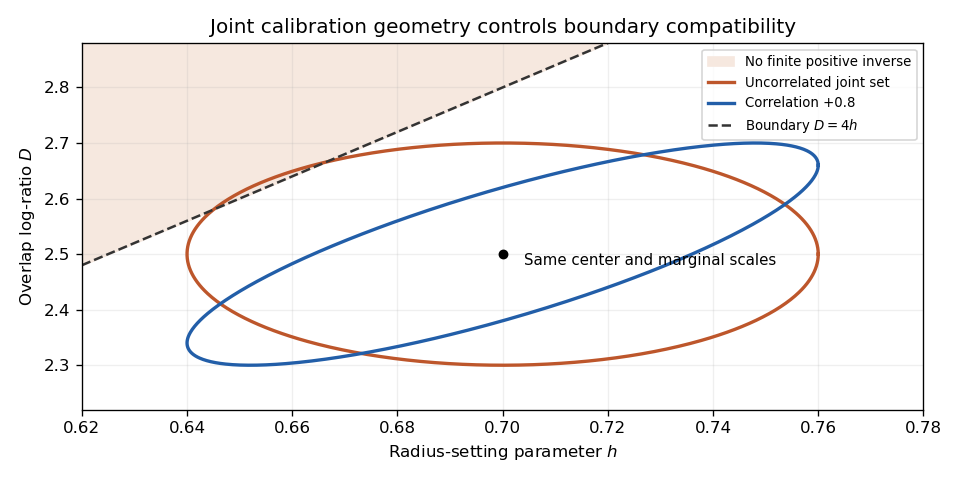
Original joint calibration sets with identical marginal scales: zero correlation crosses the finite-inversion boundary, while correlation +0.8 stays inside
. Details. 
If a set intersects the forbidden region, report the incompatibility and examine calibration, model adequacy and the meaning of the input bounds. Clipping points and applying the inverse to the survivors changes the propagated set or probability distribution. JCGM 101 separates input assignment, propagation and output summaries and gives conditions for valid Monte Carlo propagation.[ref] An illustrative ellipse is a deterministic set here; interpreting it as a confidence region requires an additional statistical model.
New to topics? Read the docs here!