Floating-point arithmetic
ID: floating-point-arithmetic

Floating-point arithmetic represents a real number by a sign, a fixed number of significant digits, and a scale. It trades exactness for a compact representation spanning many orders of magnitude. The picture shows the essential compromise: with the same precision, large numbers have wider gaps between representable neighbors. Thus accuracy is naturally relative to magnitude, rather than a fixed distance along the number line.
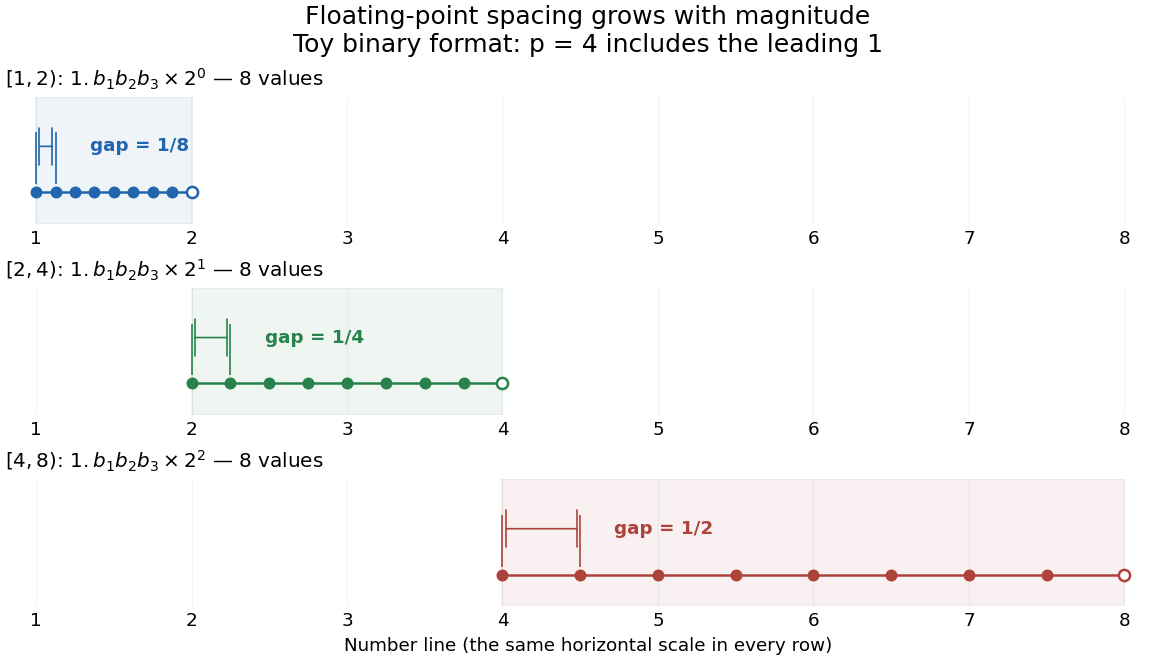
Eight normalized four-bit binary values in each of three intervals, with gaps doubling from one eighth to one half
. Details. In radix , an integer at least two, a nonzero normalized value has the positional notationwhere the digits and exponent are integers. The parenthesized factor is the significand; counts all its significant digits, including the leading digit. Normalization means , so the same value has one such representation. The allowed exponents satisfy . Finite precision restricts the available digits, while the exponent bounds restrict the range. Zero needs a separate representation. This scales a digit string in positional notation by a power of its base.[ref]
https://docs.oracle.com/cd/E19957-01/806-3568/ncg_goldberg.html. David Goldberg, What Every Computer Scientist Should Know About Floating-Point Arithmetic, §Floating-point Formats, 1991; Oracle's authorized edited reprint
For positive normalized values in , increasing the last digit by one gives the constant neighbor spacingAt the next scale, the spacing is multiplied by . In the binary numeral system with , the values in are ; those in are ; those in are . The respective gaps are , , and . Although absolute resolution deteriorates with magnitude, stays between and . This scale invariance is why floating-point arithmetic suits both microscopic and astronomical calculations.
The IEEE 754 binary64 format uses the binary numeral system with , including an implicit leading one for normalized values, and normal exponents . Its 64 stored binary digits comprise one sign digit, 11 exponent digits and 52 trailing significand digits. Subnormal numbers extend the range toward zero with a different leading-digit rule. In rounding to nearest, an operation returns the representable value closest to its exact result; a tie goes to the value whose last significant binary digit is even. Machine epsilon describes the gap just above one, whereas unit roundoff bounds a single relative rounding error in the normal range. These format and rounding rules are presented in MIT's floating-point lecture.[ref]
https://ocw.mit.edu/courses/18-335j-introduction-to-numerical-methods-spring-2019/2f313023ae3404bc217a81a31b227170_MIT18_335JS19_lec2.pdf. Per-Olof Persson, MIT 18.335J, Lecture 2: Floating-Point Arithmetic, the IEEE Standard, slides 6–9, 2019
Even an ordinary terminating decimal can require rounding in the binary numeral system. The rational number has the repeating positional notation . Every finite binary fraction has a reduced denominator that is a power of two, so the factor five in prevents an exact finite binary representation. In binary64, the exact stored values of three decimal literals and their computed sum areThe exact sum of the first two stored rational numbers is , halfway between two binary64 values. The even-last-digit tie rule rounds it upward. The printed result is
0.30000000000000004, one step above stored 0.3, so 0.1 + 0.2 == 0.3 is false. Both conversion of the inputs and rounding of the addition matter here.To reproduce the table on a Python installation using binary64, inspect exact fractions rather than only their printed decimal representations:Python's
import sys
assert (sys.float_info.radix, sys.float_info.mant_dig) == (2, 53)
for value in (0.1, 0.2, 0.3, 0.1 + 0.2):
    print(repr(value), value.as_integer_ratio())
print(0.1 + 0.2 == 0.3) # Falseas_integer_ratio() returns a pair of integers whose quotient equals the stored finite value exactly.[ref]https://docs.python.org/3.14/library/stdtypes.html#float.as_integer_ratio. Python 3.14 documentation, float.as_integer_ratio
Exact rational numbers are also useful for checking floating-point arithmetic: a short decimal printout can hide the approximation being made.Historically, David Goldberg's March 1991 ACM Computing Surveys paper explained representation, rounding and catastrophic cancellation together with the IEEE standard's design choices. Oracle provides an authorized edited reprint. Its enduring lesson is practical: use the spacing to understand roundoff error, and inspect intermediate values when mathematically equivalent algorithms behave differently.[ref]
https://docs.oracle.com/cd/E19957-01/806-3568/ncg_goldberg.html. Goldberg, 1991, reprint notice and §§Rounding Error, Cancellation


New to topics? Read the docs here!