Flow-profile mismatch in Doppler stroke-volume estimation
ID: flow-profile-mismatch-in-doppler-stroke-volume-estimation

Flow-profile mismatch in Doppler stroke-volume estimation occurs when the velocity used in a stroke volume calculation does not represent the spatial average over the measured opening. The exact instantaneous volumetric flow rate isfor fixed area . Consequently . Replacing by a centerline velocity or fastest spectral envelope requires an additional profile assumption. The ASE report distinguishes the modal part of a pulsed Doppler spectrum from the outer continuous-wave envelope representing the fastest detected cells.[ref]
Recommendations for Quantification of Doppler Echocardiography by Miguel A. Quiñones and others. PW Doppler and CW Doppler, printed p.169
An original family of axisymmetric profiles makes the missing factor explicit. Within a circular opening of radius , supposeHere is the centerline velocity. Integrating concentric annuli givesThe Doppler profile correction factor is therefore for this stipulated family. A parabolic profile has ; a blunter profile has . Both have the same centerline velocity and vanish at the wall. These shapes are examples, not fitted cardiac profiles.
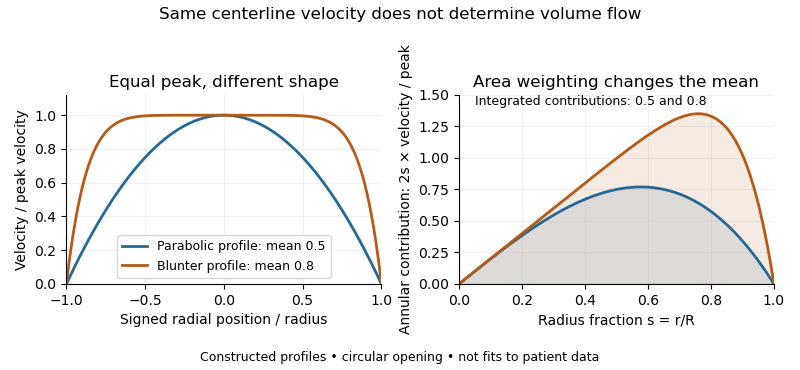

For and a centerline velocity-time integral of , uncorrected multiplication by gives . The two model profiles instead transport approximately and . Identical peak data can therefore support different transported volumes when the profile differs.
Real Doppler measurements also involve beam direction, sample-volume extent and signal processing. Their spectral envelope need not coincide with the literal centerline trace used in this example. The illustration isolates the averaging issue; it is not a universal factor-of-two correction for clinical measurements. The sampling site and anatomical area must be matched as well.[ref]
Recommendations for Quantification of Doppler Echocardiography by Miguel A. Quiñones and others. PW Doppler, p.168, matched velocity and area locations
New to topics? Read the docs here!