Fourier model of a Lyot coronagraph
ID: fourier-model-of-a-lyot-coronagraph

Consider an ideal coherent monochromatic wave from an unresolved source on the optical axis, a uniform circular entrance pupil of diameter , and ideal relay optics without wavefront errors. In the scalar Fraunhofer diffraction approximation, a Fourier transform carries the pupil's complex amplitude into the image plane. Choose dimensionless pupil coordinates in units of and angular coordinates , where is the wavelength. DefineThe coronagraphic focal plane mask has transmission , with inside the occulting disk and outside. Thus the field immediately after the mask is . Outside the disk , so the local wave intensity is still : hiding the core has left those rings intact. Reimaging an unlimited pupil giveswhere is convolution, is the Lyot stop transmission, and the proportionality constant in the irradiance is omitted. Coordinate reversals from physical relay optics are absorbed into the coordinate choice. These equations use wave amplitudes throughout propagation; applying a Fourier transform to wave intensity would give a different and incorrect model. This is the pupil/image calculation described by Sivaramakrishnan et al.; the circular disk and numerical choices below are our illustrative specialization. [ref]
https://ao.jpl.nasa.gov/Publications/Technical/2001ApJ.sivaramakrishnan.AO.pdf. Sivaramakrishnan et al., 2001, §2.1, equations 2–6
.The subtraction explains the beauty of the arrangement: in much of the interior, the original pupil field and the convolution term nearly cancel. Near a boundary, that cancellation is incomplete. The Lyot stop can therefore block a region containing disproportionately much unwanted light. A hard-edged coronagraphic focal plane mask has a transform with extended tails, so the interior need not be perfectly dark. With an unlimited relay, gives exactly: no further ring suppression occurs. A stop covering the full original optical pupil instead uses and already clips field outside the optical pupil; an undersized Lyot stop clips more of the remaining rim.
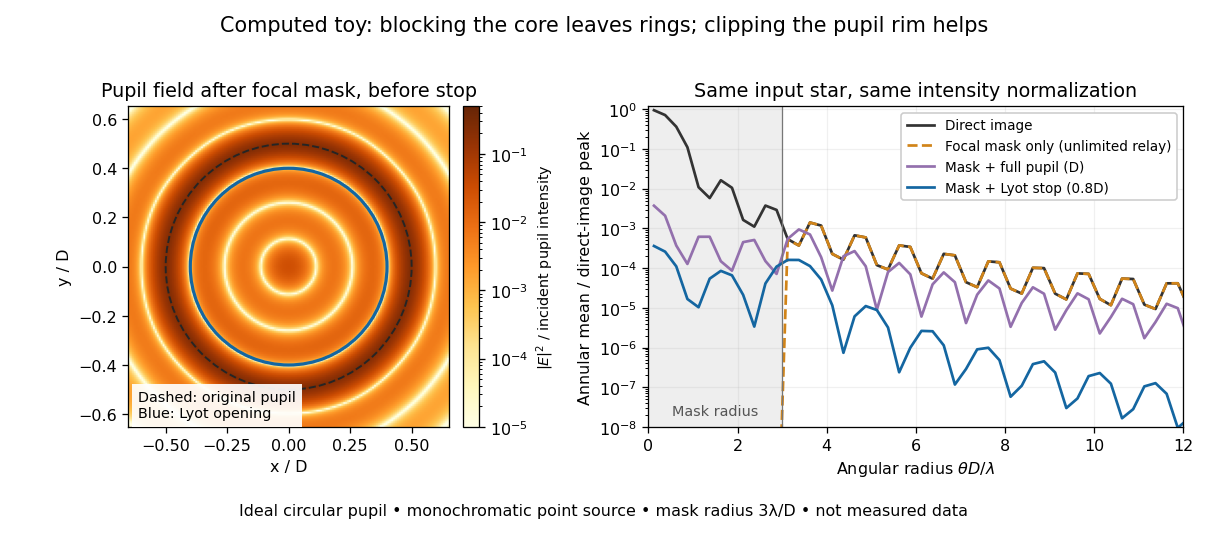
Original Fourier transform calculation for a circular entrance pupil: the residual wave intensity before the Lyot stop, and final radial profiles with different pupil openings. All curves use the same unmasked stellar peak normalization. Ideal toy, not measured data.
Details. 
The toy uses a coronagraphic focal plane mask of angular radius and a Lyot stop of diameter . The discrete Fourier transform grid has samples, with 128 across and angular sampling ; it approximates the continuous equations on a finite periodic domain. The plot averages wave intensity in annuli of width . Over the annulus , the mean wave intensity divided by the direct stellar peak is approximately without a coronagraph, the same with only the focal mask and an unlimited relay, with the mask and full pupil, and with the mask and Lyot stop. Thus the undersized opening reduces this particular annular mean about 27-fold relative to the full-pupil comparison. It does not suppress every direction by that factor, and these values do not predict a real instrument's detection limit.
The ideal toy excludes a central obstruction, support vanes, scattering of light, wavefront errors, atmospheric effects, a spread of wavelengths, pointing drift and detector noise. It also contains only the star: no simulated planet or solar corona. For a far off-axis source whose image misses the coronagraphic focal plane mask, the continuous geometric coronagraph throughput of the opening tends to relative to the full disk. Rejecting stellar light therefore costs some desired light as well. Enlarging the coronagraphic focal plane mask narrows the characteristic scale of its pupil-plane transform by the scaling property of the Fourier transform, but also hides a larger neighborhood of the source.
New to topics? Read the docs here!