Generalized pigeonhole principle
ID: generalized-pigeonhole-principle

For objects assigned to boxes, let be the number in box . The generalized pigeonhole principle statesThe ceiling function rounds up because box counts are integers. An equivalent threshold formulation says: for a positive integer , if , some box contains at least objects. For , putting objects in each box shows why the strict inequality matters. [ref]
https://ocw.mit.edu/courses/6-042j-mathematics-for-computer-science-spring-2015/mit6_042js15_textbook.pdf#page=583. Lehman, Leighton and Meyer, Mathematics for Computer Science, section 14.8.1, rule 14.8.2
Computed examples. For and , . Counts attain this bound. For and , , and the balanced counts sum to and have largest count exactly . The threshold version agrees: . In contrast, seven boxes each containing three hold only objects.
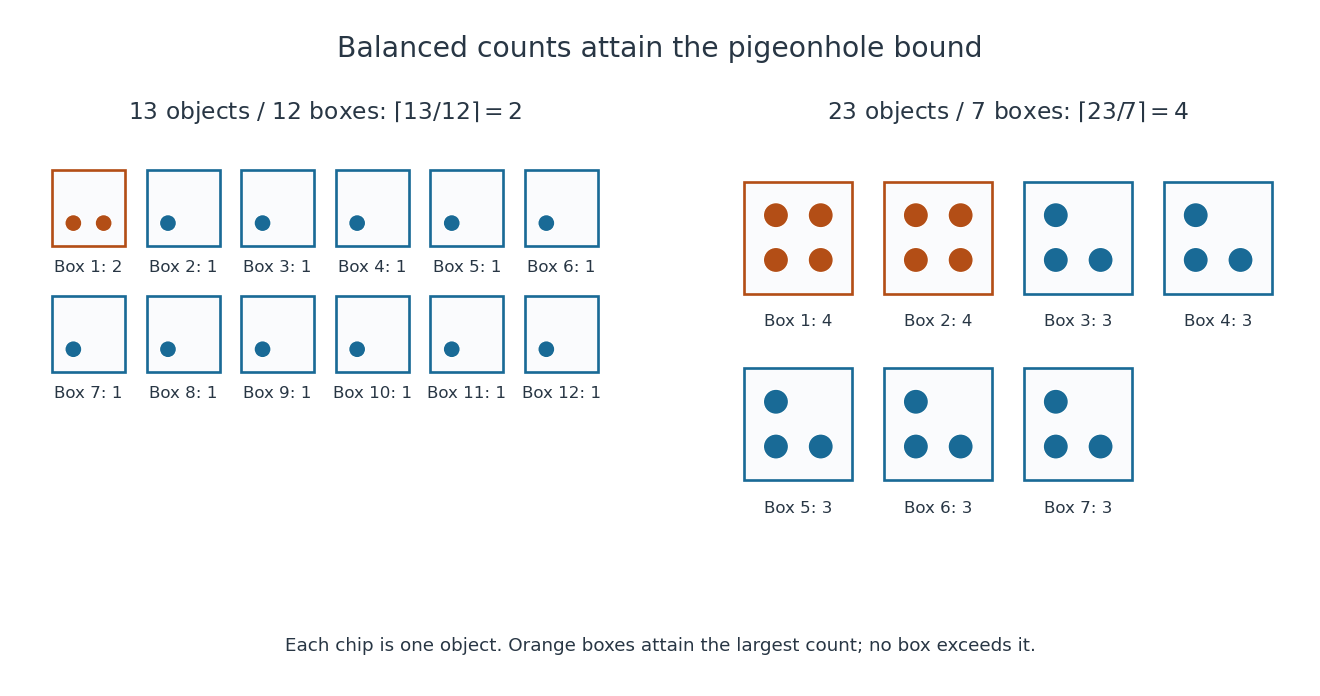
Two balanced arrangements attain the generalized pigeonhole principle bounds: thirteen objects in twelve boxes force two, and twenty-three in seven force four
. Details. 
The bound is sharp for every and . Use Euclidean division to write with integers and . Place objects in each of boxes and objects in each remaining box. The largest count is if , and if , exactly . This balanced arrangement makes the guarantee best possible even though other arrangements can be much more crowded.
Proof outline. If every count were at most , the total would be at most . This contradicts . Taking proves the displayed bound for ; for every count is zero.
New to topics? Read the docs here!