
A grapheme cluster is a sequence of Unicode code points treated as a unit by a text-segmentation rule. Default extended grapheme clusters approximate user-perceived characters, supporting operations such as moving a text cursor or deleting a visible unit. They are not a universal linguistic definition of a text character; boundaries can require language-specific tailoring.[ref]
Unicode Text Segmentation by the Unicode Consortium. Sections1,3 and3.1.1: purpose, extended clusters and default boundary rules
For example,
e followed by the combining character U+0301 COMBINING ACUTE ACCENT contains two code points, but forms one default extended grapheme cluster. Its UTF-8 representation has three bytes: 65 CC 81 in hexadecimal notation. The precomposed U+00E9 also forms one grapheme cluster, with two UTF-8 bytes, C3 A9. The two representations correspond under the canonical rules of Unicode normalization.[ref]Unicode Normalization Forms by the Unicode Consortium. Sections1.1–1.3: canonical equivalence, decomposition and composition
A glyph count answers another question: text shaping can represent the two text characters
f and i by one typographic ligature even though their default grapheme cluster boundary remains. Byte offsets, code point offsets, grapheme cluster boundaries and glyph indices therefore serve different purposes.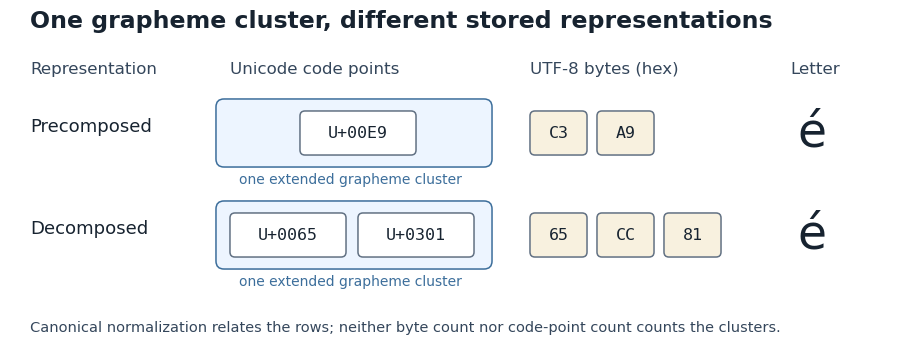

New to topics? Read the docs here!