Hall's marriage theorem
ID: hall-s-marriage-theorem

For a finite bipartite graph with disjoint left and right vertex sets, Hall's marriage theorem characterizes when distinct allowed partners can be chosen for every left vertex. A matching in a graph with matching saturation of exists if and only if every subset satisfiesThe graph neighbourhood counts distinct right vertices, rather than edges or repeated choices. This is the Hall condition. Its failure supplies a concrete Hall obstruction. Necessity follows because the chosen partners of are distinct members of ; sufficiency is the surprising assertion that these collective counts rule out every obstacle.[ref]
The right side may be larger: matching saturation of leaves right vertices unmatched. Only when does a matching in a graph saturating automatically become a perfect matching. For a specified subset , apply the same criterion only to , using the induced subgraph on . The remaining left vertices need not be matched. The empty set gives ; if is empty, the empty matching in a graph suffices.
Consider a scheduling model with three unit-duration jobs and four available slots on one machine. Each job needs exactly one slot, each slot accepts at most one job, and the allowed slots areThe bipartite graph below admits , a matching in a graph saturating all jobs while leaving slot unused. It is not a perfect matching of the seven-vertex graph. A greedy choice initially blocks , but the augmenting path in a matching replaces by ; subsequent assignment of succeeds. A bad partial choice is not an impossibility certificate.
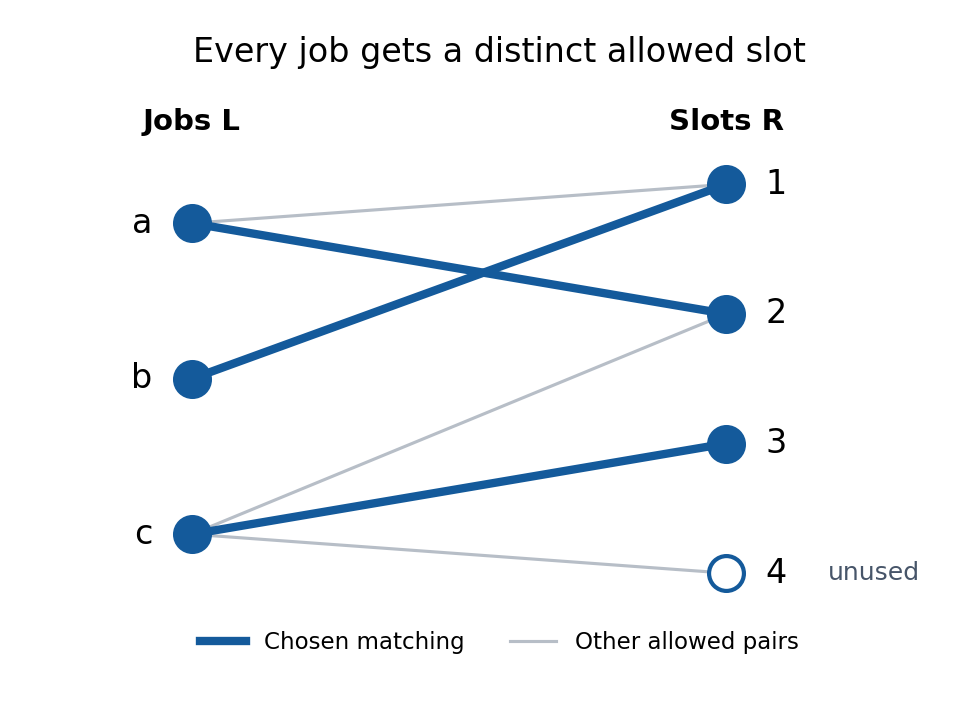
There are eight subsets of . Listing each graph neighbourhood makes the all-subset requirement explicit:
There are exactly two matchings in a graph saturating : and . Job forces slot , then job forces slot , leaving two choices for .


Hall's Marriage Theorem is a result in combinatorial mathematics, specifically in the area of graph theory and bipartite matching. It provides a necessary and sufficient condition for the existence of a perfect matching in a bipartite graph.
New to topics? Read the docs here!