The Hall condition requires enough distinct neighbours for every subset of the specified left vertex set in a finite bipartite graph. Checking the whole left set establishes only one inequality. Checking singleton sets establishes only that each left vertex has positive degree of a vertex. Overlapping lists can pass both tests and still fail to admit matching saturation of the left side.
A Hall obstruction is a left subset with fewer distinct neighbours than vertices. At most members of can be matched, so at least must remain unmatched. The pigeonhole principle proves failure without enumerating every proposed assignment.
For a stronger counterexample than an isolated vertex, take and withEvery vertex has positive degree of a vertex, the sides have equal cardinality, and . Every two-vertex left subset also passes the Hall condition. Nevertheless has only , so rules out matching saturation of .
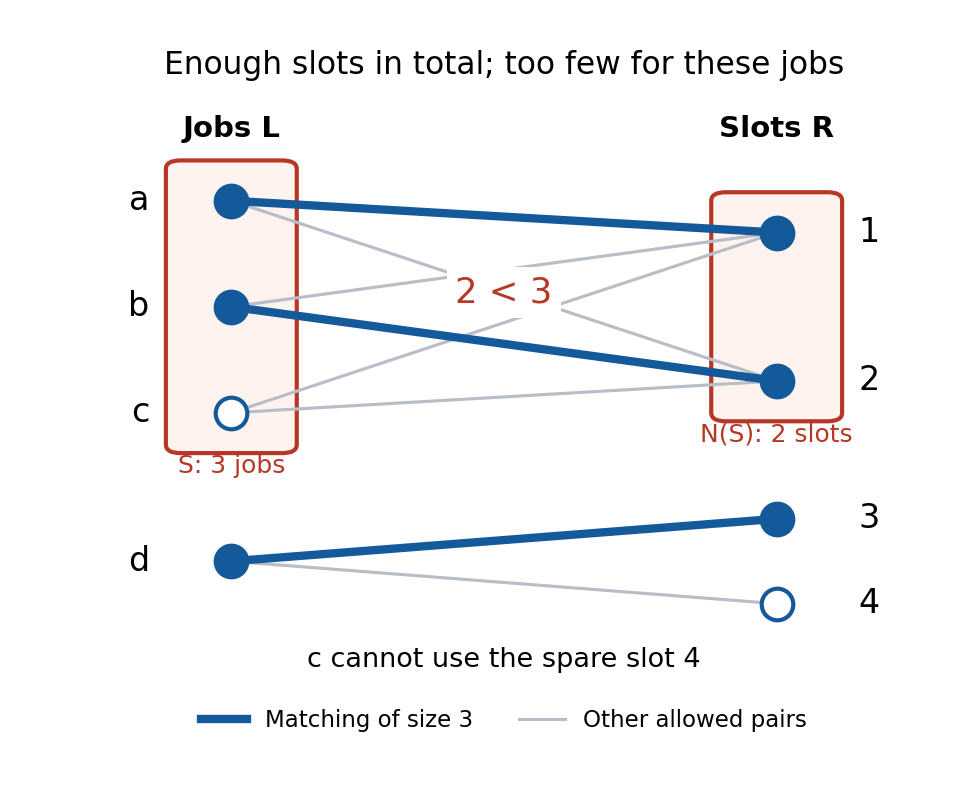

All sixteen left subsets can be checked by writing and if , otherwise . ThenOnly violates the Hall condition. Every matching in a graph uses at most two edges incident to and at most one incident to , so the matching number is three. There are exactly twelve size-three matchings in a graph: choose two of in three ways, assign them to in two ways, and choose or for . Thus the obstruction identifies the bottleneck: adding availability only for cannot help; allowing to use slot permits , a perfect matching.
Articles by others on the same topic
There are currently no matching articles.