
The harmonic mean of a nonempty finite list of positive real numbers is the multiplicative inverse of the arithmetic mean of their inverses:For two inputs, . Replacing each input by preserves the sum of inverses, making it useful when a fixed amount divided by a rate determines a cost or duration. This positive-input definition avoids division by zero; negative inputs need not retain the usual averaging or ordering properties. [ref]
https://dlmf.nist.gov/1.2.iv. NIST Digital Library of Mathematical Functions, §1.2(iv), equation 1.2.19: harmonic mean
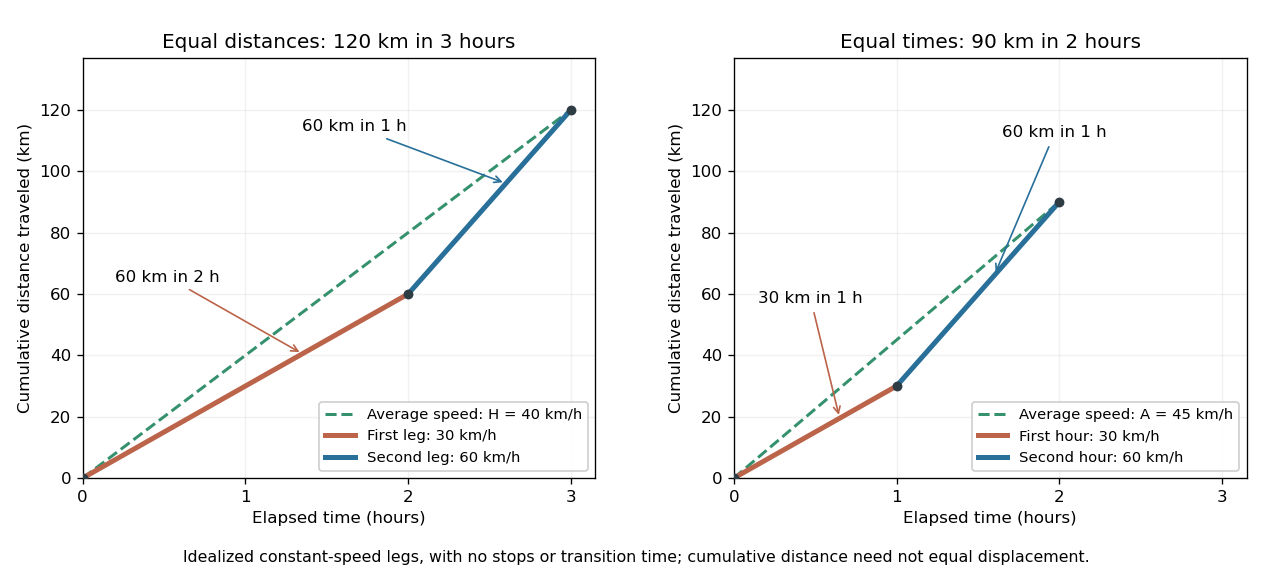
.Travel two legs of equal length at positive speeds , with no stops. Their travel times are and , so the average speed isFor two legs at and , the times are two hours and one hour. The average speed is . The same speeds maintained for one hour each instead cover in two hours, giving the arithmetic mean . A slower equal-distance leg occupies more time, so the data being averaged must include what is held equal. This is total distance traveled divided by elapsed time; a return journey can have zero average velocity while keeping a positive average speed. [ref]
https://undergroundmathematics.org/introducing-calculus/average-speed/averages. University of Cambridge, Underground Mathematics: equal-distance and equal-time speed averages
.
The arithmetic-geometric mean inequality applied to the inverses gives ; together with it yields the comparison in geometric mean. For two inputs the arithmetic–harmonic gap has the exact formFor and the gap is five. With one positive input held fixed and another approaching zero, the harmonic mean approaches zero too: a very slow fixed-distance leg dominates the travel time. Unequal leg lengths instead require a weighted harmonic mean.


The harmonic mean is a measure of central tendency that is particularly useful for sets of numbers that are defined in relation to some unit, such as rates or ratios. It is defined as the reciprocal of the arithmetic mean of the reciprocals of a set of numbers. To calculate the harmonic mean of a set of \( n \) numbers \( x_1, x_2, ...
New to topics? Read the docs here!