Velocity is the vector giving the rate of change of position with time, measured in a specified reference frame. For a differentiable path r(t), its instantaneous velocity and its average velocity between two times areThe displacement in the numerator retains direction. In Cartesian coordinates, each vector component is a derivative, for example vx=dx/dt; its sign tells whether the corresponding coordinate is increasing or decreasing. The SI unit of velocity is m/s. [ref]
v(t)=dtdr,vavg=t2−t1r(t2)−r(t1),t2>t1.
https://openstax.org/books/university-physics-volume-1/pages/3-2-instantaneous-velocity-and-speed. Ling, Sanny and Moebs, University Physics Volume 1, section 3.2: instantaneous velocity and speed
For a concrete reversal, let x(t)=(1m)+(1m/s2)t2−(2m/s)t for 0≤t≤2s. Its signed velocity is vx(t)=(2m/s2)t−2m/s: at t=0 it is −2m/s, at t=1s it is zero, and at t=2s it is +2m/s. The opposite endpoint velocities describe opposite directions, although the endpoint speeds agree. The position moves from 1m to 0 and back to 1m.
Recovering displacement from a measured velocity is an integration problem: r(t2)−r(t1)=∫t1t2v(t)dt, with the integral taken component by component. In the reversal example, ∫02svx(t)dt=0: the negative and positive contributions cancel. This distinction is useful in navigation, where the final position depends on direction as well as speed.
The normal velocity is the scalar component of a velocity in a specified unit-normal direction. Its sign depends on the orientation of the normal. At a material interface, no penetration equates the fluid and interface normal velocities; it does not require their tangential components to agree. Surface acoustic impedance uses a fixed inward normal-velocity convention to determine the sign of energy absorbed by a boundary.
Speed is the nonnegative magnitude of velocity, a scalar rather than a vector. In orthonormal Cartesian coordinates,Its SI unit is m/s. In the reversal example under velocity, the endpoint velocities −2m/s and +2m/s both have speed 2m/s, but the speed falls to zero between them. A speed reading alone therefore cannot tell which way the body is moving.
v(t)=∣v(t)∣=vx(t)2+vy(t)2+vz(t)2.
For a smooth path, the total distance traveled is its arc length, L=∫t1t2v(t)dt. Unlike the integral of a signed velocity component, this integral cannot cancel outward and return motion. The reversal example travels 2m in 2s, giving an average speed of 1m/s, while its average velocity is zero. This makes speed useful for estimating travel duration or fuel use, while velocity also tracks progress toward a destination. [ref]
https://openstax.org/books/university-physics-volume-1/pages/3-2-instantaneous-velocity-and-speed. Ling, Sanny and Moebs, section 3.2: distance traveled versus displacement
Acceleration is the time derivative of velocity, equivalently the second derivative of position:It is a vector with SI unit m/s2. A change in direction produces acceleration even if speed stays constant. For example, a car rounding a bend at steady speed needs an inward resultant force by Newton's second law. Thus acceleration does not mean only speeding up. When v>0, the dot product gives dv/dt=v⋅a/v: a perpendicular acceleration changes direction without changing speed at that instant.
a(t)=dtdv=dt2d2r.
Take counterclockwise circular motion about the origin with radius R=2m and constant angular speed ω=0.5rad/s. The position, velocity and acceleration areThe speed is Rω=1m/s throughout, while the inward centripetal acceleration has magnitude Rω2=v2/R=0.5m/s2. At the four cardinal points, reached at t=0,π,2π,3πs, the velocities in m/s are (0,1),(−1,0),(0,−1),(1,0); the accelerations in m/s2 are (−0.5,0),(0,−0.5),(0.5,0),(0,0.5). The vectors turn together, remaining perpendicular. [ref]
r(t)v(t)a(t)=(Rcos(ωt),Rsin(ωt)),=(−Rωsin(ωt),Rωcos(ωt)),=(−Rω2cos(ωt),−Rω2sin(ωt))=−ω2r(t).
https://openstax.org/books/university-physics-volume-1/pages/4-4-uniform-and-nonuniform-circular-motion. Ling, Sanny and Moebs, section 4.4: uniform circular motion
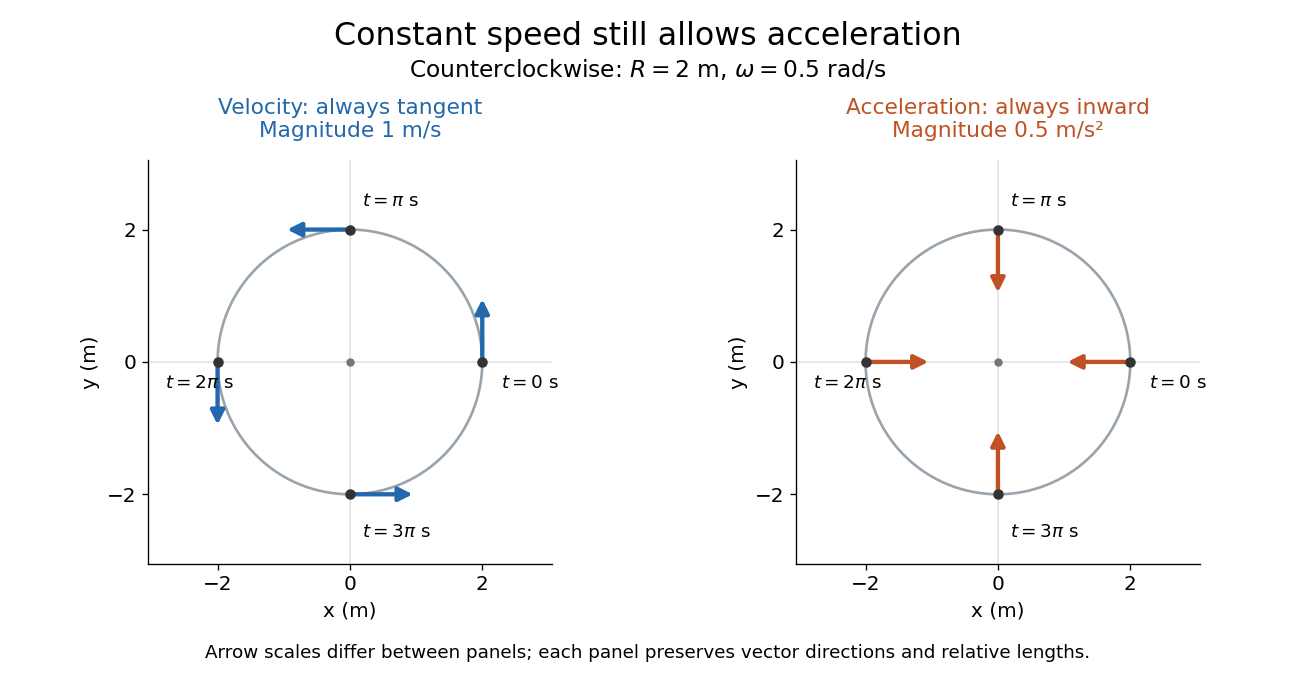
The proof outline is just two applications of the chain rule to r(t); sin2(ωt)+cos2(ωt)=1 then fixes both magnitudes. The usefulness is geometric: turning requires a force even when a speed reading remains steady, and doubling speed at fixed radius quadruples the required centripetal acceleration. The same mechanism appears in a circular orbit.
Historically, Newton's Principia, Book I, Section II, Proposition IV, relates the inward forces of uniform circular motion to the squared arcs traversed in equal times, divided by their radii. In modern notation, its dependence on speed and radius is v2/R; Newton presents a geometric argument rather than the coordinate derivatives above. [ref]
https://en.wikisource.org/wiki/The_Mathematical_Principles_of_Natural_Philosophy_(1729)/Book_1/Section_2. Newton, Principia, Book I, Proposition IV; Motte's 1729 translation
The kinematic jerk is the time derivative of acceleration. For a Kepler orbit with relative position r, relative velocity v, r=∣r∣, r˙=r⋅v/r and total mass M, differentiation of Newton's law of universal gravitation gives j=−GM(v−3r˙r/r)/r3.
A path has constant speed when the magnitude of its velocity does not vary with time. Its acceleration may still be nonzero: uniform circular motion has turning velocity and inward centripetal acceleration. Constant velocity is stronger, requiring unchanged direction as well as unchanged speed.
Terminal velocity is a constant limiting velocity approached when a velocity-dependent resistance balances the other applied forces. A falling body may keep moving while its net force and acceleration tend to zero. For downward motion in a stationary medium, its limiting speed is set by balancing gravitational weight against drag force, including buoyancy if appreciable. The balance, rather than a universal numerical value, is the defining idea. [ref]
https://openstax.org/books/university-physics-volume-1/pages/6-4-drag-force-and-terminal-speed. Ling, Sanny and Moebs, section 6.4: drag and terminal speed
The terminal velocity under linear drag gives a simple example with an explicit approach to the limit. Real falling objects need an appropriate resistance model: linear drag is useful for slow motion of a small sphere in Stokes flow, whereas many faster falling objects require quadratic drag. Changing mass also changes the question: the existing accreting raindrop with quadratic drag has a speed-radius attractor of an accreting raindrop, rather than the fixed-mass balance used below.
Consider a point mass of fixed mass M>0 released from rest in a stationary medium. Choose downward as positive, assume constant gravitational acceleration g>0, neglect buoyancy, and impose linear drag Fd=−bv with constant linear friction coefficient b>0. Here v is the signed downward velocity component; it equals speed during this descent. Newton's second law becomesThe terminal velocity balances the two forces, and the time constant τ controls how quickly that balance is approached:For the illustrative parameters M=1kg, b=2kg/s and g=9.8m/s2, the time constant is 0.5s and the terminal velocity is 4.9m/s downward. At t=1s=2τ, the downward velocity is 4.9(1−e−2)m/s≃4.23686m/s and the downward acceleration is 9.8e−2m/s2≃1.32629m/s2. This is a toy linear drag model, not a claim that every 1kg falling object has this resistance law.
Mdtdv=Mg−bv,v(0)=0,vT=bMg,τ=bM.
v(t)=vT(1−e−t/τ),a(t)=dtdv=ge−t/τ,t≥0.
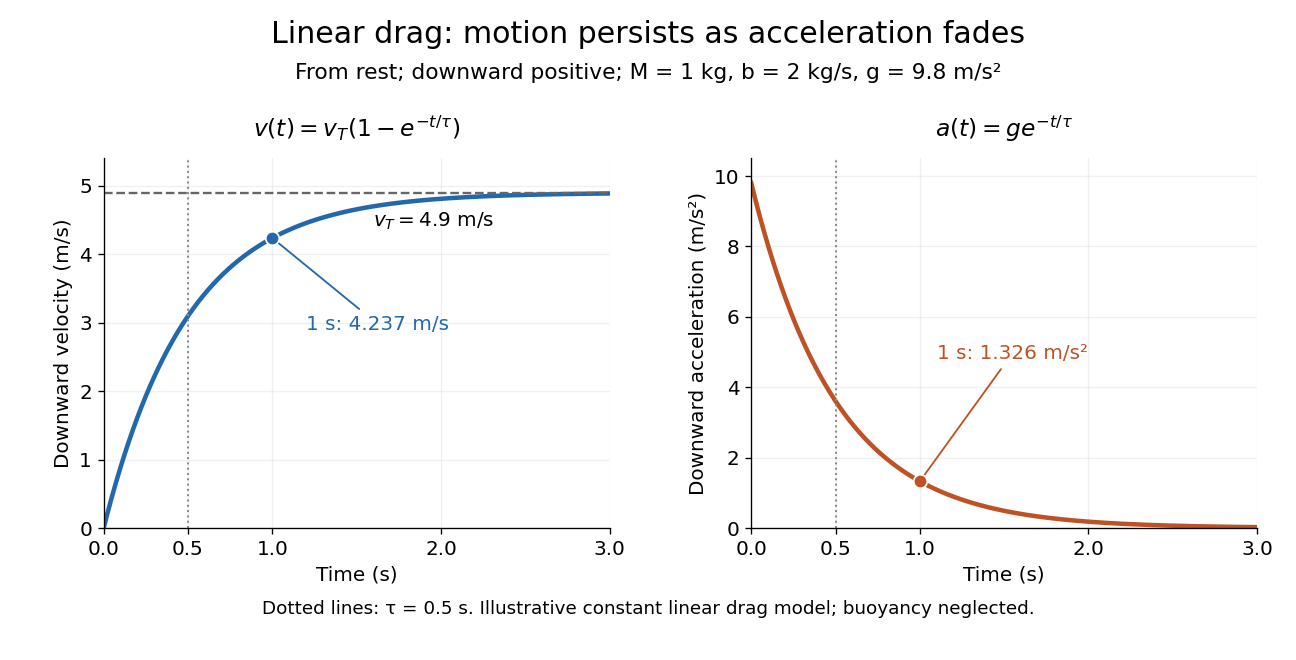
Exponential approach to terminal velocity and decay of acceleration in an illustrative linear drag model
. Details. For a proof outline, subtract the equilibrium value: u=v−vT obeys du/dt=−u/τ. The exponential decay solution and the initial condition give u=−vTe−t/τ; one derivative gives the acceleration. Every time constant multiplies the remaining gap vT−v by e−1. The exact limit is reached only as t→∞. This makes the model useful for estimating a settling duration without mistaking vanishing acceleration for vanishing velocity.
Newton already analyzed vertical motion under uniform gravity and resistance proportional to velocity in Book II, Section I, Proposition III of the Principia. His geometric construction includes a greatest downward velocity, illustrating that a limiting rate can emerge from balancing a driving force and resistance. [ref]
https://en.wikisource.org/wiki/The_Mathematical_Principles_of_Natural_Philosophy_(1729)/Book_2/Section_1. Newton, Principia, Book II, Proposition III; Motte's 1729 translation
Ancestors (5)
Incoming links (935)
- Acceleration
- Accreting raindrop with quadratic drag
- Accreting similarity disk with viscosity proportional to radius
- Additive constant
- Adjoint equations for Boussinesq scalar mixing
- Airfoil
- Air-track test of inertial motion
- Ambipolar damping
- Anelastic approximation for a rotating barotropic star
- Angle of attack
- Angular momentum
- Angular momentum and the escape energy threshold
- Angular momentum under an origin shift
- Annular viscous extension
- Antiplane perfect plasticity
- Areal velocity
- Astrocentric osculating-element oscillations
- Astroid motion of a harmonic oscillator in a rotating frame
- Axial repulsion of pusher stresslets
- Axial strain rate
- Axisymmetric geostrophic mode
- Axisymmetric waves of a homogeneous incompressible disk
- Balanced forces and constant velocity
- Bilinear map
- Blasius boundary layer
- Bottom-heavy spherical-cell orientation dynamics
- Boundary layer
- Boundary layer thickness
- Boundary work and mean-flow energy of an internal wave
- Brinkman equation
- Brinkman swimming sheet
- Broad-crested weir
- Brownian motion
- Bubble rise near a distant stress-free free surface
- Buoyancy-gradient mixing-length closure
- Buoyancy polarization of a plane internal gravity wave
- Burgers' equation
- Calculus
- Capillary closure of a falling hollow thread
- Cauchy velocity distribution
- Cell conservation in a swimming suspension
- Centred antiplane plastic fan
- Charge carrier
- Circularly polarized nonlinear Alfvén wave
- Circular orbit
- Circular orbit as continuous free fall
- Circulation (physics)
- Clamped-quartic solvability in shallow bioconvection
- Classical mechanics
- Clock hypothesis
- Closed orbits with an inverse-cube perturbation
- Coefficient of kinetic friction
- Cold radial magnetohydrodynamic wind integral
- Collapsible tube flow
- Collisionless Jeans dispersion relation
- Comoving momentum
- Condensate number current
- Conducting-square Darcy convection
- Conduit equation
- Confined-plume momentum fold
- Confined plume with compensating return flow
- Conical pendulum
- Conservative energy flux of a polytropic ideal gas
- Constant-flux floating extensional gravity current
- Constant-mass disk with viscosity proportional to radius
- Constant of integration
- Constant speed
- Constant-speed measurement of kinetic friction
- Contact discontinuity
- Contact slip
- Controllability
- Control volume
- Convection roll
- Conventional current
- Convex viscous potential minimum principle
- Corner expansion of pressure-driven sector flow
- Corotating energy invariant of an axisymmetric magnetic wind
- Corrections to a pulling measurement of kinetic friction
- Cosmological redshift
- Couette flow with a slipping lower wall
- Countertravelling decomposition of the one-dimensional wave equation
- Critical damping
- Critical layer in a shear flow
- Critical-layer regularity of a neutral Hazel mode
- Critical point of a smooth map
- Curve parameter
- Cylinder-averaged torsional Alfvén wave
- D'Alembert formula with initial velocity
- D'Alembert's formula
- Damping
- Damping measurement from free decay
- Darcy velocity
- Definite integral
- Density-gradient centrifugation
- Density-weighted viscosity of a disk
- Derivative
- Differential calculus
- Dipolar perturbations of a critically rotating cylinder
- Displacement thickness
- Doppler cooling
- Doppler cooling force
- Doppler spectroscopy
- Double integrator
- Drag coefficient
- Drift velocity
- Drude model
- Dynamic viscosity
- Eccentricity vector
- Eddington inversion
- Eddy buoyancy flux
- Eddy-current damping
- Effusion
- Elastic collision
- Electric drift in crossed uniform fields
- Electrolyte
- Electromagnetism
- Electron accelerating-voltage wavelength
- Electron magnetohydrodynamics
- Elsässer energy invariant
- Endpoint momentum flux in elongated-body recoil
- Energy uniqueness for traction-driven elasticity
- Entropy mode
- Equal-density ion-neutral Alfvén dispersion relation
- Equal interaction forces and unequal accelerations
- Equal-mass circular binary
- Escape speed, circular speed, and propulsion
- Escape velocity
- Euclidean Killing vector field
- Euclidean vector
- Exoplanet transit photometry
- Extensional equations for a slender Newtonian column
- Extensional screening length of a slumping column
- Faraday's law of induction
- Field-line angular velocity of an axisymmetric wind
- Finite propagation speed
- Finite-test-mass dynamical friction coefficient
- First-order stellar radiation force on a blackbody grain
- Flat-plate boundary-layer traverse experiment
- Floating extensional viscous gravity current
- Fluid
- Fluid mechanics
- Forced Eady edge wave
- Force-free inclusion reduces axial mobility of a centred settling sphere
- Fore-aft symmetry of a sedimenting-sphere encounter
- Fourier decay from a Green-function derivative jump
- Free fall
- Free fall in a constant gravitational field
- Free-surface image of a rotlet dipole
- Frictional heating
- Friction-induced instability of a collapsible-tube flow
- Front velocity
- Fundamental theorem of calculus
- Gaussian envelope in a Klein-Gordon medium
- Gaussian line-of-sight velocity distribution
- Geodesic conserved quantity from a Killing vector
- Geostrophic adjustment of a finite-width height ramp
- Gravity-capillary wave
- Gravity-vorticity interface wave
- Gyroradius
- Gyrotactic circular paths in a rotating cylinder
- Half-anisotropic distribution function
- Harmonic mean
- Hazel model
- HCl and DCl harmonic stretch comparison
- Helical motion in a uniform magnetic field
- Hernquist model
- Hertz spark transmission and detection experiment
- Hubble's law
- Hydraulic conductivity
- Hydraulic resistance
- Hydrodynamical helicity
- Ideal gas pressure from wall collisions
- Ideal magnetohydrodynamic energy conservation
- Incompressible flow
- Inelastic collision
- Inertia
- Inertia criterion for an inclined viscous film
- Inertial frame
- Inertial modes in a rigid rotating sphere
- Inertial motion in an accelerating frame
- Inertia tensor
- Infinite-Prandtl-number convection
- Initial and mean parcel labels in a surface wave
- Initial velocity profile of an annularly confined column
- Instantaneous power
- Integral
- Internal-force cancellation in system momentum
- Internal-wave transmission across a stratification step
- Isothermal collisionless tracer
- Isothermal stellar and gas density equivalence
- Iterated collinear boosts with equal rapidity
- Kalman measurement update
- Kelvin-Helmholtz dispersion relation with gravity
- Kepler radial energy equation
- Kepler's second law
- Kepler velocity hodograph
- Kinematic pressure
- Kinematic reversibility of Stokes flow
- Kinematic viscosity
- Kinetic energy
- Kinetic energy decomposition about the center of mass
- Kinetic-energy decomposition about the centre of mass
- Kinetic friction
- Kinetic theory
- Knudsen number
- Lagrangian fluid displacement
- Laminar flow
- Laser cooling
- Leading interaction of two sedimenting spheres
- Lift (force)
- Linear drag
- Linear friction coefficient
- Linear-gradient isopycnic focusing
- Linear inviscid damping in unbounded Couette flow
- Linearized unsteady Prandtl equation
- Long-wave bioconvection threshold in weak stratification
- Lorentz force
- Lorentz transformation
- Lubrication model of a crawling snail
- Magnetic-energy injection by differential boundary rotation
- Magnetic field
- Magnetic forces do no work
- Magnetic relaxation
- Magnetic skin-layer streaming slip
- Magnetohydrodynamic wave polarization
- Magneto-optical trap
- Mass flow rate
- Matrix-relative Brinkman velocity
- Maximally prograde stellar distribution
- Maxwell-Boltzmann distribution
- Maxwell-Boltzmann velocity distribution
- Maxwell speed distribution
- Mechanical momentum
- Meridional velocity isotropy of a two-integral distribution
- Methods of detecting exoplanets
- Momentum
- Momentum relaxation time
- Momentum thickness
- Most probable speed in the Maxwell distribution
- Motional electromotive force
- Motion of two point vortices
- Navier slip boundary condition
- Newtonian fluid stress tensor
- Newton's first law
- Newton's second law
- Newton's third law
- No lateral migration of a single sphere in a uniform tube in Stokes flow
- Nondiffusive convective angular momentum transport
- Normal component of a superfluid
- Normal mode
- Normal shock reflection at a rigid wall
- Normal velocity
- No-slip image system of a normal Stokeslet
- One-dimensional wave equation
- One-third-power similarity of an indented channel boundary layer
- Optical molasses
- Optical molasses experiment of 1985
- Orbit determination
- Orbit equation for combined inverse-square and inverse-cube attraction
- Ornstein-Uhlenbeck process
- Oscillating rigid rod in resistive-force theory
- Oscillator energy dissipation
- Osculating orbital element
- Oseen approximation
- Overdamping
- Parallel magnetohydrodynamic shock
- Partial differential equation
- Particle-laden current with suction
- Passage through a translating optical trap
- Passive acoustic impedance
- Past exam of the mathematics course of the University of Cambridge / 2001 / ia / Paper 4 / 10A / Solution
- Past exam of the mathematics course of the University of Cambridge / 2001 / ia / Paper 4 / 4A / Solution
- Past exam of the mathematics course of the University of Cambridge / 2001 / ia / Paper 4 / 9A / Solution
- Past exam of the mathematics course of the University of Cambridge / 2001 / ib / Paper 3 / 10F / Solution
- Past exam of the mathematics course of the University of Cambridge / 2001 / ib / Paper 4 / 16G / Solution
- Past exam of the mathematics course of the University of Cambridge / 2001 / ib / Paper 4 / 7G / Solution
- Past exam of the mathematics course of the University of Cambridge / 2001 / iii / Paper 35 / 2 / Solution
- Past exam of the mathematics course of the University of Cambridge / 2001 / iii / Paper 35 / 3 / Solution
- Past exam of the mathematics course of the University of Cambridge / 2001 / iii / Paper 35 / 4 / Solution
- Past exam of the mathematics course of the University of Cambridge / 2001 / iii / Paper 36 / 1 / a / Solution
- Past exam of the mathematics course of the University of Cambridge / 2001 / iii / Paper 36 / 3 / b / Solution
- Past exam of the mathematics course of the University of Cambridge / 2001 / iii / Paper 38 / 1 / Solution
- Past exam of the mathematics course of the University of Cambridge / 2001 / iii / Paper 38 / 2 / Solution
- Past exam of the mathematics course of the University of Cambridge / 2001 / iii / Paper 40 / 2 / i / Solution
- Past exam of the mathematics course of the University of Cambridge / 2001 / iii / Paper 42 / 1 / Solution
- Past exam of the mathematics course of the University of Cambridge / 2001 / iii / Paper 42 / 2 / Solution
- Past exam of the mathematics course of the University of Cambridge / 2001 / iii / Paper 42 / 3 / Solution
- Past exam of the mathematics course of the University of Cambridge / 2001 / iii / Paper 43 / 1 / a / Solution
- Past exam of the mathematics course of the University of Cambridge / 2001 / iii / Paper 43 / 1 / c / Solution
- Past exam of the mathematics course of the University of Cambridge / 2001 / iii / Paper 43 / 3 / d / Solution
- Past exam of the mathematics course of the University of Cambridge / 2001 / iii / Paper 43 / 5 / a / Solution
- Past exam of the mathematics course of the University of Cambridge / 2001 / iii / Paper 43 / 5 / c / Solution
- Past exam of the mathematics course of the University of Cambridge / 2001 / iii / Paper 44 / 1 / a / Solution
- Past exam of the mathematics course of the University of Cambridge / 2001 / iii / Paper 44 / 4 / Solution
- Past exam of the mathematics course of the University of Cambridge / 2001 / iii / Paper 45 / 1 / ii / Solution
- Past exam of the mathematics course of the University of Cambridge / 2001 / iii / Paper 45 / 1 / i / Solution
- Past exam of the mathematics course of the University of Cambridge / 2001 / iii / Paper 45 / 2 / Solution
- Past exam of the mathematics course of the University of Cambridge / 2001 / iii / Paper 45 / 3 / Solution
- Past exam of the mathematics course of the University of Cambridge / 2001 / iii / Paper 47 / 3 / Solution
- Past exam of the mathematics course of the University of Cambridge / 2001 / iii / Paper 49 / 1 / Solution
- Past exam of the mathematics course of the University of Cambridge / 2001 / iii / Paper 49 / 2 / Solution
- Past exam of the mathematics course of the University of Cambridge / 2001 / iii / Paper 50 / 1 / Solution
- Past exam of the mathematics course of the University of Cambridge / 2001 / iii / Paper 50 / 2 / Solution
- Past exam of the mathematics course of the University of Cambridge / 2002 / ia / Paper 4 / 11E / Solution
- Past exam of the mathematics course of the University of Cambridge / 2002 / ia / Paper 4 / 4E / Solution
- Past exam of the mathematics course of the University of Cambridge / 2002 / ia / Paper 4 / 9E / Solution
- Past exam of the mathematics course of the University of Cambridge / 2002 / ib / Paper 1 / 15C / Solution
- Past exam of the mathematics course of the University of Cambridge / 2002 / ib / Paper 1 / 6C / Solution
- Past exam of the mathematics course of the University of Cambridge / 2002 / ib / Paper 4 / 16C / Solution
- Past exam of the mathematics course of the University of Cambridge / 2002 / iii / Paper 43 / 2 / Solution
- Past exam of the mathematics course of the University of Cambridge / 2002 / iii / Paper 43 / 3 / Solution
- Past exam of the mathematics course of the University of Cambridge / 2002 / iii / Paper 46 / 3 / Solution
- Past exam of the mathematics course of the University of Cambridge / 2002 / iii / Paper 47 / 1 / a / Solution
- Past exam of the mathematics course of the University of Cambridge / 2002 / iii / Paper 47 / 1 / b / Solution
- Past exam of the mathematics course of the University of Cambridge / 2002 / iii / Paper 47 / 1 / c / Solution
- Past exam of the mathematics course of the University of Cambridge / 2002 / iii / Paper 47 / 2 / Solution
- Past exam of the mathematics course of the University of Cambridge / 2002 / iii / Paper 47 / 3 / Solution
- Past exam of the mathematics course of the University of Cambridge / 2002 / iii / Paper 47 / 4 / Solution
- Past exam of the mathematics course of the University of Cambridge / 2002 / iii / Paper 49 / 1 / Solution
- Past exam of the mathematics course of the University of Cambridge / 2002 / iii / Paper 49 / 3 / Solution
- Past exam of the mathematics course of the University of Cambridge / 2002 / iii / Paper 49 / 4 / Solution
- Past exam of the mathematics course of the University of Cambridge / 2002 / iii / Paper 52 / 3 / a / Solution
- Past exam of the mathematics course of the University of Cambridge / 2002 / iii / Paper 52 / 3 / b / Solution
- Past exam of the mathematics course of the University of Cambridge / 2002 / iii / Paper 52 / 5 / a / Solution
- Past exam of the mathematics course of the University of Cambridge / 2002 / iii / Paper 52 / 5 / b / Solution
- Past exam of the mathematics course of the University of Cambridge / 2002 / iii / Paper 52 / 5 / c / Solution
- Past exam of the mathematics course of the University of Cambridge / 2002 / iii / Paper 52 / 5 / e / Solution
- Past exam of the mathematics course of the University of Cambridge / 2002 / iii / Paper 52 / 6 / a / Solution
- Past exam of the mathematics course of the University of Cambridge / 2002 / iii / Paper 52 / 6 / c / Solution
- Past exam of the mathematics course of the University of Cambridge / 2003 / ia / Paper 4 / 3E / Solution
- Past exam of the mathematics course of the University of Cambridge / 2003 / ia / Paper 4 / 4E / Solution
- Past exam of the mathematics course of the University of Cambridge / 2003 / ia / Paper 4 / 9E / Solution
- Past exam of the mathematics course of the University of Cambridge / 2003 / iii / Paper 64 / 1 / Solution
- Past exam of the mathematics course of the University of Cambridge / 2003 / iii / Paper 64 / 2 / Solution
- Past exam of the mathematics course of the University of Cambridge / 2003 / iii / Paper 64 / 3 / Solution
- Past exam of the mathematics course of the University of Cambridge / 2003 / iii / Paper 71 / 2 / a / Solution
- Past exam of the mathematics course of the University of Cambridge / 2003 / iii / Paper 71 / 4 / a / Solution
- Past exam of the mathematics course of the University of Cambridge / 2003 / iii / Paper 71 / 4 / b / Solution
- Past exam of the mathematics course of the University of Cambridge / 2003 / iii / Paper 71 / 7 / a / Solution
- Past exam of the mathematics course of the University of Cambridge / 2003 / iii / Paper 73 / 1 / Solution
- Past exam of the mathematics course of the University of Cambridge / 2003 / iii / Paper 73 / 2 / Solution
- Past exam of the mathematics course of the University of Cambridge / 2003 / iii / Paper 74 / 1 / Solution
- Past exam of the mathematics course of the University of Cambridge / 2003 / iii / Paper 74 / 2 / Solution
- Past exam of the mathematics course of the University of Cambridge / 2003 / iii / Paper 74 / 4 / iii / Solution
- Past exam of the mathematics course of the University of Cambridge / 2003 / iii / Paper 74 / 5 / b / Solution
- Past exam of the mathematics course of the University of Cambridge / 2003 / iii / Paper 75 / 3 / i / a / Solution
- Past exam of the mathematics course of the University of Cambridge / 2003 / iii / Paper 75 / 3 / ii / Solution
- Past exam of the mathematics course of the University of Cambridge / 2003 / iii / Paper 75 / 3 / i / Solution
- Past exam of the mathematics course of the University of Cambridge / 2003 / iii / Paper 75 / 4 / Solution
- Past exam of the mathematics course of the University of Cambridge / 2004 / ia / Paper 4 / 11A / Solution
- Past exam of the mathematics course of the University of Cambridge / 2004 / ia / Paper 4 / 12A / Solution
- Past exam of the mathematics course of the University of Cambridge / 2004 / ia / Paper 4 / 3A / Solution
- Past exam of the mathematics course of the University of Cambridge / 2004 / ia / Paper 4 / 9A / Solution
- Past exam of the mathematics course of the University of Cambridge / 2004 / iii / Paper 64 / 1 / Solution
- Past exam of the mathematics course of the University of Cambridge / 2004 / iii / Paper 64 / 2 / Solution
- Past exam of the mathematics course of the University of Cambridge / 2004 / iii / Paper 64 / 3 / Solution
- Past exam of the mathematics course of the University of Cambridge / 2004 / iii / Paper 64 / 4 / Solution
- Past exam of the mathematics course of the University of Cambridge / 2004 / iii / Paper 73 / 1 / Solution
- Past exam of the mathematics course of the University of Cambridge / 2004 / iii / Paper 73 / 2 / Solution
- Past exam of the mathematics course of the University of Cambridge / 2004 / iii / Paper 73 / 3 / Solution
- Past exam of the mathematics course of the University of Cambridge / 2004 / iii / Paper 73 / 4 / Circulation application / Solution
- Past exam of the mathematics course of the University of Cambridge / 2004 / iii / Paper 74 / 1 / Solution
- Past exam of the mathematics course of the University of Cambridge / 2004 / iii / Paper 74 / 2 / Solution
- Past exam of the mathematics course of the University of Cambridge / 2004 / iii / Paper 74 / 3 / Solution
- Past exam of the mathematics course of the University of Cambridge / 2004 / iii / Paper 74 / 4 / Solution
- Past exam of the mathematics course of the University of Cambridge / 2004 / iii / Paper 75 / 1 / a / Solution
- Past exam of the mathematics course of the University of Cambridge / 2004 / iii / Paper 75 / 1 / b / Solution
- Past exam of the mathematics course of the University of Cambridge / 2004 / iii / Paper 75 / 3 / b / Solution
- Past exam of the mathematics course of the University of Cambridge / 2004 / iii / Paper 75 / 5 / b / Solution
- Past exam of the mathematics course of the University of Cambridge / 2004 / iii / Paper 75 / 5 / c / Solution
- Past exam of the mathematics course of the University of Cambridge / 2004 / iii / Paper 75 / 6 / a / Solution
- Past exam of the mathematics course of the University of Cambridge / 2004 / iii / Paper 77 / 1 / i / Solution
- Past exam of the mathematics course of the University of Cambridge / 2004 / iii / Paper 77 / 2 / Solution
- Past exam of the mathematics course of the University of Cambridge / 2004 / iii / Paper 77 / 3 / i / Solution
- Past exam of the mathematics course of the University of Cambridge / 2004 / iii / Paper 79 / 1 / Solution
- Past exam of the mathematics course of the University of Cambridge / 2004 / iii / Paper 79 / 3 / iii / Solution
- Past exam of the mathematics course of the University of Cambridge / 2004 / iii / Paper 79 / 3 / ii / Solution
- Past exam of the mathematics course of the University of Cambridge / 2004 / iii / Paper 79 / 3 / iv / Solution
- Past exam of the mathematics course of the University of Cambridge / 2004 / iii / Paper 79 / 3 / v / Solution
- Past exam of the mathematics course of the University of Cambridge / 2005 / ia / Paper 4 / 9C / Solution
- Past exam of the mathematics course of the University of Cambridge / 2005 / ib / Paper 2 / 17H / Solution
- Past exam of the mathematics course of the University of Cambridge / 2005 / iii / Paper 71 / 1 / Solution
- Past exam of the mathematics course of the University of Cambridge / 2005 / iii / Paper 71 / 4 / Solution
- Past exam of the mathematics course of the University of Cambridge / 2005 / iii / Paper 72 / 1 / 1 / Solution
- Past exam of the mathematics course of the University of Cambridge / 2005 / iii / Paper 72 / 1 / 2 / Solution
- Past exam of the mathematics course of the University of Cambridge / 2005 / iii / Paper 72 / 1 / Solution
- Past exam of the mathematics course of the University of Cambridge / 2005 / iii / Paper 72 / 2 / a / Solution
- Past exam of the mathematics course of the University of Cambridge / 2005 / iii / Paper 72 / 3 / a / Solution
- Past exam of the mathematics course of the University of Cambridge / 2005 / iii / Paper 72 / 3 / b / Solution
- Past exam of the mathematics course of the University of Cambridge / 2005 / iii / Paper 78 / 5 / a / Solution
- Past exam of the mathematics course of the University of Cambridge / 2005 / iii / Paper 78 / 5 / b / Solution
- Past exam of the mathematics course of the University of Cambridge / 2005 / iii / Paper 78 / 6 / Solution
- Past exam of the mathematics course of the University of Cambridge / 2005 / iii / Paper 81 / 2 / iii / Solution
- Past exam of the mathematics course of the University of Cambridge / 2005 / iii / Paper 81 / 2 / i / Solution
- Past exam of the mathematics course of the University of Cambridge / 2005 / iii / Paper 81 / 2 / iv / Solution
- Past exam of the mathematics course of the University of Cambridge / 2005 / iii / Paper 81 / 2 / v / Solution
- Past exam of the mathematics course of the University of Cambridge / 2005 / iii / Paper 81 / 3 / Solution
- Past exam of the mathematics course of the University of Cambridge / 2005 / iii / Paper 81 / 4 / ii / d / Solution
- Past exam of the mathematics course of the University of Cambridge / 2005 / iii / Paper 82 / 1 / d / Solution
- Past exam of the mathematics course of the University of Cambridge / 2005 / iii / Paper 82 / 3 / b / Solution
- Past exam of the mathematics course of the University of Cambridge / 2005 / iii / Paper 82 / 3 / d / Solution
- Past exam of the mathematics course of the University of Cambridge / 2005 / iii / Paper 82 / 4 / a / Solution
- Past exam of the mathematics course of the University of Cambridge / 2005 / iii / Paper 83 / 1 / iii / Solution
- Past exam of the mathematics course of the University of Cambridge / 2005 / iii / Paper 83 / 3 / ii / Solution
- Past exam of the mathematics course of the University of Cambridge / 2005 / iii / Paper 83 / 3 / i / Solution
- Past exam of the mathematics course of the University of Cambridge / 2005 / ii / Paper 1 / 15C / i / Solution
- Past exam of the mathematics course of the University of Cambridge / 2005 / ii / Paper 1 / 35C / Solution
- Past exam of the mathematics course of the University of Cambridge / 2005 / ii / Paper 1 / 36E / ii / Solution
- Past exam of the mathematics course of the University of Cambridge / 2005 / ii / Paper 1 / 36E / i / Solution
- Past exam of the mathematics course of the University of Cambridge / 2005 / ii / Paper 1 / 6E / a / Solution
- Past exam of the mathematics course of the University of Cambridge / 2006 / ib / Paper 3 / 18A / Solution
- Past exam of the mathematics course of the University of Cambridge / 2006 / iii / Paper 61 / 2 / a / Solution
- Past exam of the mathematics course of the University of Cambridge / 2006 / iii / Paper 62 / 2 / d / Solution
- Past exam of the mathematics course of the University of Cambridge / 2006 / iii / Paper 62 / 4 / b / Solution
- Past exam of the mathematics course of the University of Cambridge / 2006 / iii / Paper 62 / 4 / c / Solution
- Past exam of the mathematics course of the University of Cambridge / 2006 / iii / Paper 62 / 4 / d / Solution
- Past exam of the mathematics course of the University of Cambridge / 2006 / iii / Paper 66 / 3 / a / Solution
- Past exam of the mathematics course of the University of Cambridge / 2006 / iii / Paper 66 / 3 / b / Solution
- Past exam of the mathematics course of the University of Cambridge / 2006 / iii / Paper 70 / 1 / a / Solution
- Past exam of the mathematics course of the University of Cambridge / 2006 / iii / Paper 70 / 1 / d / Solution
- Past exam of the mathematics course of the University of Cambridge / 2006 / iii / Paper 70 / 2 / c / Solution
- Past exam of the mathematics course of the University of Cambridge / 2006 / iii / Paper 73 / 1 / i / Solution
- Past exam of the mathematics course of the University of Cambridge / 2006 / iii / Paper 75 / 1 / Solution
- Past exam of the mathematics course of the University of Cambridge / 2006 / iii / Paper 75 / 2 / Solution
- Past exam of the mathematics course of the University of Cambridge / 2006 / iii / Paper 76 / 2 / Solution
- Past exam of the mathematics course of the University of Cambridge / 2006 / iii / Paper 77 / 1 / Solution
- Past exam of the mathematics course of the University of Cambridge / 2006 / iii / Paper 77 / 3 / Solution
- Past exam of the mathematics course of the University of Cambridge / 2006 / iii / Paper 77 / 4 / iii / Solution
- Past exam of the mathematics course of the University of Cambridge / 2006 / iii / Paper 77 / 4 / ii / Solution
- Past exam of the mathematics course of the University of Cambridge / 2006 / iii / Paper 77 / 4 / vi / Solution
- Past exam of the mathematics course of the University of Cambridge / 2006 / iii / Paper 77 / 4 / v / Solution
- Past exam of the mathematics course of the University of Cambridge / 2006 / iii / Paper 78 / 1 / a / Solution
- Past exam of the mathematics course of the University of Cambridge / 2006 / iii / Paper 78 / 1 / Solution
- Past exam of the mathematics course of the University of Cambridge / 2006 / iii / Paper 78 / 2 / Solution
- Past exam of the mathematics course of the University of Cambridge / 2006 / iii / Paper 78 / 3 / Solution
- Past exam of the mathematics course of the University of Cambridge / 2006 / iii / Paper 78 / 4 / iii / Solution
- Past exam of the mathematics course of the University of Cambridge / 2006 / iii / Paper 78 / 4 / ii / Solution
- Past exam of the mathematics course of the University of Cambridge / 2006 / iii / Paper 78 / 4 / i / Solution
- Past exam of the mathematics course of the University of Cambridge / 2006 / iii / Paper 78 / 4 / Solution
- Past exam of the mathematics course of the University of Cambridge / 2006 / iii / Paper 79 / 1 / i / Solution
- Past exam of the mathematics course of the University of Cambridge / 2006 / iii / Paper 79 / 2 / iv / Solution
- Past exam of the mathematics course of the University of Cambridge / 2006 / iii / Paper 79 / 3 / i / Solution
- Past exam of the mathematics course of the University of Cambridge / 2006 / iii / Paper 83 / 1 / Solution
- Past exam of the mathematics course of the University of Cambridge / 2006 / iii / Paper 83 / 2 / Solution
- Past exam of the mathematics course of the University of Cambridge / 2006 / iii / Paper 83 / 3 / Solution
- Past exam of the mathematics course of the University of Cambridge / 2006 / iii / Paper 83 / 4 / Solution
- Past exam of the mathematics course of the University of Cambridge / 2006 / ii / Paper 1 / 10D / a / Solution
- Past exam of the mathematics course of the University of Cambridge / 2006 / ii / Paper 1 / 36B / Solution
- Past exam of the mathematics course of the University of Cambridge / 2006 / ii / Paper 2 / 33D / Solution
- Past exam of the mathematics course of the University of Cambridge / 2006 / ii / Paper 2 / 36B / Solution
- Past exam of the mathematics course of the University of Cambridge / 2007 / ia / Paper 4 / 10C / ii / Solution
- Past exam of the mathematics course of the University of Cambridge / 2007 / ia / Paper 4 / 10C / i / Solution
- Past exam of the mathematics course of the University of Cambridge / 2007 / ia / Paper 4 / 11C / Solution
- Past exam of the mathematics course of the University of Cambridge / 2007 / ia / Paper 4 / 3C / Solution
- Past exam of the mathematics course of the University of Cambridge / 2007 / ia / Paper 4 / 9C / ii / Solution
- Past exam of the mathematics course of the University of Cambridge / 2007 / ib / Paper 4 / 18D / Solution
- Past exam of the mathematics course of the University of Cambridge / 2007 / ib / Paper 4 / 7E / Solution
- Past exam of the mathematics course of the University of Cambridge / 2007 / iii / Paper 64 / 3 / iii / Solution
- Past exam of the mathematics course of the University of Cambridge / 2007 / iii / Paper 64 / 3 / ii / Solution
- Past exam of the mathematics course of the University of Cambridge / 2007 / iii / Paper 64 / 3 / i / Solution
- Past exam of the mathematics course of the University of Cambridge / 2007 / iii / Paper 65 / 1 / b / Solution
- Past exam of the mathematics course of the University of Cambridge / 2007 / iii / Paper 65 / 1 / c / Solution
- Past exam of the mathematics course of the University of Cambridge / 2007 / iii / Paper 65 / 2 / a / Solution
- Past exam of the mathematics course of the University of Cambridge / 2007 / iii / Paper 65 / 2 / b / Solution
- Past exam of the mathematics course of the University of Cambridge / 2007 / iii / Paper 65 / 2 / c / i / Solution
- Past exam of the mathematics course of the University of Cambridge / 2007 / iii / Paper 65 / 3 / a / Solution
- Past exam of the mathematics course of the University of Cambridge / 2007 / iii / Paper 65 / 3 / b / Solution
- Past exam of the mathematics course of the University of Cambridge / 2007 / iii / Paper 65 / 3 / c / Solution
- Past exam of the mathematics course of the University of Cambridge / 2007 / iii / Paper 65 / 4 / b / Solution
- Past exam of the mathematics course of the University of Cambridge / 2007 / iii / Paper 75 / 1 / a / Solution
- Past exam of the mathematics course of the University of Cambridge / 2007 / iii / Paper 75 / 1 / c / Solution
- Past exam of the mathematics course of the University of Cambridge / 2007 / iii / Paper 75 / 2 / c / Solution
- Past exam of the mathematics course of the University of Cambridge / 2007 / iii / Paper 75 / 3 / a / Solution
- Past exam of the mathematics course of the University of Cambridge / 2007 / iii / Paper 75 / 3 / c / Solution
- Past exam of the mathematics course of the University of Cambridge / 2007 / iii / Paper 77 / 1 / ii / Solution
- Past exam of the mathematics course of the University of Cambridge / 2007 / iii / Paper 77 / 1 / Solution
- Past exam of the mathematics course of the University of Cambridge / 2007 / iii / Paper 77 / 2 / Solution
- Past exam of the mathematics course of the University of Cambridge / 2007 / iii / Paper 77 / 3 / Solution
- Past exam of the mathematics course of the University of Cambridge / 2007 / iii / Paper 77 / 4 / Solution
- Past exam of the mathematics course of the University of Cambridge / 2007 / iii / Paper 78 / 1 / Solution
- Past exam of the mathematics course of the University of Cambridge / 2007 / iii / Paper 78 / 2 / b / Solution
- Past exam of the mathematics course of the University of Cambridge / 2007 / iii / Paper 78 / 2 / Solution
- Past exam of the mathematics course of the University of Cambridge / 2007 / iii / Paper 78 / 3 / Solution
- Past exam of the mathematics course of the University of Cambridge / 2007 / iii / Paper 81 / 1 / Solution
- Past exam of the mathematics course of the University of Cambridge / 2007 / iii / Paper 81 / 2 / Solution
- Past exam of the mathematics course of the University of Cambridge / 2007 / iii / Paper 81 / 3 / Solution
- Past exam of the mathematics course of the University of Cambridge / 2007 / iii / Paper 81 / 4 / Solution
- Past exam of the mathematics course of the University of Cambridge / 2007 / iii / Paper 83 / 1 / a / Solution
- Past exam of the mathematics course of the University of Cambridge / 2007 / iii / Paper 83 / 1 / c / Solution
- Past exam of the mathematics course of the University of Cambridge / 2007 / iii / Paper 83 / 1 / d / Solution
- Past exam of the mathematics course of the University of Cambridge / 2007 / iii / Paper 83 / 2 / a / Solution
- Past exam of the mathematics course of the University of Cambridge / 2007 / iii / Paper 83 / 2 / b / Solution
- Past exam of the mathematics course of the University of Cambridge / 2007 / iii / Paper 83 / 2 / c / Solution
- Past exam of the mathematics course of the University of Cambridge / 2007 / iii / Paper 83 / 2 / d / Solution
- Past exam of the mathematics course of the University of Cambridge / 2007 / iii / Paper 83 / 3 / a / Solution
- Past exam of the mathematics course of the University of Cambridge / 2007 / iii / Paper 83 / 3 / b / Solution
- Past exam of the mathematics course of the University of Cambridge / 2007 / iii / Paper 83 / 3 / c / Solution
- Past exam of the mathematics course of the University of Cambridge / 2008 / ia / Paper 4 / 11B / Solution
- Past exam of the mathematics course of the University of Cambridge / 2008 / ia / Paper 4 / 12B / Solution
- Past exam of the mathematics course of the University of Cambridge / 2008 / ia / Paper 4 / 3B / Solution
- Past exam of the mathematics course of the University of Cambridge / 2008 / ia / Paper 4 / 9B / Solution
- Past exam of the mathematics course of the University of Cambridge / 2008 / ib / Paper 3 / 18B / i / Solution
- Past exam of the mathematics course of the University of Cambridge / 2008 / iii / Paper 69 / 1 / b / Solution
- Past exam of the mathematics course of the University of Cambridge / 2008 / iii / Paper 69 / 2 / b / Solution
- Past exam of the mathematics course of the University of Cambridge / 2008 / iii / Paper 73 / 1 / ii / Solution
- Past exam of the mathematics course of the University of Cambridge / 2008 / iii / Paper 74 / 1 / Solution
- Past exam of the mathematics course of the University of Cambridge / 2008 / iii / Paper 74 / 2 / Solution
- Past exam of the mathematics course of the University of Cambridge / 2008 / iii / Paper 74 / 3 / ii / Solution
- Past exam of the mathematics course of the University of Cambridge / 2008 / iii / Paper 74 / 3 / i / Solution
- Past exam of the mathematics course of the University of Cambridge / 2008 / iii / Paper 86 / 1 / Solution
- Past exam of the mathematics course of the University of Cambridge / 2008 / iii / Paper 86 / 2 / Solution
- Past exam of the mathematics course of the University of Cambridge / 2008 / iii / Paper 86 / 3 / Solution
- Past exam of the mathematics course of the University of Cambridge / 2008 / iii / Paper 87 / 1 / iii / Solution
- Past exam of the mathematics course of the University of Cambridge / 2008 / iii / Paper 87 / 1 / i / Solution
- Past exam of the mathematics course of the University of Cambridge / 2008 / iii / Paper 87 / 1 / iv / Solution
- Past exam of the mathematics course of the University of Cambridge / 2008 / iii / Paper 87 / 2 / iii / Solution
- Past exam of the mathematics course of the University of Cambridge / 2008 / iii / Paper 87 / 2 / ii / Solution
- Past exam of the mathematics course of the University of Cambridge / 2008 / iii / Paper 87 / 2 / i / Solution
- Past exam of the mathematics course of the University of Cambridge / 2008 / iii / Paper 87 / 2 / iv / Solution
- Past exam of the mathematics course of the University of Cambridge / 2008 / iii / Paper 87 / 3 / iii / Solution
- Past exam of the mathematics course of the University of Cambridge / 2008 / iii / Paper 87 / 3 / ii / Solution
- Past exam of the mathematics course of the University of Cambridge / 2008 / iii / Paper 87 / 3 / i / Solution
- Past exam of the mathematics course of the University of Cambridge / 2008 / iii / Paper 87 / 3 / iv / Solution
- Past exam of the mathematics course of the University of Cambridge / 2008 / iii / Paper 87 / 3 / v / Solution
- Past exam of the mathematics course of the University of Cambridge / 2008 / iii / Paper 90 / 1 / a / Solution
- Past exam of the mathematics course of the University of Cambridge / 2008 / iii / Paper 90 / 2 / a / Solution
- Past exam of the mathematics course of the University of Cambridge / 2008 / iii / Paper 90 / 2 / b / Solution
- Past exam of the mathematics course of the University of Cambridge / 2008 / iii / Paper 90 / 4 / a / Solution
- Past exam of the mathematics course of the University of Cambridge / 2009 / ia / Paper 4 / 12A / a / Solution
- Past exam of the mathematics course of the University of Cambridge / 2009 / ia / Paper 4 / 9A / Solution
- Past exam of the mathematics course of the University of Cambridge / 2009 / iii / Paper 62 / 2 / a / Solution
- Past exam of the mathematics course of the University of Cambridge / 2009 / iii / Paper 62 / 2 / b / Solution
- Past exam of the mathematics course of the University of Cambridge / 2009 / iii / Paper 64 / 1 / a / Solution
- Past exam of the mathematics course of the University of Cambridge / 2009 / iii / Paper 64 / 2 / a / Solution
- Past exam of the mathematics course of the University of Cambridge / 2009 / iii / Paper 64 / 3 / b / iii / Solution
- Past exam of the mathematics course of the University of Cambridge / 2009 / iii / Paper 64 / 4 / c / Solution
- Past exam of the mathematics course of the University of Cambridge / 2009 / iii / Paper 73 / 3 / ii / Solution
- Past exam of the mathematics course of the University of Cambridge / 2009 / iii / Paper 73 / 3 / iv / Solution
- Past exam of the mathematics course of the University of Cambridge / 2009 / iii / Paper 73 / 3 / vi / Solution
- Past exam of the mathematics course of the University of Cambridge / 2009 / iii / Paper 74 / 1 / iii / Solution
- Past exam of the mathematics course of the University of Cambridge / 2009 / iii / Paper 74 / 1 / ii / Solution
- Past exam of the mathematics course of the University of Cambridge / 2009 / iii / Paper 74 / 1 / i / Solution
- Past exam of the mathematics course of the University of Cambridge / 2009 / iii / Paper 74 / 1 / iv / Solution
- Past exam of the mathematics course of the University of Cambridge / 2009 / iii / Paper 74 / 1 / vii / Solution
- Past exam of the mathematics course of the University of Cambridge / 2009 / iii / Paper 74 / 1 / vi / Solution
- Past exam of the mathematics course of the University of Cambridge / 2009 / iii / Paper 74 / 2 / b / Solution
- Past exam of the mathematics course of the University of Cambridge / 2009 / iii / Paper 74 / 2 / c / Solution
- Past exam of the mathematics course of the University of Cambridge / 2009 / iii / Paper 74 / 3 / Solution
- Past exam of the mathematics course of the University of Cambridge / 2009 / iii / Paper 74 / 4 / Solution
- Past exam of the mathematics course of the University of Cambridge / 2009 / iii / Paper 76 / 4 / Solution
- Past exam of the mathematics course of the University of Cambridge / 2009 / iii / Paper 78 / 1 / Solution
- Past exam of the mathematics course of the University of Cambridge / 2009 / iii / Paper 78 / 2 / Solution
- Past exam of the mathematics course of the University of Cambridge / 2009 / iii / Paper 78 / 4 / a / Solution
- Past exam of the mathematics course of the University of Cambridge / 2009 / iii / Paper 78 / 4 / b / Solution
- Past exam of the mathematics course of the University of Cambridge / 2009 / iii / Paper 80 / 1 / Solution
- Past exam of the mathematics course of the University of Cambridge / 2009 / iii / Paper 80 / 2 / Solution
- Past exam of the mathematics course of the University of Cambridge / 2009 / iii / Paper 81 / 2 / Solution
- Past exam of the mathematics course of the University of Cambridge / 2009 / iii / Paper 81 / 3 / a / Solution
- Past exam of the mathematics course of the University of Cambridge / 2009 / iii / Paper 81 / 3 / c / Solution
- Past exam of the mathematics course of the University of Cambridge / 2009 / iii / Paper 81 / 4 / a / Solution
- Past exam of the mathematics course of the University of Cambridge / 2009 / iii / Paper 81 / 4 / b / Solution
- Past exam of the mathematics course of the University of Cambridge / 2009 / iii / Paper 81 / 4 / Solution
- Past exam of the mathematics course of the University of Cambridge / 2010 / iii / Paper 59 / 1 / Solution
- Past exam of the mathematics course of the University of Cambridge / 2010 / iii / Paper 59 / 2 / Solution
- Past exam of the mathematics course of the University of Cambridge / 2010 / iii / Paper 61 / 1 / Solution
- Past exam of the mathematics course of the University of Cambridge / 2010 / iii / Paper 66 / 1 / c / Solution
- Past exam of the mathematics course of the University of Cambridge / 2010 / iii / Paper 66 / 2 / Solution
- Past exam of the mathematics course of the University of Cambridge / 2010 / iii / Paper 66 / 3 / ii / Solution
- Past exam of the mathematics course of the University of Cambridge / 2010 / iii / Paper 66 / 4 / Solution
- Past exam of the mathematics course of the University of Cambridge / 2010 / iii / Paper 74 / 4 / Solution
- Past exam of the mathematics course of the University of Cambridge / 2011 / ia / Paper 4 / 10B / b / Solution
- Past exam of the mathematics course of the University of Cambridge / 2011 / ia / Paper 4 / 10B / Solution
- Past exam of the mathematics course of the University of Cambridge / 2011 / ia / Paper 4 / 9B / a / Solution
- Past exam of the mathematics course of the University of Cambridge / 2011 / ia / Paper 4 / 9B / c / Solution
- Past exam of the mathematics course of the University of Cambridge / 2012 / ia / Paper 4 / 10B / a / Solution
- Past exam of the mathematics course of the University of Cambridge / 2012 / ia / Paper 4 / 3B / Solution
- Past exam of the mathematics course of the University of Cambridge / 2012 / ia / Paper 4 / 9B / b / Solution
- Past exam of the mathematics course of the University of Cambridge / 2012 / iii / Paper 59 / 1 / Solution
- Past exam of the mathematics course of the University of Cambridge / 2012 / iii / Paper 59 / 2 / Solution
- Past exam of the mathematics course of the University of Cambridge / 2012 / iii / Paper 59 / 4 / Solution
- Past exam of the mathematics course of the University of Cambridge / 2012 / iii / Paper 62 / 1 / Solution
- Past exam of the mathematics course of the University of Cambridge / 2012 / iii / Paper 62 / 3 / Solution
- Past exam of the mathematics course of the University of Cambridge / 2012 / iii / Paper 62 / 4 / Solution
- Past exam of the mathematics course of the University of Cambridge / 2012 / iii / Paper 7 / 1 / a / Solution
- Past exam of the mathematics course of the University of Cambridge / 2012 / iii / Paper 7 / 4 / Solution
- Past exam of the mathematics course of the University of Cambridge / 2013 / ia / Paper 4 / 10B / b / Solution
- Past exam of the mathematics course of the University of Cambridge / 2013 / ia / Paper 4 / 11B / ii / Solution
- Past exam of the mathematics course of the University of Cambridge / 2013 / ia / Paper 4 / 11B / i / Solution
- Past exam of the mathematics course of the University of Cambridge / 2013 / ia / Paper 4 / 12B / b / Solution
- Past exam of the mathematics course of the University of Cambridge / 2013 / ia / Paper 4 / 3B / Solution
- Past exam of the mathematics course of the University of Cambridge / 2013 / ia / Paper 4 / 4B / Solution
- Past exam of the mathematics course of the University of Cambridge / 2013 / iii / Paper 47 / 1 / ii / Solution
- Past exam of the mathematics course of the University of Cambridge / 2013 / iii / Paper 47 / 1 / i / Solution
- Past exam of the mathematics course of the University of Cambridge / 2013 / iii / Paper 54 / 2 / c / Solution
- Past exam of the mathematics course of the University of Cambridge / 2013 / iii / Paper 54 / 3 / a / Solution
- Past exam of the mathematics course of the University of Cambridge / 2013 / iii / Paper 65 / 1 / a / ii / Solution
- Past exam of the mathematics course of the University of Cambridge / 2013 / iii / Paper 68 / 1 / Solution
- Past exam of the mathematics course of the University of Cambridge / 2013 / iii / Paper 68 / 2 / Solution
- Past exam of the mathematics course of the University of Cambridge / 2013 / iii / Paper 68 / 3 / Solution
- Past exam of the mathematics course of the University of Cambridge / 2013 / iii / Paper 68 / 4 / Solution
- Past exam of the mathematics course of the University of Cambridge / 2013 / iii / Paper 69 / 1 / Solution
- Past exam of the mathematics course of the University of Cambridge / 2013 / iii / Paper 70 / 2 / b / Solution
- Past exam of the mathematics course of the University of Cambridge / 2014 / ia / Paper 4 / 12C / Solution
- Past exam of the mathematics course of the University of Cambridge / 2014 / ia / Paper 4 / 3C / Solution
- Past exam of the mathematics course of the University of Cambridge / 2014 / ia / Paper 4 / 9C / Solution
- Past exam of the mathematics course of the University of Cambridge / 2014 / ib / Paper 4 / 18B / Solution
- Past exam of the mathematics course of the University of Cambridge / 2014 / iii / Paper 46 / 1 / Solution
- Past exam of the mathematics course of the University of Cambridge / 2014 / iii / Paper 54 / 1 / b / Solution
- Past exam of the mathematics course of the University of Cambridge / 2014 / iii / Paper 54 / 2 / c / Solution
- Past exam of the mathematics course of the University of Cambridge / 2014 / iii / Paper 54 / 4 / d / Solution
- Past exam of the mathematics course of the University of Cambridge / 2014 / iii / Paper 58 / 1 / Solution
- Past exam of the mathematics course of the University of Cambridge / 2014 / iii / Paper 58 / 2 / Solution
- Past exam of the mathematics course of the University of Cambridge / 2014 / iii / Paper 58 / 4 / Solution
- Past exam of the mathematics course of the University of Cambridge / 2014 / iii / Paper 59 / 1 / Solution
- Past exam of the mathematics course of the University of Cambridge / 2014 / iii / Paper 59 / 2 / Solution
- Past exam of the mathematics course of the University of Cambridge / 2014 / iii / Paper 71 / 1 / Solution
- Past exam of the mathematics course of the University of Cambridge / 2014 / iii / Paper 73 / 1 / a / Solution
- Past exam of the mathematics course of the University of Cambridge / 2014 / iii / Paper 73 / 1 / b / iii / Solution
- Past exam of the mathematics course of the University of Cambridge / 2014 / iii / Paper 73 / 1 / b / ii / Solution
- Past exam of the mathematics course of the University of Cambridge / 2014 / iii / Paper 73 / 1 / b / iv / Solution
- Past exam of the mathematics course of the University of Cambridge / 2014 / iii / Paper 73 / 1 / b / v / Solution
- Past exam of the mathematics course of the University of Cambridge / 2014 / iii / Paper 73 / 2 / ii / Solution
- Past exam of the mathematics course of the University of Cambridge / 2014 / iii / Paper 73 / 2 / i / Solution
- Past exam of the mathematics course of the University of Cambridge / 2014 / iii / Paper 73 / 3 / Solution
- Past exam of the mathematics course of the University of Cambridge / 2014 / iii / Paper 73 / 4 / Solution
- Past exam of the mathematics course of the University of Cambridge / 2014 / iii / Paper 74 / 2 / a / Solution
- Past exam of the mathematics course of the University of Cambridge / 2014 / iii / Paper 74 / 4 / Solution
- Past exam of the mathematics course of the University of Cambridge / 2014 / iii / Paper 77 / 1 / a / Solution
- Past exam of the mathematics course of the University of Cambridge / 2014 / iii / Paper 77 / 1 / e / Solution
- Past exam of the mathematics course of the University of Cambridge / 2014 / iii / Paper 77 / 2 / b / Solution
- Past exam of the mathematics course of the University of Cambridge / 2014 / iii / Paper 77 / 2 / c / Solution
- Past exam of the mathematics course of the University of Cambridge / 2014 / iii / Paper 77 / 2 / f / Solution
- Past exam of the mathematics course of the University of Cambridge / 2014 / iii / Paper 77 / 3 / b / Solution
- Past exam of the mathematics course of the University of Cambridge / 2014 / iii / Paper 77 / 3 / c / Solution
- Past exam of the mathematics course of the University of Cambridge / 2014 / iii / Paper 77 / 3 / d / Solution
- Past exam of the mathematics course of the University of Cambridge / 2014 / iii / Paper 77 / 3 / e / Solution
- Past exam of the mathematics course of the University of Cambridge / 2014 / iii / Paper 77 / 3 / g / Solution
- Past exam of the mathematics course of the University of Cambridge / 2014 / iii / Paper 77 / 4 / Solution
- Past exam of the mathematics course of the University of Cambridge / 2015 / iii / Paper 63 / 1 / Solution
- Past exam of the mathematics course of the University of Cambridge / 2015 / iii / Paper 63 / 2 / Solution
- Past exam of the mathematics course of the University of Cambridge / 2015 / iii / Paper 64 / 3 / a / Solution
- Past exam of the mathematics course of the University of Cambridge / 2015 / iii / Paper 64 / 3 / b / Solution
- Past exam of the mathematics course of the University of Cambridge / 2015 / iii / Paper 72 / 4 / Solution
- Past exam of the mathematics course of the University of Cambridge / 2015 / iii / Paper 73 / 1 / a / Solution
- Past exam of the mathematics course of the University of Cambridge / 2015 / iii / Paper 73 / 1 / b / Solution
- Past exam of the mathematics course of the University of Cambridge / 2015 / iii / Paper 73 / 2 / Solution
- Past exam of the mathematics course of the University of Cambridge / 2015 / iii / Paper 73 / 3 / Solution
- Past exam of the mathematics course of the University of Cambridge / 2015 / iii / Paper 73 / 4 / Solution
- Past exam of the mathematics course of the University of Cambridge / 2015 / iii / Paper 74 / 1 / a / Solution
- Past exam of the mathematics course of the University of Cambridge / 2015 / iii / Paper 74 / 1 / b / Solution
- Past exam of the mathematics course of the University of Cambridge / 2015 / iii / Paper 74 / 2 / a / Solution
- Past exam of the mathematics course of the University of Cambridge / 2015 / iii / Paper 74 / 2 / c / Solution
- Past exam of the mathematics course of the University of Cambridge / 2015 / iii / Paper 74 / 3 / c / Solution
- Past exam of the mathematics course of the University of Cambridge / 2015 / iii / Paper 74 / 4 / a / Solution
- Past exam of the mathematics course of the University of Cambridge / 2015 / iii / Paper 74 / 4 / b / Solution
- Past exam of the mathematics course of the University of Cambridge / 2015 / iii / Paper 78 / 2 / Solution
- Past exam of the mathematics course of the University of Cambridge / 2015 / ii / Paper 2 / 12C / b / Solution
- Past exam of the mathematics course of the University of Cambridge / 2015 / ii / Paper 2 / 35E / iii / Solution
- Past exam of the mathematics course of the University of Cambridge / 2015 / ii / Paper 2 / 35E / ii / Solution
- Past exam of the mathematics course of the University of Cambridge / 2016 / ia / Paper 4 / 12B / Solution
- Past exam of the mathematics course of the University of Cambridge / 2016 / ia / Paper 4 / 3B / vi / Solution
- Past exam of the mathematics course of the University of Cambridge / 2016 / ia / Paper 4 / 9B / a / Solution
- Past exam of the mathematics course of the University of Cambridge / 2016 / iii / Paper 320 / 1 / Solution
- Past exam of the mathematics course of the University of Cambridge / 2016 / iii / Paper 320 / 2 / Solution
- Past exam of the mathematics course of the University of Cambridge / 2016 / iii / Paper 320 / 3 / Solution
- Past exam of the mathematics course of the University of Cambridge / 2016 / iii / Paper 320 / 4 / c / Solution
- Past exam of the mathematics course of the University of Cambridge / 2016 / iii / Paper 330 / 1 / b / Solution
- Past exam of the mathematics course of the University of Cambridge / 2016 / iii / Paper 330 / 2 / a / Solution
- Past exam of the mathematics course of the University of Cambridge / 2016 / iii / Paper 331 / 2 / b / Solution
- Past exam of the mathematics course of the University of Cambridge / 2017 / ia / Paper 4 / 10A / b / iii / Solution
- Past exam of the mathematics course of the University of Cambridge / 2017 / ia / Paper 4 / 10A / b / i / Solution
- Past exam of the mathematics course of the University of Cambridge / 2017 / ia / Paper 4 / 11A / b / iii / Solution
- Past exam of the mathematics course of the University of Cambridge / 2017 / ia / Paper 4 / 11A / b / ii / Solution
- Past exam of the mathematics course of the University of Cambridge / 2017 / ia / Paper 4 / 12A / a / Solution
- Past exam of the mathematics course of the University of Cambridge / 2017 / ia / Paper 4 / 12A / b / Solution
- Past exam of the mathematics course of the University of Cambridge / 2017 / ia / Paper 4 / 3A / Solution
- Past exam of the mathematics course of the University of Cambridge / 2017 / ia / Paper 4 / 4A / Solution
- Past exam of the mathematics course of the University of Cambridge / 2017 / iii / Paper 312 / 2 / i / Solution
- Past exam of the mathematics course of the University of Cambridge / 2017 / iii / Paper 314 / 1 / b / Solution
- Past exam of the mathematics course of the University of Cambridge / 2017 / iii / Paper 314 / 2 / Solution
- Past exam of the mathematics course of the University of Cambridge / 2017 / iii / Paper 316 / 1 / ii / Solution
- Past exam of the mathematics course of the University of Cambridge / 2017 / iii / Paper 316 / 1 / vii / Solution
- Past exam of the mathematics course of the University of Cambridge / 2017 / iii / Paper 316 / 2 / ii / Solution
- Past exam of the mathematics course of the University of Cambridge / 2017 / iii / Paper 316 / 2 / i / Solution
- Past exam of the mathematics course of the University of Cambridge / 2017 / iii / Paper 316 / 2 / iv / Solution
- Past exam of the mathematics course of the University of Cambridge / 2017 / iii / Paper 316 / 4 / iii / Solution
- Past exam of the mathematics course of the University of Cambridge / 2017 / iii / Paper 316 / 4 / viii / Solution
- Past exam of the mathematics course of the University of Cambridge / 2017 / iii / Paper 320 / 1 / a / Solution
- Past exam of the mathematics course of the University of Cambridge / 2017 / iii / Paper 320 / 1 / c / Solution
- Past exam of the mathematics course of the University of Cambridge / 2017 / iii / Paper 320 / 2 / Solution
- Past exam of the mathematics course of the University of Cambridge / 2017 / iii / Paper 320 / 3 / a / Solution
- Past exam of the mathematics course of the University of Cambridge / 2017 / iii / Paper 320 / 3 / b / Solution
- Past exam of the mathematics course of the University of Cambridge / 2017 / iii / Paper 320 / 4 / Solution
- Past exam of the mathematics course of the University of Cambridge / 2017 / iii / Paper 329 / 1 / b / Solution
- Past exam of the mathematics course of the University of Cambridge / 2017 / iii / Paper 329 / 2 / a / Solution
- Past exam of the mathematics course of the University of Cambridge / 2017 / iii / Paper 329 / 3 / c / Solution
- Past exam of the mathematics course of the University of Cambridge / 2017 / iii / Paper 331 / 1 / a / ii / Solution
- Past exam of the mathematics course of the University of Cambridge / 2017 / iii / Paper 331 / 1 / b / iii / Solution
- Past exam of the mathematics course of the University of Cambridge / 2017 / iii / Paper 331 / 1 / b / ii / Solution
- Past exam of the mathematics course of the University of Cambridge / 2017 / iii / Paper 331 / 1 / b / i / Solution
- Past exam of the mathematics course of the University of Cambridge / 2017 / iii / Paper 331 / 2 / a / Solution
- Past exam of the mathematics course of the University of Cambridge / 2017 / iii / Paper 331 / 4 / a / Solution
- Past exam of the mathematics course of the University of Cambridge / 2017 / iii / Paper 331 / 4 / b / Solution
- Past exam of the mathematics course of the University of Cambridge / 2017 / iii / Paper 337 / 1 / iii / Solution
- Past exam of the mathematics course of the University of Cambridge / 2017 / iii / Paper 337 / 1 / ii / Solution
- Past exam of the mathematics course of the University of Cambridge / 2017 / iii / Paper 337 / 1 / i / Solution
- Past exam of the mathematics course of the University of Cambridge / 2017 / iii / Paper 337 / 3 / a / Solution
- Past exam of the mathematics course of the University of Cambridge / 2017 / iii / Paper 343 / 3 / iii / Solution
- Past exam of the mathematics course of the University of Cambridge / 2017 / ii / Paper 3 / 13C / a / Solution
- Past exam of the mathematics course of the University of Cambridge / 2017 / ii / Paper 3 / 37B / Solution
- Past exam of the mathematics course of the University of Cambridge / 2018 / iii / Paper 345 / 1 / a / Solution
- Past exam of the mathematics course of the University of Cambridge / 2018 / iii / Paper 345 / 1 / b / Solution
- Past exam of the mathematics course of the University of Cambridge / 2018 / iii / Paper 345 / 1 / c / Solution
- Past exam of the mathematics course of the University of Cambridge / 2018 / iii / Paper 345 / 3 / a / Solution
- Past exam of the mathematics course of the University of Cambridge / 2018 / iii / Paper 345 / 3 / d / Solution
- Past exam of the mathematics course of the University of Cambridge / 2018 / iii / Paper 345 / 4 / d / Solution
- Past exam of the mathematics course of the University of Cambridge / 2019 / ia / Paper 4 / 10A / a / Solution
- Past exam of the mathematics course of the University of Cambridge / 2019 / ia / Paper 4 / 11A / b / Solution
- Past exam of the mathematics course of the University of Cambridge / 2019 / ia / Paper 4 / 9A / a / Solution
- Past exam of the mathematics course of the University of Cambridge / 2019 / iii / Paper 329 / 3 / Solution
- Past exam of the mathematics course of the University of Cambridge / 2019 / iii / Paper 331 / 4 / a / Solution
- Past exam of the mathematics course of the University of Cambridge / 2019 / iii / Paper 331 / 4 / d / Solution
- Past exam of the mathematics course of the University of Cambridge / 2021 / ia / Paper 4 / 3C / Solution
- Past exam of the mathematics course of the University of Cambridge / 2023 / ia / Paper 4 / 12C / b / Solution
- Past exam of the mathematics course of the University of Cambridge / 2023 / ia / Paper 4 / 3C / Solution
- Past exam of the mathematics course of the University of Cambridge / 2023 / ib / Paper 2 / 16D / d / Solution
- Past exam of the mathematics course of the University of Cambridge / 2023 / ib / Paper 2 / 16D / e / Solution
- Past exam of the mathematics course of the University of Cambridge / 2023 / ii / Paper 4 / 38C / a / Solution
- Past exam of the mathematics course of the University of Cambridge / 2024 / ia / Paper 4 / 11C / b / ii / Solution
- Past exam of the mathematics course of the University of Cambridge / 2024 / ia / Paper 4 / 4C / b / Solution
- Past exam of the mathematics course of the University of Cambridge / 2024 / ia / Paper 4 / 9C / a / Solution
- Past exam of the mathematics course of the University of Cambridge / 2024 / ib / Paper 1 / 16D / Solution
- Past exam of the mathematics course of the University of Cambridge / 2024 / ib / Paper 2 / 5D / Solution
- Past exam of the mathematics course of the University of Cambridge / 2024 / ib / Paper 3 / 14B / Solution
- Past exam of the mathematics course of the University of Cambridge / 2024 / ib / Paper 3 / 16D / Solution
- Past exam of the mathematics course of the University of Cambridge / 2024 / ib / Paper 3 / 4C / Solution
- Past exam of the mathematics course of the University of Cambridge / 2024 / ii / Paper 1 / 39C / Solution
- Past exam of the mathematics course of the University of Cambridge / 2024 / ii / Paper 1 / 40D / b / ii / Solution
- Past exam of the mathematics course of the University of Cambridge / 2024 / ii / Paper 1 / 40D / b / i / Solution
- Past exam of the mathematics course of the University of Cambridge / 2024 / ii / Paper 2 / 39C / Solution
- Past exam of the mathematics course of the University of Cambridge / 2024 / ii / Paper 2 / 40D / c / iii / Solution
- Past exam of the mathematics course of the University of Cambridge / 2024 / ii / Paper 2 / 8E / c / Solution
- Past exam of the mathematics course of the University of Cambridge / 2024 / ii / Paper 3 / 38C / a / Solution
- Past exam of the mathematics course of the University of Cambridge / 2024 / ii / Paper 4 / 38C / Solution
- Past exam of the mathematics course of the University of Cambridge / 2025 / ia / Paper 4 / 10B / a / Solution
- Past exam of the mathematics course of the University of Cambridge / 2025 / ia / Paper 4 / 4B / Solution
- Past exam of the mathematics course of the University of Cambridge / 2025 / ia / Paper 4 / 9B / Solution
- Past exam of the mathematics course of the University of Cambridge / 2025 / ib / Paper 2 / 14B / Solution
- Past exam of the mathematics course of the University of Cambridge / 2025 / ib / Paper 2 / 16B / Solution
- Past exam of the mathematics course of the University of Cambridge / 2025 / ib / Paper 3 / 16D / Solution
- Past exam of the mathematics course of the University of Cambridge / 2025 / ib / Paper 4 / 16D / Solution
- Past exam of the mathematics course of the University of Cambridge / 2025 / ii / Paper 1 / 39D / a / Solution
- Past exam of the mathematics course of the University of Cambridge / 2025 / ii / Paper 1 / 39D / b / Solution
- Past exam of the mathematics course of the University of Cambridge / 2025 / ii / Paper 1 / 40A / c / ii / Solution
- Past exam of the mathematics course of the University of Cambridge / 2026 / ib / Paper 3 / 15D / Solution
- Past exam of the mathematics course of the University of Cambridge / 2026 / ib / Paper 4 / 12C / Solution
- Past exam of the mathematics course of the University of Cambridge / 2026 / ii / Paper 1 / 39C / Solution
- Past exam of the mathematics course of the University of Cambridge / 2026 / ii / Paper 1 / 40C / b / Solution
- Past exam of the mathematics course of the University of Cambridge / 2026 / ii / Paper 3 / 38C / Solution
- Past exam of the mathematics course of the University of Cambridge / 2026 / ii / Paper 4 / 39C / d / Solution
- Pathline
- Perfectly inelastic collision
- Periodic heat and transport comparison
- Perpendicular fast magnetosonic simple wave
- Perpendicular magnetohydrodynamic shock
- Phase of a resonantly forced topographic edge wave
- Phase quadrature
- Photofragment-ion imaging
- Physical dimension
- Planar anti-dynamo theorem
- Planar isotropic stellar distribution function
- Planar Poiseuille flow with equal wall slip
- Planar viscous-sheet stretching equations
- Planar vorticity velocity kernel
- Plane Poiseuille flow of a Bingham fluid
- Plug-flow criterion for a column in a low-viscosity annulus
- Point-mass tidal stretching and squeezing
- Polar vector
- Pore velocity
- Potential dipole
- Potential-vorticity step edge wave
- Power
- Power-law velocity-correlation dispersion
- Power of a rocking rod
- Prandtl critical layer at a stationary shear profile
- Prandtl normal-mode equation
- Pressure
- Pressure coefficient
- Pressure compatibility at a no-slip wall
- Pressure-driven flux through a parabolic lubrication gap
- Pressure equation for inertial oscillations of a barotropic star
- Pressureless homologous spherical collapse
- Proper motion
- Proper time
- P-SV directional impedance matrix
- Quantum vortex
- Radial flow near a driven vortex core
- Radial free fall from rest
- Radial Mach number
- Radial source flow
- Radiation pressure of an isotropic photon gas
- Rapidity
- Rarefied gas flow approximations
- Rate-zonal centrifugation
- Razor-thin disk relaxation
- Reachable set
- Reduced electron magnetohydrodynamics
- Reduced mass
- Reflection from a layered SH impedance
- Relaxation to the slow-roll attractor
- Representation theory
- Resident-weighted transit time in a layered flow
- Rest mass of a coalescing relativistic collision
- Reynolds number
- Reynolds pipe-and-dye experiment
- Rigid-lid resonance of stationary topographic internal waves
- Rocket equation
- Rocket exhaust speed
- Rocket mass ratio
- Rotating-convection growth-rate polynomial
- Rotating Rayleigh-Bénard convection
- Rotational deflection of a falling body
- Rüchardt experiment
- Scallop theorem
- Sectoral inertial mode of a slowly rotating barotropic star
- Sedimentation coefficient
- Seismic impedance
- Seismic layer transfer matrix
- Series RLC circuit
- Shear-dependent settling of a sphere-and-tail body
- Shearing-coordinate magnetic flux equation
- Shear layer
- Shear velocity
- SH impedance Riccati equation
- SH input impedance
- Shock polar
- Simple harmonic motion
- Sine-Gordon two-kink time advance
- Slip length
- Small-planet transit weighting
- Speed
- Spherical clean bubble without surface tension
- Squirmer reflection from a held sphere
- State estimation
- Static friction
- Static friction on an inclined plane
- Stationary convection
- Steady surfactant film with zero surface flux
- Stellar pressure-energy tensor
- Stellar radial-velocity semi-amplitude
- Stellar reflex motion
- Stellar relaxation time
- Stellar velocity moment
- Stokes equation
- Stokes flow
- Stokes's law
- Streakline
- Streaming velocity
- Streamline
- Stress-free convection growth-rate polynomial
- Strong-shock polar for a perfect gas
- Superfluid velocity
- Surface acoustic impedance
- Surface-induced yaw of a rotlet dipole
- Swimming speed of a Brinkman sheet
- Symmetric line-plume filling-box front
- Tangential launch trajectories across the escape threshold
- Tangent plane
- Tangent space
- Tangent vector
- Temperature
- Tensioned-sheet acoustic impedance
- Terminal velocity
- Terminal velocity under linear drag
- Thermal-diffusion scaling of a convection layer
- Thermocapillary migration of an insulating bubble
- Thin-film equations with insoluble surfactant
- Three-layer stratified piecewise-linear shear flow
- Toroidal-velocity anti-dynamo theorem
- Torsional Alfvén wave
- Translating-sphere acoustic thickness dipole
- Triangular-profile line plume
- Turbulent magnetic diffusivity
- Turbulent magnetic pumping
- Turbulent round jet
- Twin paradox clock experiments
- Twin paradox with finite acceleration
- Twin paradox with fixed reunion events
- Two-beam radiation from a localized oscillating boundary
- Two-dimensional potential-vorticity inversion
- Two-dimensional vortex dynamics
- Two-layer falling film of equal-density viscous fluids
- Two-particle relative coordinate
- Two-stage rocket with proportional fuel and body masses
- Underdamping
- Uniform flow
- Unsteady Prandtl equation
- Unsteady Stokes equation
- Untruncated Eddington inversion
- Vanishing two-to-one forcing coefficient for Stokes convection
- Variable-mass system
- Vector normalization
- Velocity
- Velocity-addition formula
- Velocity ellipsoid
- Velocity-kick epicycle
- Velocity kick on a circular Kepler orbit
- Velocity-only forcing in averaged oscillator equations
- Velocity potential
- Velocity profile
- Velocity-shell identity for dynamical friction
- Vertical ascent under linear drag
- Virial mass estimate
- Virial theorem
- Virial theorem derivation and history
- Viscous damping
- Viscous magnetic-relaxation energy identity
- Volume flux per unit width
- Vortex dynamics
- Vorticity
- Vorticity of a linear shear flow
- Vorticity-sheet eigenfunction of inviscid Couette flow
- Wall friction in the Navier slip boundary condition
- Wall shear stress
- Wave action (fluid dynamics)
- Wave equation
- Wave speed
- Work-energy theorem
- World line
- Zero-frequency scattering through an elastic layer
- Zero-liquid-flux surfactant film
- Zero-mean magnetic shearing wave
- Zero-relative-velocity mass shedding
- Zeroth law of turbulence
- Zero total flux for localized tube Stokes flow
Discussion (0)
New discussionThere are no discussions about this article yet.
Articles by others on the same topic (1)



Velocity is a term that can refer to different concepts depending on the context in which it is used. Here are a few common interpretations: 1. **Physics:** In physics, velocity is a vector quantity that refers to the rate at which an object changes its position. It has both a magnitude (speed) and a direction.