Homogeneity-study measurement-order confounding
ID: homogeneity-study-measurement-order-confounding

Homogeneity-study measurement-order confounding occurs when container identity is associated with measurement time, so that instrumental drift can appear to be a difference between portions of a reference material. It is a sampling-design problem in a homogeneity study with replicated test portions: repeating each container twice does not by itself separate its material effect from the instrument's time dependence.
An original measurement model adds a drift term to the container and residual effects:Here is the container contribution, a linear drift rate and the observation time. A one-way analysis of variance that omits time can assign part of to container variation. This is confounding, rather than evidence that the material actually changed composition.
Suppose three identical containers have true value 100 in a chosen unit, residual noise is absent, and the instrument increases by one unit per measurement interval. Measuring A twice, then B twice, then C twice at times 0 through 5 produces pairs , and . Their means are 100.5, 102.5 and 104.5. The within-container mean square is and the between-container mean square is . The usual two-replicate estimate givesalthough the stipulated true between-container variance is zero. These are invented observations showing an omitted effect, not a fitted material certificate.
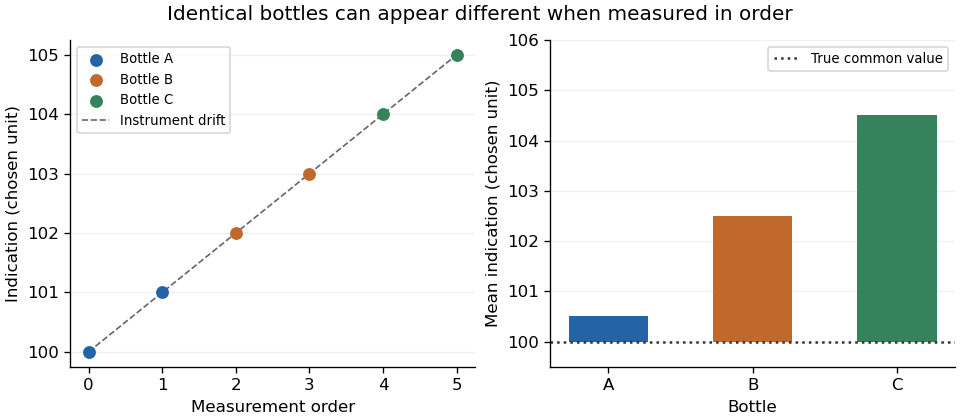
Original example: sequential measurements of identical bottles inherit an instrument's linear drift
. Details. 
Randomization breaks the systematic link between container label and measurement order in the design, but one random sequence does not guarantee cancellation of drift. The IUPAC protocol requires randomized analytical order and inspection for suspicious trends in the resulting data.[ref]
The International Harmonized Protocol for the proficiency testing of analytical chemistry laboratories by Michael Thompson and others. Appendix 1, A1.1 and A1.3, printed pp. 177–179; §3.11.4
A deliberately balanced illustration assigns A to times 0 and 5, B to 1 and 4, and C to 2 and 3. Each mean then contains the same linear-drift contribution, . This cancels drift from differences of those means, but does not reproduce the independent, equal-variance residual model: the within-pair differences still contain drift. Nonlinear drift would also require further assessment.
Retain timestamps, sample identities and the planned order. Suitable experimental blocks, repeated control measurements or a justified drift-aware homogeneity analysis can help distinguish instrument behaviour from material variation. A small residual scatter within adjacent duplicates is insufficient evidence that the instrument stayed stable over the full study.
New to topics? Read the docs here!