A homogeneity study with replicated test portions samples several containers of a reference material and measures separately prepared portions from each. The replication separates variation between containers from variation remaining within a container and the analytical procedure. Repeated detector readings of one prepared portion do not supply the same information.
The 2006 IUPAC protocol recommends randomly selecting at least ten distribution containers, homogenizing each selected container separately, and analyzing two portions from each in randomized order under a specified repeatability condition of measurement. It also requires adequate analytical precision and checks for trends, excessive rounding and discordant duplicate pairs.[ref]
The International Harmonized Protocol for the proficiency testing of analytical chemistry laboratories by Michael Thompson and others. Appendix 1, A1.1, printed p. 177; §3.11.4
An original balanced random effect model isAssume independent zero-mean container effects with variance and independent equal-variance residuals with variance . Residuals include analytical scatter and whatever within-container variation remains at the chosen portion size. One-way analysis of variance then givesso a method-of-moments estimate is . A negative estimate can occur through sampling variation; it is not negative physical variance or proof of perfect reference material homogeneity.
For a small illustrative calculation, take duplicate pairs , and in one measurement unit. The container means are 10, 12 and 14. The within-container sum of squares is 6 on three degrees of freedom, so ; the between-container sum is 16 on two degrees of freedom, so . Thus . These three invented containers explain the arithmetic; they do not meet the protocol's recommended ten-container study.
Averaging independent portions from one container gives variance . More replication reduces the residual term without removing the common container effect. Randomizing the measurement order helps prevent instrumental drift from masquerading as between-container variation.
Fitness for purpose requires comparing material variation with an appropriate tolerance, not merely failing to reject zero variation. The protocol explicitly distinguishes sufficient homogeneity from the stricter hypothesis that sampling variance is exactly zero.[ref]
The International Harmonized Protocol for the proficiency testing of analytical chemistry laboratories by Michael Thompson and others. §3.11.2, printed p. 171
Keep the portion size, sampling design and uncertainty with the conclusion.Homogeneity-study measurement-order confounding occurs when container identity is associated with measurement time, so that instrumental drift can appear to be a difference between portions of a reference material. It is a sampling-design problem in a homogeneity study with replicated test portions: repeating each container twice does not by itself separate its material effect from the instrument's time dependence.
An original measurement model adds a drift term to the container and residual effects:Here is the container contribution, a linear drift rate and the observation time. A one-way analysis of variance that omits time can assign part of to container variation. This is confounding, rather than evidence that the material actually changed composition.
Suppose three identical containers have true value 100 in a chosen unit, residual noise is absent, and the instrument increases by one unit per measurement interval. Measuring A twice, then B twice, then C twice at times 0 through 5 produces pairs , and . Their means are 100.5, 102.5 and 104.5. The within-container mean square is and the between-container mean square is . The usual two-replicate estimate givesalthough the stipulated true between-container variance is zero. These are invented observations showing an omitted effect, not a fitted material certificate.
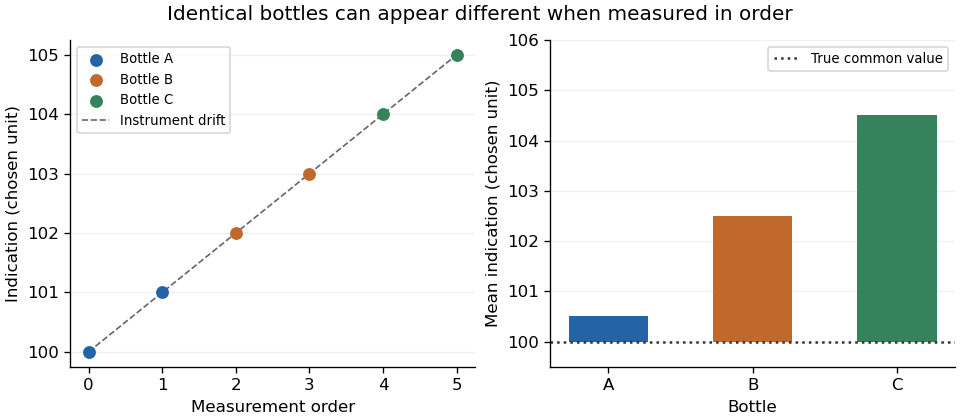
Original example: sequential measurements of identical bottles inherit an instrument's linear drift
. Details. 
Randomization breaks the systematic link between container label and measurement order in the design, but one random sequence does not guarantee cancellation of drift. The IUPAC protocol requires randomized analytical order and inspection for suspicious trends in the resulting data.[ref]
The International Harmonized Protocol for the proficiency testing of analytical chemistry laboratories by Michael Thompson and others. Appendix 1, A1.1 and A1.3, printed pp. 177–179; §3.11.4
A deliberately balanced illustration assigns A to times 0 and 5, B to 1 and 4, and C to 2 and 3. Each mean then contains the same linear-drift contribution, . This cancels drift from differences of those means, but does not reproduce the independent, equal-variance residual model: the within-pair differences still contain drift. Nonlinear drift would also require further assessment.
Retain timestamps, sample identities and the planned order. Suitable experimental blocks, repeated control measurements or a justified drift-aware homogeneity analysis can help distinguish instrument behaviour from material variation. A small residual scatter within adjacent duplicates is insufficient evidence that the instrument stayed stable over the full study.
Drift-aware homogeneity analysis estimates material variation while accounting for time-dependent changes in the measurement system. Its purpose is to prevent instrumental drift from being assigned to differences between containers in a homogeneity study with replicated test portions. The recorded order is part of the experimental data.
A simple measurement model iswith container contribution , linear drift rate and residual . A linear regression can treat container differences as fixed effects; a random effect formulation instead models a between-container variance. Either approach must distinguish the time term from the container terms. Homogeneity-study time-term identifiability depends on the actual sampling schedule.
An original noiseless example uses A at times 0 and 5 with readings 100 and 105, B at 1 and 4 with readings 103 and 106, and C at 2 and 3 with readings 101 and 102. Each within-container difference divided by its time separation gives drift rate one. Subtracting that rate times observation time yields A readings 100, B readings 102 and C readings 99. The adjustment retains the true stipulated container differences instead of forcing all means to coincide.
With noise present, the rate is uncertain. Substituting a fitted rate and then analyzing the adjusted observations as if that rate were known omits its uncertainty and induced covariance. For example, six observations with an intercept, two independent container indicators and one time coefficient leave only two residual statistical degrees of freedom when the design has full rank. A more elaborate drift curve consumes information and may explain away genuine material differences.
Randomized order and control observations help diagnose the model. The IUPAC protocol requires randomized analysis of duplicate portions and checking trends or other suspect data features.[ref]
The International Harmonized Protocol for the proficiency testing of analytical chemistry laboratories by Michael Thompson and others. Appendix 1, A1.1 and A1.3
Separately, NIST's dimensional-comparison designs deliberately balance some drift contributions through observation order.[ref]Plot residuals against time and container, retain independent controls, and state how the time dependence was chosen. A fitted linear term does not establish that all drift is linear. If time and container effects cannot be distinguished, the study needs additional information or a better design rather than an unjustifiably precise homogeneity estimate.
Homogeneity-study time-term identifiability asks whether a measurement schedule supplies enough independent information to distinguish instrumental drift from differences between containers. Adding time to a regression analysis does not guarantee that its coefficient can be estimated separately from the container effects.
In an original fixed-container measurement model,each container has an unknown intercept and all share a linear drift rate . If every observation of container occurs at one time , any rate gives the same predictions after replacing by . The data cannot distinguish those parameter sets. Algebraically, the time column lies in the span of the container-indicator columns of the design matrix.
Repeated observations at different times within at least one container can break that exact ambiguity. Subtract each container's mean:For independent, equal-variance errors with variance , the least-squares drift estimate hasprovided the denominator is positive. The formula distinguishes identifiability from precision: a positive but tiny within-container time spread permits a formally unique yet noisy estimate.
For three containers each observed twice one time unit apart, the denominator is . If each pair is instead separated by five time units, it is . With the same residual variance and a valid linear-drift model, the latter schedule reduces drift-estimate variance by 25, or its standard deviation by five. These are design calculations, not a guarantee that a longer experiment remains linear or stable.
Randomized order and controls address additional risks. The primary IUPAC protocol requires randomized analysis of duplicate portions and inspection for suspect data features.[ref]
The International Harmonized Protocol for the proficiency testing of analytical chemistry laboratories by Michael Thompson and others. Appendix 1, A1.1 and A1.3
NIST's comparison designs also use observation order to suppress specified drift contributions.[ref]Record timestamps and check the rank of a matrix for the fitted design, but also assess residual time patterns, uncertainty and physical plausibility. A randomized schedule can still have poor numerical leverage; a full-rank model can still be wrong. Drift-aware homogeneity analysis must report those distinctions rather than equating a returned regression coefficient with established material homogeneity.
Articles by others on the same topic
There are currently no matching articles.