Hookean dumbbell in planar extension
ID: hookean-dumbbell-in-planar-extension

Represent one polymer by two beads joined by an ideal linear entropic spring, and stipulate a dimensionless conformation tensor with equilibrium value . The displayed model uses velocity gradient and positive polymer relaxation time . It omits finite chain extensibility, interactions with other chains, and feedback from the polymer onto the flow. It is a teaching model, not a fitted description of Keller's apparatus.
Define the Weissenberg number for this model as and dimensionless time . With an initially isotropic , the diagonal entries obeyBelow , both transverse and longitudinal responses approach positive finite steady values:For a chosen , and : the longitudinal mean-square separation is five times its quiescent value, while the transverse separation contracts. A root-mean-square length grows as the square root of a variance, so the longitudinal length factor is , not five. The anisotropy is an orientational indicator; converting it to measured birefringence requires an additional calibrated optical relation.
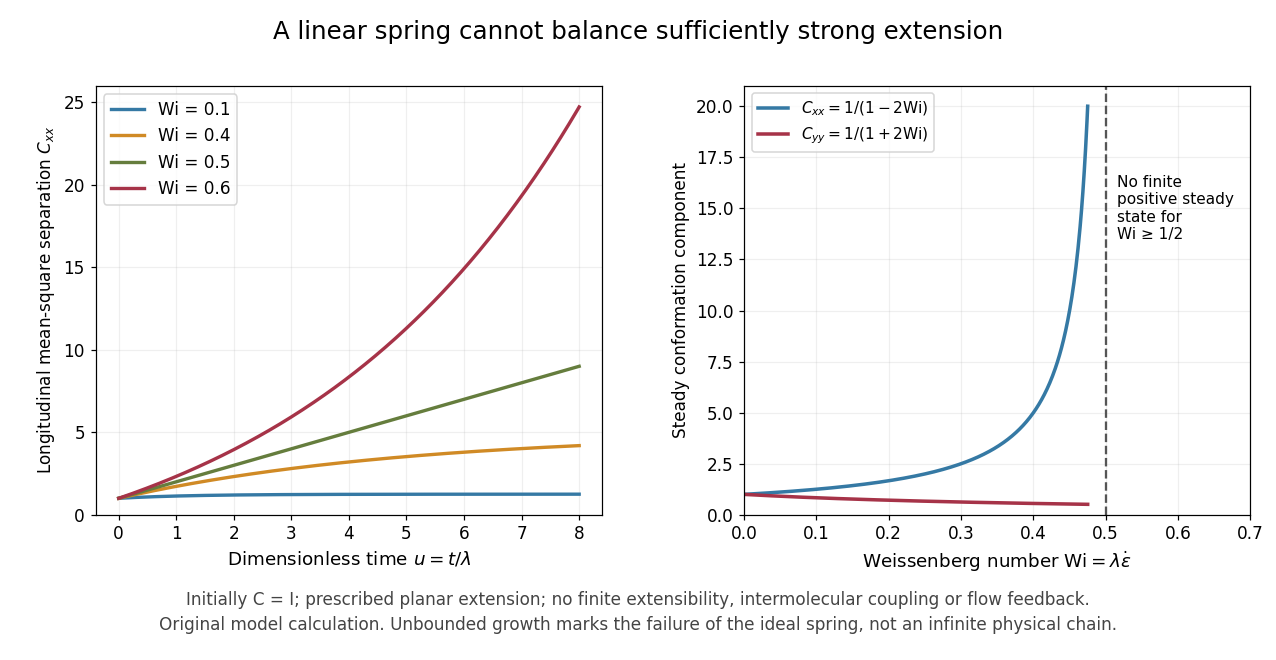

At , . Above that value, the growing homogeneous solution prevents a positive finite steady state. For instance, gives . Real chains have finite contour lengths, so this growth identifies the failure of the linear spring model. It does not establish a universal threshold for arbitrary flow histories, finite chains or other definitions of polymer relaxation time. Combining the growth equation with residence time in planar extension also explains why a large instantaneous Weissenberg number alone does not guarantee a strongly stretched exiting chain.
New to topics? Read the docs here!